
 Download PDF
Market Overview
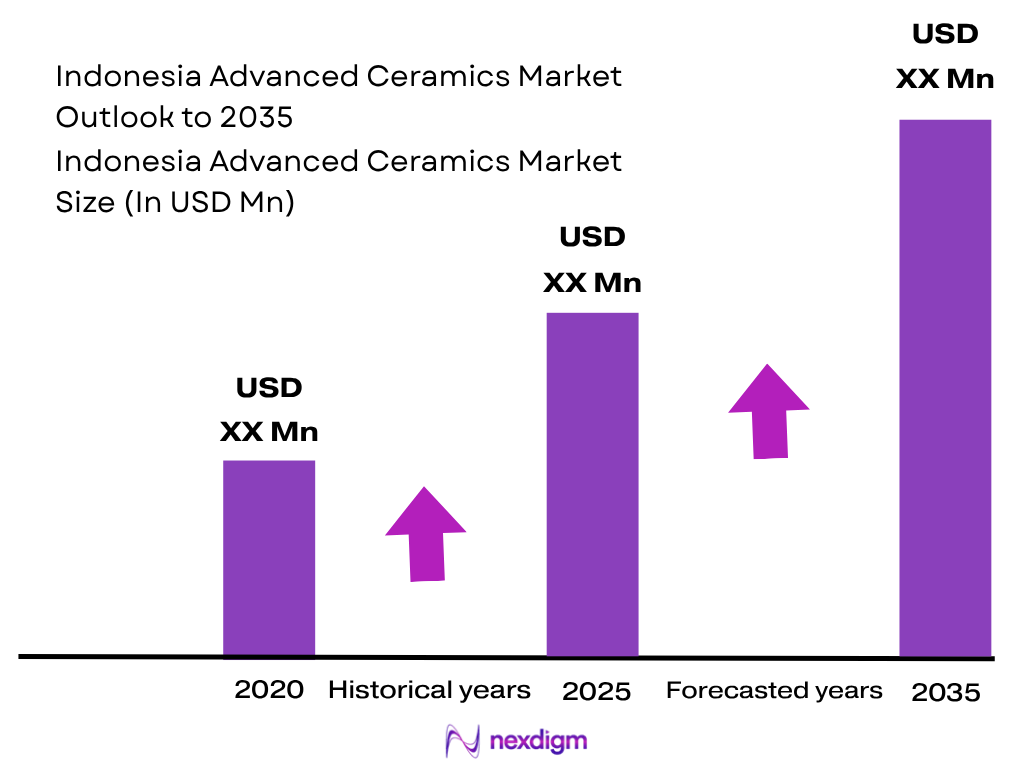
The Indonesia Advanced Ceramics Market is valued at approximately USD ~XX million, based on historical demand across electronics, automotive, mining, healthcare and industrial applications. Electronics and telematics exports increased from USD 9.119 billion in the preceding annual period to USD 9.262 billion in the latest full-year period, strengthening requirements for ceramic substrates, insulators, sensors and precision components. Manufacturing value added reached IDR 4,202,866.9 billion, supporting broader technical-material consumption across Indonesia’s industrial economy.
West Java, Jakarta, Banten, East Java and the Riau Islands are the dominant Indonesian hubs for advanced-ceramic demand because they combine automotive, electronics, medical-device, industrial-processing and logistics infrastructure. West Java’s foreign investment increased from USD 8.3 billion in the preceding annual period to USD 10.0 billion in the latest period, while Karawang hosts a 10 GWh EV-battery plant capable of producing 32.6 million cells. Batam additionally provides electronics and emerging semiconductor connectivity with Singapore.
Market Segmentation
By Material Type
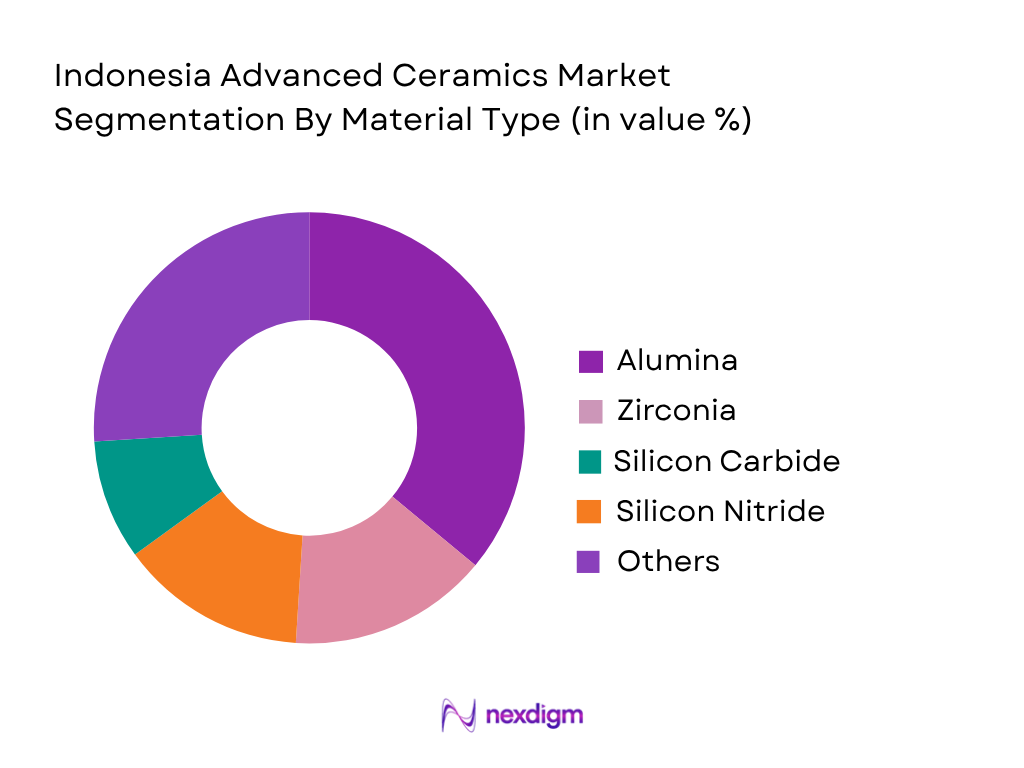
The Indonesia Advanced Ceramics Market is segmented into alumina, zirconia, silicon carbide, silicon nitride, aluminium nitride, boron nitride, piezoelectric and titanate ceramics, and other specialty advanced ceramics. Alumina represents the dominant material segment because it provides a practical combination of electrical insulation, hardness, wear resistance, corrosion resistance, temperature stability and established processing capability. Its broad performance envelope makes it suitable for electronic substrates, electrical insulators, mining wear components, pump and valve parts, laboratory components and industrial machinery. Indonesia’s expanding electronics base particularly supports alumina demand: electronics and telematics exports reached USD 9.262 billion, while the country is simultaneously developing battery, automotive and semiconductor-linked manufacturing. Alumina also has a wider supplier base and easier processing pathway than specialised materials such as aluminium nitride or silicon nitride. Silicon carbide is increasingly relevant in mining and high-temperature applications, while zirconia benefits from medical, dental and precision engineering demand. Aluminium nitride and silicon nitride are comparatively specialised but are gaining strategic relevance in power electronics and thermal-management applications.
By End-Use Industry
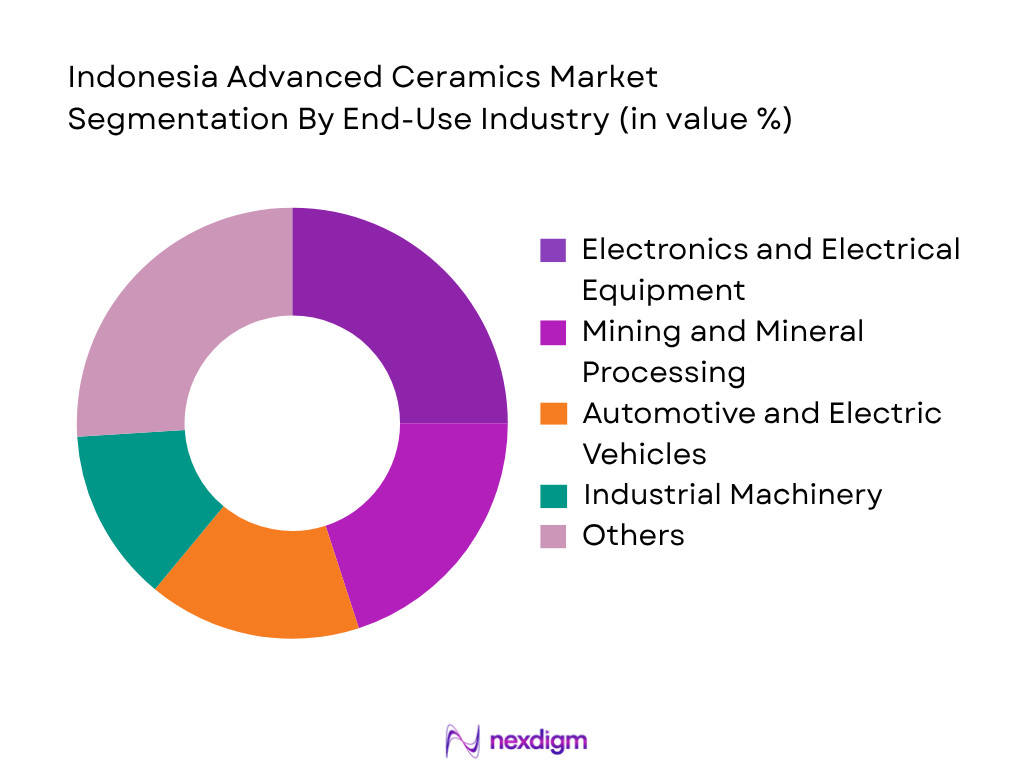
The Indonesia Advanced Ceramics Market is segmented into electronics and electrical equipment, automotive and electric vehicles, mining and mineral processing, healthcare and medical devices, industrial machinery, energy, petrochemicals and semiconductor-related applications. Electronics and electrical equipment constitute the dominant end-use segment because advanced ceramics are extensively used in substrates, insulators, sensor housings, circuit protection, thermal-management assemblies and high-reliability electronic components. Indonesia’s electronics and telematics exports reached USD 9.262 billion, while mobile phones, electronic components, electrical equipment and integrated circuits form important parts of the country’s manufacturing structure. Automotive and EV applications are also strengthening: the HLI Green Power facility in Karawang has 10 GWh of initial battery-cell capacity, with production equivalent to 32.6 million cells. Mining represents another major ceramic-use area because Indonesia’s downstream mineral investment reached IDR 245.2 trillion, including IDR 153.2 trillion in nickel, IDR 68.5 trillion in copper and IDR 21.8 trillion in bauxite, supporting wear liners, grinding media, seals and corrosion-resistant components.
Competitive Landscape
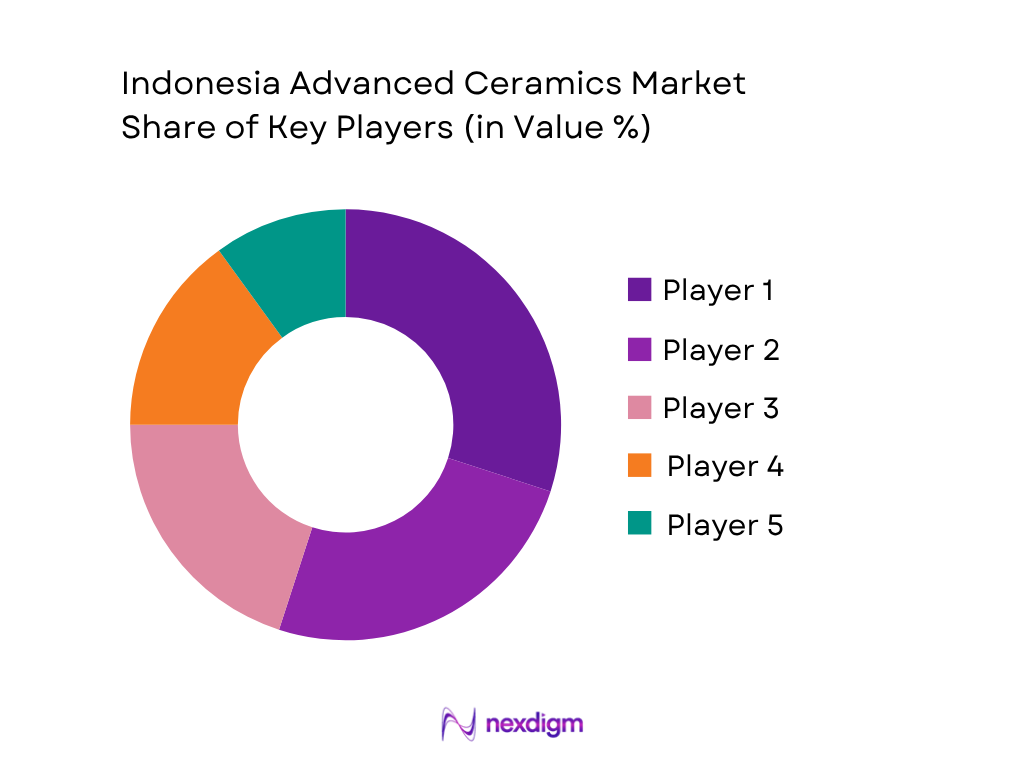
The Indonesia Advanced Ceramics Market is characterised primarily by international advanced-ceramic manufacturers supplying Indonesian OEMs, distributors and industrial users, supplemented by domestic processing and component-integration companies. Competition centres on material portfolio breadth, high-purity ceramic capability, dimensional precision, wear and thermal performance, semiconductor-grade manufacturing, application engineering and regional supply availability. Kyocera, CoorsTek, CeramTec, Morgan Advanced Materials and Saint-Gobain represent important global technology suppliers capable of serving electronics, industrial, automotive, mining, medical and high-temperature applications. Kyocera alone offers more than 200 developed ceramic materials, while Saint-Gobain’s performance ceramics network includes 11 industrial sites worldwide.
| Company | Establishment Year | Headquarters | Key Ceramic Materials | Electronics / Semiconductor Capability | Mining / Industrial Wear Capability | Automotive Capability | Medical Capability | Processing & Engineering Strength |
| Kyocera Corporation | 1959 | Kyoto, Japan | ~ | ~ | ~ | ~ | ~ | ~ |
| CoorsTek | 1910 | Golden, Colorado, USA | ~ | ~ | ~ | ~ | ~ | ~ |
| CeramTec | 1903 | Plochingen, Germany | ~ | ~ | ~ | ~ | ~ | ~ |
| Morgan Advanced Materials | 1856 | Windsor, UK | ~ | ~ | ~ | ~ | ~ | ~ |
| Saint-Gobain | 1665 | Courbevoie, France | ~ | ~ | ~ | ~ | ~ | ~ |
Indonesia Advanced Ceramics Market Analysis
Growth Drivers
Expansion of Electronics and Electrical Manufacturing
Indonesia’s expanding electronics and electrical manufacturing ecosystem is a major growth driver for the Indonesia Advanced Ceramics Market, particularly for high-purity alumina, aluminium nitride, zirconia and silicon-nitride components used in substrates, insulators, sensors, thermal-management systems and precision assemblies. Electronics and telematics exports reached USD 9,261.82 million in 2024, compared with USD 9,119.45 million in 2023, before reaching USD 12,716.6 million in 2025, indicating a substantially larger production and export platform for ceramic-enabled electronic applications. Indonesia’s Ministry of Investment also recorded total realized investment of IDR 1,714.2 trillion in 2024, while 2,456,130 workers were absorbed through realized investment projects, supporting expansion of domestic industrial capacity. Batam’s electronics manufacturing base is additionally attracting localized production of computers and electronic equipment, strengthening demand for precision insulating and heat-resistant materials. Advanced ceramics are relevant because electronic manufacturing requires dimensional stability, dielectric performance, thermal dissipation and resistance to aggressive processing environments. The macroeconomic foundation reinforces this industrial demand: IMF data place Indonesia’s 2024 nominal GDP at IDR 22,139 trillion, equivalent to USD 1,396 billion, while the World Bank records GDP per capita at USD 4,925.4.
EV Battery and Mineral Downstreaming Expanding Technical Ceramic Applications
Indonesia’s vertically integrated EV-battery and mineral-downstreaming strategy is creating another major demand driver for the Indonesia Advanced Ceramics Market, particularly across wear ceramics, electrical insulation, furnace components, precision fixtures, seals and power-electronics substrates. Government data show that mineral downstreaming attracted IDR 245.2 trillion of investment in 2024, comprising IDR 153.2 trillion in nickel, IDR 68.5 trillion in copper, IDR 21.8 trillion in bauxite and IDR 1.6 trillion in tin. EV-battery manufacturing added another IDR 8.4 trillion of downstream investment. In Karawang, the country’s first commercial EV-battery-cell facility began with 10 GWh annual production capacity, while the associated integrated South Korean EV and battery ecosystem represented USD 4.46 billion, or IDR 71.36 trillion, of investment. These facilities create technically relevant environments for alumina wear parts, zirconia components, ceramic furnace hardware and electrically insulating materials, while downstream smelting increases demand for abrasion-, corrosion- and temperature-resistant components. At the macroeconomic level, the IMF records 2024 nominal GDP of USD 1,396 billion and gross reserve assets of USD 155.7 billion, providing scale and external buffers for continued capital-intensive industrialisation.
Market Challenges
Dependence on Imported High-Purity Materials and Advanced Ceramic Components
A significant challenge for the Indonesia Advanced Ceramics Market is the gap between Indonesia’s rapidly expanding downstream manufacturing base and its comparatively limited domestic capability in semiconductor-grade ceramic powders, specialised non-oxide ceramics and ultra-precision technical ceramic processing. Indonesia’s electronics and telematics exports reached USD 9,261.82 million in 2024 and accelerated to USD 12,716.6 million in 2025, demonstrating that downstream electronics activity is expanding faster than the domestic advanced-material ecosystem required to support increasingly sophisticated production. The country is simultaneously operating a 10 GWh EV-battery-cell facility in Karawang, creating requirements for specialised insulating, wear-resistant, thermal-management and precision-processing materials. However, high-purity aluminium nitride, silicon nitride, specialised silicon carbide and tightly controlled ceramic substrates require sophisticated powder synthesis, atmosphere-controlled sintering, metallisation and precision finishing capabilities that remain less developed domestically. Import exposure consequently affects qualification lead times, inventory requirements and supply-chain resilience for Indonesian OEMs. This constraint is important within an economy whose IMF-reported nominal GDP reached IDR 22,139 trillion in 2024, equivalent to USD 1,396 billion, with an average exchange rate of IDR 15,855 per USD, making localisation of advanced ceramic inputs strategically relevant to industrial resilience.
Technical Qualification and Precision-Manufacturing Capability Constraints
The Indonesia Advanced Ceramics Market faces a second challenge in converting Indonesia’s large industrial base into domestic capability for high-specification ceramic components. Technical ceramics used in semiconductor, EV, medical and precision-industrial applications require controlled powder preparation, high-temperature sintering, dimensional inspection, grinding, lapping, polishing and application-specific qualification. The scale of the emerging customer base illustrates the challenge: Indonesia had 812 domestic medical-device producers and 5,661 medical-device distributors as of April 2025, while electronics and telematics exports reached USD 12,716.6 million in 2025. At the same time, Indonesia’s Karawang battery operation has 10 GWh annual capacity, equivalent to battery requirements for approximately 150,000 electric vehicles, creating additional demand for reliable electrically insulating and thermally stable components. Suppliers seeking these applications must achieve consistent microstructure, surface finish, dimensional tolerance and material purity rather than simply expand conventional ceramic production. Qualification barriers are particularly important because failures in medical, electronics or power applications can result in OEM rejection and extended validation cycles. Indonesia’s wider economy provides substantial manufacturing potential, with 2024 nominal GDP of IDR 22,139 trillion and GDP per capita of USD 4,925.4, but translating that scale into advanced-ceramic manufacturing requires deeper process technology and specialised engineering capabilities.
Market Opportunities
Localisation of Advanced Ceramics for EV, Battery and Mineral-Processing Equipment
The Indonesia Advanced Ceramics Market has a strong opportunity to localise ceramic components serving the country’s expanding EV-battery and mineral-processing value chain. Current industrial activity already provides a substantial addressable application base: Indonesia recorded IDR 245.2 trillion of mineral-downstreaming investment in 2024, including IDR 153.2 trillion for nickel, IDR 68.5 trillion for copper and IDR 21.8 trillion for bauxite, while EV-battery manufacturing accounted for another IDR 8.4 trillion. The integrated EV and battery ecosystem inaugurated in Karawang represented USD 4.46 billion, equivalent to IDR 71.36 trillion, and commercial battery production began with 10 GWh annual cell capacity. These operating assets can support future demand for alumina liners, ceramic grinding components, silicon-carbide wear parts, pump and valve ceramics, furnace components, insulating fixtures and advanced substrates used in power electronics. Local production would reduce dependence on imported finished components while enabling suppliers to provide faster replacement, application engineering and customised geometries to Indonesian industrial users. The macroeconomic environment provides scale for such localisation: the IMF records USD 1,396 billion of nominal GDP in 2024, while Indonesia held USD 155.7 billion in reserve assets, supporting an industrial economy capable of absorbing sophisticated manufacturing investment.
High-Purity Ceramics for Electronics, Semiconductor and Medical Manufacturing
A higher-value opportunity for the Indonesia Advanced Ceramics Market lies in developing high-purity components for electronics, semiconductor-linked manufacturing and medical devices. Indonesia’s electronics and telematics exports increased from USD 9,261.82 million in 2024 to USD 12,716.6 million in 2025, providing an expanding customer base for alumina insulators, aluminium-nitride thermal components, ceramic fixtures, sensor components and specialised electronic substrates. Batam is simultaneously strengthening electronics localisation, including domestic production of computing equipment, while its proximity to Singapore gives the island strategic relevance for regional electronics supply chains. Healthcare provides another application platform: Indonesia had 812 domestic medical-device producers and 5,661 distributors in April 2025, creating potential for precision zirconia, alumina and other biocompatible ceramic components used in dental products, diagnostic equipment, fluid-handling systems and specialised medical assemblies. Future value creation can therefore move beyond importing finished ceramics toward domestic machining, polishing, metallisation and component integration. The opportunity is supported by a sizeable national economic platform: World Bank data record 2024 GDP of approximately USD 1.4 trillion and GDP per capita of USD 4,925.4, while the IMF places nominal output at IDR 22,139 trillion, providing the industrial scale required to support deeper advanced-material localisation.
Future Outlook
The Indonesia Advanced Ceramics Market is projected to expand at approximately ~XX% CAGR during 2026–2035, supported by deeper electronics manufacturing, EV and battery localisation, mineral downstreaming, medical-device production and increased adoption of wear-resistant industrial materials. Growth is expected to shift gradually from conventional alumina applications toward higher-value silicon carbide, silicon nitride, aluminium nitride, zirconia and high-purity ceramic components.
The EV ecosystem will be an important growth platform. Indonesia inaugurated an integrated EV and battery investment ecosystem valued at USD 4.46 billion, while HLI Green Power began with 10 GWh of battery-cell capacity. Such developments increase requirements for electrically insulating components, high-temperature fixtures, power-electronics substrates, precision wear parts and thermal-management materials.
Major Players
- Kyocera Corporation
- CoorsTek
- CeramTec
- Morgan Advanced Materials
- Saint-Gobain Ceramics
- NGK Insulators
- MARUWA Co., Ltd.
- Niterra Co., Ltd.
- TOTO Fine Ceramics
- Ferrotec Holdings Corporation
- Denka Company Limited
- Tokuyama Corporation
- 3M Advanced Materials
- Schunk Technical Ceramics
- ATCERA
Key Target Audience
- Advanced Ceramic Material Manufacturers
- Electronics and Semiconductor Component Manufacturers
- Automotive, Electric Vehicle and Battery Manufacturers
- Mining and Mineral Processing Companies
- Medical Device and Dental Product Manufacturers
- Industrial Machinery and Precision Engineering Companies
- Investments and Venture Capitalist Firms
- Government and Regulatory Bodies (Ministry of Industry, Ministry of Investment and Downstream Industry/BKPM, Ministry of Health, National Standardization Agency of Indonesia, Ministry of Energy and Mineral Resources)
Research Methodology
Step 1: Identification of Key Variables
The initial phase involves constructing a comprehensive ecosystem map for the Indonesia Advanced Ceramics Market, covering ceramic powder suppliers, global technical-ceramic manufacturers, importers, distributors, precision processors and major end users. Key variables include material type, purity, processing route, application environment, component geometry, thermal properties, wear performance, electrical characteristics, procurement channels and import dependence.
Step 2: Market Analysis and Construction
Historical demand is analysed using both top-down and bottom-up approaches. Top-down analysis evaluates electronics manufacturing, EV and battery production, mining and mineral-processing investment, medical-device manufacturing and broader industrial activity. Bottom-up analysis estimates component-level ceramic utilisation across substrates, insulators, wear liners, grinding media, seals, sensors, precision components and thermal-management systems before reconciling this with supplier and trade-side information.
Step 3: Hypothesis Validation and Expert Consultation
Market hypotheses are validated through computer-assisted telephone interviews with ceramic suppliers, distributors, material engineers, electronics manufacturers, mining operators, automotive suppliers, medical-device companies and industrial OEMs. These consultations are used to verify application penetration, ceramic material preferences, procurement structures, replacement cycles, qualification requirements, technical specifications and the balance between imported finished components and locally processed materials.
Step 4: Research Synthesis and Final Output
The final phase triangulates supplier-side, demand-side and application-level findings to develop a consistent market model. Alumina, zirconia, silicon carbide, silicon nitride, aluminium nitride and specialty ceramics are assessed individually and reconciled against end-use demand. This combined top-down and bottom-up methodology establishes market segmentation, competitive positioning, geographic demand concentration and the long-term outlook for the Indonesia Advanced Ceramics Market.

- Executive Summary
- Research Methodology (Market Definition and Scope, Indonesia Advanced Ceramics Market Classification, Advanced Ceramic Powder Mapping, Oxide and Non-Oxide Ceramic Assessment, Structural and Functional Ceramic Classification, Domestic Production Assessment, Import and Distribution Mapping, Electronics Manufacturing Demand Assessment, EV and Power Electronics Application Analysis, Mining and Industrial Wear Ceramic Assessment, Medical and Dental Ceramic Mapping)

- Definition and Scope
- Indonesia Advanced Ceramics Industry Evolution and Development of Technical Ceramics, Electronics and Precision Engineering Ecosystem
- Advanced Ceramic Material Chemistry, Microstructure and Performance Characteristics
- Indonesia Advanced Ceramics Value Chain Analysis
- Indonesia Advanced Ceramics Supply Chain Analysis
- Advanced Ceramic Powder, Formulation, Forming, Sintering, Precision Machining, Metallisation and Component Integration Ecosystem Analysis
- Advanced Ceramic Integration Assessment Across Electronics, Semiconductor, Automotive, EV, Mining, Medical, Energy, Petrochemical and Industrial Applications

- Growth Drivers (Expansion of Electronics and Electrical Manufacturing, Development of EV and Battery Manufacturing Ecosystem, Increasing Mineral Processing and Smelting Activity, Growing Demand for Wear-Resistant Industrial Components, Expansion of Domestic Medical Device Manufacturing, Increasing Automation and Precision Manufacturing)
- Market Challenges (Dependence on Imported High-Purity Ceramic Powders, Limited Domestic Advanced Ceramic Sintering Capacity, High Precision Machining Requirements, Energy-Intensive Ceramic Processing, Limited Semiconductor-Grade Ceramic Manufacturing Capability, Technical Skill and Material Qualification Constraints)
- Market Opportunities (High-Purity Alumina Ceramic Localisation, Ceramic Substrates for Power Electronics, Mining Wear Components, EV Thermal Management Ceramics, Medical and Dental Zirconia Applications, Semiconductor Equipment Components, Battery Manufacturing Ceramic Components, Local Precision Ceramic Processing)
- Market Trends (High-Purity Alumina Adoption, Zirconia Precision Component Expansion, Silicon Carbide Wear Component Utilisation, Aluminium Nitride Thermal Management, Ceramic-to-Metal Integration, Near-Net-Shape Manufacturing, Localisation of Industrial Components, Additive Manufacturing of Technical Ceramics)
- Regulatory and Standards Landscape (Indonesian National Standards, Ministry of Industry Local Content Requirements, Medical Device Registration Requirements, Industrial Product Certification, Import Compliance, Hazardous Material Management, Automotive Component Standards, Electrical and Electronic Product Standards)
- SWOT Analysis
- Porter’s Five Forces Analysis
- PESTLE Analysis
- Stakeholder Ecosystem
- Competition Ecosystem

- By Market Value (2020-2025)
- By Advanced Ceramic Consumption Volume (2020-2025)
- By Oxide Ceramic Consumption Volume (2020-2025)
- By Non-Oxide Ceramic Consumption Volume (2020-2025)
- By Structural Ceramic Consumption Volume (2020-2025)
- By Functional Ceramic Consumption Volume (2020-2025)
- By Advanced Ceramic Component Shipment Volume (2020-2025)

- By Material Type (In Value %)
Alumina
Zirconia
Silicon Carbide
Silicon Nitride
Aluminium Nitride
Boron Nitride
Boron Carbide
Titanate Ceramics
Piezoelectric Ceramics
Zirconia Toughened Alumina
Machinable Glass Ceramics
Other Specialty Advanced Ceramics - By Ceramic Function (In Value %)
Structural Ceramics
Wear-Resistant Ceramics
Electrical Insulating Ceramics
Electronic and Dielectric Ceramics
Thermal Management Ceramics
Piezoelectric Ceramics
Bioceramics
Corrosion-Resistant Ceramics
High-Temperature Ceramics - By Application Type (In Value %)
Electronic Substrates and Insulators
Semiconductor Processing Components
Power Electronics Substrates
Mining Wear Liners and Grinding Components
Pump, Valve and Mechanical Seal Components
Medical and Dental Components
Automotive Sensors and Ignition Components
EV Power Module Components
Petrochemical Processing Components
Furnace and High-Temperature Components
Battery Manufacturing Ceramic Components
Industrial Cutting and Precision Components - By Processing Technology (In Value %)
Dry Pressing
Cold Isostatic Pressing
Hot Isostatic Pressing
Injection Moulding
Extrusion
Tape Casting
Slip Casting
Pressureless Sintering
Hot Pressing
Reaction Bonding
Precision Grinding and Lapping
Laser Machining
Ceramic Additive Manufacturing - By End-Use Industry (In Value %)
Electronics and Electrical Equipment
Semiconductor and Electronic Component Manufacturing
Automotive and Electric Vehicles
Mining and Mineral Processing
Healthcare and Medical Devices
Energy and Power Generation
Petrochemical and Chemical Processing
Industrial Machinery
Metallurgy and Metal Processing
Telecommunications
Battery and Energy Storage Manufacturing - By Product Form (In Value %)
Advanced Ceramic Powders
Ceramic Substrates
Ceramic Plates and Sheets
Ceramic Tubes and Rods
Ceramic Rings and Sleeves
Ceramic Balls and Grinding Media
Ceramic Bearings
Ceramic Seals and Valve Components
Wear-Resistant Ceramic Liners
Precision-Machined Ceramic Parts
Ceramic-to-Metal Assemblies
Additively Manufactured Ceramic Components - By Sales Channel (In Value %)
Direct Manufacturer-to-OEM Supply
Technical Ceramic Importers
Specialty Material Distributors
Industrial Engineering Distributors
Electronics Component Supply Network
Automotive Tier-1 Procurement
Mining Equipment and Maintenance Suppliers
Medical Device Procurement Network
Custom Ceramic Engineering and Contract Manufacturing - By Region (In Value %)
West Java
Banten
DKI Jakarta
East Java
Central Java
Riau Islands
West Kalimantan
South Sulawesi
North Sumatra
Other Indonesia

- Market Share of Major Players (By Revenue, Material Type, Product Form, End-Use Industry, Application Category, Distribution Model, Import Supply, Customer Segment)
- Cross Comparison Parameters (Advanced Ceramic Material Portfolio Breadth, High-Purity Alumina and Zirconia Capability, Non-Oxide Ceramic Capability, Precision Machining and Surface-Finishing Capability, Electronics and Semiconductor Ceramic Expertise, Mining and Industrial Wear Ceramic Portfolio, Indonesia Distribution and OEM Customer Reach, Application Engineering and Technical Support Capability)
- SWOT Analysis of Major Players
- Competitive Positioning Matrix
- Advanced Ceramic Material Portfolio Benchmarking
- Material Performance Benchmarking
- Manufacturing and Processing Capability Assessment
- Indonesia Distribution and OEM Integration Assessment
- Detailed Profiles of Major Companies
Kyocera Corporation
CoorsTek
CeramTec
Morgan Advanced Materials
Saint-Gobain Ceramics
NGK Insulators
MARUWA Co., Ltd.
Niterra Co., Ltd.
TOTO Fine Ceramics
Ferrotec Holdings Corporation
Denka Company Limited
Tokuyama Corporation
3M Advanced Materials
Schunk Technical Ceramics
ATCERA

- Electronics Manufacturer Technical Ceramic Requirement Assessment
- Semiconductor and Electronic Component Manufacturer Assessment
- Automotive OEM and Tier-1 Ceramic Application Analysis
- Electric Vehicle Manufacturer Ceramic Requirement Assessment
- Battery Manufacturer Ceramic Component Analysis
- Mining Company Wear Ceramic Adoption Assessment
- Mineral Processing and Smelter Ceramic Requirement Analysis
- Medical Device Manufacturer Bioceramic Assessment
- Petrochemical Operator Technical Ceramic Requirement Assessment
- Industrial Machinery Manufacturer Ceramic Procurement Analysis

- By Market Value (2026-2035)
- By Advanced Ceramic Consumption Volume (2026-2035)
- By Oxide Ceramic Consumption Volume (2026-2035)
- By Non-Oxide Ceramic Consumption Volume (2026-2035)
- By Structural Ceramic Consumption Volume (2026-2035)
- By Functional Ceramic Consumption Volume (2026-2035)
- By Advanced Ceramic Component Shipment Volume (2026-2035)


 Request a Sample
 Ask for Customization
 Get a Quote
 Enquire Now