
 Download PDF
Market Overview
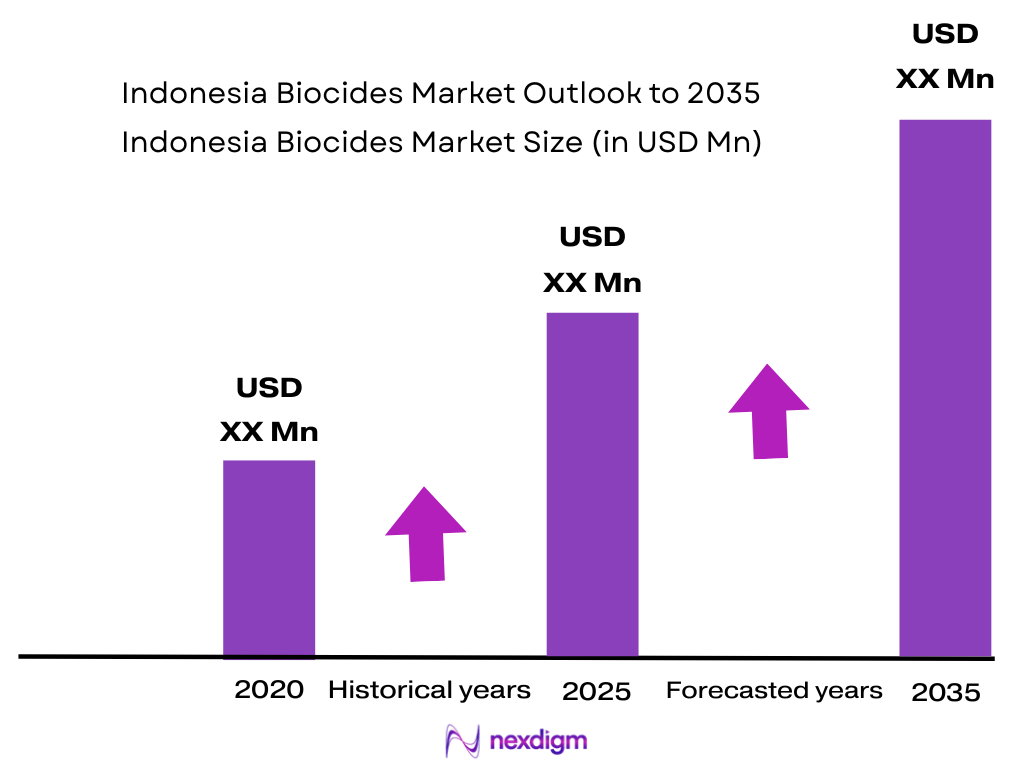
The Indonesia Biocides Market is valued at ~USD XX million, supported by the country’s large manufacturing, food-processing, agricultural, palm-oil, water-treatment and industrial-processing ecosystem. Indonesia’s GDP increased from USD1,371.17 billion to USD1,396.30 billion, while GDP per capita reached USD4,960.3. Real economic growth remained at 5.03, compared with 5.05 previously. Manufacturing is specifically covered by Indonesia’s large- and medium-scale industrial production statistics, while water supply, sewerage, waste management and remediation represent dedicated economic activities, creating recurring microbial-control requirements across process water, wastewater and industrial hygiene.
Indonesia’s biocides demand is concentrated around Java, particularly Jakarta, Surabaya, Bekasi, Karawang, Tangerang and Bandung, alongside industrial and resource centers in Sumatra and Kalimantan. Java contributed 57.02 to national economic structure and recorded economic growth of 4.92, making it the country’s principal industrial and commercial concentration. Jakarta and surrounding West Java industrial corridors host manufacturing, food processing, pharmaceuticals, chemicals and water-intensive facilities, while Surabaya supports eastern Indonesian manufacturing, food, port and industrial activity. Sumatra and Kalimantan add palm-oil, mining, plantation and energy applications to the national biocide demand base.
Market Segmentation
By Product Type
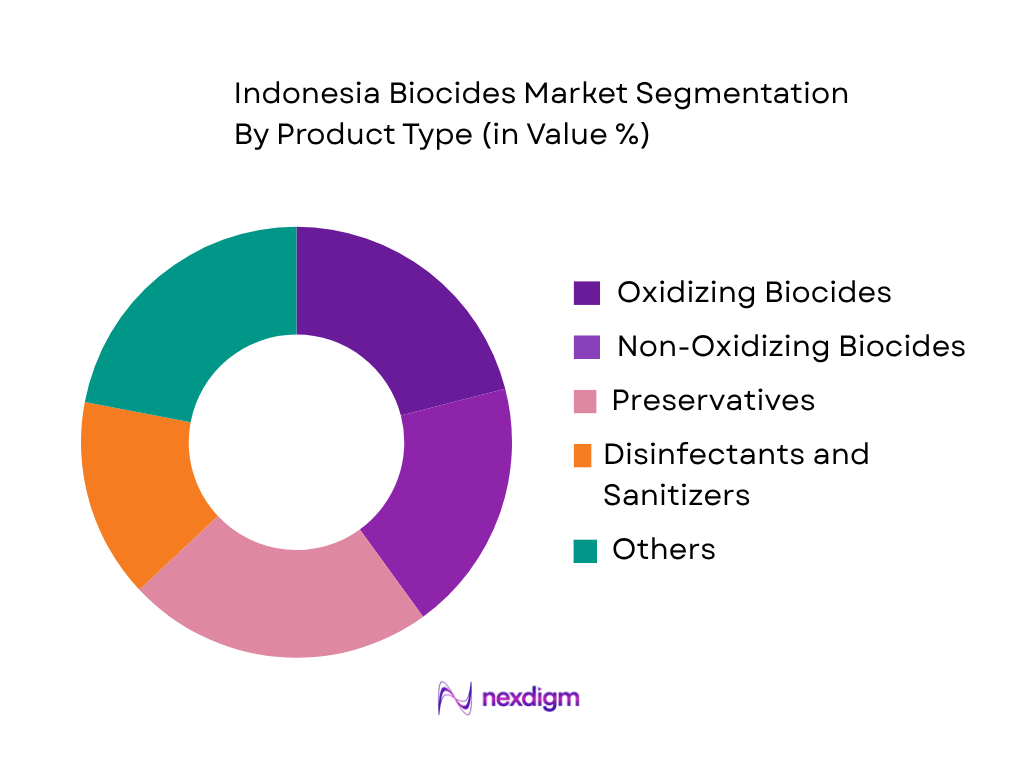
Indonesia Biocides Market is segmented by product type into oxidizing biocides, non-oxidizing biocides, preservatives, disinfectants and sanitizers, antimicrobial additives, algaecides and other microbial-control agents. Oxidizing biocides are expected to maintain the dominant position because of their broad applicability in industrial water treatment, cooling systems, wastewater treatment and sanitation. Chlorine-based chemistry, bromine chemistry, chlorine dioxide, hydrogen peroxide and related oxidizing systems can address bacteria, algae, fungi and biofilm-related problems across high-throughput water systems. Their relevance is strengthened by Indonesia’s extensive industrial and municipal water requirements and the need for rapid microbial control. BPS separately tracks water supply and wastewater-related economic activities, while its manufacturing statistics cover the large and medium industrial base that consumes process-water treatment chemicals. This combination gives oxidizing formulations a broad addressable customer base compared with narrower specialty products.
By Application
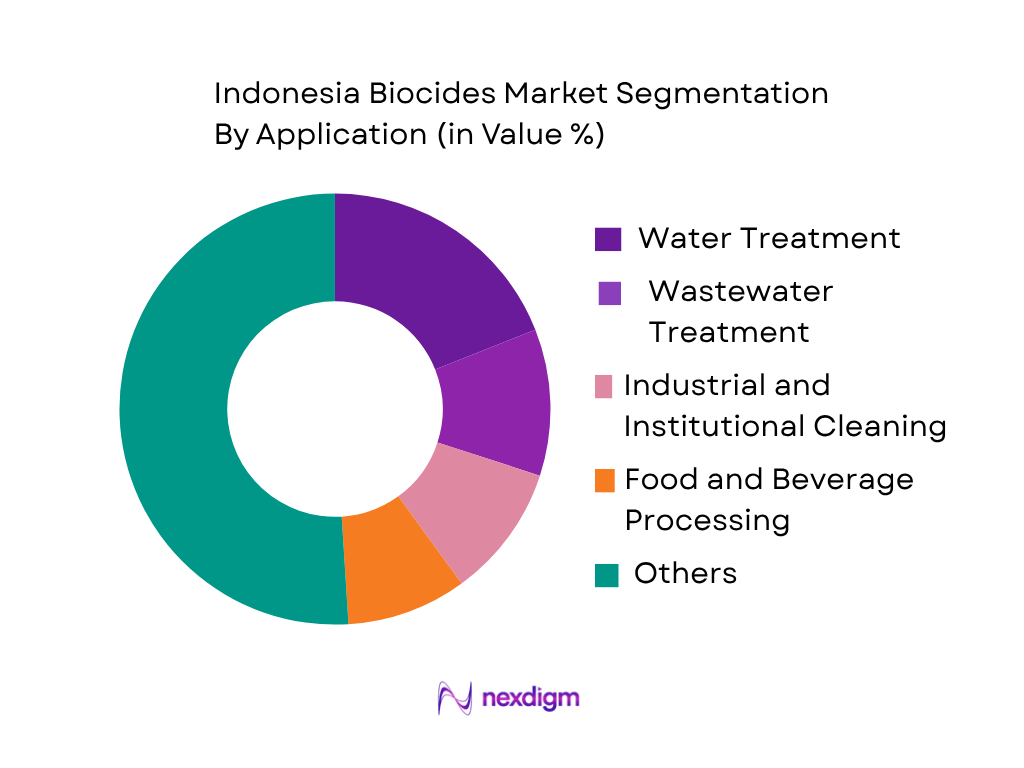
Indonesia Biocides Market is segmented by application into water treatment, wastewater treatment, industrial and institutional cleaning, food and beverage processing, paints and coatings, palm-oil processing, pharmaceuticals, pulp and paper, textiles, oil and gas, mining, agriculture, aquaculture and marine applications. Water treatment is expected to dominate because microbial control is required across multiple treatment stages, including raw-water conditioning, process water, cooling systems, wastewater treatment, membrane protection and water reuse. Indonesia’s official statistics treat water supply, sewerage, waste management and remediation as a distinct economic activity, while manufacturing statistics provide a large industrial base requiring process-water management. The country’s extensive manufacturing, food-processing, plantation, mining and chemical industries further broaden water-treatment demand. The recurring nature of microbial contamination and biofilm formation also supports repeated biocide consumption rather than one-time product use.
Competitive Landscape
The Indonesia Biocides Market comprises global specialty-chemical manufacturers, water-treatment companies, microbial-control specialists and domestic chemical formulators. Competition is shaped by active-substance breadth, formulation capability, industrial water-treatment expertise, technical service, regulatory support, local distribution and the ability to serve high-volume industries such as palm oil, food processing, manufacturing and water treatment. Domestic suppliers add competitive pressure through local formulation and technical support, while multinational suppliers contribute broader specialty chemistry and application engineering.
| Company | Established | Headquarters | Core Biocide Capability | Key Applications | Active-Substance Breadth | Local/Regional Presence | Technical Service |
| LANXESS | 2004 | Cologne, Germany | ~ | ~ | ~ | ~ | ~ |
| BASF | 1865 | Ludwigshafen, Germany | ~ | ~ | ~ | ~ | ~ |
| Arxada | 2021 | Basel, Switzerland | ~ | ~ | ~ | ~ | ~ |
| Ecolab | 1923 | St. Paul, USA | ~ | ~ | ~ | ~ | ~ |
| PT Spectrum Kemika Unitama | — | Indonesia | ~ | ~ | ~ | ~ | ~ |
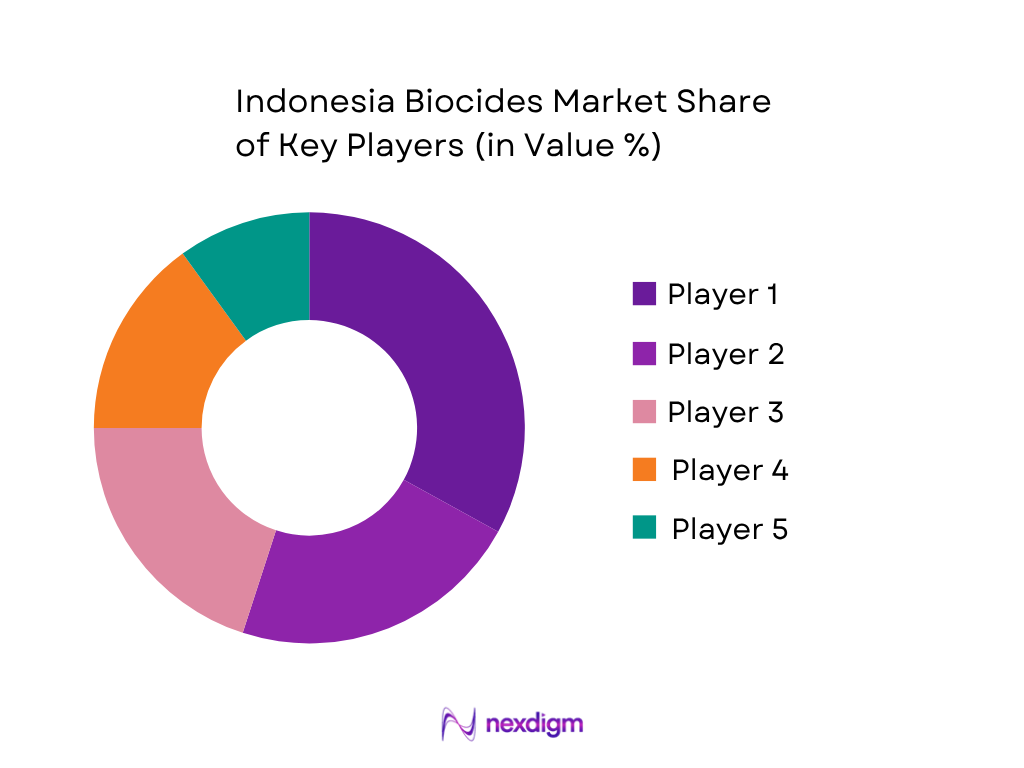
Indonesia Biocides Market Analysis
Growth Drivers
Water and Wastewater Treatment Expansion
Indonesia’s expanding industrial and municipal water ecosystem is strengthening the underlying requirement for microbial-control chemicals across raw water, process water, wastewater, cooling systems and membrane-based treatment. BPS reported national GDP of IDR22,139.0 trillion in 2024, while the World Bank recorded GDP of USD1,396.3 billion, demonstrating the scale of economic activity generating water-treatment requirements. Indonesia’s official GDP framework separately identifies Water Supply, Sewerage, Waste Management and Remediation Activities as an economic sector, alongside manufacturing, mining, agriculture and electricity and gas. Industrial demand is particularly relevant because microbial growth can create biofilm, slime, fouling and operational losses in water-intensive facilities. The country’s energy system also provides a substantial industrial water-treatment base: Indonesia had 100.6 GW of installed power-generation capacity and produced 371.6 TWh of electricity in 2024, according to the Ministry of Energy and Mineral Resources. These facilities require microbial control in cooling and circulating-water systems. The combination of a USD1.4 trillion economy, IDR78.6 million GDP per capita and extensive industrial infrastructure supports recurring demand for oxidizing and non-oxidizing biocides used in water-treatment operations.
Industrial Water Demand and Palm-Oil Processing
Indonesia’s large industrial and plantation economy creates multiple recurring applications for biocides, particularly in palm-oil mills, refineries, process-water systems, wastewater treatment and industrial cooling. BPS recorded national GDP of IDR22,139.0 trillion in 2024, with GDP per capita at IDR78.6 million, while manufacturing remained one of the country’s principal economic activities. Palm oil is especially relevant because BPS’s 2024 Permanent Estate Crops Statistics covers oil-palm area and production across provinces, combining estate-crop establishment survey data with smallholder information. Palm-oil processing generates process-water and wastewater streams where microbial growth, slime and biofilm can interfere with operations and treatment performance. The energy-intensive industrial base provides another application pool: Indonesia recorded 311.5 million barrels of crude-oil refinery input and 248.9 million barrels of fuel production in 2024. Natural-gas production reached 6,802 MMSCFD, while electricity generation reached 371.6 TWh. These operating systems require microbial management across cooling water, process water, injection water and wastewater. Consequently, industrial expansion, palm-oil processing, refining and energy production collectively support recurring demand for biocides rather than isolated consumption.
Market Challenges
Imported Active-Ingredient Dependency and Specialty-Chemical Supply-Chain Exposure
Indonesia’s biocides industry faces supply-chain constraints because many advanced active ingredients and specialty formulations depend on international chemical manufacturing and distribution networks. The challenge becomes more important when viewed against the country’s large industrial consumption base. Indonesia generated IDR22,139.0 trillion of GDP in 2024 and recorded USD1,396.3 billion of GDP, while industrial activities span manufacturing, mining, food processing, plantations, chemicals, energy and water treatment. The Ministry of Energy and Mineral Resources reported 127.7 million barrels of crude-oil imports in 2024 alongside 28.1 million kiloliters of fuel imports, illustrating the continuing role of imported industrial inputs within strategic chemical and energy supply chains. For biocide suppliers, international sourcing can expose customers to longer replenishment cycles, shipping disruptions, foreign-exchange movements and availability constraints for specialized active substances. This is particularly relevant for non-oxidizing chemistries, preservatives and application-specific formulations where substitution may require efficacy testing, equipment compatibility assessment and regulatory review. Domestic formulation and blending can reduce exposure for selected products, but sophisticated active-substance production remains more difficult to localize. The result is a competitive requirement for inventory management, multiple sourcing routes and regional warehousing to protect industrial customers from supply interruptions.
Environmental Discharge Controls, Aquatic Toxicity and Biocide Resistance
Environmental performance represents a significant challenge because Indonesia’s biocide users increasingly operate within water-treatment systems where residual chemicals can ultimately enter wastewater streams or aquatic environments. The issue is particularly relevant to industries with substantial water throughput, including power generation, palm-oil processing, food manufacturing, mining, aquaculture and oil and gas. Indonesia produced 371.6 TWh of electricity in 2024 and had 100.6 GW of installed generation capacity, creating extensive cooling-water and wastewater-treatment requirements. The country’s oil and gas system processed 311.5 million barrels of refinery input, while crude-oil production reached 212 million barrels. Such systems can require repeated microbial treatment but must balance microbial efficacy with material compatibility and environmental discharge requirements. Biocide resistance creates another technical challenge because repeated exposure to the same active chemistry can reduce treatment effectiveness and encourage higher operational complexity. Industrial users therefore need dosing optimization, rotation of active substances and monitoring of microbial conditions rather than indiscriminate chemical addition. Aquatic toxicity is particularly important for wastewater, aquaculture and marine applications, where residual biocides can affect non-target organisms. These factors favor formulations that provide reliable microbial control at controlled residual concentrations and with improved environmental profiles.
Market Opportunities
Advanced Water-Treatment Biocides and Wastewater-Reuse Applications
Indonesia offers an expanding opportunity for advanced biocides designed for membrane protection, cooling-water treatment, wastewater reuse and biofilm-specific control. The country’s economic base provides a strong current demand foundation: GDP reached IDR22,139.0 trillion in 2024, while the World Bank recorded GDP of USD1,396.3 billion and GDP per capita of USD4,925.4. Indonesia’s official economic classification separately recognizes water supply, sewerage, waste management and remediation, indicating the importance of water-related infrastructure within the national economy. Industrial systems add further demand because manufacturing, power generation, food processing, mining and palm-oil operations depend on reliable process-water management. Indonesia’s power sector operated 100.6 GW of installed capacity and generated 371.6 TWh of electricity in 2024, creating extensive cooling-water requirements where biofilm and microbial fouling can impair heat-transfer efficiency. Advanced formulations can therefore address specific operating conditions such as high organic loading, variable water quality, membrane systems and recirculating cooling loops. Opportunity areas include low-residual chemistry, oxidizing/non-oxidizing treatment combinations, automated dosing and biofilm-targeted formulations. Current industrial scale provides the customer base; future opportunity lies in improving treatment precision, reducing residual exposure and extending biocide application into higher-value water-reuse systems.
Palm-Oil, Aquaculture and Food-Processing Microbial Control
Indonesia’s large agricultural, aquaculture and food-processing ecosystem creates opportunities for specialized biocide solutions tailored to process hygiene, microbial control, wastewater treatment and biofilm management. BPS’s 2024 aquaculture establishment statistics recorded 654 active aquaculture establishments, including 444 brackish-water establishments, 68 freshwater establishments, 43 marine-culture establishments and 99 hatchery establishments. These facilities require controlled water conditions, sanitation and microbial management, creating applications for appropriately formulated disinfectants and water-treatment biocides. Indonesia’s palm-oil sector provides another large industrial application base; BPS maintains dedicated 2024 statistics covering oil-palm area and production across provinces and includes both commercial estates and smallholder production. Food and beverage processing is also supported by Indonesia’s IDR22,139.0 trillion economy and extensive manufacturing base. Opportunities therefore extend from aquaculture pond and hatchery hygiene to palm-oil process water, POME treatment and food-processing sanitation. Product development can focus on low-residual formulations, controlled microbial-spectrum activity and compatibility with wastewater-treatment systems. Local formulation and regional distribution can further improve responsiveness to customers across Java, Sumatra, Kalimantan and Sulawesi. These current agricultural, aquaculture and industrial structures provide a practical foundation for expanding specialized microbial-control applications.
Future Outlook
Over the next decade, the Indonesia Biocides Market is expected to benefit from expanding industrial water requirements, manufacturing activity, food processing, palm-oil processing, aquaculture and infrastructure development. Demand is likely to shift toward application-specific formulations that deliver microbial control while addressing environmental and operational constraints. Water treatment should remain a core demand center, while specialty opportunities are expected across membrane protection, cooling-water systems, biofilm control, food sanitation and industrial preservation. The development of local formulation and technical-service capabilities should also strengthen supply-chain resilience. The country’s economic base provides structural support for these applications. Indonesia recorded IDR22,139.0 trillion in GDP and IDR78.6 million in GDP per capita, while its economy expanded 5.03 in real terms. Manufacturing remains a separately monitored major economic activity, and official statistics specifically track water supply and wastewater-related activities.
Major Players
- LANXESS
- BASF
- Arxada
- Ecolab
- Nouryon
- Clariant
- Evonik Industries
- Solenis
- Kemira
- Buckman
- Dow
- Veolia Water Technologies
- SUEZ
- PT Spectrum Kemika Unitama
- PT Strivechem Indonesia
Key Target Audience
- Biocides and Specialty-Chemical Manufacturers
- Water and Wastewater Treatment Companies
- Palm-Oil Mills, Refineries and Plantation Groups
- Food and Beverage Processing Companies
- Pharmaceutical, Healthcare and Life-Sciences Manufacturers
- Investments and Venture Capitalist Firms
- Government and Regulatory Bodies (Ministry of Environment and Forestry, Ministry of Industry, Ministry of Health, Ministry of Agriculture, National Agency of Food and Drug Control)
- Industrial Chemical Distributors and Technical-Service Providers
Research Methodology
Step 1: Identification of Key Variables
The initial phase involves constructing an Indonesia Biocides Market ecosystem map covering active-substance manufacturers, formulators, distributors, industrial users and regulatory stakeholders. Variables include product type, active substance, application, formulation, end-use industry, consumption volume, imports, domestic formulation and technical-service requirements.
Step 2: Market Analysis and Construction
Historical market data will be compiled through top-down and bottom-up assessment of water treatment, wastewater, manufacturing, food processing, palm oil, pharmaceuticals, coatings, aquaculture, mining and oil-and-gas applications. Official Indonesian industrial and economic statistics will be used to validate the underlying demand environment.
Step 3: Hypothesis Validation and Expert Consultation
Market hypotheses will be validated through interviews with biocide manufacturers, chemical distributors, water-treatment specialists and industrial end users. Discussions will focus on active-substance selection, treatment frequency, formulation preferences, procurement behavior, regulatory requirements, substitution patterns and application-specific microbial-control challenges.
Step 4: Research Synthesis and Final Output
The final stage integrates secondary research, trade analysis, industry interviews and bottom-up application calculations. Demand estimates will be cross-checked against industrial activity, water-treatment requirements, manufacturing trends and end-use consumption patterns before final market sizing, segmentation and competitive assessments are produced.

- Executive Summary
- Research Methodology (Market Definition and Scope, Biocide Classification Framework, Active-Substance Mapping, Market Sizing Methodology, Top-Down Analysis, Bottom-Up Analysis, Demand-Side Assessment, Supply-Side Assessment, Import-Export Validation, Primary Industry Interviews, Regulatory Assessment, Data Triangulation, Forecasting Framework, Scenario Analysis, Assumptions and Limitations)

- Definition and Scope
- Indonesia Biocides Industry Structure
- Biocidal Active-Substance Ecosystem
- Biocide Formulation and Local Blending Landscape
- Indonesia Microbial-Control Industry Evolution
- Indonesia Biocides Value Chain Analysis

- Market Growth Drivers (Water and Wastewater Treatment Expansion, Industrial Water Demand, Palm Oil Processing, Food and Beverage Manufacturing, Aquaculture Production, Agriculture and Plantation Activity, Pharmaceutical Manufacturing, Mining and Mineral Processing, Oil and Gas Activity)
- Market Challenges (Imported Active-Ingredient Dependency, Chemical Registration Requirements, Environmental Discharge Controls, Aquatic Toxicity, Biocide Resistance, Hazardous Chemical Handling, Specialty-Chemical Supply-Chain Exposure, Infrastructure Gaps, Product-Quality Variability)
- Market Opportunities (Advanced Water-Treatment Biocides, Wastewater-Reuse Applications, Cooling-Tower Microbial Control, Palm-Oil Mill Biocide Applications, Aquaculture Microbial Control, Food-Processing Sanitation, Oilfield Biocides, Low-Toxicity Formulations, Biofilm-Control Technologies, Local Formulation and Regional Distribution)
- Market Trends (Low-Residual Biocide Chemistry, Biofilm-Specific Treatment, Sustainable Active Substances, Automated Chemical Dosing, Industrial Water Recycling, Advanced Disinfection, Online Microbial Monitoring, Membrane Protection, Integrated Microbial Management, Local Formulation)
- Indonesia Biocides Regulatory and Compliance Analysis
- SWOT Analysis
- Porter’s Five Forces Analysis
- PESTLE Analysis

- By Market Value (2020-2025)
- By Biocidal Active-Substance Consumption Volume (2020-2025)
- By Formulated Biocide Consumption Volume (2020-2025)
- By Domestic Production (2020-2025)
- By Imports and Exports (2020-2025)
- By Product Type (2020-2025)
- By Application (2020-2025)
- By End-Use Industry (2020-2025)

- By Product Type (In Value %)
Oxidizing Biocides
Non-Oxidizing Biocides
Disinfectants and Sanitizers
Preservatives
Antimicrobial Additives
Algaecides
Fungicides
Biofilm-Control Agents
Antifouling Biocides
Other Microbial-Control Agents - By Active Substance (In Value %)
Chlorine-Based Biocides
Bromine-Based Biocides
Chlorine Dioxide
Hydrogen Peroxide
Peracetic Acid
Glutaraldehyde
Isothiazolinones
Quaternary Ammonium Compounds
DBNPA
Bronopol
Copper-Based Biocides
Phenolic Compounds
Organic Acid-Based Biocides
Other Active Substances - By Application (In Value %)
Water Treatment
Wastewater Treatment
Cooling-Water Treatment
Industrial and Institutional Cleaning
Food and Beverage Processing
Palm Oil Processing
Oil and Gas and Petrochemicals - By End-Use Industry (In Value %)
Municipal Water and Wastewater
Industrial Water Treatment
Palm Oil Mills and Refineries
Food and Beverage Manufacturing
Pharmaceutical Manufacturing
Agriculture and Plantation
Aquaculture and Fisheries
Oil and Gas and Petrochemicals
Mining and Mineral Processing
Paints and Coatings
Pulp and Paper
Textile Manufacturing
Chemical Manufacturing
Power Generation
Automotive and Metalworking - By Formulation Type (In Value %)
Liquid Biocides
Powder and Granular Biocides
Concentrated Formulations
Ready-to-Use Disinfectants
Water-Soluble Formulations
Emulsion and Dispersion Formulations
Controlled-Release Formulations - By Functional Requirement (In Value %)
Bacterial Control
Fungal Control
Algae Control
Biofilm Control
Slime Control
Disinfection
Preservation
Biofouling Prevention
Membrane Protection
Microbiologically Influenced Corrosion Control

- Market Share of Major Players (By Value, Volume, Product Type, Active Substance, Application, End-Use Industry, Distribution Channel)
- Cross Comparison Parameters (Active-Substance Portfolio Breadth, Formulation Portfolio Breadth, Industrial Water-Treatment Capability, Palm-Oil Industry Capability, Food and Beverage Sanitation Capability, Oilfield Biocide Capability, Local Manufacturing and Blending Capability, Indonesia Distribution and Technical-Service Reach)
- SWOT Analysis of Major Companies
- Detailed Profiles of Major Companies
LANXESS
BASF
Arxada
Ecolab
Nouryon
Clariant
Evonik Industries
Solenis
Kemira
Buckman
Dow
Veolia Water Technologies
SUEZ
PT Spectrum Kemika Unitama
PT Strivechem Indonesia

- Industrial Water-Treatment Demand Assessment
- Palm-Oil Processing Customer Analysis
- Food and Beverage Customer Analysis
- Pharmaceutical and Life-Sciences Customer Analysis
- Electronics and Semiconductor Customer Analysis
- Mining and Mineral-Processing Customer Analysis
- Paints and Coatings Customer Analysis
- Pulp and Paper Customer Analysis
- Textile and Rubber Customer Analysis

- By Market Value (2026-2035)
- By Biocidal Active-Substance Consumption Volume (2026-2035)
- By Formulated Biocide Consumption Volume (2026-2035)
- By Domestic Production (2026-2035)
- By Imports and Exports (2026-2035)
- By Product Type (2026-2035)
- By Application (2026-2035)
- By End-Use Industry (2026-2035)


 Request a Sample
 Ask for Customization
 Get a Quote
 Enquire Now