
 Download PDF
Market Overview
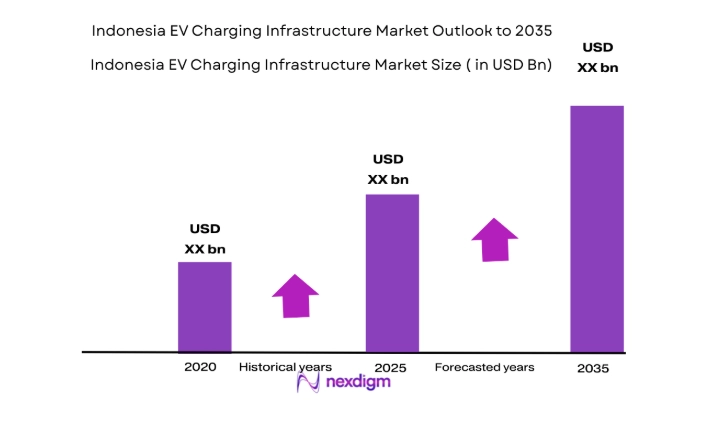
The Indonesia EV Charging Infrastructure market is witnessing rapid growth, driven by significant investments in sustainable mobility and the expansion of electric vehicle (EV) adoption. The market size has been valued at approximately USD ~ million, with expectations of steady growth as the number of electric vehicles on Indonesian roads continues to increase. Government incentives, such as subsidies for EV purchase and charging infrastructure installation, are accelerating the adoption of EVs and supporting the development of a reliable charging network. Additionally, private companies are heavily investing in building fast-charging stations, further driving market expansion.
Indonesia’s major cities, including Jakarta, Surabaya, and Bandung, are at the forefront of EV infrastructure development due to their high population density and rising environmental awareness. Jakarta, as the capital, remains a dominant hub for EV infrastructure development, benefiting from both government incentives and private sector investments. The ongoing push for sustainable urban transportation solutions and the demand for cleaner energy sources have positioned these cities as leaders in the transition to electric mobility, making them key drivers of the market.
Market Segmentation
By Product Type
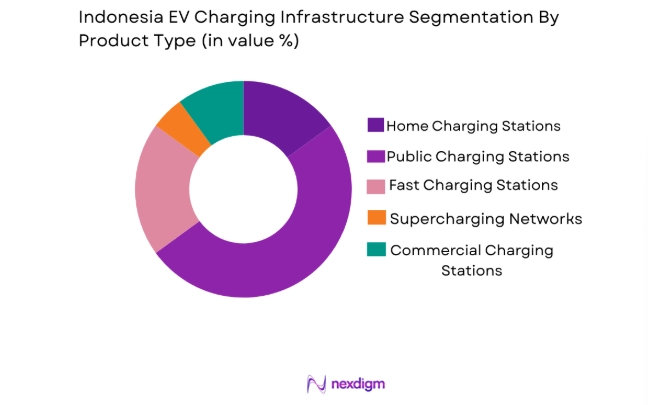
The Indonesia EV Charging Infrastructure market is segmented by product type into home charging stations, public charging stations, fast charging stations, supercharging networks, and commercial charging stations. Public charging stations are currently dominating the market due to their strategic locations in urban centers, increased consumer preference for convenient and fast charging options, and the growing availability of supportive infrastructure. These charging stations cater to a wider user base, including those who do not have access to home charging options, and are rapidly being deployed across key urban areas. The growing emphasis on reducing range anxiety and expanding the charging network has also made public charging stations a key component of the EV ecosystem, making them the leading sub-segment in market share.
By Platform Type
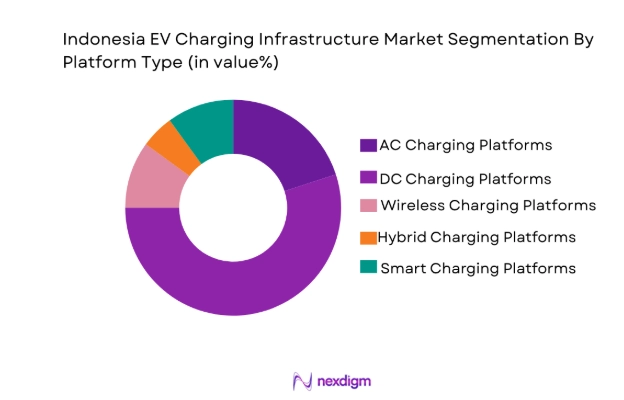
The Indonesia EV Charging Infrastructure market is segmented by platform type into AC charging platforms, DC charging platforms, wireless charging platforms, hybrid charging platforms, and smart charging platforms. DC charging platforms are dominating the market due to their ability to provide faster charging times compared to AC chargers, making them highly attractive for consumers with time constraints. These platforms are typically deployed in public charging stations, highways, and urban centers to ensure a rapid and convenient charging experience. The growing adoption of electric vehicles and the need for fast, efficient charging solutions are driving the widespread deployment of DC charging infrastructure, enabling them to capture the largest market share in the sector. The increasing demand for longer-range EVs and the need to reduce range anxiety among consumers also play a crucial role in the expansion of DC charging platforms in the Indonesian market.
Competitive Landscape
The competitive landscape of the Indonesia EV Charging Infrastructure market is characterized by an increasing number of key players investing in charging networks, with both international and local players participating. The market is consolidating as more players collaborate with government bodies and automotive companies to develop comprehensive infrastructure solutions. Some of the major players are strengthening their position by offering integrated charging services and focusing on providing fast-charging solutions to meet consumer demands.
| Company Name | Establishment Year | Headquarters | Technology Focus | Market Reach | Key Products | Revenue | Charging Station Type |
| Tesla | 2003 | California, USA | ~ | ~ | ~ | ~ | ~ |
| Shell | 1907 | The Hague, NL | ~ | ~ | ~ | ~ | ~ |
| ChargePoint | 2007 | California, USA | ~ | ~ | ~ | ~ | ~ |
| ABB | 1883 | Zurich, Switzerland | ~ | ~ | ~ | ~ | ~ |
| BP | 1908 | London, UK | ~ | ~ | ~ | ~ | ~ |
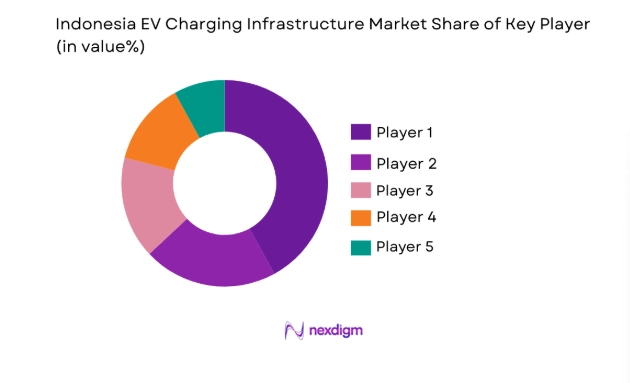
Indonesia EV Charging Infrastructure Market Analysis
Growth Drivers
Government incentives
The Indonesian government has been actively involved in creating a favorable environment for the electric vehicle (EV) market through various incentives aimed at reducing the barriers to entry for consumers and businesses alike. These incentives include direct subsidies for both electric vehicle purchases and the installation of EV charging stations. The government’s commitment to sustainability is further reflected in its support for infrastructure development, with programs that fund the establishment of charging networks in urban and rural areas. Additionally, tax exemptions and rebates for businesses that invest in EV infrastructure are encouraging more companies to participate in the market. This policy-driven approach not only helps offset the high initial costs associated with building a network of charging stations but also provides a clear economic incentive for private companies to expand EV infrastructure across the nation. The government’s proactive role ensures that both consumers and infrastructure providers are supported, which is essential for the widespread adoption of electric vehicles.
Technological advancements in charging infrastructure
As electric vehicles become more popular in Indonesia, technological advancements in charging infrastructure are becoming a critical growth driver. The introduction of fast-charging technology is transforming the EV experience by significantly reducing the time needed to charge vehicles. This development addresses one of the major consumer concerns regarding range anxiety and charging time, making electric vehicles a more attractive option for daily use. Moreover, innovations in wireless charging and smart charging technologies are opening new avenues for the market, creating more convenient and efficient charging options. Smart charging systems, which can communicate with vehicles and adjust charging speeds based on grid demand, are gaining traction as they offer more flexible solutions that help balance energy consumption. These technological advancements not only enhance user experience but also help integrate EV charging into the broader energy grid, making it easier to manage the increasing demand for electricity as more consumers adopt electric vehicles.
Market Challenges
High installation and maintenance costs
One of the primary challenges facing the Indonesian EV charging infrastructure market is the significant upfront cost associated with the installation of charging stations, particularly for fast-charging and supercharging networks. While government incentives and private investments are helping to ease the financial burden, the initial costs for setting up charging stations can still be high. Additionally, the cost of maintaining these stations, particularly in remote or underserved areas, further strains the financial viability of the infrastructure providers. The high cost of installation is exacerbated by the need to upgrade power grids and ensure reliable electricity supply to these stations. As demand for electric vehicles grows, this will put more pressure on providers to expand the network quickly. For businesses that are hesitant to make large investments, these costs can pose a significant barrier to entry. The market’s growth will depend on finding ways to reduce these installation costs while still ensuring that charging infrastructure meets the demand for fast, reliable, and accessible charging options.
Regulatory hurdles and inconsistent standards
Another significant challenge in the EV charging infrastructure market is the lack of standardization and inconsistent regulatory frameworks across different regions of Indonesia. While the national government has put forth policies aimed at promoting EV adoption, the implementation of these regulations can vary significantly between provinces and municipalities. This inconsistency can create confusion for businesses looking to expand their charging networks, as they may need to navigate a patchwork of local regulations, permit processes, and requirements for establishing charging stations. The absence of standardized protocols for charging infrastructure, such as payment systems and network interoperability, also complicates the consumer experience, preventing easy access to all available charging stations. This lack of uniformity could hinder the growth of the market and delay the widespread adoption of electric vehicles. Establishing clear, uniform standards for charging infrastructure across the country would help reduce complexity for both businesses and consumers, ensuring that the EV charging network is fully integrated and accessible nationwide.
Market Opportunities
Partnerships with automakers
One of the most promising opportunities in the Indonesia EV charging infrastructure market lies in partnerships between charging infrastructure providers and automakers. As the number of electric vehicles on the road continues to grow, automakers are increasingly investing in charging solutions to ensure that their customers have access to an adequate charging network. Collaborations between EV manufacturers and charging infrastructure providers will be key to expanding the charging network across Indonesia. These partnerships could take various forms, from automakers funding the installation of charging stations to providing exclusive access to certain stations for their customers. By working together, automakers and charging infrastructure providers can help address range anxiety and ensure that consumers have the necessary charging options as they transition to electric vehicles. Such collaborations are essential for building a comprehensive and efficient EV ecosystem, where vehicle manufacturers, charging networks, and consumers are all aligned in their goals for a sustainable future.
Expansion into underserved areas
A significant opportunity in the Indonesian EV charging infrastructure market is the expansion of charging stations into underserved rural and semi-urban areas. While major urban centers like Jakarta and Surabaya have seen substantial investment in EV infrastructure, many rural and peripheral regions are still lacking in charging facilities. Expanding infrastructure into these areas presents a large, untapped market for charging providers. As electric vehicle adoption grows beyond urban centers, especially in regions with growing environmental concerns, the demand for charging stations in rural areas will increase. Developing a network of accessible charging stations in these underserved areas will be crucial to ensuring that electric vehicles are an option for consumers nationwide, not just in major cities. This expansion would also support the Indonesian government’s broader goal of reducing carbon emissions and promoting green energy solutions across the country, creating a more inclusive and sustainable electric vehicle ecosystem.
Future Outlook
The future of the Indonesia EV Charging Infrastructure market looks promising, with anticipated growth fueled by ongoing government support and technological advancements. The demand for electric vehicles is expected to continue increasing, creating a substantial need for an expanded and more efficient charging network. The push for clean energy solutions, paired with the growth of smart technologies like wireless charging, will drive further market developments. Infrastructure investments will also be critical in ensuring the adequate availability of charging stations in urban and rural areas. As EV adoption accelerates, a robust charging network will be essential for meeting the needs of consumers, businesses, and government initiatives focused on sustainability. By 2035, the market will likely see the introduction of faster charging systems and the integration of renewable energy sources, enhancing the overall efficiency of the charging infrastructure.
Major Players
- Tesla
- Shell
- ChargePoint
- ABB
- BP
- Schneider Electric
- Siemens
- Greenlots
- EVBox
- Volta Charging
- Fastned
- IONITY
- Enel X
- Coulomb Technologies
- Circontrol
Key Target Audience
- Investments and venture capitalist firms
- Government and regulatory bodies
- Electric vehicle manufacturers
- Utility companies
- Automotive companies
- Fleet operators
- Charging network providers
- Renewable energy companies
Research Methodology
Step 1: Identification of Key Variables
This step involves identifying the essential factors that influence the market dynamics, including consumer preferences, technological advancements, regulatory trends, and economic variables.
Step 2: Market Analysis and Construction
In this phase, an in-depth analysis of market size, segmentation, and historical data is conducted. Models are developed to understand past trends and project future growth patterns.
Step 3: Hypothesis Validation and Expert Consultation
To refine our understanding, hypotheses are validated through consultations with industry experts and stakeholders. This helps ensure that assumptions align with the current market environment.
Step 4: Research Synthesis and Final Output
The final step synthesizes data from multiple sources, producing a cohesive report that highlights key findings and actionable insights for stakeholders.

- Executive Summary
- Research Methodology (Definitions, Scope, Industry Assumptions, Market Sizing Approach, Primary & Secondary Research Framework, Data Collection & Verification Protocol, Analytic Models & Forecast Methodology, Limitations & Research Validity Checks)

- Market Definition and Scope
- Value Chain & Stakeholder Ecosystem
- Regulatory / Certification Landscape
- Sector Dynamics Affecting Demand
- Strategic Initiatives & Infrastructure Growth

- Growth Drivers
Government policies supporting green energy
Expansion of EV adoption across the country
Technological advancements in fast charging solutions
Private sector investment in charging networks
Increase in environmental awareness among consumers - Market Challenges
High initial infrastructure investment costs
Limited availability of EV charging stations in rural areas
Inconsistent regulatory frameworks
Lack of standardization in charging technologies
Public reluctance to switch to electric vehicles - Market Opportunities
Government incentives for EV infrastructure development
Partnerships between automakers and charging network providers
Expansion of EV charging networks in underserved regions - Trends
Growth in the installation of fast charging stations
Integration of smart charging solutions in urban areas
Advancements in wireless charging technologies - Government Regulations & Defense Policy
Electric vehicle adoption mandates by local governments
Subsidies and incentives for infrastructure development
National policies on reducing carbon emissions - SWOT Analysis
- Stakeholder and Ecosystem Analysis
- Porter’s Five Forces Analysis
- Competition Intensity and Ecosystem Mapping

- By Market Value, 2020-2025
- By Installed Units, 2020-2025
- By Average System Price, 2020-2025
- By System Complexity Tier, 2020-2025

- By System Type (In Value%)
Home Charging Stations
Public Charging Stations
Fast Charging Stations
Supercharging Networks
Commercial Charging Stations - By Platform Type (In Value%)
AC Charging Platforms
DC Charging Platforms
Wireless Charging Platforms
Hybrid Charging Platforms
Smart Charging Platforms - By Fitment Type (In Value%)
Dedicated EV Charging Stations
Retrofit Charging Stations
Integrated EV Charging Solutions
Mobile Charging Station - By End User Segment (In Value%)
Private EV Owners
Commercial Fleet Operators
Government Organizations
EV Manufacturers
Third-Party Charging Providers - By Procurement Channel (In Value%)
Direct Procurement
Government Tenders
Private Sector Procurement
Online Bidding Platforms
Third-party Distributors

- Market structure and competitive positioning
Market share snapshot of major players - Cross Comparison Parameters (System Type, Platform Type, Procurement Channel, End User Segment, Fitment Type)
- SWOT Analysis of Key Competitors
- Pricing & Procurement Analysis
- Key Players
Tesla
Shell
ChargePoint
ABB
Siemens
BP Chargemaster
Schneider Electric
Eaton
Greenlots
Fastned
EVBox
Enel X
IONITY
Volta Charging
Coulomb Technologies

- Increased demand for charging infrastructure from private EV owners
- Commercial fleet operators seeking scalable charging solutions
- Government agencies promoting public infrastructure
- EV manufacturers collaborating with charging network providers

- Forecast Market Value, 2026-2035
- Forecast Installed Units, 2026-2035
- Price Forecast by System Tier, 2026-2035
- Future Demand by Platform, 2026-2035


 Request a Sample
 Ask for Customization
 Get a Quote
 Enquire Now