
 Download PDF
Market Overview
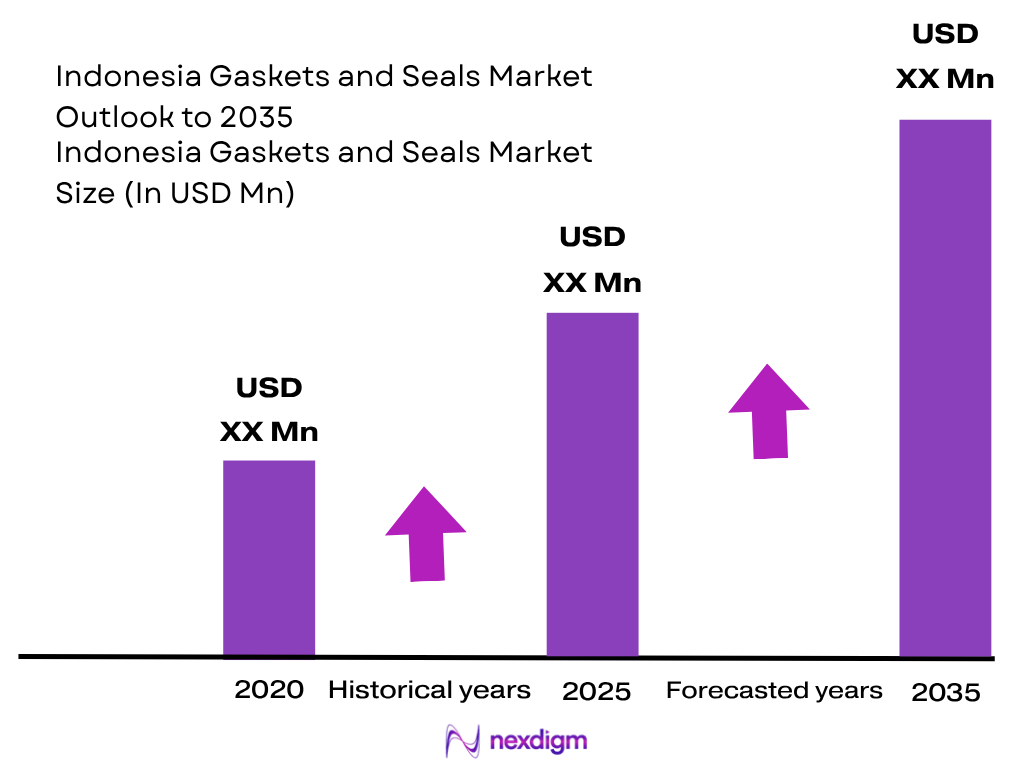
The Indonesia Gaskets and Seals Market is valued at approximately USD ~X.X billion, based on historical industry assessment, and is supported by Indonesia’s large automotive, manufacturing, mining, refining and process-industry base. Domestic motor-vehicle production reached 1.19 million units in the latest full-year period compared with 1.395 million units in the preceding period, while vehicle exports reached 472,000 CBU units, sustaining demand for O-rings, shaft seals, engine seals and precision elastomer components.
Java, particularly Greater Jakarta-Bekasi-Cikarang, West Java, Banten and East Java, represents the principal sealing-demand cluster because automotive plants, chemical facilities, machinery manufacturers, refineries and industrial estates are concentrated in these regions. Indonesia’s manufacturing industry generated approximately IDR 4,202.9 trillion in economic value, while mining generated around IDR 2,026.6 trillion. Outside Java, Sulawesi and North Maluku are increasingly important because Indonesia’s nickel-processing ecosystem comprises 131 operating, construction-stage and planned smelter projects.
Market Segmentation
By Product Type
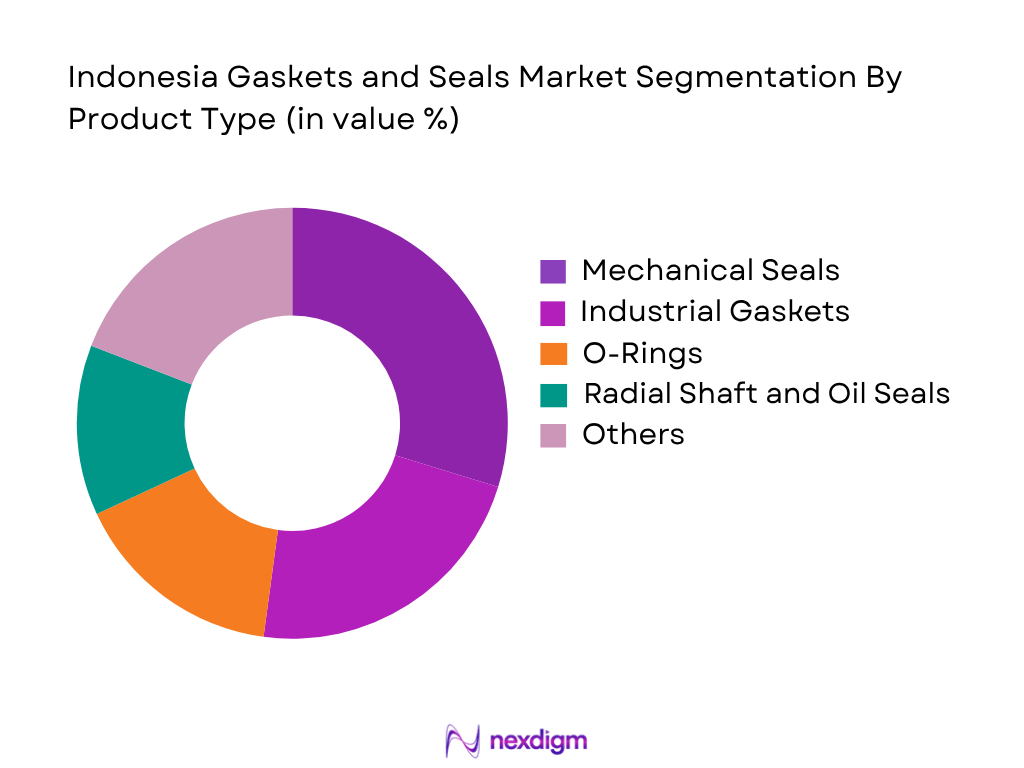
The Indonesia Gaskets and Seals Market is segmented by product type into mechanical seals, industrial gaskets, O-rings, radial shaft and oil seals, hydraulic and pneumatic seals, gland packing and other engineered sealing products. Mechanical seals represent the dominant product category in the report’s market model because Indonesia has an extensive installed base of pumps, compressors, agitators and rotating equipment across oil and gas, refining, petrochemicals, mining, pulp and paper, palm oil processing and power generation. Mechanical seals are critical in preventing process-fluid leakage and maintaining reliability under high pressure, corrosive media, abrasive slurry and elevated-temperature operating conditions. Indonesia’s accelerating mineral-processing activity further reinforces demand; the country is developing 131 nickel smelters, including 110 pyrometallurgical and 21 hydrometallurgical facilities, with projected ore-processing requirements reaching 438.3 million tonnes annually across the identified project base. This creates substantial requirements for pump seals, slurry-compatible mechanical seals, seal-support systems and maintenance replacements.
By End-Use Industry
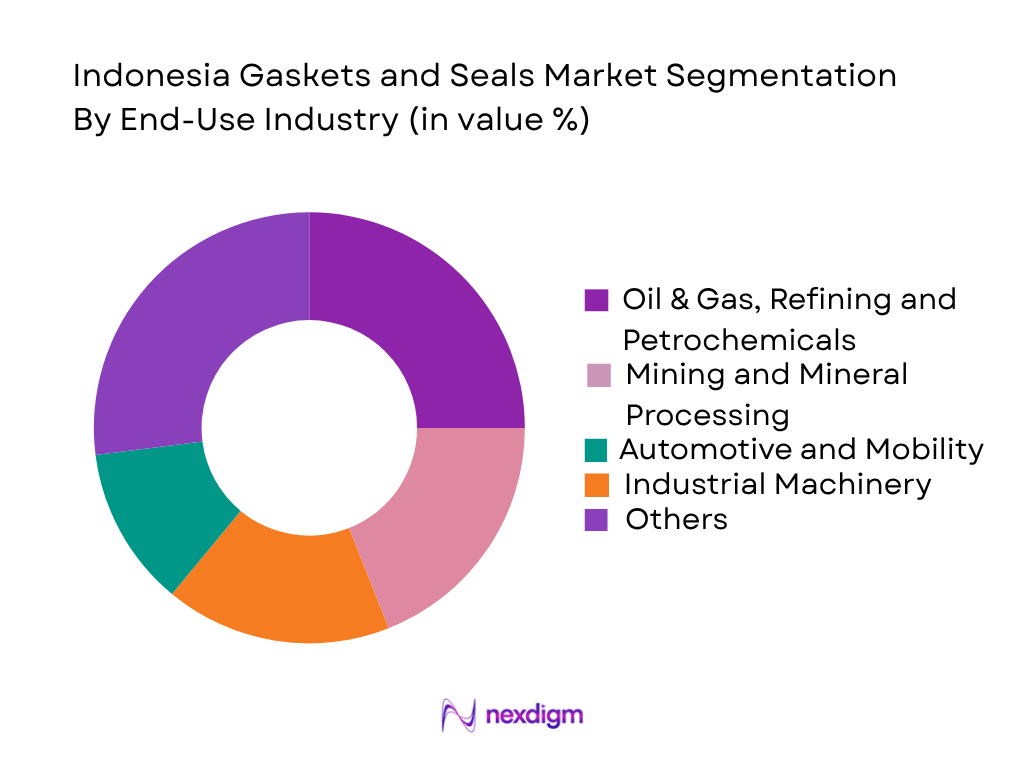
The Indonesia Gaskets and Seals Market is segmented by end-use industry into oil and gas and refining, mining and mineral processing, automotive and mobility, petrochemicals and chemicals, industrial machinery, power generation, palm oil and oleochemicals, pulp and paper, water treatment and other industrial applications. Oil and gas, refining and petrochemicals form the largest combined demand pool in the report model because these facilities operate large numbers of pumps, compressors, valves, pipelines, heat exchangers and pressure vessels that require mechanical seals, spiral-wound gaskets, graphite gaskets, packing and high-performance elastomer seals. Mining and mineral processing represent another substantial demand center because the country has 365 nickel mining permits across six provinces, alongside 79 operating nickel smelters, 74 under construction and 17 in planning or permitting stages in the latest official assessment. Such asset intensity creates recurring gasket and seal replacement requirements associated with abrasive slurries, hydraulic equipment, rotating machinery and high-temperature processing systems.
Competitive Landscape
The Indonesia Gaskets and Seals Market combines international sealing-technology manufacturers with domestic gasket fabricators, mechanical-seal specialists, distributors and MRO suppliers. Competition is particularly strong in mechanical seals, industrial gaskets, O-rings and hydraulic sealing products. International suppliers compete through engineering capability, proprietary materials, OEM qualifications and application support, while domestic participants compete through local fabrication, faster delivery, repair services and responsiveness to refinery, mining and general-industrial customers. EagleBurgmann, for example, maintains production and service operations in Cikarang alongside service locations in Surabaya, Pekanbaru, Balikpapan and Cilegon.
| Company | Establishment Year | Headquarters | Core Sealing Portfolio | Key Material Capability | Major Indonesia Demand Exposure | Process-Industry Capability | Engineering Model | Aftermarket / Service Strength |
| EagleBurgmann | 2004* | Wolfratshausen, Germany | ~ | ~ | ~ | ~ | ~ | ~ |
| Freudenberg Sealing Technologies | 1849* | Weinheim, Germany | ~ | ~ | ~ | ~ | ~ | ~ |
| Trelleborg Sealing Solutions | 1952 | Stuttgart, Germany | ~ | ~ | ~ | ~ | ~ | ~ |
| Flowserve | 1997 | Irving, Texas, USA | ~ | ~ | ~ | ~ | ~ | ~ |
| Parker Hannifin | 1917 | Cleveland, Ohio, USA | ~ | ~ | ~ | ~ | ~ | ~ |
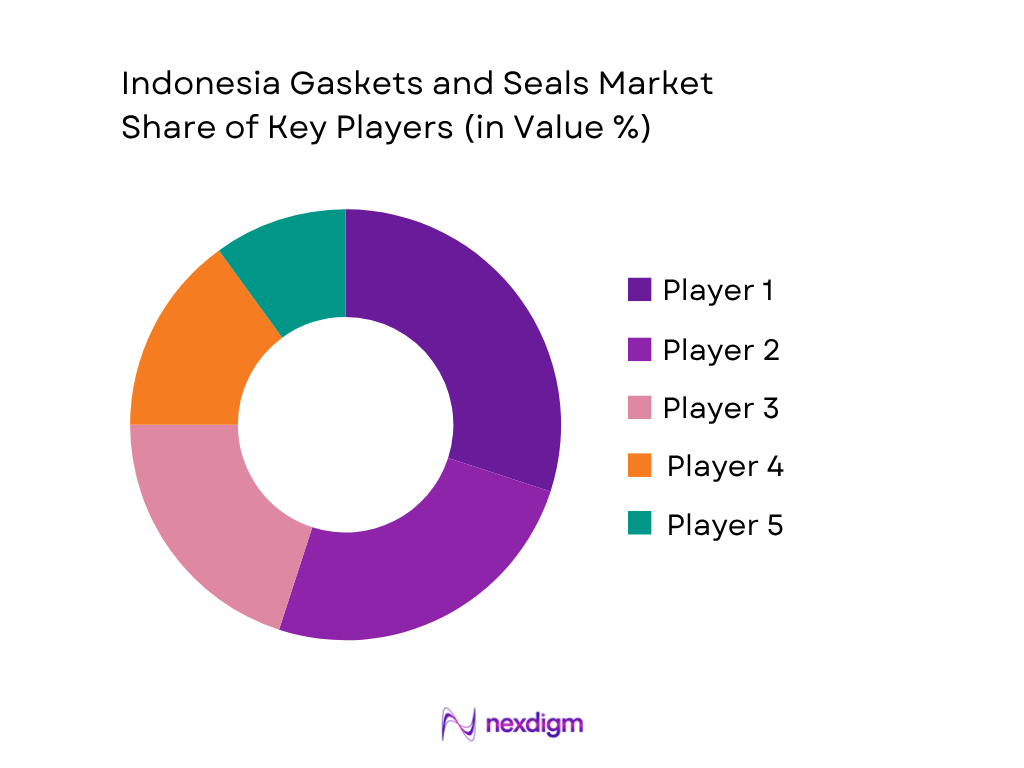
Indonesia Gaskets and Seals Market Analysis
Growth Drivers
Expansion of Nickel Mining, Smelting and Mineral Processing
Indonesia’s accelerated nickel downstreaming is a major growth driver for the Indonesia Gaskets and Seals Market because smelters, hydrometallurgical plants and mineral-processing facilities require mechanical seals, slurry seals, hydraulic seals, flange gaskets and high-temperature sealing systems across pumps, agitators, compressors, valves and material-handling equipment. In 2024, Indonesia had 17 billion tonnes of nickel resources and 5 billion tonnes of nickel reserves, while approved nickel production volumes reached approximately 240 million tonnes. A subsequent industry assessment identified 131 nickel smelters, comprising 110 pyrometallurgical facilities and 21 hydrometallurgical facilities, with associated ore requirements of 438.3 million tonnes annually across operational, construction and planned assets. During 2025, the domestic downstream ecosystem included 365 nickel mining permits across 6 provinces, alongside 79 operating smelters, 74 smelters under construction and 17 projects in planning or permitting. Indonesia’s economy generated approximately USD 1.396 trillion of GDP in 2024, providing a substantial macroeconomic base for industrial investment. This expanding processing footprint directly increases installed rotating equipment and creates recurring demand for abrasion-resistant, chemically compatible and high-temperature gasket and seal replacements.
Large Oil and Gas, Refining and Process-Equipment Installed Base
Indonesia’s extensive oil and gas infrastructure is another major driver of gasket and seal consumption because upstream production facilities, refineries, pipelines, gas-processing plants and terminals depend on mechanical seals, compressor seals, spiral-wound gaskets, graphite gaskets, valve packing and engineered elastomers to maintain fluid containment and equipment reliability. Oil and gas investment reached USD 17.5 billion in 2024, forming the largest component of Indonesia’s USD 32.3 billion energy and mineral-sector investment. The country recorded combined oil and gas lifting of approximately 1.606 million barrels of oil equivalent per day, including 579,700 barrels of oil per day and 5,481 million standard cubic feet of gas per day. Oil and gas investment subsequently reached USD 18.02 billion in 2025, maintaining a substantial expenditure base for exploration, field development, processing equipment and infrastructure. Indonesia also identified 128 hydrocarbon basins, with 20 basins already developed and substantial additional exploration activity underway. Against national GDP of approximately USD 1.396 trillion in 2024, this asset-intensive energy sector creates recurring first-fit, turnaround, overhaul and emergency-MRO requirements for technically qualified sealing components across Indonesia’s industrial facilities.
Market Challenges
Contraction in Domestic Automotive Production
Weakness in automotive manufacturing represents a challenge for the Indonesia Gaskets and Seals Market because vehicle production is an important demand source for oil seals, radial shaft seals, O-rings, transmission seals, engine gaskets, bearing seals and precision moulded elastomer components. Indonesia produced 1,196,664 vehicles in 2024, including 1,026,976 passenger vehicles and 169,688 commercial vehicles. The country’s installed automotive production capability is approximately 2.2 million vehicles annually, indicating that a substantial portion of manufacturing capacity remained unused during the year. Indonesia also exported approximately 472,000 completely built vehicles, meaning sealing suppliers remain exposed not only to domestic demand but also to export-oriented assembly schedules. Lower vehicle output reduces first-fit seal volumes and can place pressure on suppliers whose production lines are concentrated in conventional internal-combustion engine, transmission and drivetrain applications. Indonesia nevertheless recorded approximately USD 1.396 trillion of GDP in 2024, demonstrating that the wider economy remains large enough to support industrial diversification. For gasket and seal manufacturers, the challenge is therefore to reduce dependence on traditional vehicle platforms while expanding into electric-drive sealing, battery thermal-management components, industrial machinery and aftermarket replacement applications.
High Dependence on Imported Sealing Products
Import dependence remains a significant challenge for the Indonesia Gaskets and Seals Market, particularly for high-specification elastomer products, precision seals and engineered components required by automotive, energy, mining and process-industry customers. Indonesia imported 9,199,760 kilograms of vulcanized-rubber gaskets, washers and seals under HS 401693 during 2024, with an import value of USD 151.65 million. Major supply sources included Japan at USD 34.81 million, China at USD 26.96 million, the United States at USD 18.07 million, Thailand at USD 10.86 million and Vietnam at USD 9.96 million. By comparison, Indonesia exported 4,709,450 kilograms of the same category with a value of USD 62.94 million. This trade structure demonstrates the continuing requirement for foreign-produced sealing components and materials, particularly where OEM qualifications, dimensional precision or specialized compounds are required. Indonesia’s broader economy generated approximately USD 1.396 trillion in GDP during 2024, yet domestic seal manufacturing capability remains uneven across specialized applications. Import reliance can therefore create longer procurement chains, inventory requirements and replacement-lead-time exposure for critical industrial equipment operating in geographically dispersed locations.
Market Opportunities
Localization of Gasket and Seal Manufacturing
Indonesia presents a strong future opportunity for localized gasket and seal production because existing trade flows demonstrate substantial domestic consumption of imported sealing products that could increasingly be served through local moulding, machining, gasket conversion, mechanical-seal assembly and repair capabilities. During 2024, Indonesia imported 9.20 million kilograms of vulcanized-rubber gaskets, washers and seals valued at USD 151.65 million, while exports amounted to 4.71 million kilograms valued at USD 62.94 million. Imports from Japan alone reached USD 34.81 million, while China supplied USD 26.96 million and the United States supplied USD 18.07 million. These current trade volumes provide a measurable installed demand base for companies considering domestic manufacturing of O-rings, oil seals, hydraulic seals, custom rubber components and industrial gasket products. Indonesia’s GDP stood at approximately USD 1.396 trillion in 2024, while energy and mineral-sector investment reached USD 32.3 billion, reinforcing the scale of the industrial economy consuming these products. Expanding domestic production can support shorter delivery cycles, localized engineering, emergency-MRO availability and customized components while reducing reliance on imported standard and specialized sealing products.
Expansion of High-Performance Sealing and Industrial MRO Services
The increasing complexity of Indonesia’s energy and mineral infrastructure creates a future opportunity for suppliers offering mechanical-seal repair, high-performance polymers, slurry-resistant seals, graphite gaskets and emergency MRO services. Energy and mineral investment reached USD 32.3 billion in 2024, including USD 17.5 billion in oil and gas and USD 7.7 billion in minerals and coal. During 2025, total investment remained substantial at USD 31.96 billion, including USD 18.02 billion in oil and gas and USD 7.00 billion in minerals and coal. Indonesia also had 79 operating nickel smelters, 74 facilities under construction and 17 projects in planning or permitting, while the oil and gas sector contained 128 identified basins, including 20 already developed. These operating assets use pumps, compressors, hydraulic systems, slurry pipelines, valves and process vessels that require periodic seal inspection, refurbishment and replacement. Indonesia’s GDP of approximately USD 1.396 trillion in 2024 provides the broader economic foundation for this industrial activity. Suppliers capable of local seal-face refurbishment, reverse engineering, condition monitoring and rapid replacement support are therefore positioned to capture increasing lifecycle-service demand from critical industrial equipment.
Future Outlook
The Indonesia Gaskets and Seals Market is projected to expand at approximately ~X.X% CAGR during 2026-2035, supported by mineral downstreaming, refinery modernization, manufacturing activity and greater requirements for reliable industrial equipment. Demand is expected to shift progressively toward higher-performance mechanical seals, PTFE-based products, FKM/FFKM elastomers, graphite gaskets and engineered sealing systems. Local repair, refurbishment and manufacturing capabilities are also expected to gain strategic importance as industrial customers seek shorter lead times and reduced dependence on imported critical spares.
Indonesia’s nickel-processing buildout provides a particularly important long-term industrial demand platform. The identified nickel-smelter pipeline includes 131 facilities, and official assessments indicate considerable additional processing infrastructure under construction and planning. Increased mineral downstreaming expands the installed population of pumps, hydraulic systems, slurry-handling equipment, compressors and high-temperature processing machinery, all of which generate initial fitment and recurring MRO sealing requirements.
Major Players
- EagleBurgmann Indonesia
- John Crane Indonesia
- Flowserve
- Freudenberg Sealing Technologies
- Trelleborg Sealing Solutions
- Parker Hannifin Indonesia
- SKF Indonesia
- NOK / Freudenberg-NOK Sealing Technologies
- A.W. Chesterton
- Garlock
- KLINGER
- PT Tri Graha Sealisindo
- PT Arezda Purnama Loka / INGI
- PT Sentra Mitra Nusantara
- Sinar Harapan Seal
Key Target Audience
- Gasket, Mechanical Seal and Engineered Polymer Seal Manufacturers
- Oil & Gas, Refinery, Petrochemical and Chemical Industry Operators
- Mining, Nickel Processing and Metal Smelting Companies
- Automotive OEMs and Tier-1/Tier-2 Component Manufacturers
- Pump, Compressor, Valve and Industrial Machinery Manufacturers
- Industrial MRO Distributors, Seal Repair and Rotating-Equipment Service Providers
- Investments and Venture Capitalist Firms
- Government and Regulatory Bodies (Ministry of Industry/Kemenperin, Ministry of Energy and Mineral Resources/ESDM, SKK Migas, Ministry of Investment and Downstream Industry/BKPM, National Standardization Agency/BSN)
Research Methodology
Step 1: Identification of Key Variables
The initial phase involves developing an ecosystem map covering gasket and seal manufacturers, raw-material suppliers, distributors, OEMs, EPC contractors, MRO providers and major industrial users in the Indonesia Gaskets and Seals Market. Secondary research identifies critical variables including installed equipment, industrial output, trade flows, automotive production, refinery activity, smelter infrastructure, material requirements and replacement cycles that determine sealing-product consumption.
Step 2: Market Analysis and Construction
Historical market demand is constructed using both top-down and bottom-up methods. The top-down model evaluates relevant automotive, mining, oil and gas, refining, industrial machinery and processing activity, while the bottom-up model examines supplier revenues, product shipments, distributor sales, import flows, installed equipment and application-specific gasket and seal consumption. The two approaches are reconciled to establish market value and segment allocations.
Step 3: Hypothesis Validation and Expert Consultation
Market hypotheses are validated through structured discussions and computer-assisted telephone interviews with gasket manufacturers, mechanical-seal suppliers, distributors, plant-maintenance teams, pump and compressor specialists and end-user procurement personnel. These consultations validate product mix, replacement intervals, OEM-versus-MRO demand, material preferences, competitive positioning, import dependency and customer purchasing criteria, thereby reducing reliance on assumptions created during the secondary-research phase.
Step 4: Research Synthesis and Final Output
The final stage integrates primary findings with company information, government industrial data, automotive production statistics, mining and smelting infrastructure, import-export information and application-level demand analysis. Data points are triangulated across multiple variables and reconciled using top-down and bottom-up calculations. The final output establishes market sizing, segmentation, competitive positioning, growth drivers, challenges, opportunities and the long-term outlook for the Indonesia Gaskets and Seals Market.

- Executive Summary
- Research Methodology (Market Definition and Scope, Indonesia Gaskets and Seals Market Classification, Static and Dynamic Sealing Demand Assessment, Gasket and Seal Consumption Mapping, Installed Pump, Compressor and Valve Base Assessment, Domestic Gasket and Seal Manufacturing Capacity Assessment, Imported Sealing Product Dependency Analysis, Elastomer, PTFE, Graphite and Metallic Material Assessment, Mechanical Seal Installed Base Mapping, Automotive Sealing Content Assessment, Refinery and Petrochemical Sealing Demand Mapping, Mining and Smelting Equipment Sealing Assessment, Primary Industry Interviews)

- Definition and Scope
- Indonesia Gaskets and Seals Industry Evolution and Development of Industrial Gaskets, Mechanical Seals, O-Rings, Hydraulic and Pneumatic Seals, Rotary Shaft Seals and Engineered Sealing Ecosystem
- Domestic Gasket Fabrication, Mechanical Seal Assembly, Rubber Moulding, PTFE Processing, Graphite Conversion and Precision Sealing Industry Structure
- Indonesia Gaskets and Seals Value Chain Analysis
- Indonesia Gaskets and Seals Supply Chain Analysis
- Raw Material Supplier, Gasket Converter, Seal Manufacturer, OEM, Industrial Distributor, EPC Contractor, MRO Service Provider and End-User Ecosystem Analysis

- Growth Drivers (Expansion of Nickel and Mineral Downstream Processing, Large Refinery and Petrochemical Installed Base, Automotive Manufacturing Activity, Growth of Mining Equipment Operations, Expansion of Palm Oil and Oleochemical Processing, Industrial Maintenance and Shutdown Demand, Increasing Pump and Compressor Installed Base, Growing Requirement for Higher Equipment Reliability)
- Market Challenges (Dependence on Imported High-Specification Seals, Foreign Currency Exposure for Specialty Materials, Price Competition in Commodity Gaskets, Fragmented Local Distribution, Counterfeit and Low-Quality Replacement Products, Limited Local FFKM and Specialty PTFE Capability, Qualification Barriers in Oil and Gas Applications, Remote-Site MRO Logistics)
- Market Opportunities (Mechanical Seal Localization, Refinery Turnaround Gasket Supply, Nickel Smelter Sealing Applications, Hydrogen and Gas Processing Seals, EV Battery and E-Drive Sealing, High-Performance PTFE and FFKM Components, Mining Slurry Seal Systems, Predictive Maintenance and Seal Monitoring, Local Repair and Refurbishment Services, Indonesian Manufacturing Hub Development)
- Market Trends (Cartridge Mechanical Seal Adoption, Graphite and Spiral Wound Gasket Usage, Engineered PTFE Seal Penetration, High-Pressure Process Sealing, Slurry-Resistant Mining Seals, Fugitive Emission Reduction, Seal Condition Monitoring, Local Custom Machining, OEM-to-MRO Lifecycle Contracts, High-Performance Elastomer Adoption)
- Regulatory and Standards Landscape (SNI Requirements, API-Based Oil and Gas Sealing Specifications, ASME Flange and Gasket Standards, ISO Mechanical Seal Requirements, Pertamina Contractor and Technical Requirements, Ministry of Industry Local Content Requirements, TKDN Compliance, Occupational Safety Requirements, Environmental Emission Compliance, Food-Contact and Pharmaceutical Material Requirements)
- SWOT Analysis
- Porter’s Five Forces Analysis
- PESTLE Analysis
- Stakeholder Ecosystem
- Competition Ecosystem

- By Market Value (2020-2025)
- By Gasket and Seal Shipment Volume (2020-2025)
- By Static Sealing Consumption Volume (2020-2025)
- By Dynamic Sealing Consumption Volume (2020-2025)
- By Domestic Gaskets and Seals Production Volume (2020-2025)
- By Imported Gaskets and Seals Volume (2020-2025)
- By OEM Sealing Consumption (2020-2025)
- By Replacement and MRO Sealing Consumption (2020-2025)
- By Average Selling Price (2020-2025)

- By Product Type (In Value %)
Mechanical Seals
Industrial Gaskets
O-Rings
Radial Shaft and Oil Seals
Hydraulic Seals
Pneumatic Seals
Gland Packings
Spiral Wound Gaskets
Graphite Gaskets
PTFE Gaskets
Ring-Type Joint Gaskets
Rubber-Moulded Seals
Spring-Energized Seals
Custom Engineered Sealing Components - By Material Type (In Value %)
NBR
HNBR
EPDM
FKM
FFKM
Silicone/VMQ
Polyurethane
PTFE
Filled and Modified PTFE
Expanded Graphite
Compressed Non-Asbestos Fibre
Aramid Fibre Composites
Stainless Steel
Carbon Steel
Nickel and Specialty Alloys
Carbon Graphite
Silicon Carbide
Tungsten Carbide
Multi-Material Sealing Systems - By Equipment Application (In Value %)
Centrifugal Pumps
Positive-Displacement Pumps
Compressors
Industrial Valves
Flanged Piping Systems
Agitators and Mixers
Heat Exchangers
Reactors and Pressure Vessels
Gearboxes
Motors and Bearing Housings
Hydraulic Cylinders
Pneumatic Cylinders
Mining Slurry Equipment
Automotive Engines and Transmissions
Electric Drive Units
Battery Thermal Management Systems
Steam Turbines
Process Furnaces and Boilers - By End-Use Industry (In Value %)
Oil and Gas Upstream
Oil Refining
Petrochemicals and Chemicals
Automotive and Mobility
Mining and Mineral Processing
Nickel and Metal Smelting
Power Generation
Pulp and Paper
Industrial Machinery
Food and Beverage Processing
Palm Oil and Oleochemicals
Water and Wastewater
Marine and Shipbuilding
Cement
Pharmaceuticals
Fertilizers
Other Manufacturing Industries - By Region (In Value %)
Greater Jakarta and Banten
West Java
Central Java
East Java
Riau and Riau Islands
South Sumatra
East Kalimantan
South Kalimantan
South Sulawesi
North Maluku
Papua and Other Eastern Indonesia Industrial Zones

- Market Share of Major Players (By Indonesia Revenue, Gasket and Seal Shipment Volume, Mechanical Seal Exposure, Industrial Gasket Exposure, Automotive Seal Exposure, Oil and Gas and Refining Exposure, Mining and Smelting Exposure, Indonesia Manufacturing and Service Footprint)
- Cross Comparison Parameters (Static and Dynamic Sealing Portfolio Breadth, Mechanical Seal and Pump-Sealing Capability, FKM-FFKM-PTFE-Graphite Material Capability, Indonesia Manufacturing and Service-Centre Footprint, Oil and Gas-Refining-Petrochemical Exposure, Mining-Smelting and Slurry-Sealing Capability, Automotive and E-Mobility Design-In Exposure, Engineered-to-Order and Emergency-MRO Response Capability)
- SWOT Analysis of Major Players
- Competitive Positioning Matrix
- Pricing and Sealing Product Category Benchmarking
- Detailed Profiles of Major Companies
EagleBurgmann Indonesia – Mechanical Seals, Seal Supply Systems, Compressor Seals, Packings, Gaskets, Expansion Joints, Repair and Field Service
John Crane Indonesia – Mechanical Seals, Dry Gas Seals, Seal Support Systems, Couplings, Filtration and Rotating Equipment Reliability Solutions
Flowserve – Pump Seals, Compressor Seals, Cartridge Seals, Mixer Seals, Seal Support Systems and Process Industry Applications
Freudenberg Sealing Technologies – O-Rings, Radial Shaft Seals, Automotive Seals, Hydraulic and Pneumatic Seals and Engineered Elastomer Solutions
Trelleborg Sealing Solutions – Hydraulic Seals, Pneumatic Seals, Rotary Seals, PTFE Seals and Engineered Polymer Sealing Systems
Parker Hannifin Indonesia – O-Rings, Hydraulic Seals, Pneumatic Seals, Rotary Seals and Engineered Sealing and Shielding Solutions
SKF Indonesia – Bearing Seals, Radial Shaft Seals, Large-Diameter Seals and Industrial Rotating Equipment Sealing Solutions
NOK / Freudenberg-NOK Sealing Technologies – Automotive Oil Seals, O-Rings, Hydraulic Seals and Precision Elastomer Components
A.W. Chesterton – Mechanical Seals, Split Seals, Cartridge Seals, Gaskets, Packing and Engineered Polymer Seals
Garlock – Industrial Gaskets, Compression Packing, Oil Seals, Bearing Isolators and High-Performance Process Sealing Solutions
KLINGER – CNAF Gaskets, PTFE Gaskets, Graphite Gaskets, Metallic Gaskets and Industrial Flange Sealing Solutions
PT Tri Graha Sealisindo – Mechanical Seals, Metallic and Semi-Metallic Gaskets, Gland Packing, PHE Gaskets and PTFE Lining
PT Arezda Purnama Loka / INGI – Metallic, Non-Metallic and Composite Industrial Gaskets, Packing and Engineered Sealing Products
PT Sentra Mitra Nusantara – O-Rings, Oil Seals, Mechanical Seals, Custom-Moulded Rubber, Gland Packing and Sheet Packing
Sinar Harapan Seal – Mechanical Seals, O-Rings, Hydraulic Seals, Oil Seals, Gaskets, Couplings and Custom Industrial Seals

- Oil and Gas Operator Sealing Requirement Assessment
- Refinery and Petrochemical Plant Gasket and Mechanical Seal Demand Assessment
- Mining and Smelting Operator Heavy-Duty Sealing Requirement Analysis
- Automotive OEM and Tier Supplier Sealing Demand Assessment
Pump and Compressor Manufacturer Mechanical Seal Requirement Assessment - Palm Oil and Oleochemical Processor Sealing Requirement Assessment
- Power Plant Rotating Equipment Seal Demand Assessment
- Pulp and Paper Mill Sealing Requirement Assessment
- Industrial MRO Distributor Replacement Seal Demand Assessment
- EPC Contractor Gasket and Seal Specification Assessment
- Water and Wastewater Utility Sealing Requirement Assessment
- Marine and Shipbuilding Operator Sealing Requirement Assessment

- By Market Value (2026-2035)
- By Gasket and Seal Shipment Volume (2026-2035)
- By Static Sealing Consumption Volume (2026-2035)
- By Dynamic Sealing Consumption Volume (2026-2035)
- By Domestic Gaskets and Seals Production Volume (2026-2035)
- By Imported Gaskets and Seals Volume (2026-2035)
- By OEM Sealing Consumption (2026-2035)
- By Replacement and MRO Sealing Consumption (2026-2035)
- By Average Selling Price (2026-2035)


 Request a Sample
 Ask for Customization
 Get a Quote
 Enquire Now