
 Download PDF
Market Overview
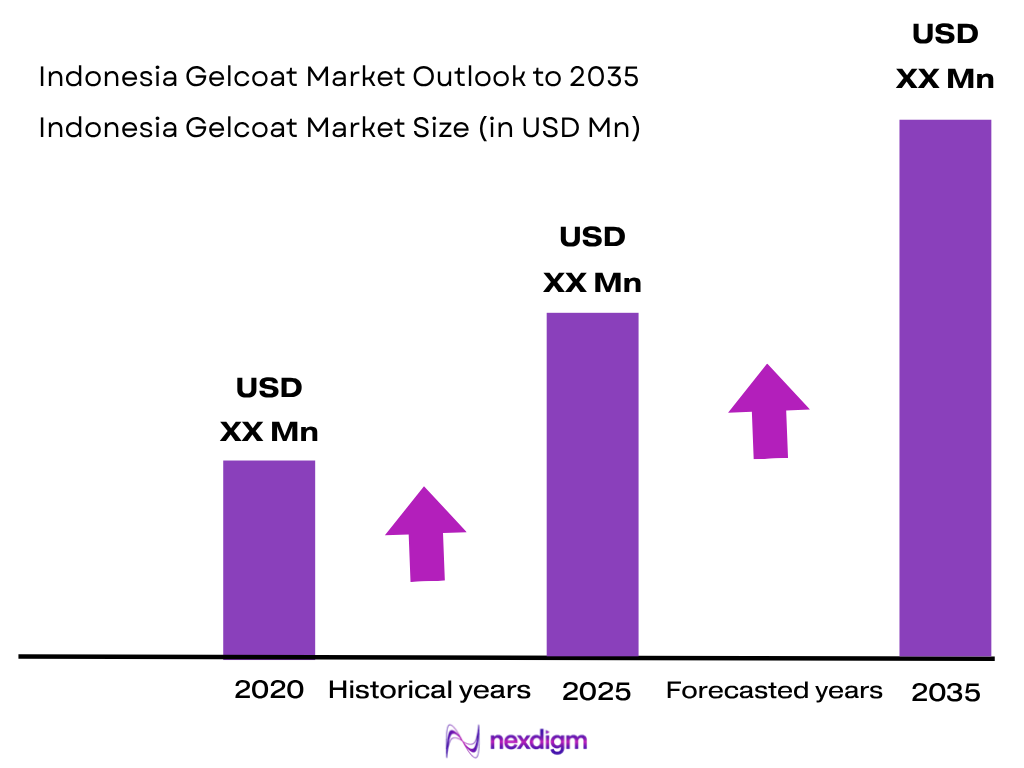
The Indonesia Gelcoat Market is valued at approximately USD ~XX million, based on historical market assessment. Demand is supported by the country’s large marine, construction, water-storage, industrial FRP and transportation ecosystem. Indonesia’s nominal GDP increased from approximately USD 1.37 trillion to USD 1.40 trillion, while investment realization reached IDR 1,714.2 trillion in the latest comparable period. These fundamentals support continuing consumption of polyester resins, gelcoats and fiberglass composite products.
Greater Jakarta, Banten, West Java, East Java, Batam and Bali are prominent demand centres in the Indonesia Gelcoat Market. Java dominates because it concentrates chemical processing, automotive manufacturing, construction activity, composite distributors and industrial FRP fabricators, while East Java has substantial marine and industrial activity. Batam benefits from shipbuilding and marine manufacturing, whereas Bali supports fiberglass boats, pools and tourism-related composite products. Investment realization in Java reached IDR 818.8 trillion, reinforcing its industrial importance.
Market Segmentation
By Resin Chemistry
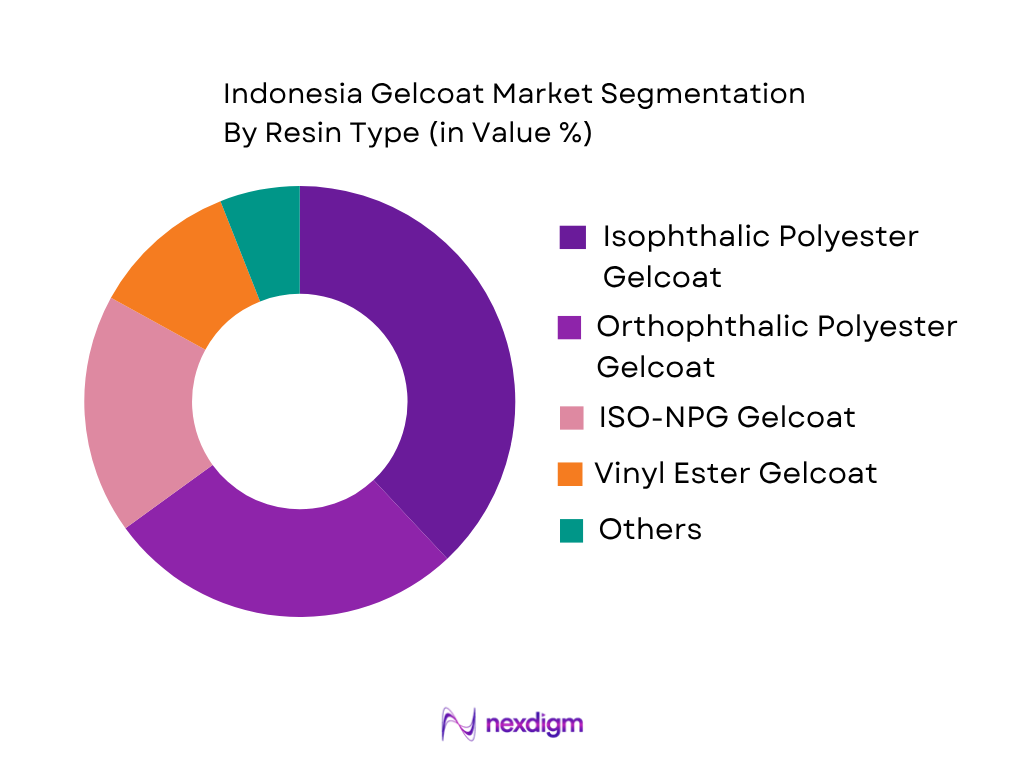
The Indonesia Gelcoat Market is segmented by resin chemistry into orthophthalic polyester, isophthalic polyester, ISO-NPG, vinyl ester and specialty modified gelcoats. Isophthalic polyester gelcoat represents the dominant category in the report model because it provides a practical balance between weather resistance, hydrolysis resistance, mechanical properties and processing suitability for Indonesia’s major fiberglass applications. It is extensively relevant to boats, tanks, pipes, sanitary products, pools and external FRP components exposed to humid tropical environments. Compared with general-purpose orthophthalic formulations, isophthalic systems offer stronger durability for applications involving moisture and outdoor exposure without moving entirely into higher-performance vinyl ester chemistry. Indonesia’s chemical and pharmaceutical sector recorded substantial investment activity, while domestic resin and composite-material suppliers provide polyester resin systems to industrial processors. The country’s extensive marine geography further supports demand for moisture-resistant gelcoat technologies. ISO-NPG and vinyl ester systems are increasingly important in premium marine and chemical-resistance applications but remain more specialized than conventional isophthalic products.
By End-Use Application
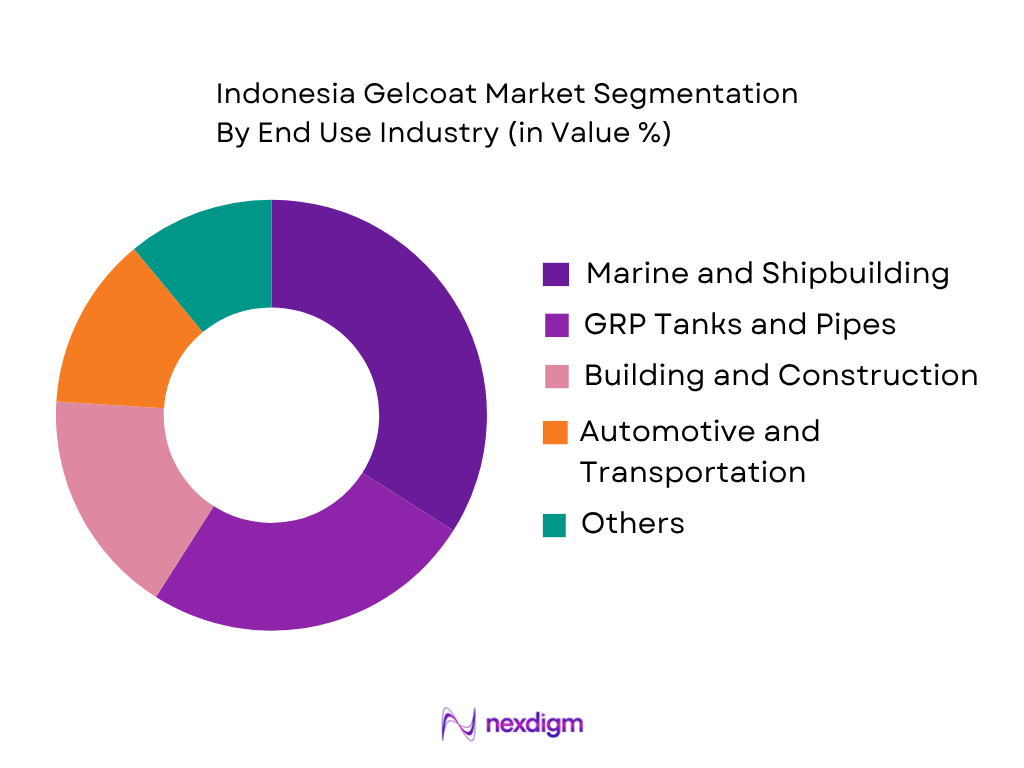
The Indonesia Gelcoat Market is segmented into marine and boatbuilding, GRP tanks and pipes, building and construction, automotive and transportation, and industrial or specialty composite applications. Marine and boatbuilding applications hold the leading share in the report model because Indonesia’s archipelagic geography generates structurally high demand for fishing boats, passenger craft, workboats, patrol craft, tourism boats and marine components. Gelcoat is particularly important in fiberglass vessels because it provides the visible moulded surface while contributing to water, ultraviolet and weather exposure resistance. Domestic builders manufacture fiberglass vessels across Bali, Java, Batam and other coastal manufacturing locations. Marine applications commonly utilize isophthalic and ISO-NPG gelcoats, with vinyl ester barrier layers applied where greater hydrolysis or osmosis resistance is required. Industrial tanks and pipes represent the next major application because chemical processing, water infrastructure and industrial facilities use corrosion-resistant FRP. Construction, sanitary products, swimming pools and automotive components broaden the addressable gelcoat consumption base.
Competitive Landscape
The Indonesia Gelcoat Market comprises domestic resin manufacturers and distributors alongside international composite-material groups supplying marine, industrial and specialty gelcoat technologies. PT Justus Kimiaraya and related Justus operations have strong domestic exposure through polyester resin and composite materials, while PT Wah Lee Indonesia and PT Perdana Chemindo Perkasa participate in composite raw-material distribution. International suppliers such as Polynt and Scott Bader contribute specialized marine, ISO-NPG, vinyl ester and tooling technologies. Competition is primarily based on chemistry breadth, local product availability, pigmentation capability, technical support and application-specific performance.
| Company | Establishment Year | Headquarters | Key Gelcoat Chemistry | Major Indonesia Applications | Marine Capability | Chemical-Resistance Capability | Tooling/Specialty Capability |
| PT Justus Kimiaraya / Justus Group | ~XX | Indonesia | ~ | ~ | ~ | ~ | ~ |
| PT Wah Lee Indonesia | ~XX | Jakarta, Indonesia | ~ | ~ | ~ | ~ | ~ |
| PT Perdana Chemindo Perkasa | ~XX | Indonesia | ~ | ~ | ~ | ~ | ~ |
| Polynt Composites | 1955 | Scanzorosciate, Italy | ~ | ~ | ~ | ~ | ~ |
| Scott Bader | 1921 | Wollaston, Northamptonshire, UK | ~ | ~ | ~ | ~ | ~ |
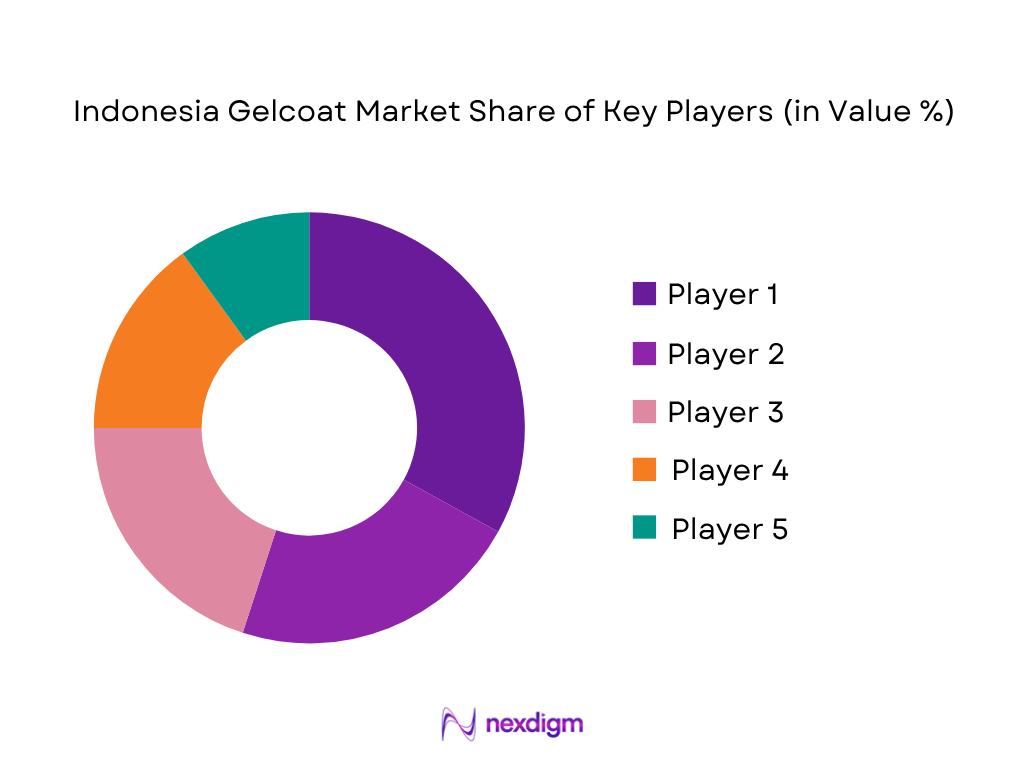
Indonesia Gelcoat Market Analysis
Growth Drivers
Large Fiberglass Boatbuilding and Marine-Transport Base
Indonesia’s extensive marine economy provides a structural demand driver for marine-grade gelcoats used on fiberglass fishing boats, passenger vessels, workboats, patrol craft, tourism boats and molded marine components. The Ministry of Marine Affairs and Fisheries recorded 14,617 centrally licensed fishing vessels as of December 31, 2024, while preliminary capture-fisheries production reached 6.7 million tons through November and fish landings recorded at fishing ports reached 1.3 million tons. The Ministry of Industry also reports that Indonesia has more than 250 shipyards and 127 supporting industries producing materials and components for marine applications. These figures establish a substantial vessel-manufacturing, maintenance and refurbishment ecosystem in which marine gelcoat is required for surface finishing, ultraviolet protection, water resistance and cosmetic restoration of fiberglass structures. The broader macroeconomic environment further supports this industrial demand: World Bank data record Indonesia’s 2024 population at 283,487,931, GDP at approximately USD 1.4 trillion, and GDP per capita at USD 4,925.4. This combination of vessel activity, shipbuilding infrastructure and domestic economic scale supports recurring consumption of isophthalic, ISO-NPG, barrier-coat and specialty marine gelcoat systems.
Expansion of Industrial, Chemical and Construction Applications for FRP
Growth in Indonesia’s industrial investment and construction activity is increasing the addressable application base for gelcoats used on FRP tanks, pipes, ducts, scrubbers, equipment covers, building components and corrosion-resistant structures. The Ministry of Investment and Downstream Industry/BKPM recorded IDR 1,714.2 trillion of investment realization during 2024, including IDR 407.8 trillion directed toward downstream sectors. Within this total, mineral downstream activities attracted IDR 245.2 trillion, palm-oil and oleochemical activities IDR 67.1 trillion, pulp and paper IDR 64.0 trillion, and petrochemical activities IDR 23.1 trillion. These sectors operate processing facilities where chemical exposure, moisture and corrosion can create demand for FRP equipment protected by isophthalic or vinyl ester gelcoat systems. BPS additionally identifies construction as one of Indonesia’s important economic sectors and maintains dedicated construction-industry statistics covering materials, establishments and project activity. The macroeconomic foundation is also substantial: the World Bank reports 2024 GDP of around USD 1.4 trillion and a population of 283,487,931. Consequently, Indonesia’s expanding industrial asset base supports gelcoat demand beyond marine applications, particularly in chemical processing, water handling, industrial utilities and molded construction composites.
Market Challenges
Dependence on Specialty Resin Inputs and Complex Gelcoat Formulation Requirements
The Indonesia Gelcoat Market faces a material challenge from the technical complexity of sourcing and formulating specialty polyester, ISO-NPG and vinyl ester systems required for demanding marine and chemical-resistance applications. Domestic composite production benefits from an established chemical sector, but premium gelcoat formulations also require controlled resin chemistry, styrene or alternative reactive diluents, pigments, UV stabilizers, thixotropic agents, catalysts and performance additives. BKPM data indicate that Indonesia attracted IDR 23.1 trillion of petrochemical downstream investment during 2024, while chemical and pharmaceutical investment reached IDR 31.61 trillion in the third quarter alone. These numbers demonstrate an expanding domestic chemical ecosystem, but they also highlight the scale of downstream industries competing for sophisticated chemical inputs and manufacturing capacity. Indonesia recorded total investment realization of IDR 1,714.2 trillion during 2024, creating additional industrial demand for specialty materials. World Bank data place national GDP at roughly USD 1.4 trillion, GDP per capita at USD 4,925.4, and population at 283,487,931. For gelcoat suppliers, consistent access to specialty resins and additives therefore remains essential because formulation variability can directly affect cure behavior, colour consistency, chemical resistance, hydrolysis performance and finished FRP surface quality.
Archipelagic Distribution and Application-Control Requirements
Indonesia’s geographically dispersed industrial and marine customer base creates significant distribution and technical-service challenges for gelcoat suppliers. BKPM recorded IDR 895.4 trillion of investment realization outside Java during 2024 compared with IDR 818.8 trillion within Java, showing that a large share of industrial development is occurring across Sumatra, Kalimantan, Sulawesi and other regions rather than being concentrated around Jakarta and Java-based resin distribution hubs. Gelcoat products require controlled storage, catalyst handling and application procedures, while fiberglass fabricators need consistent film thickness, mould preparation, curing and spray parameters to prevent defects including pinholes, blistering, cracking and uneven surfaces. The challenge is particularly important in marine applications: the Ministry of Marine Affairs and Fisheries recorded 14,617 centrally licensed fishing vessels at the end of 2024 and operated licensing services across 30 locations during the year, illustrating the geographic spread of Indonesia’s fishing activity. The Ministry of Industry additionally identifies more than 250 shipyards and 127 marine-supporting industries nationwide. World Bank data showing a population of 283,487,931 reinforce the geographic scale suppliers must cover. Consequently, distributor inventory, local technical support and trained applicators remain critical barriers to consistent gelcoat performance outside major manufacturing clusters.
Market Opportunities
Expansion of High-Performance Marine and Fishing-Vessel Gelcoat Systems
Indonesia offers significant future opportunity for ISO-NPG, hydrolysis-resistant and specialty marine gelcoats because its existing fishing and shipbuilding ecosystem provides a large installed base requiring original fabrication, repair and surface refurbishment. The Ministry of Marine Affairs and Fisheries recorded 14,617 centrally licensed fishing vessels at the end of 2024, compared with 14,386 active permits in October, while 6,892 vessels had migrated into the central licensing system. Preliminary capture-fisheries production reached 6.7 million tons through November, with 1.3 million tons of fish landings already recorded through fishing ports. The Ministry of Industry reports more than 250 shipyards operating across Indonesia alongside 127 supporting industries, creating an existing industrial network through which marine composite technologies can be commercialized. This installed ecosystem provides opportunities for gelcoat suppliers to introduce ISO-NPG surfaces, vinyl ester barrier layers, ultraviolet-resistant formulations, colour-matched repair products and specialized tooling gelcoats without relying on speculative future vessel statistics. World Bank indicators further show Indonesia supported 283,487,931 residents and approximately USD 1.4 trillion of GDP in 2024. These current fundamentals create a substantial platform for future penetration of higher-performance marine gelcoat technologies across commercial, fishing and recreational fiberglass vessels.
Domestic Specialty Gelcoat Localization for Industrial FRP Applications
Localization of specialty gelcoat formulation represents a strong future opportunity as Indonesia expands chemical processing, mineral downstreaming, industrial infrastructure and manufacturing outside traditional Java production centres. BKPM recorded IDR 1,714.2 trillion of investment realization during 2024, including IDR 407.8 trillion in downstream activities. Mineral downstreaming accounted for IDR 245.2 trillion, comprising IDR 153.2 trillion in nickel, IDR 68.5 trillion in copper, IDR 21.8 trillion in bauxite and IDR 1.6 trillion in tin-related investment. Petrochemical downstream investment reached another IDR 23.1 trillion. These industrial categories create potential demand for corrosion-resistant FRP tanks, process piping, scrubbers, ducts, equipment housings and protective composite structures where vinyl ester and chemical-resistant gelcoats are technically relevant. Importantly, investment outside Java reached IDR 895.4 trillion, creating an opportunity for regional stocking, colour matching and application support closer to industrial users in Sumatra, Kalimantan and Sulawesi. Indonesia’s macroeconomic scale reinforces the localization case, with World Bank data reporting approximately USD 1.4 trillion in GDP and 283,487,931 people in 2024. Future suppliers can therefore differentiate through domestic formulation, customized pigmentation, low-styrene grades and localized technical services rather than relying predominantly on imported finished specialty products.
Future Outlook
The Indonesia Gelcoat Market is forecast to expand at approximately ~XX.X% CAGR during 2026–2035, supported by continued development of marine fiberglass products, corrosion-resistant industrial equipment, GRP water infrastructure and specialized construction composites. Demand is expected to progressively shift toward higher-performance isophthalic, ISO-NPG and vinyl ester formulations as fabricators place greater emphasis on hydrolysis resistance, ultraviolet durability, surface quality and chemical resistance. Domestic resin formulation and distribution capabilities are also expected to become more important as fabricators seek shorter lead times, customized colour matching and stronger application support.
Major Players
- PT Justus Kimiaraya / PT Justus Sakti Raya
- PT Wah Lee Indonesia
- PT Perdana Chemindo Perkasa
- Polynt Composites
- AOC
- Scott Bader
- BÜFA Composite Systems
- Mechemco
- Swancor
- Changzhou New Materials
- PT Chemindo Interbuana
- PT Diwan Budi Perkasa
- ORI Group / Amertec
- Bali Fiberglass
- PT Mutiara Fibrindo
Key Target Audience
- Gelcoat and Unsaturated Polyester Resin Manufacturers
- Fiberglass and Composite Raw Material Distributors
- Marine and Fiberglass Boat Manufacturers
- GRP Tank, Pipe and Industrial Equipment Manufacturers
- Automotive, Construction and Specialty Composite Manufacturers
- Investments and Venture Capitalist Firms
- Government and Regulatory Bodies (Ministry of Industry, Ministry of Investment and Downstream Industry/BKPM, Ministry of Environment, Indonesian Classification Bureau)
- Chemical, Petrochemical, Mining and Industrial Infrastructure Companies
Research Methodology
Step 1: Identification of Key Variables
The initial phase involves constructing an ecosystem map encompassing gelcoat manufacturers, unsaturated polyester resin suppliers, fiberglass distributors, FRP fabricators, boatbuilders, tank and pipe manufacturers and industrial users in the Indonesia Gelcoat Market. Extensive desk research is used to identify variables including gelcoat consumption, resin chemistry, domestic production capability, import dependency, application mix, distribution structure and end-user demand.
Step 2: Market Analysis and Construction
Historical industry information is analyzed using both top-down and bottom-up approaches. The top-down assessment evaluates Indonesia’s marine, construction, automotive, chemical processing and FRP manufacturing ecosystem, while the bottom-up assessment considers gelcoat supplier volumes, distributor activity and consumption by fiberglass fabricators. Resin utilization, application requirements and trade flows are triangulated to construct a consistent market framework.
Step 3: Hypothesis Validation and Expert Consultation
Market hypotheses are validated through computer-assisted telephone interviews with polyester resin manufacturers, gelcoat suppliers, fiberglass distributors, boatbuilders, tank manufacturers and industrial FRP processors. Discussions assess resin chemistry preferences, gelcoat consumption patterns, application methods, colour requirements, supply-chain constraints and procurement behaviour. Expert feedback is used to refine segmentation assumptions and validate competitive positioning.
Step 4: Research Synthesis and Final Output
The final phase integrates findings obtained from suppliers, distributors, fabricators and downstream industries. Company-level analysis is compared with trade statistics, manufacturing indicators, industrial investment and construction activity to validate the market structure. The resulting assessment provides historical trends, market segmentation, competitive benchmarking, forecast scenarios and strategic recommendations for stakeholders participating in the Indonesia Gelcoat Market.

- Executive Summary
- Research Methodology (Market Definition and Scope, Indonesia Gelcoat Market Classification, Orthophthalic-Isophthalic-ISO-NPG-Vinyl Ester Gelcoat Demand Assessment, Gelcoat Consumption Mapping, Domestic Gelcoat and Unsaturated Polyester Resin Manufacturing Capacity Assessment, Import Dependency Analysis, Styrene and Polyester Feedstock Assessment, Pigment and Additive Supply Mapping, Marine and Industrial Composite Demand Assessment, FRP Fabricator Mapping, Primary Industry Interviews, Top-Down Market Sizing, Bottom-Up Company Revenue and Volume Assessment, Trade Flow Analysis, Data Triangulation, Pricing Assessment, Forecasting Framework)

- Definition and Scope
- Indonesia Gelcoat Industry Evolution
- Domestic Unsaturated Polyester Resin Manufacturing
- Indonesia Gelcoat Value Chain Analysis
- Indonesia Gelcoat Supply Chain Analysis

- Growth Drivers (Large Domestic Fiberglass Boatbuilding Base, Archipelagic Marine Transport Requirements, Growth of FRP Water Tank and Pipe Applications, Expansion of Chemical-Resistant Composite Equipment, Construction Composite Demand, Domestic UPR Manufacturing Capability, Increasing Industrial Corrosion Protection Requirements, Automotive Composite Adoption, Growth of Recreational Marine and Tourism Infrastructure)
- Market Challenges (Styrene Emission Management, Dependence on Imported Specialty Additives and Pigments, Feedstock Price Volatility, Gelcoat Blistering and Osmosis Risk, Application Skill Requirements, Surface Defect Management, Colour Consistency Challenges, Limited Premium Specialty Gelcoat Manufacturing, Logistics Across Indonesian Archipelago, Competition from Conventional Paint and Coating Systems)
- Market Opportunities (ISO-NPG Marine Gelcoat Expansion, Vinyl Ester Chemical-Resistant Gelcoat, Low-Styrene Formulation Development, Domestic Specialty Gelcoat Localization, Gelcoat for FRP Fishing Boats, Advanced GRP Tank and Pipe Applications, Tooling Gelcoat Expansion, Fire-Retardant Surface Systems, Custom Pigmentation Services, Marine Repair and Re-Gelcoating, Eastern Indonesia Distribution Expansion)
- Market Trends (Shift Toward ISO-NPG Chemistry, Higher UV Resistance, Improved Hydrolysis Resistance, Low-Styrene Formulations, Pre-Pigmented Gelcoat Adoption, Spray Application Expansion, Vinyl Ester Barrier Layers, Customized Colour Matching, Higher Surface Gloss Requirements, Tooling System Integration, Domestic Composite Supply Chain Localization)
- Regulatory and Standards Landscape (Ministry of Industry Chemical Manufacturing Requirements, Ministry of Environment and Forestry Emission and Hazardous Waste Requirements, Indonesian Classification Bureau Marine Material Certification, Indonesian National Standards, Occupational Chemical Exposure Requirements, Marine Vessel Standards, Industrial Chemical Storage Requirements, Safety Data Sheet Compliance)
- SWOT Analysis
- Porter’s Five Forces Analysis
- PESTLE Analysis

- By Market Value (2020-2025)
- By Gelcoat Consumption Volume (2020-2025)
- By Domestic Gelcoat Production Volume (2020-2025)
- By Domestic Gelcoat Production Value (2020-2025)
- By Gelcoat Import Value (2020-2025)
- By Gelcoat Import Volume (2020-2025)

- By Resin Chemistry (In Value %)
Orthophthalic Polyester Gelcoat
Isophthalic Polyester Gelcoat
ISO-NPG Gelcoat
Vinyl Ester Gelcoat
Epoxy-Modified Surface Coat
Acrylic-Modified Gelcoat
Low-Styrene Polyester Gelcoat
Styrene-Reduced Gelcoat
Specialty Hybrid Gelcoat - By Product Function (In Value %)
General Purpose Gelcoat
Marine Grade Gelcoat
Tooling Gelcoat
Chemical-Resistant Gelcoat
Fire-Retardant Gelcoat
UV- and Weather-Resistant Gelcoat
Food and Potable Water Application Gelcoat
Clear Gelcoat
Pigmented Gelcoat
Barrier Coat
Flowcoat and Topcoat - By Application Method (In Value %)
Hand Lay-Up Gelcoat
Brush-Applied Gelcoat
Roller-Applied Gelcoat
Spray-Up Gelcoat
Airless Spray Gelcoat
Automated Gelcoat Spray
Mould-Applied Gelcoat
Post-Applied Protective Surface Coat - By End-Use Application (In Value %)
Fiberglass Boats and Vessel Components
Fishing Boats and Workboats
GRP Water Tanks
Chemical Storage Tanks
FRP Pipes and Fittings
Architectural and Building Components
Automotive and Transportation Components
Swimming Pools and Water Features
Sanitary Ware and Bathroom Components
Industrial Covers and Enclosures
Composite Moulds and Tooling
Sports and Recreational Products - By End-Use Industry (In Value %)
Marine and Shipbuilding
Water and Wastewater Infrastructure
Chemical and Petrochemical
Building and Construction
Automotive and Transportation
Industrial Manufacturing
Oil and Gas
Mining and Mineral Processing
Hospitality and Recreational Infrastructure
Utilities and Municipal Infrastructure
Renewable Energy and Advanced Composites

- Market Share of Major Players (By Indonesia Revenue, Gelcoat Sales Volume, Resin Chemistry, Marine Exposure, Industrial FRP Exposure, Domestic Manufacturing Footprint, Distribution Coverage, Application Segment)
- Cross Comparison Parameters (Indonesia Gelcoat Revenue, Installed Gelcoat and UPR Production Capacity, Orthophthalic-Isophthalic-ISO-NPG-Vinyl Ester Portfolio Breadth, Marine-GRP Tank-Pipe-Construction Application Coverage, Low-Styrene and Specialty Formulation Capability, Custom Pigmentation and Colour-Matching Capability, Indonesia Manufacturing and Distribution Footprint, Application Laboratory and FRP Technical-Service Capability)
- SWOT Analysis of Major Players
- Detailed Profiles of Major Companies
PT Justus Kimiaraya / PT Justus Sakti Raya – YUKALAC Unsaturated Polyester Resin, General Gelcoat, Tooling Gelcoat, Chemical-Resistant Resin and Domestic Composite Manufacturing Platform
PT Wah Lee Indonesia – Unsaturated Polyester Resin, Gelcoat, Epoxy Vinyl Ester Resin, Marine, Water Tank, SMC-BMC and Industrial Composite Material Solutions
PT Perdana Chemindo Perkasa – Fiberglass Resin, Marine Composite Materials, UPR, Vinyl Resin, Fiberglass Reinforcement and Nationwide Composite Distribution
Polynt Composites – Polyester and Vinyl Ester Resins, Marine Gelcoats, ISO-NPG Systems, Tooling Materials and Industrial Composite Solutions
AOC – Unsaturated Polyester and Vinyl Ester Resin Systems, Gelcoats, Marine Composites, Infrastructure and Corrosion-Resistant Applications
Scott Bader – Crystic Gelcoats, Polyester and Vinyl Ester Resins, Marine Surface Systems, Tooling and Chemical-Resistant Composite Technologies
BÜFA Composite Systems – Gelcoats, Topcoats, Pigment Pastes, Tooling Materials, Fire-Retardant Systems and Marine-Industrial Surface Technologies
Mechemco – General Purpose Gelcoats, Tooling Gelcoats, Flame-Retardant Gelcoats, Chemical-Resistant Resins and Industrial Composite Systems
Swancor – Epoxy Vinyl Ester Resins, Corrosion-Resistant Composite Systems, Industrial Chemical Applications and High-Performance FRP Materials
Changzhou New Materials – ISO-NPG Gelcoat, Tooling Gelcoat, High-Gloss Surface Systems, UV-Resistant and Industrial Composite Gelcoat Technologies
PT Chemindo Interbuana – Composite Raw Material Distribution, Polyester Resin, Fiberglass Reinforcement, Pigments and Industrial Chemical Supply
PT Diwan Budi Perkasa – GFRP Tanks, Pipes, Fittings, Scrubbers and Project-Specific Industrial Composite Fabrication
ORI Group / Amertec – FRP and GRP Pipes, Industrial Composite Systems, Large-Scale Composite Manufacturing and Corrosion-Resistant Infrastructure Applications
Bali Fiberglass – Fiberglass Boatbuilding, Marine Repair, Swimming Pools, Storage Tanks and Non-Marine FRP Product Manufacturing
PT Mutiara Fibrindo – Fiberglass Passenger Boats, Patrol Boats, Workboats, Fireboats and Integrated Marine Composite Manufacturing

- Fiberglass Boatbuilder Procurement Assessment
- FRP Tank Manufacturer Requirement Analysis
- FRP Pipe Manufacturer Requirement Assessment
- Architectural FRP Fabricator Analysis
- Automotive Composite Manufacturer Assessment
- Composite Tooling Manufacturer Assessment

- By Market Value (2026-2035)
- By Gelcoat Consumption Volume (2026-2035)
- By Domestic Gelcoat Production Volume (2026-2035)
- By Domestic Gelcoat Production Value (2026-2035)
- By Gelcoat Import Value (2026-2035)
- By Gelcoat Import Volume (2026-2035)


 Request a Sample
 Ask for Customization
 Get a Quote
 Enquire Now