

 Download PDF
 Download PDF
Market Overview
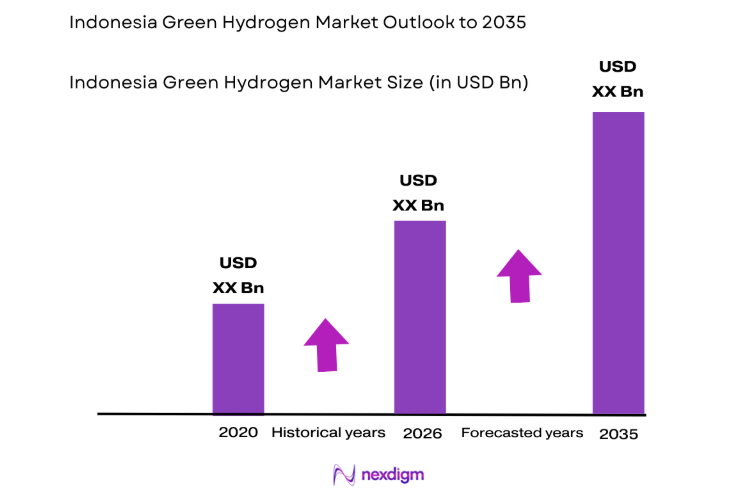
The Indonesia Green Hydrogen market is set to reach USD ~ billion based on a recent historical assessment, driven by the country’s increasing focus on clean energy transition and decarbonization goals. With Indonesia’s national energy policies aiming for 23% renewable energy by 2025, green hydrogen presents a viable solution to achieve energy security and sustainability. Technological advancements, favorable policies, and international investments are key drivers of this market’s expansion.
Indonesia’s major regions, including Java, Sumatra, and Bali, are witnessing a surge in green hydrogen projects due to their renewable energy potential. These areas offer abundant solar, wind, and water resources, which are crucial for the production of green hydrogen. Furthermore, the government’s strategic positioning of green hydrogen as part of its energy mix ensures that these regions are central to its development.
Market Segmentation
By Production Method
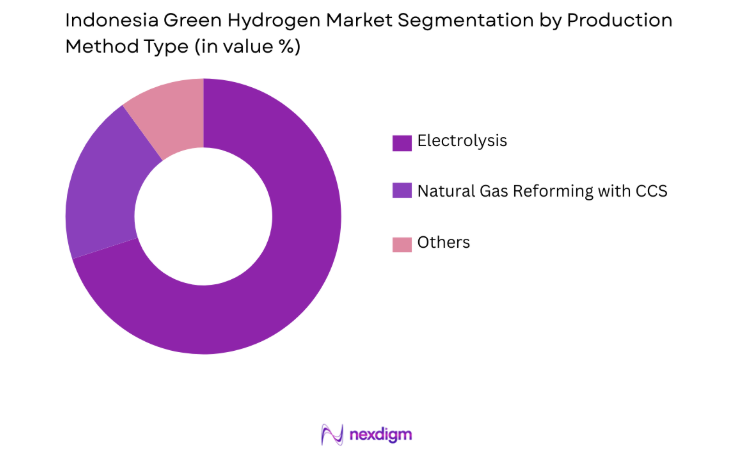
The Indonesia Green Hydrogen market is segmented by production method into electrolysis, natural gas reforming with carbon capture and storage (CCS), and others. Electrolysis, powered by renewable energy sources, has recently dominated the market share due to its sustainable and environmentally friendly nature. As the cost of renewable energy continues to decline, electrolysis is increasingly adopted for large-scale green hydrogen production, particularly in Java, where solar and wind energy resources are abundant. The technology’s scalability and decreasing capital costs continue to fuel its growth in Indonesia.
By End-User Industry
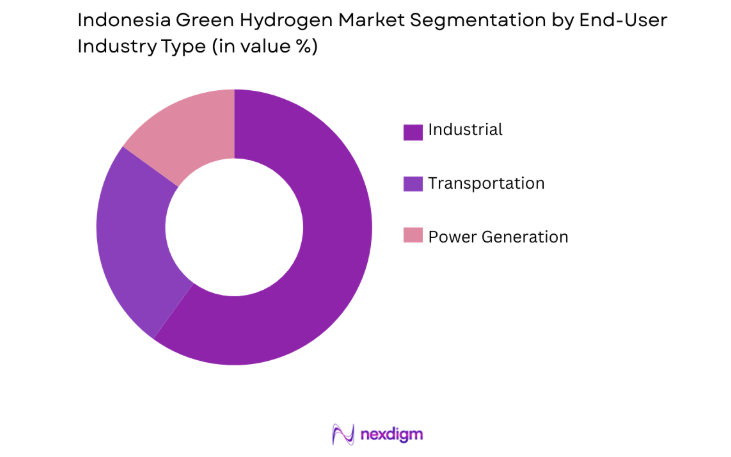
The Indonesia Green Hydrogen market is segmented by end-user industry into industrial, transportation, and power generation. The industrial sector has the dominant market share due to its significant energy consumption and the push for decarbonization. Industries such as steel, cement, and chemical production are increasingly adopting green hydrogen to reduce their carbon emissions and meet sustainability goals. As the cost of green hydrogen continues to decrease, its role in decarbonizing heavy industries in Indonesia will grow further, especially in key regions like Java and Sumatra.
Competitive Landscape
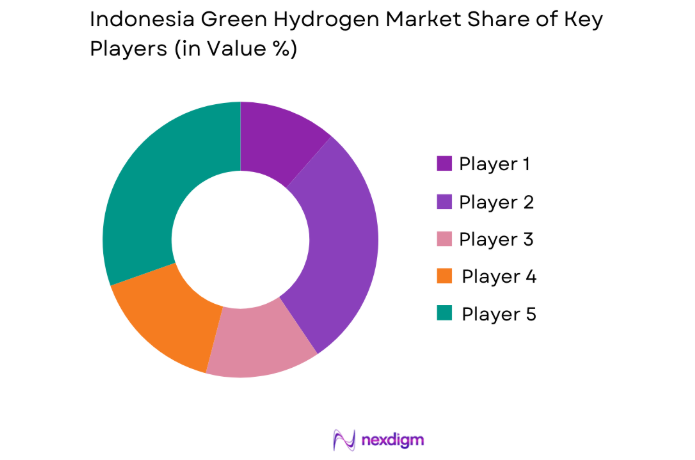
The competitive landscape of the Indonesia Green Hydrogen market is shaped by both global and local players. Global giants like Air Liquide and Siemens Energy are leading the way with advanced technology and large-scale hydrogen projects. Meanwhile, local companies such as Pertamina and PLN are increasingly focusing on green hydrogen production as part of Indonesia’s renewable energy goals. With increasing government support and policy frameworks, there is a growing trend of consolidation in the market, enhancing the competitive dynamics.
| Company Name | Establishment Year | Headquarters | Technology Focus | Market Reach | Key Products | Revenue | Market-Specific Focus |
| Air Liquide | 1902 | France | ~ | ~ | ~ | ~ | ~ |
| Siemens Energy | 2008 | Germany | ~ | ~ | ~ | ~ | ~ |
| Pertamina | 1957 | Indonesia | ~ | ~ | ~ | ~ | ~ |
| PLN (Persero) | 1945 | Jakarta, Indonesia | ~ | ~ | ~ | ~ | ~ |
| Siemens Gamesa | 1976 | Spain | ~ | ~ | ~ | ~ | ~ |
Indonesia Green Hydrogen Market Analysis
Growth Drivers
Government Policy and International Investments
Indonesia’s renewable energy targets and commitment to reducing carbon emissions have driven the growth of the green hydrogen market. The government’s 23% renewable energy target by 2025 has paved the way for various green hydrogen initiatives, with substantial international investments, including collaborations with foreign companies. The increasing focus on hydrogen as a key component of Indonesia’s energy transition aligns with the country’s long-term sustainability and carbon-neutral goals. In addition, the support of multilateral organizations and bilateral partnerships with advanced hydrogen markets such as Japan and Australia is catalyzing Indonesia’s green hydrogen development.
Technological Advancements in Hydrogen Production
Advances in electrolysis and other hydrogen production methods are major drivers of market growth in Indonesia. As renewable energy costs continue to decline, green hydrogen production becomes increasingly economically viable. Furthermore, the growing adoption of green hydrogen technologies in industrial applications is expected to accelerate, particularly in heavy industries such as steel and cement. With ongoing advancements in hydrogen storage, distribution, and fuel cell technologies, the green hydrogen market is poised for rapid growth in Indonesia’s energy sector.
Market Challenges
Infrastructure and Storage Issues
A key challenge for the Indonesia Green Hydrogen market is the lack of infrastructure for hydrogen production, storage, and distribution. While there is abundant renewable energy capacity, the infrastructure needed to produce and store green hydrogen at scale is still under development. Indonesia’s logistics network and distribution channels are not yet optimized for hydrogen, especially in remote regions. Large-scale hydrogen storage solutions, such as underground caverns and liquefaction facilities, require significant investment, presenting a substantial barrier to widespread adoption.
High Production Costs
While the cost of producing green hydrogen through electrolysis has been declining, it remains relatively high compared to other hydrogen production methods, such as steam methane reforming. The high cost of renewable energy infrastructure and electrolyzers adds to the production costs, limiting the competitiveness of green hydrogen. As a result, unless the cost of renewable energy continues to fall and technology improves, green hydrogen may remain a niche market in Indonesia, particularly for use in industrial applications.
Opportunities
Expansion in Industrial Applications
The industrial sector in Indonesia presents significant opportunities for green hydrogen adoption. Industries such as steel, cement, and chemicals are increasingly seeking low-carbon alternatives to traditional fuels. As Indonesia pushes toward decarbonization, green hydrogen offers a cleaner, more sustainable solution for heavy industries, especially in regions like Sumatra and Java where renewable energy resources are abundant. With the government incentivizing green hydrogen projects, the industrial sector represents a key growth opportunity for the market.
Offshore Hydrogen Production
Indonesia’s vast coastline and significant offshore wind potential create opportunities for large-scale offshore hydrogen production. Offshore wind farms, particularly in the Sunda Strait and Bali Strait, offer strong wind resources that can be harnessed for electrolysis. Producing green hydrogen offshore allows for large-scale production, which could be distributed to domestic industries or exported to other countries in Southeast Asia. This innovation aligns with Indonesia’s renewable energy goals and positions the country as a regional leader in green hydrogen production.
Future Outlook
The Indonesia Green Hydrogen market is expected to experience substantial growth in the coming years, supported by government policies, technological advancements, and increasing demand for clean energy solutions. As Indonesia strives to achieve its renewable energy and decarbonization targets, the market for green hydrogen will expand, particularly in industrial applications. However, infrastructure development and cost reduction remain critical factors that will determine the pace of adoption. The future of green hydrogen in Indonesia looks promising, with both domestic and international collaborations likely to shape the sector’s evolution.
Major Players
- Air Liquide
- Siemens Energy
- Pertamina
- PLN (Persero)
- Siemens Gamesa
- Linde Group
- Shell
- Mitsubishi Heavy Industries
- Plug Power
- Hydrogenics
- NEL ASA
- Envision Energy
- Snam S.p.A.
- Thyssenkrupp
- Kawasaki Heavy Industries
Key Target Audience
- Investments and venture capitalist firms
- Government and regulatory bodies
- Hydrogen technology developers
- Industrial sector players
- Renewable energy companies
- Power generation firms
- Clean technology investors
Research Methodology
Step 1: Identification of Key Variables
Identifying key market variables, such as government policies, technological trends, and industry adoption, that will influence the future of green hydrogen in Indonesia.
Step 2: Market Analysis and Construction
Collecting primary and secondary data from market leaders, industry reports, and government publications to model the growth of the green hydrogen market in Indonesia.
Step 3: Hypothesis Validation and Expert Consultation
Engaging with industry experts and stakeholders, including government agencies and green hydrogen developers, to validate the assumptions and trends identified during the research process.
Step 4: Research Synthesis and Final Output
Synthesizing data and insights to provide a comprehensive analysis of the Indonesia Green Hydrogen market, including growth drivers, challenges, and opportunities.

- Executive Summary
- Research Methodology (Definitions, Scope, Industry Assumptions, Market Sizing Approach, Primary & Secondary Research Framework, Data Collection & Verification Protocol, Analytic Models & Forecast Methodology, Limitations & Research Validity Checks)

- Market Definition and Scope
- Value Chain & Stakeholder Ecosystem
- Regulatory / Certification Landscape
- Sector Dynamics Affecting Demand

- Growth Drivers
Government commitment to renewable energy
Rising demand for decarbonization
Technological advancements in hydrogen production - Market Challenges
High initial investment costs
Lack of infrastructure for hydrogen distribution
Regulatory barriers to large-scale implementation - Market Opportunities
Partnerships for hydrogen technology development
Integration of hydrogen into existing energy infrastructure
Potential for exports to hydrogen-importing countries - Trends
Increasing demand for low-carbon hydrogen
Growing adoption of hydrogen in transport and industry - Government Regulations
Renewable energy policies and targets
Regulations for carbon emissions
Government funding for green hydrogen projects - SWOT Analysis
- Porter’s Five Forces

- By Market Value, 2020-2025
- By Installed Units, 2020-2025
- By Average System Price, 2020-2025
- By System Complexity Tier, 2020-2025

- By System Type (In Value%)
Electrolyzer-based Hydrogen Production
Biomass-based Hydrogen Production
Natural Gas Reforming with Carbon Capture
Coal Gasification with Carbon Capture
Other Emerging Technologies - By Platform Type (In Value%)
On-site Hydrogen Production
Off-site Hydrogen Production
Hybrid Systems
Integrated Systems - By Fitment Type (In Value%)
On-grid Solutions
Off-grid Solutions
Modular Solutions
Portable Solutions - By End User Segment (In Value%)
Industrial Sector
Transport Sector
Power Generation Sector

- Market Share Analysis
- Cross Comparison Parameters (Technology adoption, Government incentives, Cost of production, Market competition, Infrastructure development, Research and development, Market readiness)
- SWOT Analysis of Key Competitors
- Pricing & Procurement Analysis
- Key Players
Air Products and Chemicals
Nel ASA
Siemens Energy
Plug Power
Linde Group
Ballard Power Systems
Thyssenkrupp
Haldor Topsoe
Hydrogenics
Cummins Inc.
Air Liquide
ITM Power
McPhy Energy
Acciona
Green Hydrogen Systems

- Growing adoption in heavy industries
- Increasing investment in clean transportation
- Government-led projects for hydrogen power generation
- Private sector innovation in hydrogen technologies

- Forecast Market Value, 2026-2035
- Forecast Installed Units, 2026-2035
- Price Forecast by System Tier, 2026-2035
- Future Demand by Platform, 2026-2035


 Request a Sample
 Ask for Customization
 Get a Quote
 Enquire Now