
 Download PDF
Market Overview
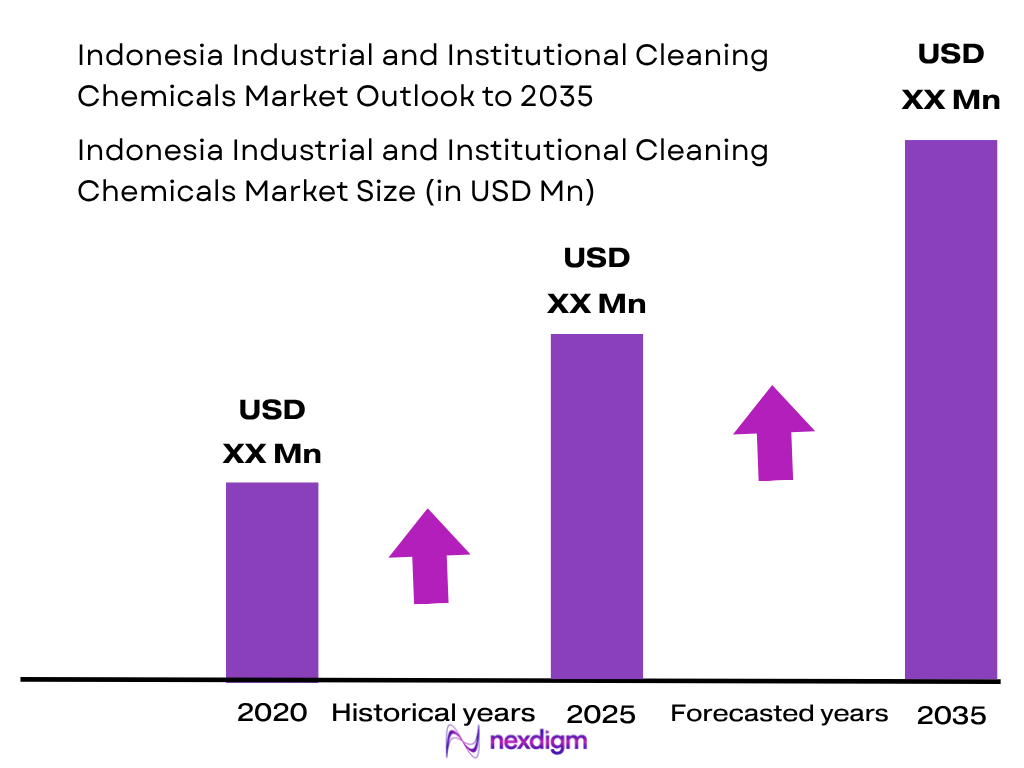
The Indonesia Industrial and Institutional Cleaning Chemicals Market is valued at approximately USD ~ billion, based on a five-year historical analysis. Demand is supported by recurring sanitation requirements across healthcare, food processing, hospitality, commercial facilities and manufacturing. Indonesia’s manufacturing value added increased from IDR ~3,900 trillion to IDR 4,202.9 trillion across the latest two annual observations, reinforcing the installed industrial base requiring degreasers, disinfectants, process cleaners and general-purpose chemicals.
Jakarta, Surabaya and Bandung represent the dominant demand centres because of their concentration of hospitals, hotels, offices, manufacturing facilities, foodservice establishments and professional facility-management operations. Jakarta alone recorded 422 accommodation establishments and 8,727 rooms in the preceding annual dataset, while Indonesia’s continuing industrial expansion strengthens chemical consumption in Java’s manufacturing corridors. Surabaya’s industrial and logistics ecosystem and Bandung’s manufacturing-commercial base further support recurring institutional and industrial cleaning requirements.
Market Segmentation
By Product Type
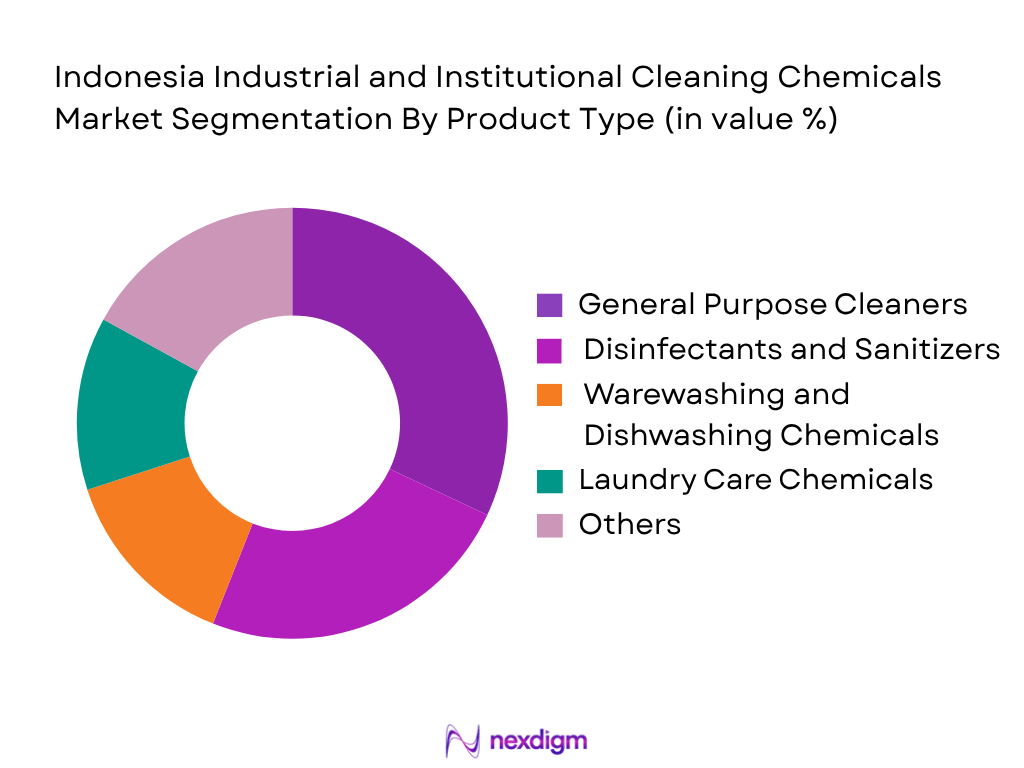
The Indonesia Industrial and Institutional Cleaning Chemicals Market is segmented by product type into general-purpose cleaners, disinfectants and sanitizers, warewashing and dishwashing chemicals, laundry care chemicals, vehicle wash chemicals and other specialty cleaning chemicals. General-purpose cleaners hold the dominant market share owing to their broad applicability across manufacturing plants, hotels, offices, hospitals, retail establishments and public facilities. Unlike application-specific formulations, general-purpose cleaners support routine floor, hard-surface, equipment and facility maintenance, generating recurring consumption across a wider customer base. Their dominance is further supported by ease of procurement, established distribution networks and availability from both multinational and domestic formulators. Large institutional buyers increasingly procure concentrated multi-purpose products because controlled dilution can lower chemical cost per cleaning cycle, packaging requirements and storage requirements. However, disinfectants and sanitizers remain strategically important, particularly in healthcare, food processing and commercial kitchens, where hygiene protocols require validated microbial-control performance.
By Raw Material Type
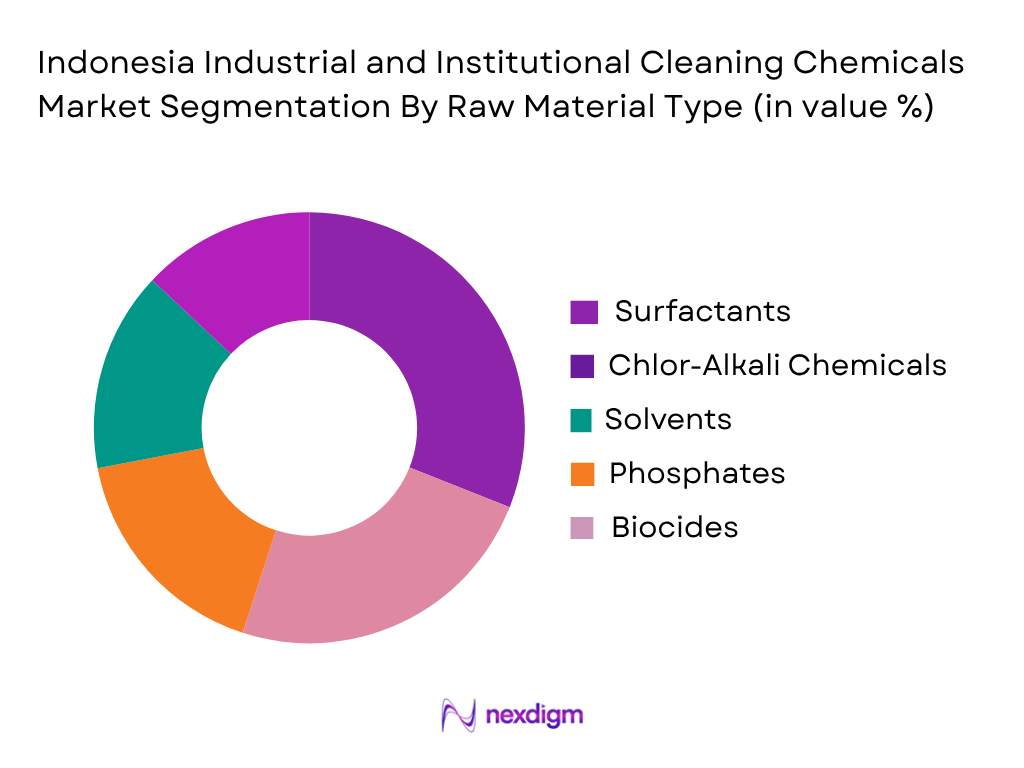
The Indonesia Industrial and Institutional Cleaning Chemicals Market is segmented by raw material into surfactants, chlor-alkali chemicals, solvents, phosphates and biocides. Surfactants account for the dominant market share because they perform fundamental wetting, emulsification, soil removal and dispersion functions across general-purpose cleaners, laundry formulations, warewashing products, degreasers and numerous specialty industrial cleaners. Their extensive formulation versatility creates demand across both institutional and industrial applications. Indonesia also has a substantial local formulation ecosystem, although specialty inputs can remain dependent on imported materials. Chlor-alkali chemicals maintain a substantial position because alkaline and chlorine-based chemistry is widely employed in sanitation, bleaching, degreasing and food-processing applications. Biocides serve a smaller but higher-specification market where microbial control is critical, including hospitals, food and beverage plants and institutional sanitation. Published Indonesia-focused industrial-cleaning research also identifies surfactants as the leading ingredient category.
Competitive Landscape
The Indonesia Industrial and Institutional Cleaning Chemicals Market combines multinational hygiene-solution providers, global chemical companies and domestic formulators and distributors. Competition extends beyond chemical pricing to product efficacy, dilution economics, dosing technology, technical service, regulatory compliance, formulation capability and geographic distribution. International companies are particularly relevant in sophisticated food-processing, hospitality, healthcare and manufacturing accounts, while Indonesian suppliers compete through local formulation, responsive service, lower logistics costs and relationships with institutional procurement networks.
| Major Player | Establishment Year | Headquarters | Key I&I Capability | Product Focus | Key End-Use Industries | Indonesia Presence | Dosing/Technology Capability | Competitive Positioning |
| Ecolab | 1923 | St. Paul, USA | ~ | ~ | ~ | ~ | ~ | ~ |
| Diversey / Solenis | 1923 / 1907 | USA | ~ | ~ | ~ | ~ | ~ | ~ |
| BASF | 1865 | Ludwigshafen, Germany | ~ | ~ | ~ | ~ | ~ | ~ |
| Kao Corporation | 1887 | Tokyo, Japan | ~ | ~ | ~ | ~ | ~ | ~ |
| 3M | 1902 | Minnesota, USA | ~ | ~ | ~ | ~ |
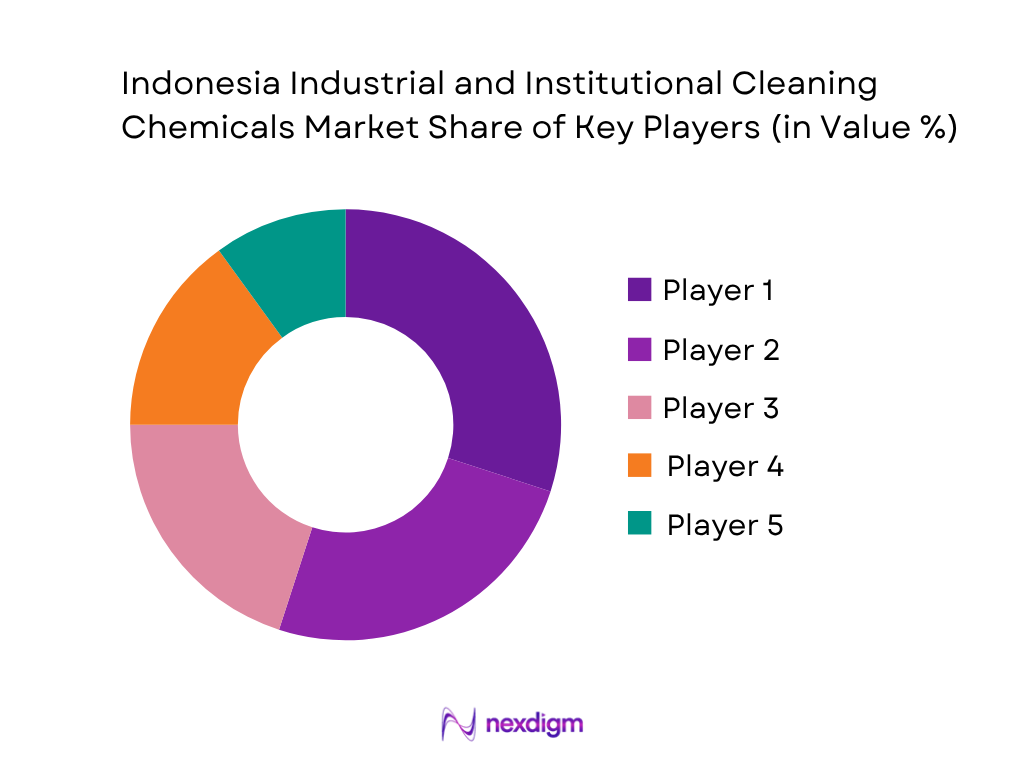
Indonesia Industrial and Institutional Cleaning Chemicals Market Analysis
Growth Drivers
Large Manufacturing Base Drives Recurring Demand for Industrial Cleaning Chemicals
Indonesia’s large industrial footprint creates recurring demand for degreasers, equipment cleaners, floor-care chemicals, disinfectants, process-sanitation chemicals and other industrial maintenance formulations. BPS-Statistics Indonesia recorded 32,193 active medium and large manufacturing establishments in 2024, demonstrating the breadth of facilities requiring routine equipment and plant sanitation. The World Bank reported Indonesia’s manufacturing value added at IDR 4,202.8669 trillion in 2024, while broader industry including construction generated IDR 8,704.7054 trillion. Indonesia’s total GDP reached IDR 22,139.0 trillion, according to BPS, providing a sizeable macroeconomic base for continued industrial activity. These indicators are directly relevant to professional cleaning-chemical demand because manufacturing facilities require chemicals for removing oils, grease, processing residues, scale and microbial contamination from machinery, production surfaces and utilities. Food processing, chemicals, pharmaceuticals, automotive manufacturing and engineered products also require specialized cleaning regimes that are substantially more technical than household cleaning. The large installed industrial base therefore supports repeat consumption of surfactant-based cleaners, alkaline degreasers, acidic descalers, disinfectants and specialty formulations. Sources: BPS-Statistics Indonesia; World Bank World Development Indicators.
Expanding Healthcare, Foodservice and Hospitality Sectors Support Institutional Cleaning Demand
Indonesia has an extensive institutional network that generates continuous demand for disinfectants, general-purpose cleaners, warewashing chemicals, laundry chemicals, washroom cleaners and surface-care products. BPS’s Village Potential Statistics recorded 3,115 hospitals, 251 maternity hospitals, 4,846 inpatient community health centres and 5,730 non-inpatient community health centres in 2024. The same institutional sanitation opportunity is reinforced by Indonesia’s foodservice base: BPS reported 5.28 million food and beverage service businesses in 2024, covering restaurants, catering establishments and other commercial foodservice operators. Hospitality adds another major cleaning environment, with BPS collecting accommodation statistics across all 38 provinces and 514 regencies/cities, demonstrating the nationwide spread of professional accommodation infrastructure. Healthcare facilities require repeated disinfection of high-touch surfaces, floors, patient areas, laboratories and sanitation zones, while commercial kitchens require detergents, degreasers, dishwashing chemicals and food-contact sanitizers. The scale of these end-use establishments therefore creates a recurring consumption base that is closely linked to operating activity rather than discretionary consumer purchasing. Sources: BPS-Statistics Indonesia; Ministry of Health of the Republic of Indonesia.
Market Challenges
Dependence on imported surfactants and specialized cleaning inputs
Indonesia’s industrial and institutional cleaning-chemical supply chain remains exposed to imported formulation inputs, particularly surface-active agents used across detergents, degreasers, disinfectant systems and specialty cleaners. World Bank WITS trade data based on UN Comtrade show that Indonesia imported 56,101,300 kilograms of non-ionic surface-active agents in 2024, including 20,406,400 kilograms from Singapore and 16,316,300 kilograms from China. Indonesia also imported 43,361,100 kilograms of anionic surface-active agents, with China supplying 17,103,300 kilograms, while imports of cationic surface-active agents reached 12,695,600 kilograms, including 8,056,980 kilograms from China. These are important formulation building blocks for institutional laundry products, hard-surface cleaners, industrial degreasers and disinfectant formulations. Dependence on several foreign supply corridors introduces procurement exposure for domestic formulators that need consistent active chemistry, specification and delivery schedules. The challenge is particularly relevant for professional cleaning chemicals because industrial users cannot easily substitute formulations when surface compatibility, foam characteristics, microbial efficacy or process-equipment requirements are tightly specified. Greater domestic formulation does not fully remove this exposure when key functional inputs still originate overseas. Source: World Bank World Integrated Trade Solution using UN Comtrade data.
Geographic fragmentation increases complexity of nationwide professional cleaning-chemical distribution
Indonesia’s archipelagic structure creates a market-specific challenge for suppliers that must deliver chemicals, dispensing equipment and technical support across dispersed industrial and institutional facilities. BPS accommodation data cover 38 provinces and 514 regencies/cities, illustrating the geographic breadth of potential institutional customers, while BPS identified 32,193 active medium and large manufacturing establishments in 2024 distributed across the country. At the same time, economic activity remains concentrated: BPS reported that provinces on Java generated IDR 12,624.3 trillion-equivalent economic activity within the national IDR 22,139.0 trillion GDP structure, making Java the principal commercial and industrial centre while important customers remain distributed beyond it. Professional cleaning chemicals are operational products that require reliable replenishment, and concentrates, disinfectants and specialty formulations may also require controlled handling and technical guidance. Suppliers therefore need warehouses, regional distributors and service personnel beyond Jakarta and Java to serve hospitals, food processors, hotels, mining operations and manufacturing plants in Sumatra, Kalimantan, Sulawesi and eastern Indonesia. This geographic dispersion increases inventory planning requirements and makes consistent national service levels more difficult than in geographically compact markets. Source: BPS-Statistics Indonesia.
Market Opportunities
Expansion of specialized sanitation solutions for foodservice and healthcare facilities
Indonesia’s existing institutional infrastructure provides a substantial platform for future penetration of professional hygiene programs, particularly concentrated disinfectants, food-contact sanitizers, commercial warewashing chemistry and controlled-dosing systems. BPS recorded 5.28 million food and beverage service businesses in 2024, creating a broad addressable base for kitchen degreasers, dishwashing detergents, rinse aids, surface sanitizers and drain-care chemicals. Healthcare infrastructure adds 3,115 hospitals, 251 maternity hospitals, 4,846 inpatient community health centres and 5,730 non-inpatient community health centres, according to BPS Village Potential Statistics. These facilities require cleaning routines across patient spaces, operating areas, kitchens, laundries, public areas and sanitation infrastructure. The opportunity therefore lies not merely in increasing chemical volumes, but in upgrading facilities from manually diluted commodity products toward standardized professional systems incorporating concentrated chemistry, dispensing equipment and usage protocols. Such solutions can become increasingly relevant as large hospitals, foodservice chains, hospitality operators and facility-management providers seek greater consistency across multiple sites. The scale of the existing institutional estate supports expansion without relying on hypothetical future facility-count projections. Sources: BPS-Statistics Indonesia; Ministry of Health of the Republic of Indonesia.
Localization of professional cleaning formulations and substitution of imported specialty products
Indonesia has a clear opportunity to deepen domestic formulation and blending capabilities for industrial and institutional cleaning products because substantial volumes of relevant chemistry currently enter through imports. World Bank WITS data show imports of 18,216,400 kilograms of retail-packed washing and cleaning preparations in 2024. Separately, Indonesia imported 56,101,300 kilograms of non-ionic surfactants, 43,361,100 kilograms of anionic surfactants and 12,695,600 kilograms of cationic surfactants during the same period. The industrial demand base supporting localization is substantial: BPS counted 32,193 active medium and large manufacturing establishments, while World Bank data placed manufacturing value added at IDR 4,202.8669 trillion. These figures indicate an established local customer ecosystem capable of supporting domestic blending of degreasers, detergents, CIP chemicals, laundry formulations and institutional cleaners. Localization can also support faster customization for Indonesian water conditions, soils, industrial processes and packaging requirements. The future opportunity is strongest for manufacturers that combine locally blended base formulations with imported high-performance actives only where technically necessary, progressively reducing dependence on fully imported finished professional cleaning products. Sources: World Bank World Integrated Trade Solution; BPS-Statistics Indonesia; World Bank World Development Indicators.
Future Outlook
The Indonesia Industrial and Institutional Cleaning Chemicals Market is forecast to expand at a CAGR of approximately ~6.0% during 2026-2035. Growth is expected to be supported by expansion in food processing, healthcare, hospitality, manufacturing and commercial infrastructure. Suppliers are also likely to benefit from the transition toward concentrated formulations, automated dosing, sustainable chemistry and performance-based procurement. Published market research places the broader long-term Indonesia I&I cleaning-chemicals growth corridor at approximately 5%-7%.
Demand is expected to move progressively from commodity cleaning products toward specialized solutions that deliver measurable sanitation performance while lowering water, chemical and labour consumption. Concentrated cleaners, enzymatic formulations, automated dispensers and low-VOC or bio-based formulations are expected to gain commercial relevance. Food processors and healthcare facilities should remain attractive customer categories because sanitation is integral to operational compliance rather than discretionary facility expenditure.
Major Players
- Ecolab Indonesia
- Diversey Indonesia / Solenis
- BASF Indonesia
- Kao Indonesia
- 3M Indonesia
- Reckitt Indonesia
- Procter & Gamble Indonesia
- Unilever Indonesia
- Lautan Luas
- Neochem Indonesia
- Tritunggal Artha Makmur
- Heaven Chemical Indonesia
- Sarana Cipta Mandiri
- Getsemani Benindo Indonesia
- ChemX / Intan Teknik Solusi
Key Target Audience
- Industrial and Institutional Cleaning Chemical Manufacturers
- Specialty Chemical and Raw Material Manufacturers
- Professional Hygiene Chemical Distributors and Importers
- Facility Management and Contract Cleaning Companies
- Food Processing, Healthcare, Hospitality and Manufacturing Procurement Organizations
- Investments and Venture Capitalist Firms
- Banks, Private Equity Firms and Institutional Investors
- Government and Regulatory Bodies (Ministry of Health of the Republic of Indonesia, Ministry of Industry of the Republic of Indonesia, Ministry of Environment, National Standardization Agency of Indonesia [BSN], and BPOM)
Research Methodology
Step 1: Identification of Key Variables
The initial phase involves constructing a comprehensive ecosystem map covering manufacturers, formulators, raw material suppliers, importers, distributors, facility-management providers and industrial and institutional end users. Secondary research is used to identify critical variables such as product consumption, pricing, import dependence, local formulation capacity, customer density, application intensity and distribution structures influencing the Indonesia Industrial and Institutional Cleaning Chemicals Market.
Step 2: Market Analysis and Construction
Historical market information is compiled and analysed using both top-down and bottom-up approaches. The assessment evaluates cleaning chemical consumption across manufacturing, food processing, healthcare, hospitality, commercial facilities and other institutional environments. Import flows, domestic formulation activity, distributor revenues, average selling prices and facility-level consumption benchmarks are reconciled to construct the market size and segment-level revenue structure.
Step 3: Hypothesis Validation and Expert Consultation
Market hypotheses are validated through computer-assisted telephone interviews (CATIs) and structured discussions with cleaning chemical manufacturers, distributors, procurement managers, facility-management companies and technical professionals. These consultations assess product penetration, customer purchasing behaviour, dilution practices, pricing, supplier relationships and application trends. Primary findings are subsequently compared with secondary information to identify inconsistencies and refine market assumptions.
Step 4: Research Synthesis and Final Output
The final stage triangulates demand-side consumption estimates with manufacturer, distributor, import and formulation-side information. Product-level and raw-material-level findings are reconciled with competitive intelligence and end-use demand indicators. The resulting dataset is subjected to internal validation before developing market forecasts, competitive positioning, segment outlooks and strategic recommendations for the Indonesia Industrial and Institutional Cleaning Chemicals Market.

- Executive Summary
- Research Methodology (Market Definition and Scope, Indonesia Industrial and Institutional Cleaning Chemicals Taxonomy, Industrial Cleaning Chemical Classification, Institutional Cleaning Chemical Classification, Professional Hygiene Solution Mapping, Cleaning Chemical Application Framework, Raw Material Assessment, Sustainable Cleaning Chemistry Evaluation, Market Sizing Framework, Top-Down Analysis, Bottom-Up Analysis, Domestic Manufacturing Assessment, Import Dependency Assessment, Demand-Side Assessment)

- Definition and Scope
- Indonesia Industrial and Institutional Cleaning Chemicals Industry Evolution and Professional Hygiene Development
- Industrial and Institutional Cleaning Chemicals Manufacturing and Formulation Process
- Cleaning Chemicals Value Chain Analysis
- Indonesia Industrial and Institutional Cleaning Chemicals Supply Chain Analysis
- Cleaning Chemical Raw Material Ecosystem Analysis
- Indonesia Cleaning Chemicals Import Dependency and Localization Assessment
- Industrial Cleaning Application Architecture and Institutional Hygiene Solution Framework

- Growth Drivers (Expansion of Food and Beverage Processing Industry, Growth of Manufacturing Sector, Increasing Hygiene Standards in Hospitals and Healthcare Facilities, Expansion of Hospitality and Tourism Infrastructure, Rising Demand for Professional Cleaning Services, Increasing Adoption of Concentrated Cleaning Chemicals, Workplace Hygiene Requirements, Growth of Commercial and Industrial Infrastructure)
- Market Challenges (Raw Material Price Volatility, Dependence on Imported Specialty Chemicals, Rupiah Exchange Rate Exposure, Fragmented Inter-Island Distribution Structure, High Logistics Costs across the Archipelago, Price Competition from Local Formulators, Regulatory Compliance Costs, Limited Adoption of Automated Chemical Dosing among Smaller Facilities)
- Market Opportunities (Bio-Based Cleaning Chemicals, Green Cleaning Formulations, Automated Chemical Dispensing Systems, Digital Hygiene Monitoring Solutions, Customized Food Processing Sanitation Programs, Healthcare Infection Prevention Solutions, Enzyme-Based Cleaning Technologies, Local Production of Specialty Cleaning Chemicals)
- Market Trends (Low-VOC Cleaning Chemicals, Concentrated Product Adoption, Eco-Friendly Formulations, Automatic Dosing Systems, Water-Efficient Cleaning Technologies, Premium Disinfection Solutions, Sustainable Packaging, Closed-Loop Chemical Dispensing Systems)
- Regulatory and Standards Landscape (Indonesia Ministry of Health Regulations, PKRT Product Registration Requirements, SNI Cleaning Product Standards, Chemical Safety and Labeling Requirements, Industrial Hygiene Regulations, Hazardous Chemical Handling Requirements, Wastewater Discharge Compliance, Environmental Protection Regulations)
- SWOT Analysis
- Porter’s Five Forces Analysis
- PESTLE Analysis
- Stakeholder Ecosystem
- Competition Ecosystem

- By Market Value (2020-2025)
- By Cleaning Chemical Consumption Volume (2020-2025)
- By Domestic Production Volume (2020-2025)
- By Import Volume (2020-2025)
- By Export Volume (2020-2025)
- By Average Selling Price (2020-2025)
- By Industrial Facility Chemical Consumption Intensity (2020-2025)
- By Institutional Facility Chemical Consumption Intensity (2020-2025)

- By Product Type (In Value %)
General Purpose Cleaners
Industrial Degreasers and Heavy-Duty Cleaners Disinfectants and Sanitizers
Warewashing and Dishwashing Chemicals
Laundry Care Chemicals
Floor Care Chemicals
Vehicle Wash Chemicals
Food Processing Cleaning Chemicals
Healthcare Cleaning Chemicals
Specialty Industrial Cleaning Chemicals
Surface and Glass Cleaning Chemicals - By Raw Material Type (In Value %)
Surfactants
Chlor-Alkali Chemicals
Solvents
Biocides
Phosphates
Enzymes
Acids and Alkalis
Chelating Agents
Fragrances and Preservatives
Bio-Based Raw Materials - By End-Use Industry (In Value %)
Food and Beverage Processing
Healthcare Facilities
Manufacturing and Industrial Plants
Hospitality and Commercial Establishments
Educational Institutions
Retail Facilities
Transportation and Logistics Facilities
Pharmaceutical Manufacturing
Mining, Oil and Gas Facilities
Government and Public Institutions - By Distribution Channel (In Value %)
Direct Manufacturer Sales
Industrial Chemical Distributors
Professional Cleaning Product Distributors
Facility Management Companies
Janitorial Supply Providers
B2B Digital Platforms
Institutional Procurement Contracts
Specialty Hygiene Solution Providers - By Region (In Value %)
Java
Jakarta
West Java
Central Java
East Java
Banten
Sumatra
North Sumatra
South Sumatra
Riau
Lampung
Kalimantan
East Kalimantan
South Kalimantan
West Kalimantan
Sulawesi
South Sulawesi
North Sulawesi
Central Sulawesi
Bali and Nusa Tenggara
Maluku and Papua

- Market Share of Major Players (By Revenue, Volume, Product Category, Raw Material Type, End-Use Industry, Market Type, Distribution Channel)
- Cross Comparison Parameters(Product Portfolio Breadth, Industrial Cleaning Chemical Capability, Institutional Hygiene Solution Coverage, Manufacturing and Local Blending Capacity, Indonesia Distribution Network Reach, Automated Dosing and Dispensing Technology Capability, Technical Service and Hygiene Audit Strength, Sustainable Formulation and Innovation Capability)
- SWOT Analysis of Major Players
- Competitive Positioning Matrix
- Pricing and Distribution Network Benchmarking
- Detailed Profiles of Major Companies
Ecolab Indonesia
Diversey Indonesia / Solenis
BASF Indonesia
Kao Indonesia
3M Indonesia
Reckitt Indonesia
Procter & Gamble Indonesia
Unilever Indonesia
Lautan Luas
Neochem Indonesia
Tritunggal Artha Makmur
Heaven Chemical Indonesia
Sarana Cipta Mandiri
Getsemani Benindo Indonesia
ChemX / Intan Teknik Solusi

- Buyer Segmentation
- Procurement Behaviour
- Supplier Selection Criteria
- Buyer Pain Points
- Technology Adoption Assessment
- Replacement and Repurchase Behaviour

- By Market Value (2026-2035)
- By Cleaning Chemical Consumption Volume (2026-2035)
- By Domestic Production Volume (2026-2035)
- By Import Volume (2026-2035)
- By Export Volume (2026-2035)
- By Average Selling Price (2026-2035)
- By Industrial Facility Chemical Consumption Intensity (2026-2035)
- By Institutional Facility Chemical Consumption Intensity (2026-2035)


 Request a Sample
 Ask for Customization
 Get a Quote
 Enquire Now