

 Download PDF
 Download PDF
Market Overview
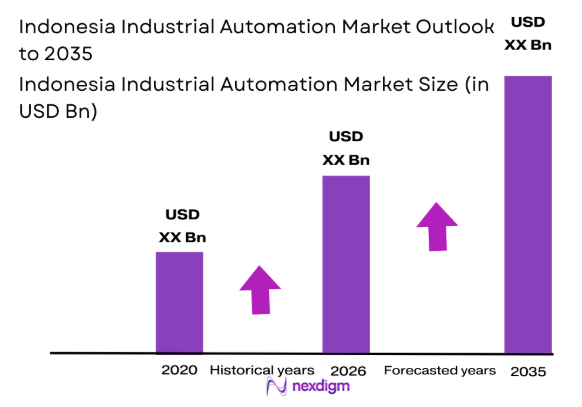
The Indonesia Industrial Automation market is projected to reach a market value of USD ~ billion based on a recent historical assessment. This market is driven by the increasing adoption of automation technologies in key sectors like automotive, electronics, and food & beverage manufacturing. The push toward Industry 4.0, coupled with government incentives, is further catalyzing the demand for automated systems in the country. The expanding manufacturing base and the need for enhanced operational efficiency are central to the growth of this sector.
Key markets for industrial automation in Indonesia include Jakarta, Surabaya, and Batam. Jakarta is a major industrial hub with a well-developed infrastructure, fostering the growth of automation solutions. Surabaya and Batam are also emerging as key players, driven by their proximity to industrial parks and global trade routes. These cities lead in adoption due to their concentration of industries that require advanced automation to meet production demands.
Market Segmentation
By Product Type
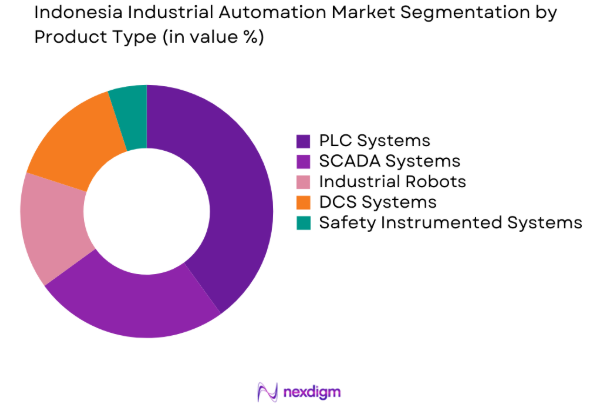
The Indonesia Industrial Automation market is segmented by product type into programmable logic controllers (PLCs), supervisory control and data acquisition (SCADA) systems, industrial robots, distributed control systems (DCS), and safety instrumented systems (SIS). Recently, PLC systems have dominated the market share due to their flexibility in managing complex industrial processes and the growing need for cost-effective automation solutions. The demand for PLCs in industries like automotive and food processing is a key factor in their dominance.
By Platform Type
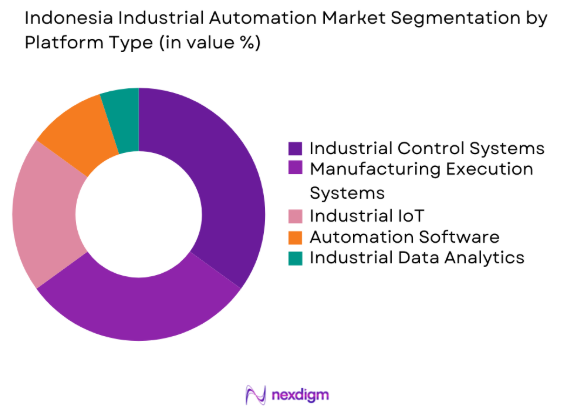
The market is segmented into industrial control systems, manufacturing execution systems, industrial internet of things (IIoT), automation software, and industrial data analytics. Industrial control systems have captured the largest share due to their essential role in controlling and monitoring manufacturing processes. The increasing integration of IIoT into operations has made industrial control systems indispensable, contributing to their dominance in the market.
Competitive Landscape
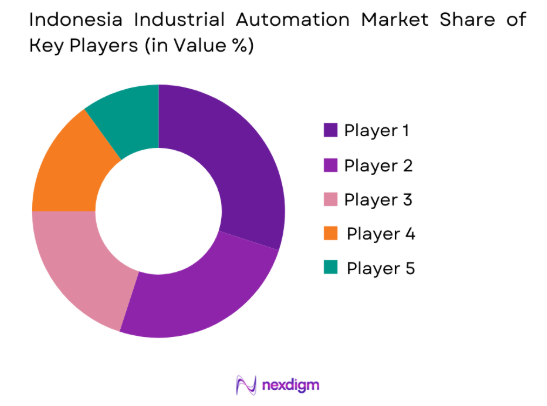
The Indonesia Industrial Automation market is competitive, with key players driving growth through technological innovations and strategic partnerships. Major players in the market are enhancing their offerings with integrated solutions that address the specific needs of local industries. These companies are also leveraging government initiatives to expand their market reach and cater to the increasing demand for automation across sectors.
| Company Name | Establishment Year | Headquarters | Technology Focus | Market Reach | Key Products | Revenue (USD) | Market-Specific Parameter |
| Siemens AG | 1847 | Germany | ~ | ~ | ~ | ~ | ~ |
| Rockwell Automation | 1903 | USA | ~ | ~ | ~ | ~ | ~ |
| Mitsubishi Electric | 1921 | Japan | ~ | ~ | ~ | ~ | ~ |
| ABB Ltd. | 1988 | Switzerland | ~ | ~ | ~ | ~ | ~ |
| Schneider Electric | 1836 | France | ~ | ~ | ~ | ~ | ~ |
Indonesia Industrial Automation Market Analysis
Growth Drivers
Technological Advancements
Technological advancements in automation systems, particularly in robotics, AI, and IIoT, are major drivers for the Indonesia Industrial Automation market. As industries like automotive and food & beverage seek to improve production speed and reduce errors, automation technologies provide a solution for enhanced efficiency. Robotics can handle complex tasks with precision, while AI optimizes operations to improve decision-making and minimize downtime. These advancements are pushing automation adoption across various sectors, contributing to the market’s growth. The ongoing support for Industry 4.0 by the Indonesian government further accelerates the integration of these technologies into manufacturing processes, ensuring the transition to smarter, more efficient systems. These technological developments play a key role in transforming Indonesia’s industrial landscape.
Government Support for Industry 4.0
The Indonesian government’s initiatives to promote Industry 4.0 are vital in driving the growth of the industrial automation market. Policies such as tax breaks, subsidies for technological investments, and improvements in infrastructure have created an enabling environment for automation adoption. These initiatives are essential for industries that are looking to modernize and adopt smarter production processes. By investing in the digital transformation of local industries, the government is not only fostering economic growth but also ensuring the long-term sustainability of industrial automation in the country. This support is particularly impactful for sectors like automotive, electronics, and food processing, which are pivotal to Indonesia’s industrial landscape.
Market Challenges
High Capital Investment
A major challenge for businesses in Indonesia is the high initial investment required to implement industrial automation systems. The cost of advanced technologies like robots, sensors, and control systems can be a significant barrier, especially for small and medium-sized enterprises (SMEs). Although automation delivers long-term benefits in efficiency and cost reduction, the upfront financial burden remains a key hurdle. Furthermore, the need for skilled labor to operate and maintain these complex systems adds to the costs, making it difficult for many companies to fully transition to automated solutions. These financial and workforce challenges limit the widespread adoption of industrial automation, particularly among SMEs.
Skill Gaps and Workforce Resistance
Another challenge in the Indonesia Industrial Automation market is the skill gap and resistance to change within the workforce. As automation systems become more complex, the need for specialized skills in robotics, AI, and system maintenance grows. However, the lack of a skilled workforce in Indonesia makes it difficult for many businesses to adopt and effectively operate advanced automation technologies. Additionally, there is resistance from employees who fear job displacement due to the increasing automation of manual tasks. Overcoming these challenges requires significant investment in training and education to equip the workforce with the necessary skills to operate and maintain automation systems.
Opportunities
Smart Manufacturing and IIoT Integration
The adoption of smart manufacturing technologies and IIoT presents a significant opportunity for the Indonesia Industrial Automation market. As manufacturers focus on improving operational efficiency, reducing downtime, and enhancing product quality, IIoT solutions offering real-time data analytics and predictive maintenance are becoming essential. These technologies allow for remote monitoring and control of machines, optimizing production processes and minimizing costly downtime. The continued rise of Industry 4.0 and digital transformation in Indonesian industries strengthens the demand for IIoT solutions, positioning it as a key growth opportunity. With the increasing need for smarter and more efficient manufacturing, IIoT will play a pivotal role in the market’s expansion.
Partnerships and Collaborations
As demand for industrial automation solutions grows, partnerships and collaborations between automation solution providers and local manufacturers present a key opportunity in the market. These collaborations enable solution providers to tailor their offerings to meet the unique needs of local industries and optimize automation technologies for the Indonesian market. Additionally, partnerships can lead to cost savings and faster market penetration, as local manufacturers can leverage the expertise of global automation firms while benefiting from government incentives and infrastructure developments. This opportunity allows both foreign and local players to expand their market share and contribute to the growth of industrial automation in Indonesia.
Future Outlook
Over the next five years, the Indonesia Industrial Automation market is expected to witness substantial growth, driven by technological advancements, government support, and the growing adoption of smart manufacturing. The demand for automation solutions will continue to rise as industries look for ways to increase productivity, reduce operational costs, and improve product quality. The integration of IIoT, AI, and robotics will reshape the industrial landscape, leading to smarter, more efficient manufacturing processes. Government policies supporting digital transformation will further enhance the market’s growth, ensuring that Indonesia remains at the forefront of automation adoption in Southeast Asia.
Major Players
- Siemens AG
- Rockwell Automation
- Mitsubishi Electric
- ABB Ltd.
- Schneider Electric
- Yokogawa Electric Corporation
- Omron Corporation
- Beckhoff Automation
- Honeywell International
- Emerson Electric
- Bosch Rexroth
- Fanuc Corporation
- Rittal GmbH
- Panasonic Corporation
- Eaton Corporation
Key Target Audience
- Investments and venture capitalist firms
- Government and regulatory bodies
- Manufacturing companies in automotive, electronics, and food & beverage
- Automation solution providers
- System integrators
- Energy efficiency consultants
- Large-scale industrial manufacturers
- OEMs in machinery and robotics
Research Methodology
Step 1: Identification of Key Variables
This step involves identifying the key variables that influence the industrial automation market in Indonesia, such as technological advancements, government policies, and industrial trends. The study focuses on defining the scope of the market, relevant factors, and the main players.
Step 2: Market Analysis and Construction
Data is collected through primary and secondary research, analyzing existing reports, interviews with industry experts, and statistical data. This phase helps to construct a clear view of the market size, trends, and potential growth areas.
Step 3: Hypothesis Validation and Expert Consultation
The hypotheses derived from initial research are validated through expert consultations. Industry professionals and stakeholders are consulted to provide deeper insights into market dynamics and validate the collected data.
Step 4: Research Synthesis and Final Output
The final step synthesizes all collected information into a coherent report, which includes market trends, forecasts, and analysis of the competitive landscape, ensuring that all findings are supported by solid data.

- Executive Summary
- Research Methodology (Definitions, Scope, Industry Assumptions, Market Sizing Approach, Primary & Secondary Research Framework, Data Collection & Verification Protocol, Analytic Models & Forecast Methodology, Limitations & Research Validity Checks)

- Market Definition and Scope
- Value Chain & Stakeholder Ecosystem
- Regulatory / Certification Landscape
- Sector Dynamics Affecting Demand
- Strategic Initiatives & Infrastructure Growth

- Growth Drivers
Technological Advancements
Government Initiatives
Rise in Labor Costs
Industry 4.0 Adoption
Increased Demand for Energy Efficiency - Market Challenges
High Initial Investment
Complex Integration Processes
Lack of Skilled Workforce
Cybersecurity Threats
Regulatory Compliance Issues - Market Opportunities
Smart Manufacturing Growth
Investment in AI & Robotics
Collaborations with Local Players - Trends
Increased Adoption of IoT
Rise of Autonomous Systems
Focus on Sustainability - Government Regulations
- SWOT Analysis of Key Competitors
- Porter’s Five Forces

- By Market Value, 2020-2025
- By Installed Units, 2020-2025
- By Average System Price, 2020-2025
- By System Complexity Tier, 2020-2025

- By System Type (In Value%)
PLC Systems
SCADA Systems
DCS Systems
Industrial Robots
Safety Instrumented Systems - By Platform Type (In Value%)
Industrial Control Systems
Manufacturing Execution Systems
Industrial Internet of Things
Automation Software
Industrial Data Analytics - By Fitment Type (In Value%)
On-premise Solutions
Cloud-based Solutions
Hybrid Solutions
Integrated Solutions
Modular Solutions - By End User Segment (In Value%)
Automotive Industry
Electronics & Semiconductor
Food & Beverage
Oil & Gas
Pharmaceuticals - By Procurement Channel (In Value%)
Direct Procurement
Government Tenders
Private Sector Procurement
Online Bidding Platforms
Third-party Distributors

- Market Share Analysis
- Cross Comparison Parameters (System Type, Platform Type, Procurement Channel, End User Segment, Fitment Type, Technology Integration, Automation Scope, Product Customization, Deployment Time, Vendor Support)
- SWOT Analysis of Key Competitors
- Pricing & Procurement Analysis
- Key Players
Siemens AG
Schneider Electric
Mitsubishi Electric
Rockwell Automation
ABB Ltd.
Honeywell International
Emerson Electric
Yokogawa Electric Corporation
Panasonic Corporation
Bosch Rexroth
Fanuc Corporation
Omron Corporation
Beckhoff Automation
Rittal GmbH
Eaton Corporation

- Manufacturers’ Increasing Focus on Automation
- Government’s Push for Smart Infrastructure
- Rise in Automation in Agriculture
- Automation in Supply Chain Management

- Forecast Market Value, 2026-2035
- Forecast Installed Units, 2026-2035
- Price Forecast by System Tier, 2026-2035
- Future Demand by Platform, 2026-2035


 Request a Sample
 Ask for Customization
 Get a Quote
 Enquire Now