

 Download PDF
 Download PDF
Market Overview
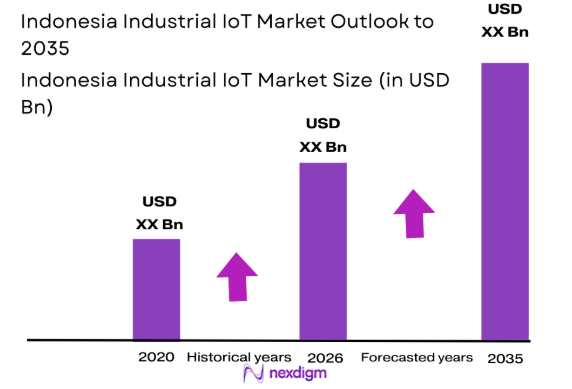
The Indonesia Industrial IoT market has been experiencing significant growth, driven by increasing demand for automation and the adoption of connected devices across various industries. With advancements in sensor technology, cloud computing, and edge processing, the market is poised to grow rapidly. The market size is expected to reach approximately USD ~ billion based on a recent historical assessment, fueled by ongoing government initiatives and the rising demand for smart manufacturing technologies.
The growth in Indonesia’s industrial IoT market is primarily concentrated in urban centers such as Jakarta, Surabaya, and Batam. These cities are the primary hubs for industrial activities, bolstered by infrastructure investments and the presence of manufacturing industries. Additionally, government policies promoting Industry 4.0 and digital transformation have contributed significantly to the dominance of these regions, making them key players in Indonesia’s IoT adoption.
Market Segmentation
By Product Type
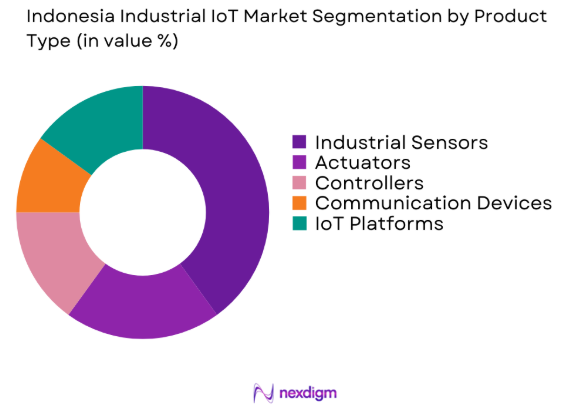
The Indonesia Industrial IoT market is segmented by product type into industrial sensors, actuators, controllers, communication devices, and IoT platforms. Recently, industrial sensors have had a dominant market share due to the increasing need for real-time data collection and automation across manufacturing plants. The demand for sensors is driven by advancements in sensor technology and the growing adoption of IoT systems in industries such as automotive, oil & gas, and energy, where precision monitoring is critical.
By End User Segment
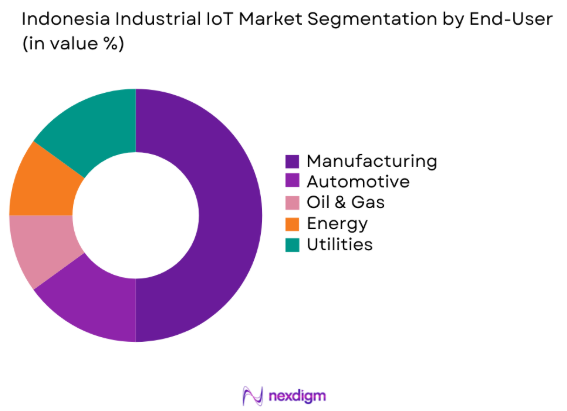
The market is segmented into manufacturing, automotive, oil & gas, energy, and utilities. The manufacturing sector has the largest market share, primarily due to the sector’s massive adoption of automation and smart factory technologies. Indonesia’s rapid industrialization and the Indonesian government’s push towards Industry 4.0 have made this sector a leader in adopting industrial IoT solutions, with an increasing number of manufacturers turning to IoT to optimize their processes, reduce operational costs, and increase efficiency.
Competitive Landscape
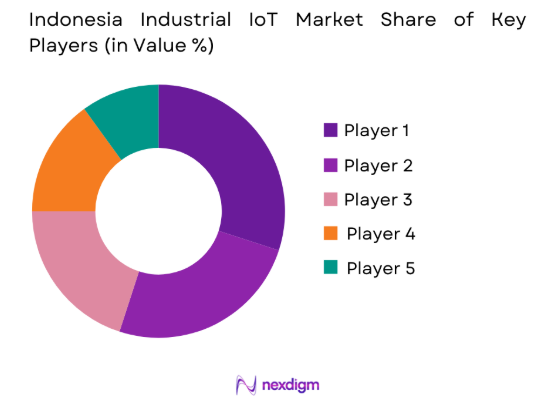
The competitive landscape of Indonesia’s Industrial IoT market is dominated by both global and local players. Major multinational companies are investing heavily in IoT infrastructure, while local players focus on providing region-specific solutions tailored to the needs of Indonesian industries. The market is also seeing increasing consolidation as companies strive to enhance their technological offerings and expand market share through mergers and acquisitions. These players focus on developing advanced solutions to meet the rising demand for smart manufacturing and automation across the industrial sector.
| Company Name | Establishment Year | Headquarters | Technology Focus | Market Reach | Key Products | Revenue (USD) | Additional Parameter |
| Siemens AG | 1847 | Germany | ~ | ~ | ~ | ~ | ~ |
| Honeywell International | 1906 | USA | ~ | ~ | ~ | ~ | ~ |
| ABB | 1988 | Switzerland | ~ | ~ | ~ | ~ | ~ |
| Rockwell Automation | 1903 | USA | ~ | ~ | ~ | ~ | ~ |
| Cisco Systems | 1984 | USA | ~ | ~ | ~ | ~ | ~ |
Indonesia Industrial IoT Market Analysis
Growth Drivers
Technological Advancements
The adoption of IoT and sensor technologies has significantly driven the growth of Indonesia’s Industrial IoT market. The integration of sensors, cloud computing, and edge technologies enables industries to collect real-time data, which enhances operational efficiency and minimizes downtime. As IoT platforms and data analytics continue to evolve, businesses gain the ability to make data-driven decisions that optimize production processes. This integration allows industries to streamline operations, improve asset management, and reduce costs by identifying inefficiencies. The market’s expansion is further supported by the increasing need for automation in sectors like manufacturing, energy, and automotive, where real-time monitoring and predictive maintenance are essential for enhancing performance and reliability.
Government Support for Industry 4.0
The Indonesian government has played a crucial role in accelerating the growth of industrial IoT by promoting digital technologies and smart manufacturing. Policies supporting Industry 4.0 and the digitization of the industrial sector have created a favorable environment for IoT adoption. Government initiatives, including tax incentives and funding for IoT research, have made it easier for businesses to invest in IoT solutions. These efforts have attracted both local and international companies to invest in Indonesia’s industrial IoT infrastructure. Furthermore, the government’s commitment to upgrading the country’s manufacturing capabilities and supporting innovation has spurred the widespread deployment of IoT technologies, enabling businesses to improve efficiency, productivity, and competitiveness across key industries.
Market Challenges
High Initial Investment Costs
A major challenge for the industrial IoT market in Indonesia is the high initial investment required to implement IoT solutions. Small and medium enterprises (SMEs) in the country face significant financial barriers when it comes to adopting IoT systems, as these technologies demand considerable capital expenditure on sensors, devices, and network infrastructure. This high cost of implementation is a considerable hurdle, particularly for businesses with limited access to capital or financing options. As a result, many SMEs struggle to adopt IoT technologies despite their potential to improve efficiency and reduce operational costs. Overcoming this challenge will require more accessible financing options, government support, and cost-effective IoT solutions tailored to the needs of smaller businesses.
Skilled Workforce Shortage
A key challenge facing the industrial IoT market in Indonesia is the shortage of a skilled workforce capable of managing and maintaining IoT systems. As industries adopt automation and IoT technologies, the demand for engineers and technicians with expertise in these advanced fields has surged. However, the current talent pool is inadequate to meet this growing need. This skills gap hinders businesses from fully utilizing the potential of industrial IoT solutions, limiting the ability to optimize operations and achieve the desired efficiency gains. Addressing this challenge will require investment in education and training programs to develop a workforce proficient in IoT technologies, as well as partnerships between industry and educational institutions to bridge the skills gap.
Opportunities
Adoption of Predictive Maintenance
Predictive maintenance is emerging as a significant opportunity for the Indonesia Industrial IoT market. As industries like manufacturing, automotive, and oil & gas increasingly invest in automation, the demand for predictive maintenance solutions is expected to grow. These solutions, driven by IoT sensors and data analytics, enable businesses to monitor the health of equipment in real time, predict potential failures, and prevent costly downtime. By adopting predictive maintenance, companies can improve operational efficiency, reduce maintenance costs, and extend the lifespan of critical machinery. As Indonesia’s industrial sector continues to embrace IoT technologies, predictive maintenance is set to play a pivotal role in enhancing the reliability and performance of industrial operations.
Smart Manufacturing Expansion
The growing adoption of smart manufacturing practices presents a significant opportunity for the Indonesia Industrial IoT market. As manufacturers increasingly deploy IoT systems, sensors, and robotics, smart factories are becoming more prevalent across the country. These technologies enable manufacturers to optimize production processes, improve efficiency, and enhance overall productivity. The Indonesian government’s focus on Industry 4.0, coupled with the rising awareness of the benefits of IoT-driven automation, is expected to accelerate the expansion of smart manufacturing in Indonesia. This shift towards smart factories is expected to drive further adoption of industrial IoT solutions, enabling businesses to stay competitive while reducing costs and improving operational performance.
Future Outlook
Looking forward, the Indonesia Industrial IoT market is expected to continue its upward trajectory over the next five years. Technological advancements, such as 5G connectivity and AI integration, will drive the development of more sophisticated and efficient IoT solutions. Increased government support for digital transformation and smart manufacturing, coupled with rising demand for automation in industries such as automotive, energy, and manufacturing, will fuel market growth. However, challenges such as high initial investments and a shortage of skilled workers may slow down the pace of adoption, particularly among SMEs.
Major Players
- Siemens AG
- Honeywell International
- ABB
- Rockwell Automation
- Cisco Systems
- General Electric
- Mitsubishi Electric
- Emerson Electric
- Bosch Rexroth
- Advantech Co.
- Toshiba Corporation
- Schneider Electric
- Huawei Technologies
- Yokogawa Electric
- Keyence Corporation
Key Target Audience
- Investments and venture capitalist firms
- Government and regulatory bodies
- Manufacturers and industrial enterprises
- Automation solution providers
- Technology developers
- System integrators
- Equipment suppliers
- Energy and utilities firms
Research Methodology
Step 1: Identification of Key Variables
This step involves defining the scope of the study, identifying key market variables such as product types, technology, and geographical regions, and collecting relevant data.
Step 2: Market Analysis and Construction
In this step, the market is segmented, and key trends, growth drivers, challenges, and opportunities are analyzed. Data is gathered from primary and secondary sources.
Step 3: Hypothesis Validation and Expert Consultation
The formulated hypotheses are validated through interviews and consultations with industry experts, stakeholders, and companies to ensure the accuracy of the findings.
Step 4: Research Synthesis and Final Output
In the final step, the gathered data is synthesized into a comprehensive report, including an executive summary, key findings, and actionable insights based on the market analysis.

- Executive Summary
- Research Methodology (Definitions, Scope, Industry Assumptions, Market Sizing Approach, Primary & Secondary Research Framework, Data Collection & Verification Protocol, Analytic Models & Forecast Methodology, Limitations & Research Validity Checks)

- Market Definition and Scope
- Value Chain & Stakeholder Ecosystem
- Regulatory / Certification Landscape
- Sector Dynamics Affecting Demand
- Strategic Initiatives & Infrastructure Growth

- Growth Drivers
Technological Advancements
Government Support for Industry 4.0
Rising Demand for Automation in Manufacturing - Market Challenges
High Initial Investment Costs
Data Security Concerns
Lack of Skilled Workforce - Market Opportunities
Integration of AI with IoT
Adoption of Predictive Maintenance
Growth in Smart Manufacturing - Trends
Increasing Use of Robotics
Shift Toward Smart Factories
Rising Adoption of Edge Computing - Government Regulations
- SWOT Analysis of Key Competitors
- Porter’s Five Forces

- By Market Value, 2020-2025
- By Installed Units, 2020-2025
- By Average System Price, 2020-2025
- By System Complexity Tier, 2020-2025

- By System Type (In Value%)
Industrial Sensors
Industrial Controllers
Edge Computing Systems
Communication Gateways
Industrial Robotics - By Platform Type (In Value%)
Cloud-Based Platforms
On-Premise Platforms
Hybrid Platforms
Mobile-Based Platforms
Edge Computing Platforms - By Fitment Type (In Value%)
On-Premise Solutions
Cloud-Based Solutions
Hybrid Solutions
Modular Solutions
Integrated Solutions - By End User Segment (In Value%)
Manufacturing Sector
Oil & Gas Industry
Energy & Utilities
Logistics & Supply Chain
Automotive Industry - By Procurement Channel (In Value%)
Direct Procurement
Government Tenders
Private Sector Procurement
Online Bidding Platforms
Third-Party Distributors

- Market Share Analysis
- Cross Comparison Parameters (System Type, Platform Type, Procurement Channel, End User Segment, Fitment Type, Product Lifecycle, Geographical Distribution, Investment Focus, Integration Complexity, Scalability Potential)
- SWOT Analysis of Key Competitors
- Pricing & Procurement Analysis
- Key Players
Siemens AG
General Electric
Honeywell International
Cisco Systems
Rockwell Automation
Schneider Electric
ABB
Mitsubishi Electric
Emerson Electric
Bosch Rexroth
Huawei Technologies
Cisco Systems
Advantech Co.
Toshiba Corporation
Baker Hughes

- Increased Demand for Automation in Manufacturing
- Role of Government in IoT Adoption
- Adoption of Predictive Maintenance in Energy & Utilities
- Growth of Smart Factories in the Automotive Industry

- Forecast Market Value, 2026-2035
- Forecast Installed Units, 2026-2035
- Price Forecast by System Tier, 2026-2035
- Future Demand by Platform, 2026-2035


 Request a Sample
 Ask for Customization
 Get a Quote
 Enquire Now