
 Download PDF
Market Overview
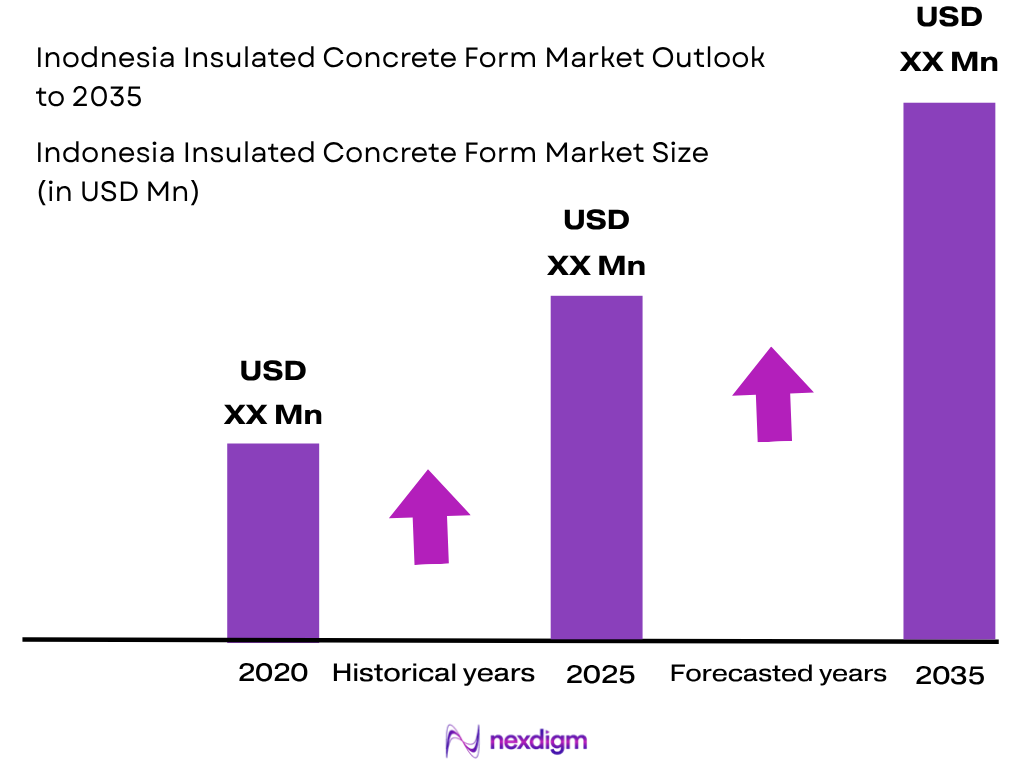
The Indonesia Insulated Concrete Form Market is valued at approximately USD~ billion, based on a five-year historical assessment, with demand supported by energy-efficient construction, urban development and disaster-resilient building requirements. Indonesia’s broader economy increased from IDR 20,892.4 trillion to IDR 22,139.0 trillion, while construction strengthened its position among the country’s largest economic sectors. These fundamentals provide a sizeable construction base for EPS forms, reinforced-concrete wall systems and industrialized construction technologies.
Jakarta, Surabaya and Bandung represent the principal demand centres for the Indonesia Insulated Concrete Form Market because of their concentration of residential developers, commercial construction, infrastructure contractors and building-material distribution. Indonesia’s GDP per capita moved from IDR 75.0 million to IDR 78.6 million, alongside continuing construction activity. Jakarta benefits from capital-city scale and corporate development, Surabaya serves East Java’s construction economy, while Bandung benefits from West Java’s expanding residential and commercial building ecosystem.
Market Segmentation
By ICF Type
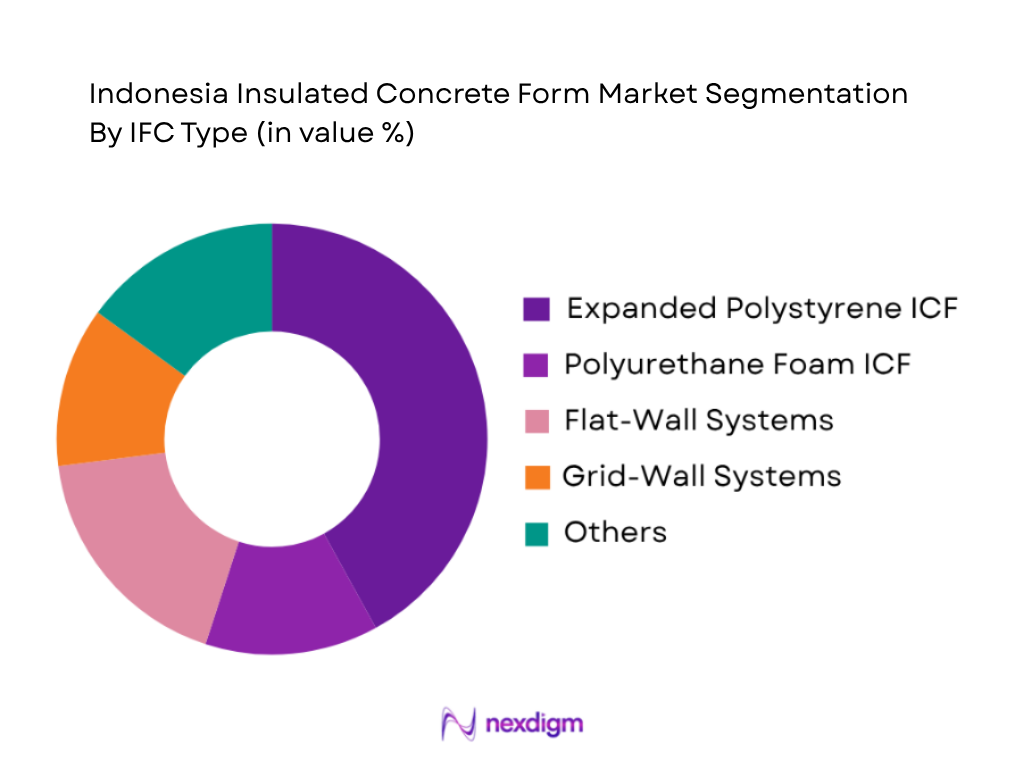
The Indonesia Insulated Concrete Form Market is segmented by ICF type into Expanded Polystyrene ICF, polyurethane foam ICF, flat-wall systems, grid-wall systems, post-and-lintel systems and other specialized forms. Expanded Polystyrene ICF dominates this segmentation, primarily because EPS combines permanent formwork with continuous insulation while remaining lightweight enough for handling at construction sites. Its interlocking configuration facilitates repetitive residential wall construction and accommodates reinforced-concrete cores required for structural applications. Indonesia’s tropical climate strengthens the relevance of insulated wall envelopes, while its earthquake exposure increases interest in monolithic reinforced-concrete construction. EPS forms also fit the industry’s movement toward prefabrication and reduced on-site operations. Manufacturers can modify EPS density, form thickness, web spacing and concrete-core dimensions for different structural specifications. Flat-wall and grid-wall configurations remain important, particularly where contractors prioritize structural design flexibility, but EPS-based ICF provides the broadest combination of insulation, permanent formwork, construction speed and compatibility with concrete-intensive Indonesian building practices.
By End User
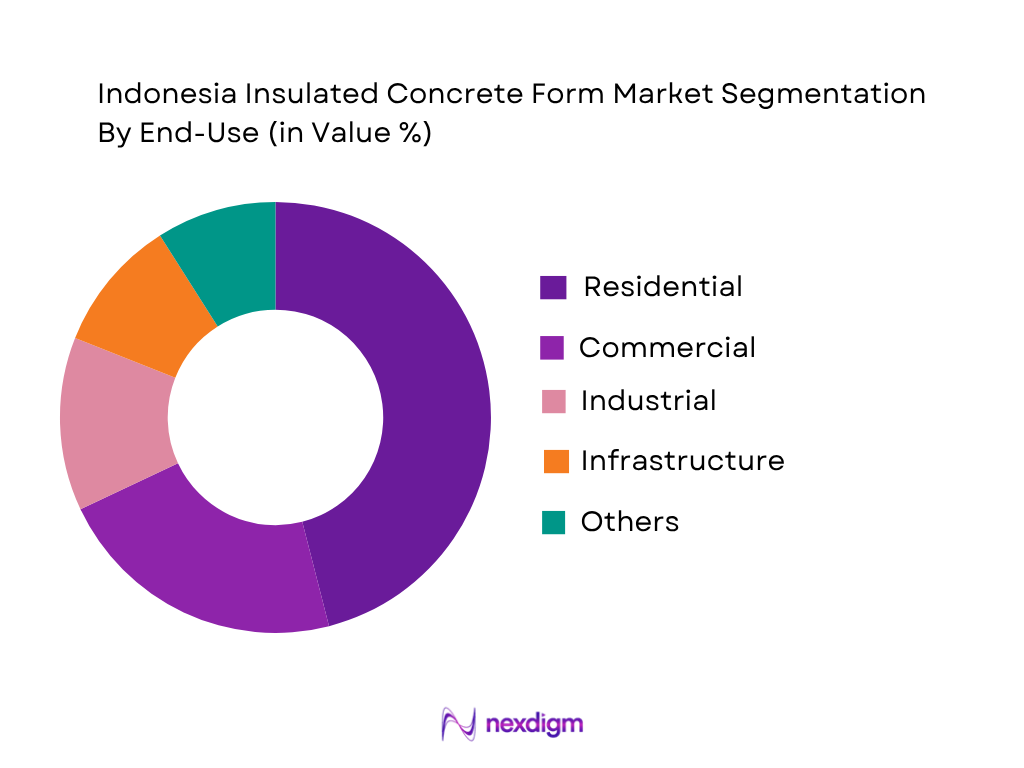
The Indonesia Insulated Concrete Form Market is segmented by end user into residential, commercial, industrial, infrastructure, and government and utilities. Residential construction holds the dominant position because ICF technology is particularly compatible with landed houses, villas, low-rise residential developments, standardized housing projects and disaster-resilient dwellings. Residential developers can use repetitive ICF block configurations to combine the structural wall, concrete formwork and insulation layers within a coordinated construction process. The system is also relevant to Indonesia’s need for thermally efficient housing in a hot and humid environment, where reducing heat transmission through external walls can improve indoor comfort. Reinforced-concrete cores additionally strengthen the proposition in earthquake-prone locations. Commercial applications are developing through hotels, offices and institutional buildings, while industrial users can employ insulated concrete walls for facilities requiring durable envelopes. Infrastructure and government applications remain strategically important because public-sector green-building policies and resilient-building requirements can facilitate broader acceptance of industrialized wall technologies.
Competitive Landscape
The Indonesia Insulated Concrete Form Market has a fragmented competitive ecosystem combining specialized building-system suppliers, concrete-component manufacturers, construction companies and international ICF technology providers. Competition extends beyond dedicated ICF suppliers because EPS forms compete directly with precast concrete, conventional reinforced-concrete framing, masonry, AAC blocks and other industrialized wall systems. Companies with local concrete-production capabilities, engineering support, contractor relationships and nationwide construction networks are consequently positioned to influence ICF adoption as the technology moves beyond specialized projects.
| Company | Establishment | Headquarters | Product / System Focus | ICF Market Relevance | Primary End Use | Material Capability | Project Capability | Geographic Positioning |
| PT Beton Elemen Persada | 2000 | Jakarta, Indonesia | ~ | ~ | ~ | ~ | ~ | ~ |
| PT Insulcon | 2005 | Jakarta, Indonesia | ~ | ~ | ~ | ~ | ~ | ~ |
| PT ICF Indonesia | 2010 | Bandung, Indonesia | ~ | ~ | ~ | ~ | ~ | ~ |
| PT Wijaya Karya Beton Tbk | 1997 | Jakarta, Indonesia | ~ | ~ | ~ | ~ | ~ | ~ |
| PT Adhi Karya (Persero) Tbk | 1974 | Jakarta, Indonesia | ~ | ~ | ~ | ~ | ~ | ~ |
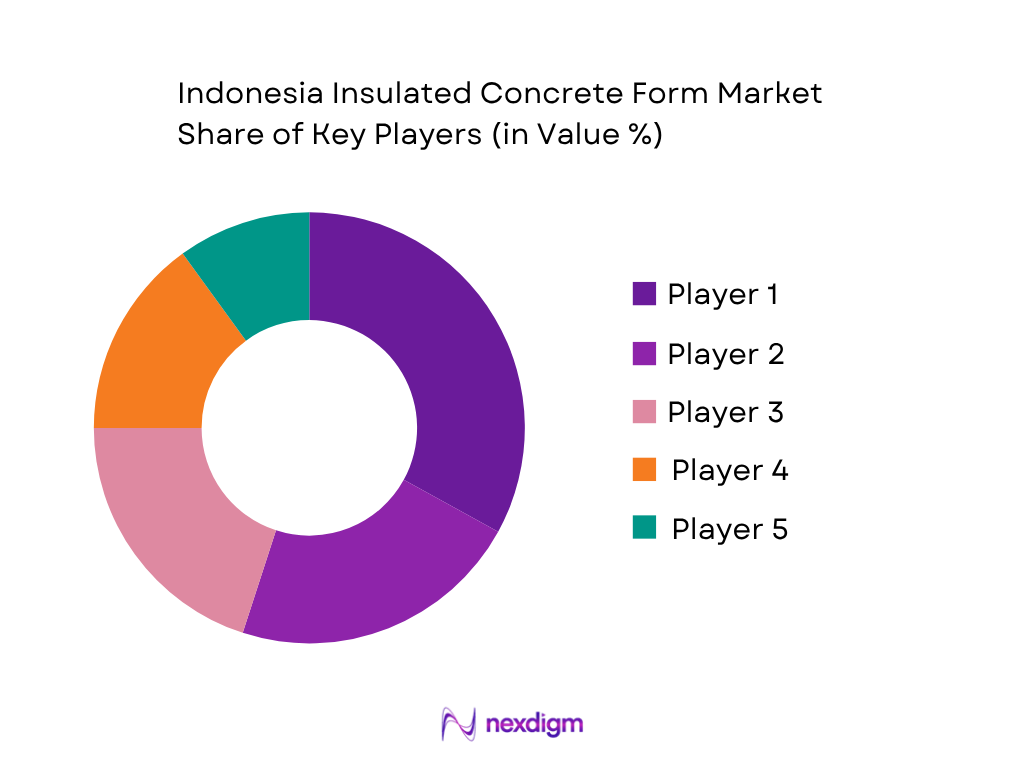
Indonesia Insulated Concrete Form Market Analysis
Growth Drivers
Expansion of Residential Construction and Persistent Housing Requirement
Indonesia’s residential construction base is a primary demand driver for insulated concrete form systems because the technology is most applicable where developers need repetitive structural walls, permanent insulation, rapid form assembly and durable reinforced-concrete construction. BPS-Statistics Indonesia recorded national GDP of IDR 22,139.0 trillion in 2024, while construction generated IDR 2,233.5 trillion of economic output, confirming the scale of the addressable building ecosystem into which ICF systems can be introduced. The World Bank recorded Indonesia’s population at exactly 283,487,931 people in 2024 and GDP at USD 1,396.3 billion, with GDP per capita at USD 4,925.4. This demographic and economic base continuously generates demand for landed houses, urban residential developments, affordable housing, apartments, worker accommodation and supporting community infrastructure. More directly, BP Tapera reported that Indonesia’s FLPP subsidized-housing financing supported 200,300 housing units in 2024 with subsidies valued at IDR 24.6 trillion. That volume is important for ICF suppliers because affordable-housing schemes rely on standardized floorplans, repetitive wall dimensions, predictable material consumption and accelerated construction cycles—the same operating characteristics that favor modular EPS stay-in-place formwork. An ICF wall combines two permanent insulation layers with an in-situ reinforced-concrete core, reducing the number of separate wall-construction stages compared with systems that require independent masonry, structural framing and insulation processes. Large housing programs therefore provide an opportunity to standardize block geometries, corner forms, lintel details and reinforcement schedules across multiple units. Indonesia’s residential demand is also geographically dispersed across Java, Sumatra, Kalimantan, Sulawesi and other islands, creating room for regional moulding and distribution hubs rather than reliance on a single national production facility. The broader construction base strengthens the availability of ready-mix concrete, reinforcing steel, cement, finishing materials and contractors required for ICF installation. As household formation and urban expansion sustain new construction activity, the combination of 283.5 million residents, more than 200,000 subsidized homes financed within a single year, and IDR 2,233.5 trillion of national construction output creates a tangible demand platform for ICF adoption in mass housing, landed residential construction and developer-led communities. For manufacturers, the strongest commercial proposition is therefore not insulation alone, but the ability to package EPS formwork, concrete-core engineering, reinforcement detailing, wall-system standardization and installer support into a repeatable housing solution. (BPS Web API)
Demand for Seismic-Resistant, Faster and Industrialized Building Methods
Indonesia’s structural-risk environment supports demand for wall technologies that combine reinforced concrete with repeatable construction procedures, making seismic resilience and industrialized construction a second major driver for ICF adoption. The country’s 2024 population of 283,487,931 creates substantial exposure to housing and infrastructure disruption when earthquakes and other natural hazards damage buildings. BNPB data reported 6,126 houses damaged by disasters in 2024, illustrating the continuing need for resilient residential construction and reconstruction technologies. The construction sector itself generated IDR 2,233.5 trillion in national output during 2024, according to BPS-Statistics Indonesia, giving Indonesia a sufficiently large concrete-construction ecosystem to support wider deployment of reinforced ICF walls without requiring an entirely new structural-material supply chain. ICF systems are relevant because the EPS form is principally a permanent formwork and insulation component; the principal load-bearing element is the reinforced concrete placed continuously inside the forms. This architecture can support structural-wall continuity, vertical and horizontal reinforcement, engineered openings and wall-to-foundation connections that are important in earthquake-prone markets. The method also industrializes part of the wall-building process by manufacturing interlocking blocks or panels off-site with standardized dimensions and then assembling them on site before reinforcement and concrete placement. This reduces dependence on repeated temporary formwork erection and dismantling and can simplify wall geometry across standardized housing projects. Indonesia’s macroeconomic capacity provides further support: the World Bank recorded 2024 GDP at USD 1,396.3 billion, while BPS measured GDP at IDR 22,139.0 trillion. Those figures indicate a construction economy capable of supporting investments in EPS moulding machines, ICF tooling, connector production, concrete pumps and installer-training networks. The same demand logic extends to post-disaster reconstruction, schools, healthcare buildings, government accommodation, hotels and low-rise commercial buildings where structural robustness and rapid project delivery are critical. Indonesia’s building geography also creates value for lightweight formwork: EPS forms have considerably lower handling weight than conventional permanent concrete wall elements, helping contractors move form components before the heavier concrete is produced or delivered locally. For ICF suppliers, seismic positioning will nevertheless depend on engineered concrete-core thickness, reinforcement spacing, concrete strength, connection design and compliance with applicable Indonesian structural standards rather than simply promoting the insulating form itself. The combination of 6,126 disaster-damaged homes, a IDR 2,233.5 trillion construction sector and a population exceeding 283 million people therefore supports a market-specific case for reinforced, standardized and rapidly deployable ICF wall systems.
Market Challenges
Strong Competition from Established Masonry, AAC, Precast and Conventional Concrete Systems
The largest structural challenge for Indonesia’s Insulated Concrete Form Market is that ICF must compete inside an already enormous and mature concrete-and-masonry construction ecosystem rather than create demand in a greenfield building market. BPS-Statistics Indonesia valued national construction activity at IDR 2,233.5 trillion in 2024, within an economy of IDR 22,139.0 trillion. This large installed construction base supports established procurement relationships for cement, ready-mix concrete, precast components, concrete blocks, AAC blocks, clay bricks, reinforcement, plywood formwork and conventional cast-in-place structural systems. These materials already have broad distributor networks and contractor familiarity across major Indonesian construction centres. The challenge for ICF suppliers is therefore commercial and operational: developers are not simply comparing one wall material against another, but comparing complete construction sequences, subcontractor availability, structural-design practices, finishing procedures and supply reliability. Indonesia also financed 200,300 FLPP subsidized housing units in 2024 through BP Tapera, with subsidy funding of IDR 24.6 trillion. This illustrates the size of standardized residential construction demand, but it simultaneously shows why incumbent building systems are difficult to displace. Affordable-housing contractors repeatedly use familiar wall specifications, labour teams and local materials, so a new ICF supplier must prove that its block dimensions, concrete-core requirements, reinforcement detailing, electrical-service routing and wall finishes can integrate into high-volume housing construction without disrupting delivery. ICF also remains dependent on several materials that conventional construction already consumes—cement, aggregates, ready-mix concrete and reinforcing steel—while adding EPS forms, plastic webs or connectors and specialized bracing. Consequently, a supplier cannot rely solely on claims of construction speed or thermal insulation; it must demonstrate a coordinated building system that contractors can execute reliably. Indonesia’s 283,487,931-person population creates very large construction demand, but it also means building practices are deeply embedded across thousands of contractors and local material dealers. A standardized ICF solution deployed in Jakarta or West Java may encounter different contractor capabilities and logistics when transferred to Sumatra, Kalimantan or eastern provinces. Competitive pressure is especially strong from precast and factory-produced concrete systems in large developments, because these technologies are also marketed around speed, standardization and lower site labour intensity. ICF providers must therefore differentiate through continuous thermal insulation, reduced temporary formwork, monolithic concrete-wall construction, seismic engineering and lighter pre-concrete handling rather than competing purely as another wall product. The IDR 2,233.5 trillion construction economy is thus both the market opportunity and the principal competitive barrier: it provides scale, but that scale is already served by entrenched systems with established contractors, specifications and distribution networks.
Archipelagic Logistics, Limited ICF-Specific Installer Capability and Site Execution Complexity
Indonesia’s geography creates a particularly important challenge for ICF because market expansion requires synchronized availability of EPS forms, connectors, reinforcement, concrete, bracing equipment and trained installation teams. The World Bank recorded Indonesia’s population at 283,487,931 in 2024, distributed across a vast archipelagic territory rather than a single concentrated construction corridor. While ICF forms are lightweight before concrete placement, their bulky EPS geometry means transportation efficiency depends on truck and container utilization, nesting capability and proximity to moulding facilities. Supplying projects outside Java can therefore require regional inventories or decentralized manufacturing if firms want to avoid long-distance movement of low-density form components. The scale of Indonesia’s construction sector—IDR 2,233.5 trillion of output in 2024 according to BPS—also means an ICF supplier competing nationally must support projects at a level far beyond selling forms.
Market Opportunities
Affordable Housing and Disaster-Resilient Residential Construction
Affordable and disaster-resilient housing represents one of the strongest future-facing opportunities for Indonesia’s Insulated Concrete Form Market because current housing-finance activity already demonstrates large-scale demand for standardized residential construction. BP Tapera reported 200,300 FLPP-supported subsidized housing units in 2024 with total subsidy funding of IDR 24.6 trillion. This existing volume provides an immediate addressable construction channel in which repetitive wall layouts, standardized unit types and controlled construction sequences can support ICF deployment. The opportunity is strengthened by Indonesia’s demographic scale: the World Bank recorded 283,487,931 residents in 2024, while national GDP reached USD 1,396.3 billion and GDP per capita stood at USD 4,925.4. These indicators support continuing household formation and residential development across major urban regions and secondary cities. At the same time, BNPB recorded 6,126 houses damaged by disasters in 2024, reinforcing the need for building systems that can be engineered around structural continuity and reinforced-concrete cores. This combination creates a specific ICF opportunity: suppliers can develop standardized housing packages in which EPS block layouts, corner components, reinforcement schedules, window and door openings and concrete-core dimensions are pre-engineered for common affordable-housing formats. Rather than selling ICF simply as premium insulation, manufacturers can position it as an integrated structural-envelope system suitable for repetitive residential delivery. The EPS forms remain around the reinforced concrete after placement, reducing separate formwork removal while providing continuous insulation around the structural core.
Nusantara Development, Localized ICF Manufacturing and High-Performance Building Applications
Nusantara and Indonesia’s broader shift toward new, high-performance urban construction create a future opportunity for ICF suppliers that can localize production and integrate with Indonesian concrete and engineering capabilities. The Nusantara Capital Authority reported IDR 58.4 trillion of investment across eight groundbreaking rounds associated with the capital-development program, while 109 state-budget construction packages had been contracted for Nusantara-related works through 2024. The development already includes diverse building categories rather than only government offices: by the Authority’s reporting, Hotel Nusantara had 191 rooms, Mayapada Hospital provided 200 beds, Hermina Hospital provided another 200 beds, and the operating solar installation supplied 10 MW. Earlier in 2024, the Authority reported aggregate Nusantara investment reaching IDR 51.35 trillion, while Phase VI groundbreaking involved 8 business entities and IDR 1.75 trillion of realized investment. These current construction indicators demonstrate a pipeline of residential, hospitality, healthcare, education, office and commercial building typologies that can accommodate high-performance wall technologies. For ICF suppliers, the opportunity is not confined to Nusantara itself. A successful specification within a prominent new-city development can establish reference projects for wider adoption in Kalimantan, Java, Bali and other construction markets. Localization is particularly important. Indonesia’s construction sector generated IDR 2,233.5 trillion in 2024, showing that cement, concrete, steel and contracting capacity already exists at substantial scale.
Future Outlook
The Indonesia Insulated Concrete Form Market is expected to expand at approximately ~XX% CAGR during 2026–2035, supported by the convergence of residential construction, green-building requirements, industrialized construction and demand for disaster-resistant structures. Indonesia’s extensive construction economy creates a substantial addressable base for ICF suppliers even where conventional masonry and precast systems remain entrenched. The strongest opportunity is expected to emerge from localized ICF manufacturing. Domestic moulding of EPS blocks, manufacture of polypropylene webs and connectors, local reinforcement sourcing and integration with ready-mix concrete networks can improve supply availability and make ICF systems easier to specify across repetitive residential developments.
Major Players
- PT Beton Elemen Persada
- PT Insulcon
- PT ICF Indonesia
- PT Wijaya Karya Beton Tbk
- PT Adhi Karya (Persero) Tbk
- PT PP (Persero) Tbk
- PT Semen Indonesia (Persero) Tbk
- PT Jaya Konstruksi Manggala Pratama Tbk
- PT Wijaya Karya (Persero) Tbk
- PT Total Bangun Persada Tbk
- PT Bumi Serpong Damai Tbk
- Airlite Plastics Company / Fox Blocks
- Amvic Building System
- BuildBlock Building Systems
- Nudura / RPM International
Key Target Audience
- Insulated Concrete Form Manufacturers and System Providers
- EPS and Construction-Insulation Manufacturers
- Residential, Commercial and Industrial Real Estate Developers
- Construction Companies, EPC Contractors and Building-System Integrators
- Concrete, Reinforcement and Building Material Suppliers
- Investments and Venture Capitalist Firms
- Banks, Infrastructure Investors and Project Financing Institutions
- Government and Regulatory Bodies (Ministry of Public Works, Ministry of Housing and Settlement Areas, Ministry of Energy and Mineral Resources, Ministry of Environment, National Development Planning Agency/Bappenas, National Standardization Agency/BSN)
Research Methodology
Step 1: Identification of Key Variables
The initial phase constructs the Indonesia Insulated Concrete Form Market ecosystem covering EPS suppliers, ICF manufacturers, concrete producers, reinforcement suppliers, developers, contractors and regulatory stakeholders. Extensive secondary research identifies variables including installed ICF wall area, form consumption, concrete-core configuration, building application, regional demand, project pipeline, thermal requirements and competing wall technologies.
Step 2: Market Analysis and Construction
Historical market information is analyzed using both top-down and bottom-up approaches. The top-down assessment evaluates Indonesia’s construction economy, residential and commercial building activity and addressable wall-system demand, while the bottom-up model assesses ICF suppliers, project installations, form consumption and realized project activity. The two approaches are reconciled to establish a consistent market framework.
Step 3: Hypothesis Validation and Expert Consultation
Market hypotheses are validated through computer-assisted telephone interviews with ICF system suppliers, EPS processors, concrete companies, developers, contractors, architects, structural engineers and building-material distributors. Discussions focus on technology adoption, project applications, competitive substitution, procurement practices, installer availability and regional demand conditions, allowing secondary findings and preliminary market assumptions to be challenged and refined.
Step 4: Research Synthesis and Final Output
The final phase triangulates supplier-side findings, demand-side interviews, construction indicators and regulatory information. Inputs from manufacturers and construction participants are compared with the bottom-up market model to validate segmentation, competitive positioning and adoption patterns. The resulting analysis integrates market sizing, industry structure, end-user behaviour, technology evolution and future opportunities into a unified Indonesia Insulated Concrete Form Market assessment.

- Executive Summary
- Research Methodology (Market Definition and Scope, Indonesia Insulated Concrete Form Market Classification, EPS ICF Block and Panel Demand Assessment, Installed ICF Wall Area Mapping, Domestic ICF Manufacturing Capacity Assessment, Imported ICF System Dependency Analysis, EPS Raw Material and Moulding Assessment, Reinforced Concrete Core Consumption Mapping, Reinforcing Steel Requirement Assessment, Ready-Mix Concrete Integration Analysis, Building Application Demand Mapping, Regional Construction Activity Assessment, Primary Industry Interviews, Top-Down Construction Sector Assessment, Bottom-Up Company Revenue and Installation Volume Assessment, Project Pipeline Analysis, Distribution Network Assessment, Data Triangulation, Pricing Assessment, Forecasting Framework)

- Definition and Scope
- Indonesia Insulated Concrete Form Industry Evolution
- ICF Block Manufacturing
- Indonesia Insulated Concrete Form Value Chain Analysis
- Indonesia Insulated Concrete Form Supply Chain Analysis

- Growth Drivers (Expansion of Residential Construction, Persistent Housing Requirement, Growth of Industrialized Building Methods, Demand for Seismic-Resistant Housing, Increased Need for Faster Construction, Growing Reinforced Concrete Construction Base, Tropical Cooling Load Reduction, Expansion of New Urban Development, Construction Activity Around Nusantara Capital Region, Demand for Reduced Site Labour and Construction Waste)
- Market Challenges (Strong Competition from Clay Brick and AAC Block Construction, Dominance of Conventional Reinforced Concrete Frame Systems, Limited ICF-Specific Contractor Familiarity, EPS Fire Performance Requirements, Concrete Placement and Consolidation Complexity, Bracing and Alignment Requirements, Limited Domestic Dedicated ICF Manufacturing, Regional Logistics Across the Indonesian Archipelago, Moisture and Waterproofing Requirements, Availability of Trained ICF Installers)
- Market Opportunities (Affordable Housing Using ICF, Disaster-Resilient Residential Construction, New Capital Region Building Applications, Domestic EPS ICF Manufacturing Localization, Post-Earthquake Housing Reconstruction, Hospitality and Villa Construction, Energy-Efficient Commercial Buildings, Institutional and School Construction, Remote-Area Rapid Housing, Worker Accommodation, Graphite EPS ICF Systems, Recycled EPS Permanent Formwork, Integrated ICF Wall-and-Roof Systems)
- Market Trends (Interlocking EPS Block Adoption, Stay-in-Place Insulated Formwork, Monolithic Reinforced Concrete Walls, Continuous Insulation, Factory-Moulded EPS Components, Modular Wall Geometry, Pumped Concrete Integration, BIM-Assisted ICF Design, Higher-Density EPS Forms, Flame-Retardant EPS Adoption, Reduced-Waste Construction, Low-Thermal-Bridge Wall Design, Prefabricated Construction Integration)
- Regulatory and Standards Landscape (SNI Structural Concrete Requirements, SNI Seismic Design Requirements, SNI Building Envelope Energy Conservation Requirements, Building Construction Technical Standards, Fire Safety Requirements, EPS Material Compliance, Reinforcement Requirements, Concrete Quality Standards, Green Building Requirements, Building Permit Compliance, Occupational Safety Requirements)
- SWOT Analysis
- Porter’s Five Forces Analysis
- PESTLE Analysis

- By Market Value (2020-2025)
- By ICF Block and Panel Consumption Volume (2020-2025)
- By Installed ICF Wall Area (2020-2025)
- By Domestic ICF Production Volume (2020-2025)
- By Imported ICF System Volume (2020-2025)

- By ICF System Architecture (in value %)
Interlocking EPS Block ICF Systems
Flat-Wall ICF Systems
Panel-and-Connector ICF Systems
Fixed-Web ICF Systems
Knock-Down ICF Systems
Post-and-Beam ICF Systems
Grid-Wall ICF Systems
Screen-Grid ICF Systems
Vertical ICF Systems
Hybrid Permanent Formwork Systems - By Insulating Form Material (in value %)
Standard Expanded Polystyrene ICF
High-Density EPS ICF
Graphite-Enhanced EPS ICF
Flame-Retardant EPS ICF
Recycled-Content EPS ICF
Cement-Bonded EPS Composite ICF
Cement-Bonded Fibre Formwork
Wood-Cement Insulated Forms
Hybrid Insulated Concrete Forms
Other Stay-in-Place Insulation Systems - By Concrete Core Configuration (in value %)
Narrow Concrete Core Systems
Medium Concrete Core Systems
Wide Concrete Core Systems
Variable-Width Concrete Core Systems
Flat Monolithic Reinforced Concrete Core
Grid-Type Reinforced Concrete Core
High-Seismic-Resistance Concrete Core
Multi-Storey Structural Concrete Core - By Building Application (in value %)
External Load-Bearing Walls
Internal Structural Walls
External Building Envelope Walls
Foundation Walls
Basement Walls
Retaining Walls
Lift and Stair Cores
Swimming Pools and Water Structures
Utility and Service Structures
ICF Floor and Roof Integration
Cold and Temperature-Controlled Structures - By End-Use Construction (in value %)
Landed Residential Housing
Affordable and Social Housing
Low-Rise Multifamily Residential
Mid-Rise Residential Buildings
Luxury Villas and Resort Residences
Hotels and Hospitality Developments
Schools and Educational Facilities
Healthcare Facilities
Government and Institutional Buildings
Commercial and Office Buildings
Industrial and Warehouse Facilities
Worker Accommodation - By Construction Delivery Model (in value %)
Private Residential Developer Projects
Government Housing Projects
Affordable Housing Development
Self-Build and Custom Housing
Main Contractor Procurement
Specialist ICF Contractor Projects
Design-and-Build Projects
Design-Supply-Installation Packages
Turnkey ICF Construction
Emergency and Post-Disaster Housing Projects

- Market Share of Major Players (Indonesia Revenue, ICF Form Volume, Installed ICF Wall Area, Product Portfolio, Residential Project Exposure, Commercial Project Exposure, Domestic Manufacturing Capability, Distribution and Installation Footprint)
- Cross Comparison Parameters (Indonesia ICF Revenue, ICF Block Panel and Permanent Formwork Portfolio Breadth, EPS Density Thermal and Fire Performance Capability, Concrete Core Thickness and Seismic Structural Configuration Flexibility, Indonesia Manufacturing and Local Material Sourcing Capability, Residential Affordable Housing Hospitality and Institutional Project Exposure, Java Sumatra Kalimantan and Eastern Indonesia Distribution Footprint, Structural Design Installer Training and On-Site Technical Support Capability)
- SWOT Analysis of Major Players (ICF Technology, Manufacturing Capability, Regional Reach, Seismic Performance, Thermal Capability, Contractor Network)
- Detailed Profiles of Major Companies
PT Beton Elemen Persada – Precast Concrete Components, Structural Wall Systems, Building Components and Industrialized Construction Solutions
PT Wijaya Karya Beton Tbk – Precast Concrete, Structural Building Components, Construction Engineering and Nationwide Manufacturing Capability
PT Waskita Beton Precast Tbk – Precast Structural Components, Building Systems, Concrete Products and Infrastructure Construction Applications
PT Semen Indonesia (Persero) Tbk – Cement, Ready-Mix Concrete, Building Materials and Integrated Concrete Construction Supply
PT Indocement Tunggal Prakarsa Tbk – Cement, Ready-Mix Concrete, Building Material Solutions and Concrete Construction Supply
PT Solusi Bangun Indonesia Tbk – Cement, Concrete, Construction Materials and Integrated Building Solutions
PT Adhi Karya (Persero) Tbk – Residential Construction, Building Development, Engineering and Industrialized Construction Capability
PT PP (Persero) Tbk – Building Construction, Residential Development, Engineering and Prefabricated Construction Applications
PT Total Bangun Persada Tbk – Building Construction, High-Performance Construction, Commercial and Residential Project Execution
PT Jaya Konstruksi Manggala Pratama Tbk – Building and Infrastructure Construction, Concrete Works and Project Execution Capability
PT Modern Panel Indonesia – Precast Concrete Components, Structural Wall Panels and Industrialized Building Systems
Tremco CPG / Nudura – EPS Insulated Concrete Forms, Reinforced Concrete Wall Systems, Building Envelope Solutions and International ICF Technology Benchmark
Fox Blocks / Airlite Plastics – Double-Insulated EPS ICF Blocks, Reinforced Concrete Wall Systems, Specialty Forms and Contractor Support Technology
Amvic Building System – Stay-in-Place EPS ICF Blocks, High-Thermal-Resistance Concrete Wall Systems and International ICF Technology Benchmark
BuildBlock Building Systems – Reversible EPS ICF Blocks, Multiple Concrete Core Configurations, Residential and Commercial ICF Technology Benchmark

- Residential Developer ICF Adoption Assessment
- Affordable Housing Developer Assessment
- Hospitality Developer ICF Assessment
- Government Housing Procurement Assessment
- Industrial Developer ICF Assessment
- Architect ICF Specification Assessment
- Structural Engineer ICF Assessment

- By Market Value (2026-2035)
- By ICF Block and Panel Consumption Volume (2026-2035)
- By Installed ICF Wall Area (2026-2035)
- By Domestic ICF Production Volume (2026-2035)
- By Imported ICF System Volume (2026-2035)


 Request a Sample
 Ask for Customization
 Get a Quote
 Enquire Now