

 Download PDF
Market Overview
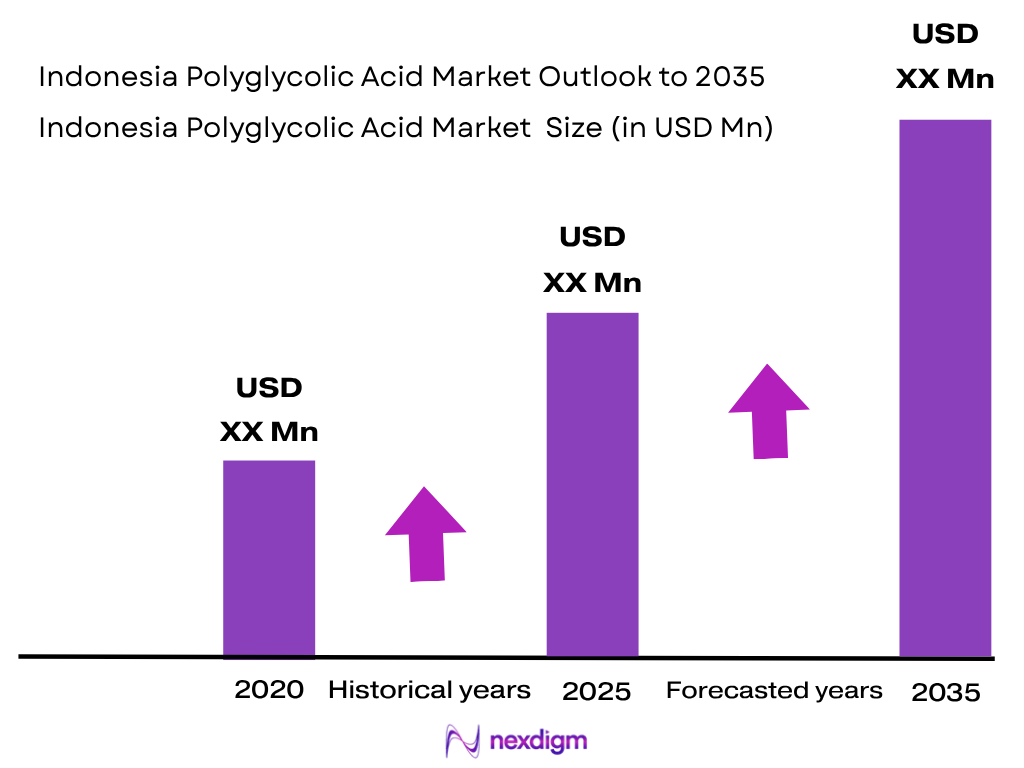
The Indonesia Polyglycolic Acid Market is valued at approximately USD ~XX million, based on the report’s historical market model, with demand concentrated in absorbable sutures, resorbable medical products and specialty polymers. The preceding industry reporting cycle recorded 783 domestic medical-device producers, 4,632 distributors and 12,931 domestic device registrations, while the latest reporting cycle recorded more than 15,000 domestically manufactured medical-device products, strengthening potential downstream demand for medical-grade PGA and glycolide materials.
Greater Jakarta, West Java and the Batam–Riau Islands manufacturing corridor form the most relevant commercial hubs for the Indonesia Polyglycolic Acid Market because they combine medical-device regulation, import distribution, industrial conversion and healthcare manufacturing infrastructure. Cikarang in West Java added Indonesia’s largest IVD manufacturing facility during the latest reporting period, while the preceding national industry base included 783 manufacturers and 4,632 medical-device distributors. Jakarta additionally anchors national regulatory, healthcare procurement and importer activity, reinforcing its PGA distribution importance.
Market Segmentation
By Grade Type
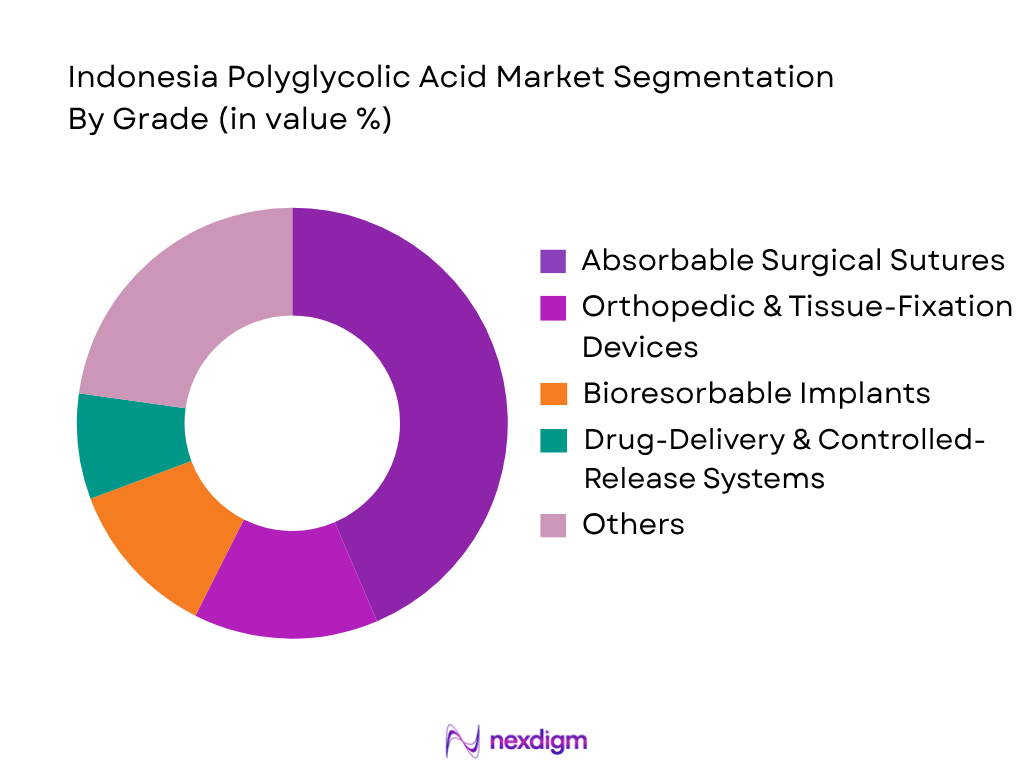
The Indonesia Polyglycolic Acid Market is segmented into medical-grade PGA, suture-grade PGA, implantable-grade PGA, industrial-grade PGA, fiber-spinning-grade PGA, extrusion-grade PGA and barrier-film/coating-grade PGA. Medical-grade PGA represents the dominant segment in the report model, primarily because Indonesia’s established commercial demand for glycolide-containing materials is concentrated in regulated healthcare applications rather than large-scale industrial PGA conversion. Indonesia’s official SATUSEHAT medical-device database already lists glycolide/lactide absorbable surgical sutures such as Polysorb, registered as a Class C sterile surgical device and distributed through PT Medtronic Indonesia.
By Application Type
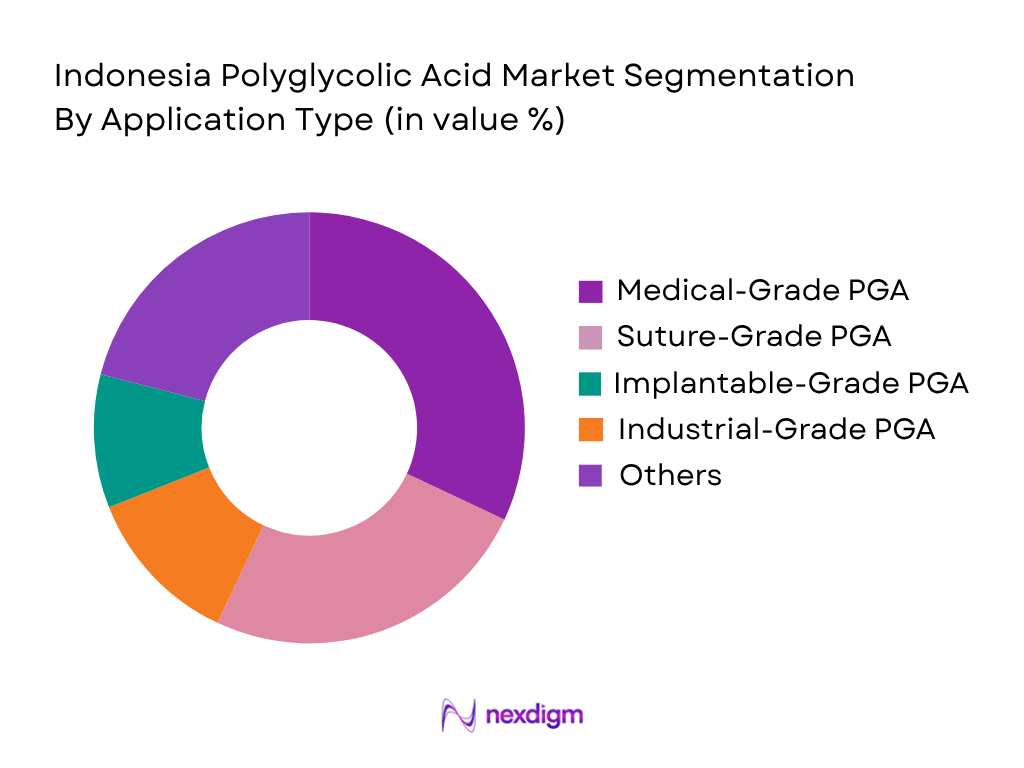
The Indonesia Polyglycolic Acid Market is segmented into absorbable surgical sutures, orthopedic and tissue-fixation devices, bioresorbable implants, drug-delivery systems, surgical meshes and tissue reinforcement, high-barrier packaging and specialty industrial components. Absorbable surgical sutures represent the dominant application in the report model because this is the most commercially established pathway for glycolide-based resorbable materials within Indonesia’s medical-device ecosystem. Indonesia’s Ministry of Health product system identifies registered absorbable glycolide/lactide surgical sutures under the general and plastic-surgery equipment category, demonstrating an existing regulated procurement pathway.
Competitive Landscape
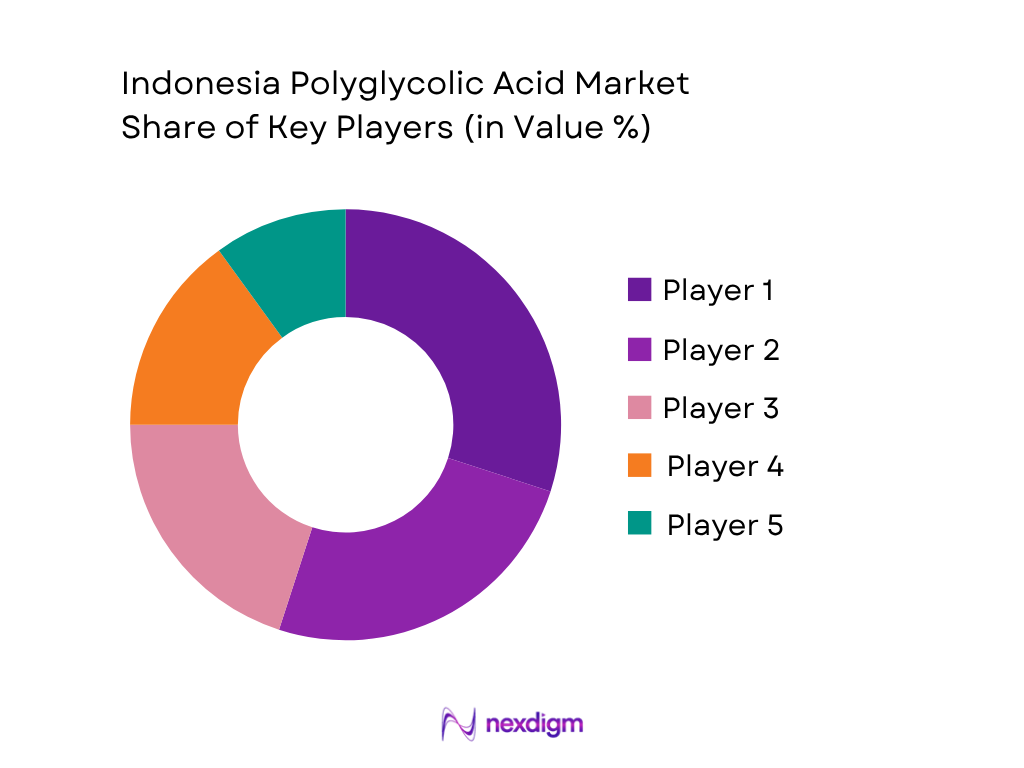
The Indonesia Polyglycolic Acid Market has a specialized competitive environment comprising global neat-PGA producers, medical-grade resorbable polymer suppliers and large medical-device companies supplying glycolide-based wound-closure products. Kureha is differentiated by industrial-scale neat PGA technology, while Corbion competes through GMP-grade polyglycolide and glycolide copolymers. B. Braun and Johnson & Johnson MedTech/Ethicon participate primarily through downstream surgical products, while W. L. Gore operates in advanced implantable biomaterials. This structure means competition extends across material supply, processing expertise, regulatory capability and healthcare access rather than resin production alone.
| Company | Establishment Year | Headquarters | PGA / Glycolide Position | Primary Application | Material Capability | Processing / Device Capability | Indonesia Relevance | Regulatory / Technical Strength |
| Kureha Corporation | 1944 | Tokyo, Japan | ~ | ~ | ~ | ~ | ~ | ~ |
| Corbion N.V. | 1919 | Amsterdam, Netherlands | ~ | ~ | ~ | ~ | ~ | ~ |
| B. Braun | 1839 | Melsungen, Germany | ~ | ~ | ~ | ~ | ~ | ~ |
| Johnson & Johnson MedTech / Ethicon | 1886 | New Brunswick, USA | ~ | ~ | ~ | ~ | ~ | ~ |
| W. L. Gore & Associates | 1958 | Newark, Delaware, USA | ~ | ~ | ~ | ~ | ~ | ~ |
Indonesia Polyglycolic Acid Market Analysis
Growth Drivers
Expansion of Domestic Medical-Device Manufacturing
Indonesia’s expanding medical-device manufacturing ecosystem is strengthening the commercial foundation for the Indonesia Polyglycolic Acid Market, particularly for medical-grade PGA used in absorbable sutures and bioresorbable devices. Ministry of Health data recorded 812 domestic medical-device producers and 5,661 distributors as of April 2025, providing a sizeable manufacturing and distribution network for specialized biomaterials. By June 2025, domestic medical devices held 16,930 marketing authorizations covering 473 product types, indicating increasing product localization and regulatory capability. This creates scope for imported medical-grade PGA to be converted locally through extrusion, fiber spinning, braiding, coating and finished-device manufacturing. Indonesia’s broader industrial base also supports this development: BPS recorded approximately 30,000 medium and large manufacturing establishments in 2024, providing an established technical manufacturing ecosystem. From a macroeconomic perspective, the IMF recorded Indonesia’s 2024 nominal GDP at Rp22,139 trillion, equivalent to USD1,396 billion, with GDP per capita of USD4,909. These economic and industrial indicators support investment in higher-value healthcare manufacturing and create a progressively larger domestic platform for PGA-based surgical and bioresorbable products.
Growing Localization of Absorbable Medical Products
Increasing emphasis on locally manufactured healthcare products represents another important driver for the Indonesia Polyglycolic Acid Market because absorbable sutures remain one of the most established commercial applications for glycolide-based polymers. Indonesia’s Ministry of Health reported more than 15,000 domestically manufactured medical-device products in 2024, demonstrating a growing base of locally registered healthcare products capable of supporting additional material localization. By 2025, Indonesia had 812 domestic medical-device manufacturers, alongside 5,661 distributors, creating multiple routes for PGA resin, fibers and finished sutures to reach hospitals and surgical-care providers. Domestic medical-device registrations reached 16,930 permits covering 473 product categories, confirming increasing regulatory participation by local manufacturers. At the same time, imported products still accounted for 56,478 marketing authorizations across 1,575 product types, illustrating substantial scope for replacing imported finished devices with locally converted products. PGA suppliers can benefit through partnerships with Indonesian suture manufacturers and contract device producers that initially import qualified polymer but localize braiding, coating, sterilization and packaging. Indonesia’s macroeconomic scale reinforces this opportunity: IMF data place 2024 nominal GDP at USD1,396 billion and GDP per capita at USD4,909, supporting continued development of domestic medical manufacturing capabilities.
Market Challenges
High Dependence on Imported Medical Materials and Devices
Import dependence remains a structural challenge for the Indonesia Polyglycolic Acid Market, particularly because Indonesia does not yet have a large established production base for high-purity medical-grade PGA and glycolide comparable with major Asian polymer-producing countries. Ministry of Health data published in 2025 recorded 56,478 marketing authorizations for imported medical devices covering 1,575 product types, compared with 16,930 domestic-device authorizations covering 473 product types. This large numerical gap demonstrates that Indonesia’s healthcare supply chain continues to depend substantially on foreign manufacturers and imported technologies. For PGA, such dependence can extend beyond finished sutures to the upstream polymer itself, requiring local medical-device companies to manage international supplier qualification, import logistics, moisture-sensitive storage, traceability and inventory availability. The challenge is commercially important because only 812 domestic medical-device producers were operating against 5,661 distributors, showing that distribution capacity remains much broader than domestic manufacturing capability. Indonesia’s macroeconomic scale can support localization, but import requirements remain material within a USD1,396 billion nominal economy in 2024, according to the IMF. Consequently, PGA market development requires stronger domestic conversion capability and supplier partnerships rather than depending indefinitely on imported finished resorbable devices.
Limited Specialized PGA Conversion and Qualification Capability
The Indonesia Polyglycolic Acid Market faces a technical challenge because medical-grade PGA cannot be processed using ordinary commodity-plastic manufacturing practices. Its hydrolytic sensitivity requires tightly controlled drying, storage, extrusion, fiber spinning, braiding, coating and sterilization, while implantable applications additionally require validated material consistency and regulatory documentation. Indonesia had approximately 30,000 medium and large manufacturing establishments in 2024, according to BPS, but the specialized medical-device base remains substantially narrower, with 812 domestic producers recorded in 2025. The gap between the overall manufacturing ecosystem and the specialized medical-device sector illustrates why widespread PGA conversion capability cannot be assumed. Manufacturers must also satisfy an increasingly extensive regulatory environment: domestic medical devices had 16,930 marketing authorizations spanning 473 product types, while imported devices had 56,478 authorizations covering 1,575 product types. These figures demonstrate the breadth of products competing for regulatory and manufacturing resources. The technical challenge is particularly relevant for PGA because inappropriate moisture exposure or thermal processing can alter molecular characteristics and degradation performance. Indonesia’s 2024 nominal GDP of Rp22,139 trillion and GDP per capita of USD4,909 provide an economic foundation for upgrading manufacturing capabilities, but specialized polymer-processing expertise, validation infrastructure and qualified material supply remain critical barriers to broader PGA adoption.
Market Opportunities
Localization of PGA-Based Sutures and Bioresorbable Medical Devices
Localization of PGA-based medical products represents a significant future opportunity for the Indonesia Polyglycolic Acid Market, particularly in absorbable sutures, temporary fixation products, surgical meshes and other resorbable devices. Current industry statistics indicate that Indonesia already has the downstream ecosystem required to begin expanding domestic conversion. The Ministry of Health recorded 812 domestic medical-device manufacturers and 5,661 distributors in 2025, while domestic products accounted for 16,930 marketing authorizations covering 473 product types. Imported medical devices, however, still represented 56,478 authorizations across 1,575 product types, creating a sizeable substitution opportunity for manufacturers capable of localizing selected products. PGA suppliers could initially support this transition without requiring immediate domestic polymerization by supplying medical-grade resin to Indonesian companies for local fiber spinning, extrusion, braiding, coating, sterilization and packaging. The country’s wider manufacturing ecosystem provides additional capacity, with BPS identifying approximately 30,000 medium and large manufacturing establishments in 2024. Indonesia also operates within a substantial macroeconomic base: the IMF reported 2024 nominal GDP of USD1,396 billion and GDP per capita of USD4,909. These current capabilities provide a credible foundation for expanding higher-value PGA conversion and gradually increasing local content in resorbable medical devices.
Development of Indonesia as a Regional PGA Medical-Device Conversion Hub
Indonesia has an opportunity to develop into a regional conversion and distribution platform for PGA-based medical products, using its expanding manufacturing base and large domestic medical-device network as foundations for future Southeast Asian supply. The country already had 812 medical-device producers and 5,661 distributors in 2025, giving international PGA suppliers access to a broad downstream commercial network. Domestic devices carried 16,930 marketing authorizations covering 473 product types, demonstrating that local companies possess growing regulatory and product-development capabilities. At the broader industrial level, Indonesia had approximately 30,000 medium and large manufacturing establishments in 2024, creating potential access to plastics processing, precision manufacturing, packaging and contract-production expertise that can be adapted for qualified PGA applications. Imported medical devices still held 56,478 marketing authorizations across 1,575 product types, indicating that substantial product categories remain available for localization and regional manufacturing strategies. Rather than immediately pursuing capital-intensive upstream PGA polymerization, Indonesian companies can build capabilities around medical-grade resin conversion, suture manufacturing, sterilization, packaging and device assembly. The macroeconomic platform is also substantial: IMF data place 2024 nominal GDP at Rp22,139 trillion, equivalent to USD1,396 billion, and GDP per capita at USD4,909. These current industrial and economic assets create a realistic pathway toward future regional PGA application development and ASEAN-oriented supply.
Future Outlook
The Indonesia Polyglycolic Acid Market is expected to expand at a forecast CAGR of ~XX% during 2026–2035, supported by healthcare manufacturing localization, wider use of synthetic absorbable sutures and development of bioresorbable medical devices. Import substitution in medical devices is expected to create opportunities for localized PGA processing and finished-device manufacturing. Over time, application development could extend from wound closure into orthopedic fixation, tissue reinforcement, controlled drug delivery and specialty barrier materials.
Medical applications are likely to remain central because PGA offers controlled degradation while maintaining useful initial mechanical properties. Corbion’s medical polymer platform illustrates the wider application possibilities: its GMP-grade resorbable portfolio includes polyglycolide and glycolide copolymers designed for biodegradable medical devices and controlled drug-delivery systems. Indonesia’s policy direction is also supportive of greater domestic medical-device manufacturing. The Ministry of Health reported 812 domestic medical-device producers and 5,661 distributors as of April 2025, while locally produced devices represented an increasingly important component of national procurement. This creates a foundation for partnerships involving imported medical-grade PGA resin, local conversion, suture production and eventually more sophisticated bioresorbable components.
Major Players
- Kureha Corporation – Kuredux PGA resin and specialty PGA materials
- Corbion N.V. – PURASORB medical-grade polyglycolide and glycolide polymers
- BMG Co., Ltd. – Medical-grade polyglycolide and bioresorbable materials
- Shanghai Pujing Chemical Technology Co., Ltd. – Medical and industrial PGA materials
- CHN Energy Yulin Chemical Co., Ltd. – Integrated PGA and glycolic-acid-chain production
- Shanghai DODGEN Chemical Technology Co., Ltd. – PGA polymerization and processing technology
- B. Braun – Absorbable surgical sutures and wound-closure products
- Johnson & Johnson MedTech / Ethicon – Glycolide-based absorbable wound closure
- Healthium Medtech Limited – PGA-based absorbable surgical sutures
DemeTECH Corporation – PGA absorbable surgical sutures - SERAG-WIESSNER GmbH & Co. KG – Synthetic PGA absorbable sutures
- RESORBA Medical GmbH – PGA wound-closure products
- Lotus Surgicals Pvt. Ltd. – PGA and synthetic absorbable sutures
- Universal Sutures – PGA surgical wound-closure products
- PT Oneject Indonesia – Domestic medical-device and surgical consumable manufacturing ecosystem
Key Target Audience
- PGA Resin and Glycolide Manufacturers
- Absorbable Surgical Suture Manufacturers
- Bioresorbable Medical Device and Implant Manufacturers
- Medical Biomaterial Importers and Specialty Polymer Distributors
- Hospitals, Surgical Procurement Groups and Healthcare Networks
- Pharmaceutical and Drug-Delivery Device Manufacturers
- Investments and Venture Capitalist Firms
- Government and Regulatory Bodies (Indonesia Ministry of Health, Directorate General of Pharmaceuticals and Medical Devices, Ministry of Industry, National Public Procurement Agency)
Research Methodology
Step 1: Identification of Key Variables
The initial phase involves mapping the complete Indonesia Polyglycolic Acid Market ecosystem, including PGA producers, glycolide suppliers, importers, medical-device manufacturers, suture producers, hospitals, pharmaceutical companies and polymer converters. Desk research and proprietary databases are used to identify variables such as resin availability, import dependence, PGA consumption, device registrations, application mix, processing capability and medical-device localization.
Step 2: Market Analysis and Construction
Historical market development is assessed through both top-down and bottom-up approaches. Top-down analysis evaluates Indonesia’s medical-device manufacturing base, surgical-material ecosystem and specialty polymer industry, while bottom-up analysis calculates PGA requirements across absorbable sutures, implants, drug-delivery applications and industrial uses. Import channels, supplier activity and device-manufacturer demand are triangulated to construct the market model.
Step 3: Hypothesis Validation and Expert Consultation
Market hypotheses are validated through computer-assisted telephone interviews with polymer distributors, medical-device manufacturers, surgical consumable suppliers, healthcare procurement professionals and application specialists. Discussions focus on material qualification, imported versus domestic supply, regulatory requirements, PGA processing constraints, competitive polymers and downstream demand. Primary findings are reconciled with Ministry of Health registrations and secondary industry evidence.
Step 4: Research Synthesis and Final Output
The final phase integrates top-down indicators with bottom-up material-consumption estimates to derive the consolidated Indonesia Polyglycolic Acid Market assessment. Supplier positioning, application demand, regulatory conditions and domestic manufacturing capacity are cross-validated. Data triangulation is then used to finalize segmentation, competitive benchmarking and forecast assumptions, ensuring that the resulting analysis reflects both material-level and downstream healthcare-market dynamics.

- Executive Summary
- Research Methodology (Market Definition and Scope, Indonesia Polyglycolic Acid Market Classification, Medical-Grade and Industrial-Grade PGA Assessment, Glycolic Acid and Glycolide Feedstock Mapping, PGA Resin Supply Assessment, Top-Down Market Sizing, Bottom-Up Application Consumption Analysis, Absorbable Suture Demand Assessment, Bioresorbable Medical Device Mapping, Specialty Packaging Application Evaluation, Medical Device Manufacturing Ecosystem Analysis)

- Definition and Scope
- Indonesia Polyglycolic Acid Industry Evolution and Development of Bioresorbable Biomaterials Ecosystem
- PGA Chemistry, Glycolide Polymerization and Controlled Hydrolysis Characteristics
- Indonesia Polyglycolic Acid Value Chain Analysis
- Indonesia Polyglycolic Acid Supply Chain Analysis
- Glycolic Acid, Glycolide, PGA Resin, Medical Polymer, Absorbable Suture and Specialty Packaging Ecosystem Analysis
- PGA Integration Assessment Across Absorbable Sutures, Bioresorbable Medical Devices and High-Barrier Packaging Applications

- Growth Drivers (Expansion of Domestic Medical Device Manufacturing, Increasing Medical Device Localization, Large Hospital and Surgical Care Ecosystem, Growth of Absorbable Suture Applications, Development of Bioresorbable Medical Devices, Expansion of Specialty Polymer Processing)
- Market Challenges (Dependence on Imported PGA and Glycolide Materials, Limited Domestic High-Purity PGA Polymerization Capacity, Moisture and Hydrolysis Sensitivity, Medical Device Registration Complexity, Competition from PLGA and PDO-Based Materials, Limited Specialized PGA Processing Expertise)
- Market Opportunities (Localization of Absorbable Surgical Sutures, Bioresorbable Fixation Devices, Surgical Meshes and Tissue Reinforcement, Controlled-Release Pharmaceutical Systems, High-Barrier Packaging Applications, ASEAN Medical Device Supply Expansion)
- Market Trends (Medical Device Localization, Bioresorbable Polymer Adoption, Synthetic Absorbable Suture Expansion, Medical Polymer Traceability, Controlled Degradation Engineering, Specialty Packaging Material Innovation, PGA Copolymer Development)
- Regulatory and Standards Landscape (Indonesia Ministry of Health Medical Device Registration, AKD Domestic Medical Device Registration, AKL Imported Medical Device Registration, Medical Device Distribution Requirements, Good Manufacturing Practices for Medical Devices, Local Content Requirements, Food-Contact Packaging Requirements)
- SWOT Analysis
- Porter’s Five Forces Analysis
- PESTLE Analysis
- Stakeholder Ecosystem
- Competition Ecosystem

- By Market Value (2020-2025)
- By PGA Consumption Volume (2020-2025)
- By Medical-Grade PGA Consumption Volume (2020-2025)
- By Industrial-Grade PGA Consumption Volume (2020-2025)
- By Absorbable Suture PGA Consumption Volume (2020-2025)
- By Bioresorbable Medical Device PGA Consumption Volume (2020-2025)
- By High-Barrier Packaging PGA Consumption Volume (2020-2025)

- By Grade Type (In Value %)
Medical-Grade PGA
Suture-Grade PGA
Implantable-Grade PGA
Industrial-Grade PGA
Fiber-Spinning-Grade PGA
Extrusion-Grade PGA
Injection-Moulding-Grade PGA
Barrier-Film and Coating-Grade PGA - By Application Type (In Value %)
Absorbable Surgical Sutures
General Surgery Sutures
Obstetric and Gynecological Sutures
Dental and Oral Surgery Sutures
Orthopedic and Tissue-Fixation Devices
Bioresorbable Implants
Drug-Delivery and Controlled-Release Systems
High-Barrier Packaging Films
Specialty Industrial Components - By End-Use Industry (In Value %)
Medical Device Manufacturing
Hospitals and Surgical Care
Dental and Oral Healthcare
Orthopedic and Trauma Care
Pharmaceutical and Drug Delivery
Contract Medical Device Manufacturing
Food and Beverage Packaging
Specialty Polymer Processing - By Physical Form (In Value %)
PGA Resin Pellets
Medical Polymer Granules
Multifilament Fibers
Braided PGA Sutures
Monofilaments
Bioresorbable Meshes and Scaffolds
Barrier Films
Barrier Coatings
Extruded and Moulded Components - By Degradation Profile (In Value %)
Rapid-Absorption PGA
Standard-Absorption PGA
Controlled-Hydrolysis PGA
Extended Mechanical-Retention PGA Systems
Application-Specific Degradation PGA
PGA-Based Copolymer Systems - By Region (In Value %)
Greater Jakarta
West Java
Banten
Central Java
East Java
North Sumatra
South Sulawesi
Batam and Riau Islands

- Market Share of Major Players (By PGA Resin Supply, Medical-Grade PGA Presence, Absorbable Suture Portfolio, Bioresorbable Device Applications, Industrial PGA Applications, Distribution Coverage, Customer Segment, Indonesia Market Presence)
- Cross Comparison Parameters (PGA Resin and Glycolide Supply Capability, Medical-Grade Polymer Purity and Consistency, Absorbable Suture and Implant Product Portfolio, Degradation and Tensile-Retention Engineering Capability, PGA Fiber-Spinning and Processing Expertise, Indonesia Medical Device Distribution Reach, Indonesia Regulatory and Product Registration Readiness, Application Development and Technical Support Capability)
- SWOT Analysis of Major Players
- Competitive Positioning Matrix
- Detailed Profiles of Major Companies
Kureha Corporation – Kuredux PGA Resin, High-Strength and Specialty PGA Applications
Corbion N.V. – PURASORB Polyglycolide and Medical-Grade Bioresorbable Polymer Materials
BMG Co., Ltd. – Medical-Grade Polyglycolide and Bioresorbable Polymer Materials
Shanghai Pujing Chemical Technology Co., Ltd. – Medical and Industrial PGA Materials
CHN Energy Yulin Chemical Co., Ltd. – PGA and Glycolic-Acid-Chain Production
Shanghai DODGEN Chemical Technology Co., Ltd. – PGA Polymerization Technology and Industrial PGA Materials
B. Braun – Absorbable Surgical Sutures and Wound-Closure Solutions
Johnson & Johnson MedTech / Ethicon – Glycolide-Based Absorbable Surgical Sutures and Wound-Closure Products
Healthium Medtech Limited – PGA-Based Absorbable Sutures and Surgical Products
DemeTECH Corporation – PGA Absorbable Surgical Sutures
SERAG-WIESSNER GmbH & Co. KG – PGA-Based Synthetic Absorbable Surgical Sutures
RESORBA Medical GmbH – PGA Absorbable Surgical Sutures and Wound-Closure Products
Lotus Surgicals Pvt. Ltd. – PGA and Synthetic Absorbable Surgical Sutures
Universal Sutures – PGA Absorbable Sutures and Surgical Wound-Closure Products
PT Oneject Indonesia – Domestic Medical Device Manufacturing and Surgical Consumable Solutions

- Medical Device Manufacturer PGA Adoption Assessment
- Absorbable Suture Manufacturer Material Requirements Analysis
- Hospital and Surgical Application Assessment
- Dental and Oral Surgery Application Assessment
- Orthopedic and Bioresorbable Device Manufacturer Analysis
- Pharmaceutical and Drug-Delivery Application Assessment
- Medical Biomaterial Distributor Assessment
- High-Barrier Packaging Converter Analysis
- PGA Material Attribute Preference Analysis

- By Market Value (2026-2035)
- By PGA Consumption Volume (2026-2035)
- By Medical-Grade PGA Consumption Volume (2026-2035)
- By Industrial-Grade PGA Consumption Volume (2026-2035)
- By Absorbable Suture PGA Consumption Volume (2026-2035)
- By Bioresorbable Medical Device PGA Consumption Volume (2026-2035)
- By High-Barrier Packaging PGA Consumption Volume (2026-2035)


 Request a Sample
 Ask for Customization
 Get a Quote
 Enquire Now