

 Download PDF
Market Overview
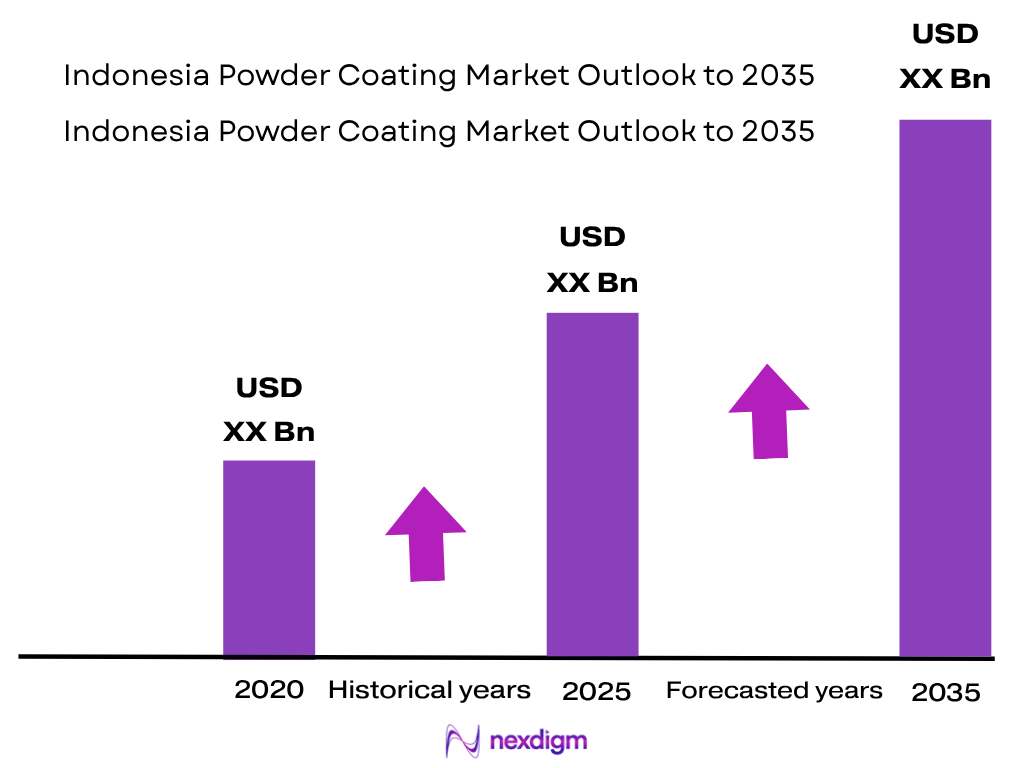
The Indonesia Powder Coating Market is represented at approximately USD ~ billion, using the requested placeholder for the base-year valuation. Demand is supported by manufacturing, consumer goods, automotive components, motorcycles, architectural aluminium and industrial fabrication. Domestic motorcycle sales increased from 6,236,992 units in the preceding observation to 6,333,310 units in the latest observation, while motorcycle exports moved from 570,004 units to 572,506 units, sustaining powder demand for frames, rims and fabricated components.
Greater Jakarta, Bekasi-Cikarang, Karawang, Tangerang-Banten, Surabaya-Sidoarjo and other Java manufacturing clusters dominate Indonesia’s powder-coating activity because they concentrate automotive, motorcycle, appliance, aluminium-extrusion and metalworking facilities. Indonesia operated 156 licensed industrial estates covering 76,594 hectares, with 48,087 hectares occupied, supporting dense OEM and supplier networks. Construction also remained the country’s fourth-largest economic sector, strengthening architectural aluminium, fabricated-steel and infrastructure-related powder-coating demand around major urban and industrial corridors.
Market Segmentation
By Resin Chemistry
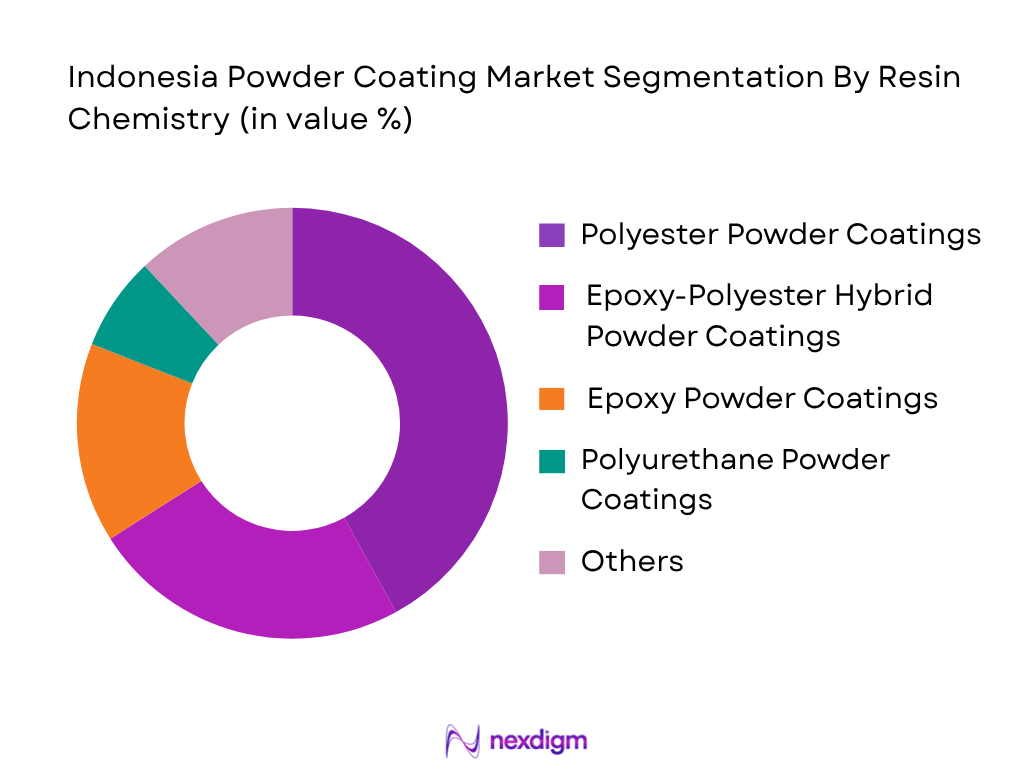
The Indonesia Powder Coating Market is segmented by resin chemistry into pure polyester, TGIC polyester, TGIC-free polyester, epoxy-polyester hybrid, pure epoxy, polyurethane, acrylic and specialty thermoplastic powders. Polyester powder coatings hold the dominant market position because Indonesia combines a tropical climate with substantial architectural aluminium, outdoor metalwork, motorcycle-component and general-industrial demand. Exterior profiles, doors, windows, façades, fences, outdoor furniture and fabricated equipment require UV stability and weather resistance, making polyester chemistry better suited than conventional indoor hybrids for many exposed applications. Indonesia also has a developed network of architectural powder applicators across West Java, Banten, Central Java, East Java and North Sumatra. Jotun’s Indonesian approved-applicator network includes companies in Cikarang, Tangerang, Semarang, Mojokerto, Sidoarjo and Medan-area markets using façade, super-durable and higher-performance architectural powder systems. Polyester additionally supports matt, textured and metallic finishes required by architectural and consumer-product manufacturers. Epoxy-polyester hybrids remain important for indoor appliances, furniture, shelving and industrial equipment because of their balance of appearance, mechanical properties and application versatility.
By End-Use Industry
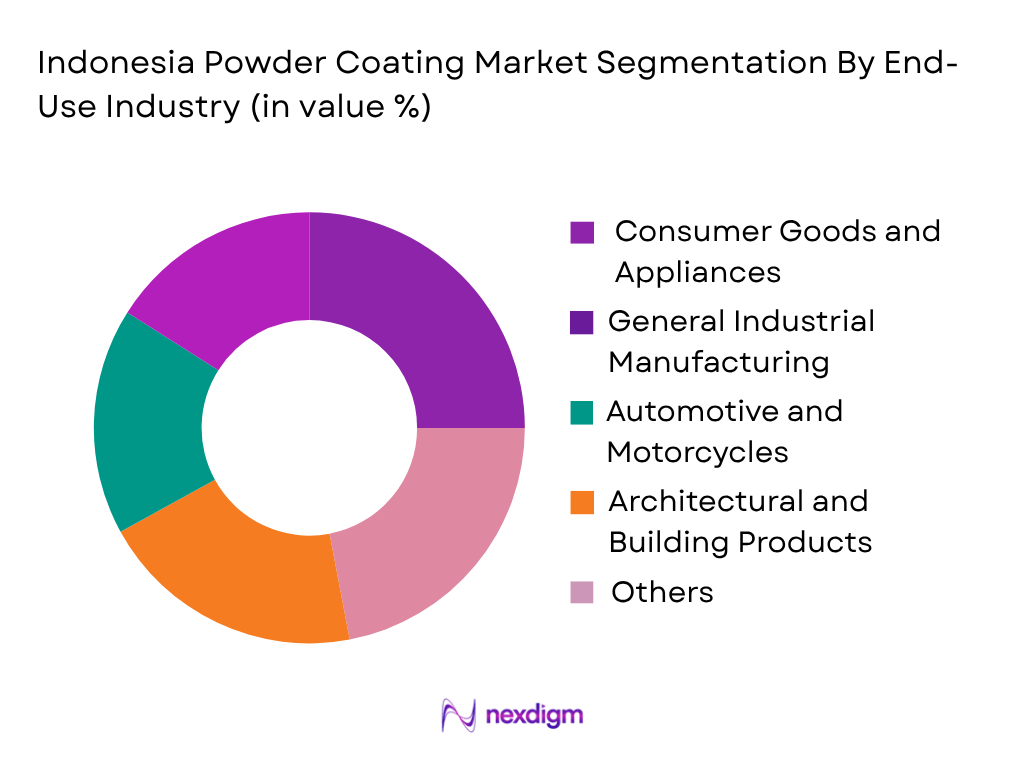
The Indonesia Powder Coating Market is segmented by end-use industry into consumer goods and appliances, general industrial manufacturing, automotive and motorcycles, architectural and building products, furniture and other industrial applications. Consumer goods and appliances represent the leading segment because powder coatings are extensively suitable for refrigerators, washing machines, air-conditioning equipment, metal cabinets, shelving, electrical housings and other factory-finished products requiring uniform appearance and durable surfaces. External country-level powder-coating research also identifies consumer goods as Indonesia’s leading application category. The segment is reinforced by Indonesia’s broader manufacturing scale and the clustering of appliance and electronics production across Java’s industrial corridors. General industrial demand remains substantial because Indonesia had 156 operational licensed industrial estates covering 76,594 hectares, providing a large installed customer base of fabricators and equipment manufacturers. Automotive and motorcycle applications are also significant: domestic motorcycle sales reached 6,333,310 units, creating recurring finishing requirements across frames, wheels, racks and component assemblies. Architectural applications benefit from urban construction and Indonesia’s sizeable aluminium fabrication ecosystem.
Competitive Landscape
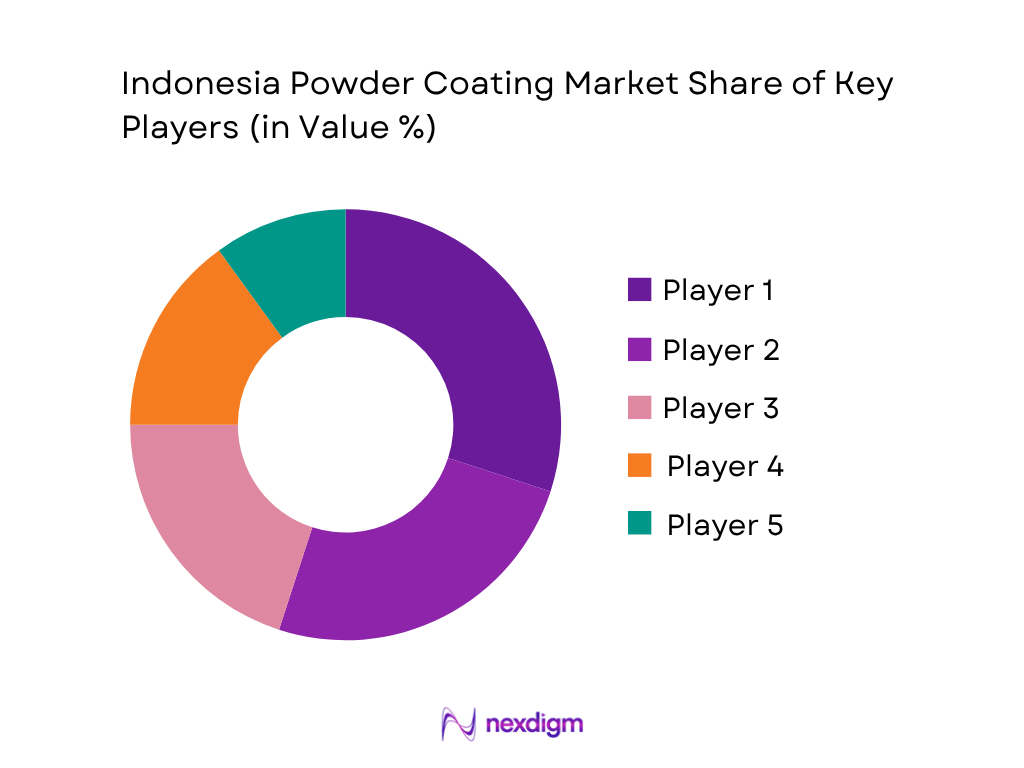
The Indonesia Powder Coating Market combines multinational coating groups with regional suppliers and specialist importers. Competition is concentrated around local availability, architectural qualification, resin breadth, colour matching, low-bake capability and technical support. Axalta maintains a dedicated powder-coating operation in the Jababeka Industrial Estate in Bekasi, while Jotun supports an extensive network of approved architectural applicators across Indonesia. Major suppliers increasingly compete through super-durable polyester, functional epoxy, corrosion-protection and material-efficient powder technologies rather than standard colours alone.
| Company | Establishment Year | Headquarters | Indonesia Presence | Key Powder Portfolio | Resin / Technology Capability | Major End Uses | Architectural / Corrosion Capability | Technical & Distribution Position |
| AkzoNobel | 1792 heritage | Amsterdam, Netherlands | ~ | ~ | ~ | ~ | ~ | ~ |
| Jotun | 1926 | Sandefjord, Norway | ~ | ~ | ~ | ~ | ~ | ~ |
| Axalta Coating Systems | 1866 heritage | Philadelphia, USA | ~ | ~ | ~ | ~ | ~ | ~ |
| PPG Industries | 1883 | Pittsburgh, USA | ~ | ~ | ~ | ~ | ~ | ~ |
| Nippon Paint | 1881 | Osaka, Japan | ~ | ~ | ~ | ~ | ~ | ~ |
Indonesia Powder Coating Market Analysis
Growth Drivers
Large Motorcycle, Automotive Component and Metal-Fabrication Manufacturing Base
Indonesia’s automotive and two-wheeler manufacturing ecosystem is a major demand driver for powder coatings because motorcycle frames, rims, brackets, racks, suspension components, automotive seat structures, wheels, battery enclosures and fabricated assemblies require durable corrosion protection and consistent factory-applied finishes. Indonesia recorded 6,333,310 motorcycles distributed domestically in 2024, compared with 6,236,992 units in 2023, while complete-motorcycle exports reached 572,506 units in 2024. Indonesia’s four-wheel vehicle industry also produced approximately 1.19 million vehicles in 2024, while complete built-up vehicle exports reached roughly 472,000 units. These physical production volumes create recurring demand for polyester, epoxy-polyester hybrid, epoxy primer and functional powder technologies across captive OEM lines and component suppliers. The automotive ecosystem is concentrated around Bekasi-Cikarang, Karawang, Greater Jakarta and Banten, allowing powder manufacturers, distributors and job coaters to serve dense groups of metal-processing customers. Indonesia’s nominal GDP reached IDR 22,139 trillion, equivalent to approximately USD 1,396 billion, in 2024, while GDP per capita reached IDR 78.6 million. The combination of millions of motorcycles, more than one million vehicles produced annually and a sizeable domestic manufacturing economy provides powder-coating suppliers with a recurring substrate base extending across steel, aluminium and fabricated assemblies.
Expansion of Industrial Estates and Manufacturing Clusters
Indonesia’s expanding industrial-estate ecosystem is a second structural growth driver because powder-coating demand is closely linked to concentrations of appliance factories, metal fabricators, electrical-equipment producers, automotive suppliers, machinery manufacturers and construction-product companies. Indonesia had 156 licensed and operating industrial-estate companies in July 2024, collectively covering 76,594 hectares. Of this land, 48,087 hectares had already been occupied by tenants or estate infrastructure, while another 26,381 hectares remained available for investment. These figures demonstrate a substantial existing manufacturing footprint capable of supporting new powder-coating lines, job coaters and downstream metal-processing capacity. Large clusters in West Java, Banten, Central Java and East Java are particularly important because they combine OEM manufacturing with aluminium processing, sheet-metal fabrication, electrical enclosures and appliance assembly. Powder coating benefits from this clustering because applicators can economically maintain stocked colours, pretreatment chemicals, recovery equipment and technical-service teams near multiple customers. Indonesia recorded nominal GDP of IDR 22,139 trillion in 2024, while international reserves reached USD 155.7 billion at the end of 2024 and GDP per capita reached IDR 78.6 million. Industrial estates additionally generate direct demand for coated gates, racks, warehouse equipment, electrical cabinets, HVAC systems, structural accessories and material-handling equipment.
Market Challenges
Weakness in Four-Wheel Vehicle Production and Sales
The contraction in Indonesia’s four-wheel vehicle industry creates a direct challenge for powder-coating suppliers serving automotive wheels, chassis components, brackets, seat structures, underbody components, battery housings and other fabricated metal parts. Indonesia recorded 865,723 wholesale vehicle sales in 2024, compared with 1,005,802 units in 2023, while retail sales totaled 889,680 vehicles. Domestic vehicle production reached approximately 1.19 million units in 2024, compared with around 1.395 million units in 2023, indicating lower factory utilization across assembly and component supply chains. The weakness continued into 2025, when national wholesale sales reached 803,687 units and retail sales stood at 833,692 units. Lower assembly volumes can affect powder demand disproportionately for qualified automotive applications because coating suppliers invest in colour approval, corrosion testing, line trials and customer-specific formulations that cannot always be redirected quickly toward other end uses. Indonesia’s broader economic base remained considerably larger than the automotive cycle alone, with nominal GDP of approximately USD 1,396 billion in 2024, national GDP of IDR 22,139 trillion, and foreign-exchange reserves of USD 155.7 billion at year-end. This divergence means powder producers need diversified positions across motorcycles, architectural aluminium, appliances, electrical equipment and general metal fabrication to reduce dependence on passenger-vehicle programs.
Imported Raw-Material Exposure and Rupiah-Linked Supply Risk
Indonesia’s powder-coating industry remains exposed to imported specialty inputs, creating a challenge for manufacturers that depend on polyester and epoxy resins, curing agents, titanium dioxide, specialty pigments, metallic effects and performance additives sourced through regional or global supply chains. This exposure becomes particularly relevant when the rupiah weakens because imported raw-material procurement, freight and inventory requirements are generally denominated directly or indirectly in foreign currencies. Indonesia’s average exchange rate moved from IDR 15,237 per US dollar in 2023 to IDR 15,855 in 2024, while the end-of-period exchange rate moved from IDR 15,399 to IDR 16,132 per US dollar. Total external debt also increased from USD 408.5 billion in 2023 to USD 426.1 billion in 2024, illustrating the broader economy’s continued interaction with foreign-currency financing and trade flows. Indonesia nevertheless maintained USD 155.7 billion in reserve assets at the end of 2024, providing a macroeconomic buffer against external volatility. For powder manufacturers, currency and import exposure can complicate raw-material planning because standard industrial products, architectural powders and high-performance functional systems require different resin, pigment and additive packages. A qualified curing agent, metallic pigment or corrosion additive cannot always be substituted without retesting colour, gloss, mechanical properties, cure response and corrosion performance, increasing supply-chain complexity.
Market Opportunities
Electric Vehicles, Battery Systems and Electrical Equipment Coatings
Indonesia’s emerging electric-vehicle ecosystem creates a forward-looking opportunity for powder coatings used on battery housings, module frames, electrical cabinets, busbars, charging equipment, motor components, underbody protection systems and thermally or electrically demanding metal assemblies. Battery-electric vehicle wholesale sales reached 23,900 units during January–April 2025, including 2,517 units in January, 5,183 units in February, 8,800 units in March and approximately 7,400 units in April. During January–November 2025, national battery-electric vehicle wholesales expanded to 82,525 units out of 710,084 total vehicle wholesales, demonstrating that electric drivetrains were moving from a niche application toward a meaningful manufacturing and component ecosystem. The opportunity for powder coatings extends beyond vehicle exterior parts because electrification increases the importance of dielectric insulation, corrosion resistance, edge coverage and consistent coating thickness on high-value electrical and structural components. Indonesia recorded nominal GDP of IDR 22,139 trillion or approximately USD 1,396 billion in 2024, with foreign-exchange reserves reaching USD 155.7 billion. Existing motorcycle scale further broadens the opportunity, with 6,333,310 motorcycles sold domestically in 2024. These current indicators support future demand for epoxy insulation powders, polyester exterior finishes, thermally durable systems, corrosion-resistant primers and specialized coatings for charging and power-distribution equipment.
Architectural Aluminium, Infrastructure and Corrosion-Resistant Powder Systems
Indonesia’s large construction and infrastructure base creates a significant opportunity for super-durable architectural polyester and high-corrosion-resistance powder systems used on aluminium profiles, curtain walls, windows, doors, railings, roofing accessories, electrical cabinets, street furniture and fabricated infrastructure components. Construction remained one of Indonesia’s largest economic activities in 2024, while total national GDP at current market prices reached IDR 22,139 trillion. The scale of industrial estates strengthens the opportunity further, with 156 operating industrial estates covering 76,594 hectares and 48,087 hectares already occupied. Every factory, warehouse, logistics building or processing facility generates potential downstream demand for powder-coated doors, windows, aluminium façades, HVAC equipment, electrical enclosures, fencing, storage systems and other fabricated products. Indonesia’s geographic conditions also make coating performance particularly important because many economic centres are located in humid tropical or coastal environments, creating technical requirements for exterior durability, corrosion resistance and stable colour retention. The macroeconomic foundation remains sizeable, with nominal GDP of approximately USD 1,396 billion in 2024 and international reserves of USD 155.7 billion. Suppliers capable of providing super-durable polyester, TGIC-free systems, corrosion-resistant primers and powder-on-powder protection can increasingly target architectural extruders, façade fabricators, industrial-estate contractors and metal-processing job coaters.
Future Outlook
The Indonesia Powder Coating Market is expected to expand at approximately ~6.5% CAGR during 2026–2035, using the requested placeholder assumption. Growth should increasingly come from super-durable architectural powders, motorcycles and EV components, appliance manufacturing, electrical equipment, industrial-estate expansion and corrosion-resistant infrastructure applications. Lower-temperature curing and higher transfer efficiency are likely to become more important as applicators seek better productivity. Local technical support, colour availability and application-line optimization will remain critical competitive differentiators.
Architectural powder coatings represent an important long-term development area because Indonesia’s climate exposes aluminium façades and exterior metalwork to intense UV radiation, humidity and rainfall. Suppliers already offer products targeted specifically at these conditions. Jotun Durasol is designed around QUALICOAT Class 3 and AAMA 2605 performance, while Super Durable carries QUALICOAT Class 2 and AAMA 2604 positioning. The existing network of qualified Indonesian applicators indicates a developed foundation for higher-durability architectural powder adoption.
Major Players
- PT International Paint Indonesia – AkzoNobel Interpon
- PT Jotun Powder Coatings Indonesia
- PT Axalta Powder Coating Systems Indonesia – Alesta / Nap-Gard
- PT Oxyplast Indonesia – Protech Group / Oxyplast
- PT PPG Coatings Indonesia – Envirocron
- Nippon Paint Indonesia
- Kansai Paint Indonesia
- The Sherwin-Williams Company – Powder Coatings / Inver
- TIGER Coatings – TIGER Drylac
- KCC Corporation
- IFS Coatings
- Pulver Kimya
- ST Powder Coatings
- Neokem
- Adapta Color
Key Target Audience
- Powder Coating Manufacturers
- Automotive, EV and Auto Component Manufacturers
- Motorcycle and Two-Wheeler Component Manufacturers
- Architectural Aluminium Extruders, Fabricators and Job Coaters
- Appliance, Electrical Equipment and Industrial Machinery Manufacturers
- Resin, Pigment, Additive and Powder Application Equipment Suppliers
- Investments and Venture Capitalist Firms
- Government and Regulatory Bodies (Ministry of Industry – Kemenperin, Ministry of Environment – KLH, National Standardization Agency of Indonesia – BSN, Ministry of Public Works – PU, Ministry of Investment and Downstream Industry/BKPM)
Research Methodology
Step 1: Identification of Key Variables
The initial phase involves constructing an ecosystem map covering all relevant participants in the Indonesia Powder Coating Market, including raw-material suppliers, powder formulators, distributors, job coaters, equipment suppliers and OEMs. Extensive secondary research is used to identify important variables such as resin chemistry, application technology, powder consumption, domestic production, imports, end-use activity and regional manufacturing concentration.
Step 2: Market Analysis and Construction
Historical market data is assessed through complementary top-down and bottom-up models. The top-down framework analyzes manufacturing, automotive, motorcycle, construction, appliance and industrial activity, while the bottom-up model evaluates supplier revenues, powder volumes, job-coater throughput and OEM consumption. Results are reconciled across resin chemistry and end-use segments to construct a consistent Indonesia Powder Coating Market model.
Step 3: Hypothesis Validation and Expert Consultation
Market hypotheses are subsequently validated through structured discussions and computer-assisted telephone interviews with powder manufacturers, distributors, applicators, equipment suppliers and industrial buyers. Consultations assess resin preferences, film thickness, curing profiles, powder recovery, colour-change requirements, qualification procedures and supplier-selection criteria. The resulting operational insights are used to refine market segmentation and test assumptions generated through secondary research.
Step 4: Research Synthesis and Final Output
The final phase triangulates manufacturer-level information with demand-side consumption indicators and end-use production activity. Powder volumes are cross-checked against application-line throughput, coating intensity, industry output and trade patterns. Findings from OEMs and job coaters are incorporated to validate the bottom-up analysis, resulting in a comprehensive view of market structure, competition, technology adoption and long-term opportunities within the Indonesia Powder Coating Market.

- Executive Summary
- Research Methodology (Market Definition and Scope, Indonesia Powder Coating Taxonomy, Thermoset and Thermoplastic Powder Classification, Resin Chemistry Mapping, Functional and Decorative Powder Classification, Substrate Mapping, Surface Pretreatment Assessment, Electrostatic Application Technology Assessment, Cure Technology Assessment, Film Thickness Assessment, Powder Recovery and Reclaim Assessment, Market Sizing Framework)

- Definition and Scope
- Indonesia Powder Coating Industry Evolution and Technology Development
- Powder Coating Manufacturing and Formulation Process
- Powder Coating Value Chain Analysis
- Indonesia Powder Coating Supply Chain Analysis
- Resin, Pigment, Additive and Filler Ecosystem Analysis
- Indonesia Powder Coating Import Dependency and Localization Assessment
- OEM Powder Coating Application Architecture and Job-Coater Solution Framework

- Growth Drivers (Expansion of Automotive and Motorcycle Manufacturing, Growth of Industrial Estates, Rising Architectural Aluminum Demand, Expansion of Appliance and Electronics Manufacturing, Increasing Industrial Metal Fabrication, Infrastructure Development, Liquid-to-Powder Conversion, Increasing Demand for Corrosion-Resistant Finishes)
- Market Challenges (Dependence on Imported Polyester and Epoxy Resins, Raw Material Supply Volatility, Energy-Intensive Cure Requirements, Pretreatment Quality Variation, Fragmented Job-Coater Ecosystem, Tropical Humidity and Corrosion Exposure, Price Competition from Imported Powders, Skilled Applicator Constraints)
- Market Opportunities (Super-Durable Architectural Powders, Low-Bake and Fast-Cure Powders, EV Battery and Electrical Insulation Powders, Motorcycle Component Powder Coatings, Marine and Coastal Corrosion-Protection Powders, Fusion-Bonded Epoxy Pipeline and Rebar Coatings, Localized Specialty Powder Manufacturing, Automated Powder Application Systems)
- Market Trends (TGIC-Free Polyester Adoption, Low-Bake Fast-Cure Systems, Super-Durable Architectural Powders, Metallic and Textured Finishes, Functional Powder Coatings, Robotic Powder Application, Dense-Phase Powder Delivery, Sustainable Solvent-Free Finishing)
- Regulatory and Standards Landscape (Ministry of Environment and Forestry Environmental Requirements, Ministry of Industry Manufacturing Requirements, Indonesian National Standard Requirements, Hazardous and Toxic Material Management Requirements, Occupational Safety and Health Standards, Industrial Air Emission Requirements, Combustible Powder Dust Safety Requirements, ASTM and ISO Powder Coating Test Standards)
- SWOT Analysis
- Porter’s Five Forces Analysis
- PESTLE Analysis
- Stakeholder Ecosystem
- Competition Ecosystem

- By Market Value (2020-2025)
- By Powder Coating Consumption Volume (2020-2025)
- By Coated Surface Area (2020-2025)
- By Domestic Production Volume (2020-2025)
- By Import Volume (2020-2025)
- By Export Volume (2020-2025)
- By Average Selling Price (2020-2025)
- By Thermoset Powder Consumption (2020-2025)
- By Thermoplastic Powder Consumption (2020-2025)

- By Resin Chemistry (In Value %)
Pure Polyester Powder Coatings
TGIC Polyester Powder Coatings
TGIC-Free Polyester Powder Coatings
Super-Durable Polyester Powder Coatings
Epoxy Powder Coatings
Epoxy-Polyester Hybrid Powder Coatings
Polyurethane Powder Coatings
Acrylic Powder Coatings
Fluoropolymer Powder Coatings
Silicone Polyester Powder Coatings
Nylon Powder Coatings
Polyethylene Powder Coatings
Other Specialty Thermoplastic Powders - By Coating Technology (In Value %)
Thermosetting Powder Coatings
Thermoplastic Powder Coatings
Low-Temperature Cure Powder Coatings
Low-Bake Fast-Cure Powder Coatings
Ultra-Low-Bake Powder Coatings
UV-Curable Powder Coatings
Thin-Film Powder Coatings
High-Temperature Resistant Powder Coatings - By Functional Performance (In Value %)
Decorative Powder Coatings
Corrosion-Resistant Powder Coatings
Super-Durable Architectural Powders
High-Temperature Powder Coatings
Electrical Insulation and Dielectric Powders
Antimicrobial Powder Coatings
Anti-Graffiti Powder Coatings
Scratch-Resistant Powder Coatings
Chemical-Resistant Powder Coatings
Marine and Coastal Corrosion-Protection Powders
Fire-Retardant Powder Coatings
Fusion-Bonded Epoxy Powders
Rebar Powder Coatings
Zinc-Rich and Zinc-Free Powder Primers - By End-Use Industry (In Value %)
Automotive and Auto Components
Motorcycles and Two-Wheeler Components
Architectural Aluminum and Building Products
General Industrial Manufacturing
Appliances and White Goods
Electrical and Electronics
Furniture and Metal Fabrication
HVAC and Refrigeration Equipment
Industrial Machinery and Equipment
Infrastructure and Construction
Agricultural and Construction Equipment
Oil and Gas Equipment
Marine and Shipbuilding
Renewable Energy Equipment
Telecommunication Equipment - By Distribution Channel (In Value %)
Direct Powder Manufacturer-to-OEM Sales
Direct Manufacturer-to-Job Coater Sales
Authorized Powder Coating Distributors
Industrial Paint and Coating Distributors
Regional Stocking Warehouses
Dealer and Reseller Networks
Equipment and Powder Bundled Distribution
Project-Specific Supply Contracts
Online B2B Industrial Platforms
Custom Color and Small-Batch Channels - By Region (In Value %)
Greater Jakarta
West Java
Banten
Central Java
East Java
North Sumatra
Riau
Riau Islands
South Sumatra
South Sulawesi
East Kalimantan
Batam
Bali
West Kalimantan
Remaining Indonesia

- Market Share of Major Players (By Revenue, Volume, Resin Chemistry, Powder Technology, End-Use Industry, Application Type, Market Type, Distribution Channel)
- Cross Comparison Parameters (Indonesia Powder Manufacturing and Supply Footprint, Resin Chemistry and Thermoset-Thermoplastic Portfolio Breadth, Low-Temperature and Fast-Cure Technology Capability, Super-Durable Tropical Architectural Powder Portfolio Strength, Automotive and Motorcycle Powder Coating Capability, Marine and Heavy-Corrosion Protection Capability, Custom Color Matching and Technical Application Support, Sustainable and TGIC-Free Low-Energy Powder Portfolio)
- SWOT Analysis of Major Players
- Competitive Positioning Matrix
- Pricing and Distribution Network Benchmarking
- Detailed Profiles of Major Companies
PT International Paint Indonesia – AkzoNobel Interpon
PT Jotun Powder Coatings Indonesia
PT Axalta Powder Coating Systems Indonesia – Alesta / Nap-Gard
PT Oxyplast Indonesia – Protech Group / Oxyplast
PT PPG Coatings Indonesia – Envirocron
Nippon Paint Indonesia
Kansai Paint Indonesia
The Sherwin-Williams Company – Powder Coatings / Inver
TIGER Coatings – TIGER Drylac
KCC Corporation
IFS Coatings
Pulver Kimya
ST Powder Coatings
Neokem
Adapta Color

- Buyer Segmentation
- OEM Procurement Behaviour
- Supplier Selection Criteria
- Buyer Pain Points
- Technology Adoption Assessment
- Replacement and Repurchase Behaviour

- By Market Value (2026-2035)
- By Powder Coating Consumption Volume (2026-2035)
- By Coated Surface Area (2026-2035)
- By Domestic Production Volume (2026-2035)
- By Import Volume (2026-2035)
- By Export Volume (2026-2035)
- By Average Selling Price (2026-2035)
- By Thermoset Powder Consumption (2026-2035)
- By Thermoplastic Powder Consumption (2026-2035)


 Request a Sample
 Ask for Customization
 Get a Quote
 Enquire Now