

 Download PDF
 Download PDF
Market Overview
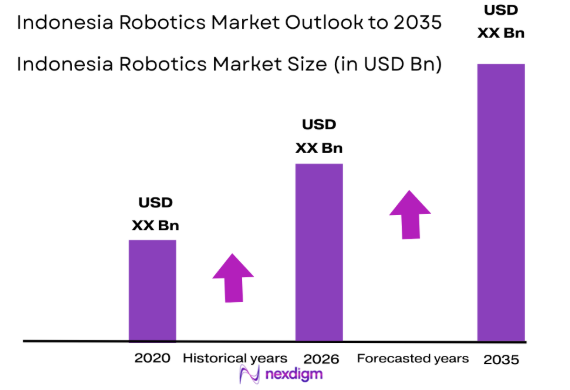
The Indonesia Robotics Market is expected to witness substantial growth, driven by the increasing adoption of automation technologies across various industries. The market size, valued in billions ~ USD, is primarily driven by the growing demand for robotics in manufacturing, logistics, and healthcare sectors. Technological advancements such as AI integration, the rise of collaborative robots, and automation in industries have been key catalysts for market expansion. The government’s push for Industry 4.0 also enhances the integration of robotics into manufacturing processes, further propelling market growth.
Indonesia is emerging as a prominent player in the robotics industry, with Jakarta and Surabaya being major cities leading the adoption of robotic technologies. These cities are supported by government policies, investments in infrastructure, and the establishment of tech hubs. Additionally, Indonesia’s growing manufacturing sector, particularly in automotive and electronics, has spurred the demand for industrial robots. This combination of urbanization, industrial development, and government initiatives has solidified Indonesia’s position as a leading market for robotics in Southeast Asia.
Market Segmentation
By Product Type
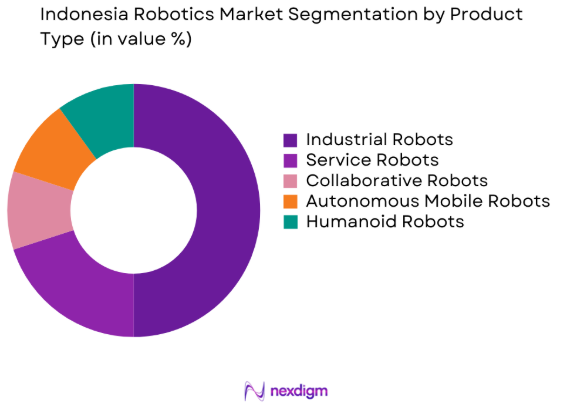
The Indonesia Robotics Market is segmented by product type into industrial robots, service robots, collaborative robots, autonomous mobile robots, and humanoid robots. The industrial robots sub-segment dominates the market due to the increasing automation of manufacturing processes, particularly in the automotive and electronics sectors. The rise of Industry 4.0, coupled with labor cost reduction and productivity improvements, has driven this shift toward industrial robots, leading to their dominant market share. The demand for service robots and collaborative robots is also growing but remains secondary to industrial robots.
By Platform Type
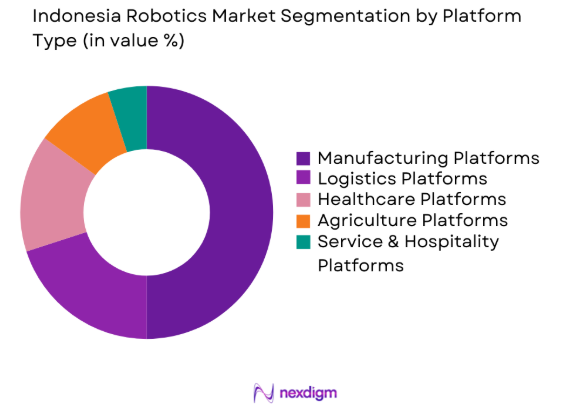
The market is segmented by platform type into manufacturing platforms, logistics platforms, healthcare platforms, agriculture platforms, and service & hospitality platforms. Manufacturing platforms have the largest market share, driven by Indonesia’s booming manufacturing sector, which heavily relies on automation for increased efficiency. The demand for robotics in logistics is also expanding due to the rise of e-commerce and the need for improved warehouse management systems. Healthcare and agriculture platforms are emerging as growing segments, but they currently contribute less to the overall market compared to manufacturing.
Competitive Landscape
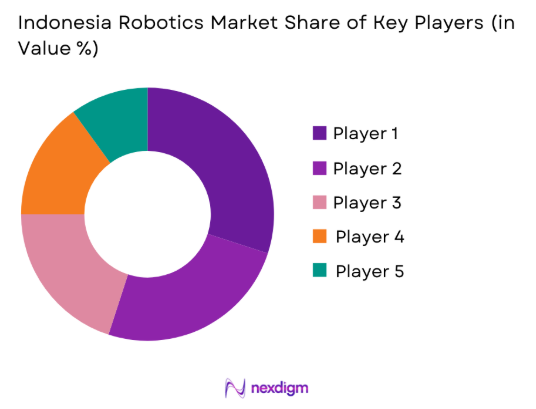
The competitive landscape of the Indonesia Robotics Market is characterized by both local and international players vying for market share. Key players are focusing on technological advancements, strategic partnerships, and expansion to maintain their competitive edge. Major players are increasing their investments in automation solutions, leading to market consolidation. As the demand for robotics solutions across industries grows, the market is witnessing the entry of new players, which is intensifying competition.
| Company Name | Establishment Year | Headquarters | Technology Focus | Market Reach | Key Products | Revenue | Additional Market-Specific Parameter |
| ABB | 1988 | Switzerland | ~ | ~ | ~ | ~ | ~ |
| KUKA | 1898 | Germany | ~ | ~ | ~ | ~ | ~ |
| Yaskawa Electric | 1915 | Japan | ~ | ~ | ~ | ~ | ~ |
| FANUC | 1956 | Japan | ~ | ~ | ~ | ~ | ~ |
| Universal Robots | 2005 | Denmark | ~ | ~ | ~ | ~ | ~ |
Indonesia Robotics Market Analysis
Growth Drivers
Technological Advancements in Robotics
Technological advancements in robotics, particularly the development of collaborative robots (cobots), are major drivers of growth in the Indonesia Robotics Market. Cobots, which work alongside human operators, are enhancing safety and reducing costs, making them ideal for small and medium-sized enterprises. The integration of artificial intelligence (AI) and machine learning allows robots to perform more complex tasks, boosting their applicability across diverse sectors. These innovations are improving operational efficiency and increasing productivity, driving the demand for robotics solutions in industries such as manufacturing, logistics, and healthcare. The growing sophistication of robotics technology is making automation more accessible and valuable, further accelerating the adoption of robotics in Indonesia.
Government Support for Automation and Industry 4.0
The Indonesian government’s support for automation and Industry 4.0 is a key growth driver for the robotics market. Policies such as tax incentives for automation technologies, government-backed funding for robotics research, and the creation of industrial parks are encouraging businesses to adopt robotics solutions. These initiatives are designed to enhance Indonesia’s manufacturing capabilities, reduce operational costs, and improve global competitiveness. By fostering technology adoption and supporting smart manufacturing, the government plays a crucial role in driving market expansion. This proactive approach to automation and digital transformation is expected to continue fueling growth in the robotics sector, positioning Indonesia as a leader in the Southeast Asian market.
Market Challenges
High Initial Capital Investment
A major challenge hindering the growth of the Indonesia Robotics Market is the high initial investment required for robotics adoption. While robotics offers long-term productivity gains, the upfront cost of purchasing and implementing systems can be a significant barrier, especially for small and medium-sized enterprises (SMEs). Additionally, ongoing expenses such as maintenance, training, and the need for skilled labor to operate the systems further increase the financial burden. These costs are particularly challenging for industries with narrow profit margins, making widespread robotics adoption difficult. As a result, the financial obstacles remain a critical challenge, limiting the growth of robotics across various sectors in Indonesia.
Lack of Skilled Workforce
The shortage of skilled labor to operate and maintain advanced robotics systems is a significant challenge for the Indonesia Robotics Market. While interest in automation is rising, there is a limited supply of workers proficient in robotics, AI, and related technologies. Companies are often forced to invest heavily in training programs or collaborate with external partners to bridge this skills gap. This shortage of qualified personnel hinders the widespread adoption of robotics, particularly in emerging sectors like healthcare and agriculture, where automation is still in the early stages. The lack of a skilled workforce not only slows down the adoption of robotics but also impacts the effectiveness of the systems deployed, limiting their potential benefits.
Opportunities
Adoption of Robotics in Healthcare
The healthcare sector in Indonesia offers a significant opportunity for robotics companies. As the demand for advanced medical devices, surgical robots, and automated systems in hospitals and clinics rises, robotics can play a crucial role in surgeries, rehabilitation, and healthcare facility management. These solutions help improve patient outcomes and enhance operational efficiency. With an aging population and increasing healthcare demands, robotics adoption in this sector is expected to grow rapidly. This shift presents a strong growth opportunity for robotics market players, enabling them to meet the evolving needs of the healthcare industry while contributing to improved healthcare services and patient care across Indonesia.
Expansion of Robotics in Agriculture
Agriculture in Indonesia is progressively adopting robotics to boost productivity and address labor shortages while meeting the growing demand for food. Robotics solutions are being employed for various agricultural tasks, such as planting, harvesting, and crop monitoring, significantly improving operational efficiency. The Indonesian government’s backing of smart agriculture initiatives, coupled with ongoing advancements in robotic farming technologies, creates a substantial growth opportunity. As automation becomes more prevalent in the agricultural sector, robotics will play a key role in reducing costs, enhancing crop yields, and optimizing farming practices. This trend is poised to revolutionize the agriculture industry, making it more sustainable, efficient, and capable of meeting the increasing food production needs of the country.
Future Outlook
Over the next five years, the Indonesia Robotics Market is expected to grow significantly, driven by technological advancements, increased adoption of robotics in various industries, and government support for Industry 4.0 initiatives. The market will see increased demand for both industrial and service robots, with manufacturing, logistics, and healthcare sectors leading the way. Regulatory support for automation and technological developments in AI, machine learning, and collaborative robotics will further boost the market. As robotics becomes more affordable and accessible, smaller businesses will also begin integrating automation into their operations, contributing to market growth.
Major Players
- ABB
- KUKA
- Yaskawa Electric
- FANUC
- Universal Robots
- Stäubli Robotics
- Rethink Robotics
- IRobot
- NACHI-FUJIKOSHI
- Epson Robots
- Denso Robotics
- Omron Corporation
- Honda Robotics
- Mitsubishi Electric
- Boston Dynamics
Key Target Audience
- Investments and venture capitalist firms
- Government and regulatory bodies
- Automation solution providers
- Manufacturing industry leaders
- Healthcare institutions
- E-commerce and logistics companies
- Agricultural technology firms
- Robotics technology developers
Research Methodology
Step 1: Identification of Key Variables
The first step involves identifying the key variables that influence the robotics market, including product types, platform types, and end-user sectors. These variables guide the scope of the research and determine the areas to focus on.
Step 2: Market Analysis and Construction
Market analysis is carried out by evaluating the demand for robotics across different sectors, identifying growth drivers, challenges, and trends. This analysis helps in constructing a clear picture of market dynamics.
Step 3: Hypothesis Validation and Expert Consultation
The next step involves validating hypotheses with the help of expert consultations and industry insights. This ensures the accuracy of the research and alignment with real-world scenarios.
Step 4: Research Synthesis and Final Output
Finally, the research findings are synthesized, and the final report is produced, presenting a comprehensive analysis of the robotics market in Indonesia, including market size, segmentation, trends, and key players.

- Executive Summary
- Research Methodology (Definitions, Scope, Industry Assumptions, Market Sizing Approach, Primary & Secondary Research Framework, Data Collection & Verification Protocol, Analytic Models & Forecast Methodology, Limitations & Research Validity Checks)

- Market Definition and Scope
- Value Chain & Stakeholder Ecosystem
- Regulatory / Certification Landscape
- Sector Dynamics Affecting Demand
- Strategic Initiatives & Infrastructure Growth

- Growth Drivers
Technological Advancements in Robotics
Government Support for Industrial Automation
Increased Demand for Automation in Manufacturing - Market Challenges
High Initial Investment Costs
Technological Integration and Interoperability Issues
Shortage of Skilled Workforce - Market Opportunities
Expansion of Robotics in Healthcare
Growth in Collaborative Robot Adoption
Rising Demand for Automation in E-commerce and Logistics - Trends
Increasing Use of AI in Robotics
Rise of Autonomous Mobile Robots
Surge in Robotics in Agricultural Automation - Government Regulations
- SWOT Analysis of Key Competitors
- Porter’s Five Forces

- By Market Value, 2020-2025
- By Installed Units, 2020-2025
- By Average System Price, 2020-2025
- By System Complexity Tier, 2020-2025

- By System Type (In Value%)
Industrial Robots
Service Robots
Collaborative Robots
Autonomous Mobile Robots
Humanoid Robots - By Platform Type (In Value%)
Manufacturing Platforms
Logistics Platforms
Healthcare Platforms
Agriculture Platforms
Service & Hospitality Platforms - By Fitment Type (In Value%)
On-premise Solutions
Cloud-based Solutions
Hybrid Solutions
Modular Solutions
Integrated Solutions - By End User Segment (In Value%)
Manufacturing Industry
Healthcare Sector
Logistics & Warehousing
Agricultural Sector
Service & Hospitality Industry - By Procurement Channel (In Value%)
Direct Procurement
Government Tenders
Private Sector Procurement
Online Bidding Platforms
Third-party Distributors

- Market Share Analysis
- Cross Comparison Parameters (System Type, Platform Type, Procurement Channel, End User Segment, Fitment Type, Regional Deployment, Automation Level, Product Complexity, Technology Integration, Service Model)
- SWOT Analysis of Key Competitors
- Pricing & Procurement Analysis
- Key Players
ABB
KUKA
Yaskawa Electric
FANUC
Universal Robots
Stäubli Robotics
Rethink Robotics
iRobot
NACHI-FUJIKOSHI
Epson Robots
Denso Robotics
Omron Corporation
Honda Robotics
Mitsubishi Electric
Boston Dynamics

- Growing Adoption in Manufacturing and Production
- Expansion in the Healthcare Sector
- Increase in Logistics and Warehouse Automation
- Emerging Applications in Agriculture

- Forecast Market Value, 2026-2035
- Forecast Installed Units, 2026-2035
- Price Forecast by System Tier, 2026-2035
- Future Demand by Platform, 2026-2035


 Request a Sample
 Ask for Customization
 Get a Quote
 Enquire Now