

 Download PDF
Market Overview
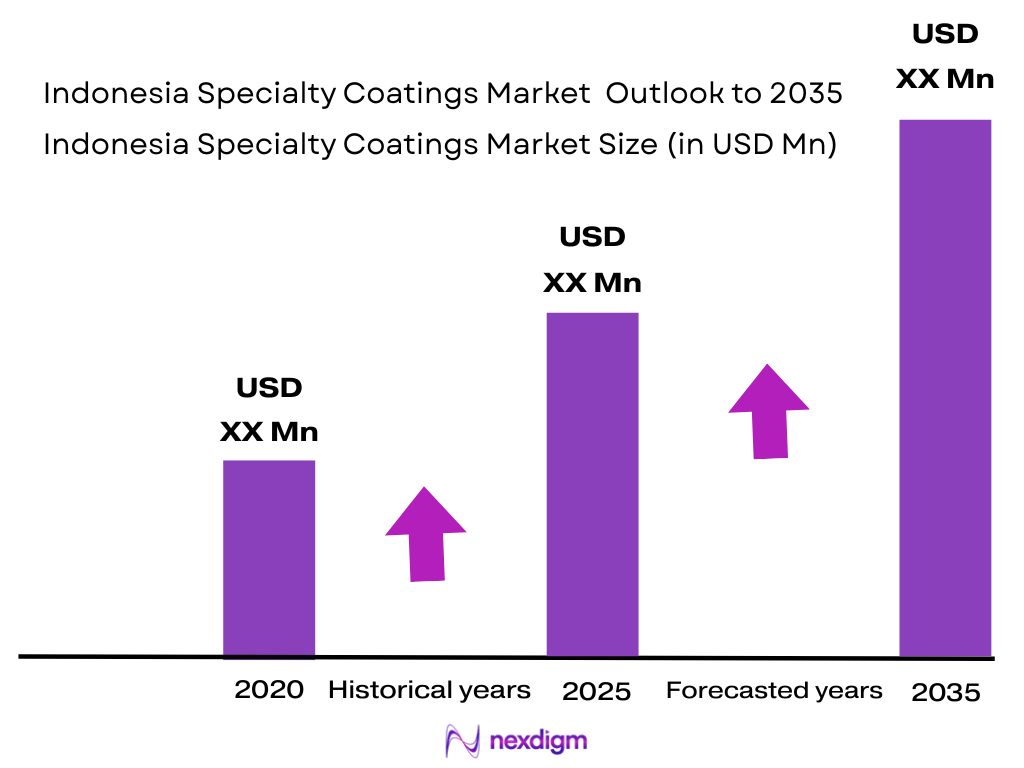
The Indonesia Specialty Coatings Market is valued at ~USD XX billion in 2024, supported by demand from automotive manufacturing, infrastructure development, marine applications, oil and gas, mining, electronics, industrial equipment and construction sectors. Indonesia recorded a GDP of approximately USD 1.37 trillion in 2024, compared with USD 1.32 trillion in 2023, while economic growth remained around 5.0 according to World Bank estimates. Industrial expansion, infrastructure investment and manufacturing activities continue to generate demand for corrosion-resistant, heat-resistant and functional coating solutions.
Indonesia Specialty Coatings Market is dominated by major industrial regions including Jakarta, West Java, East Java, Batam and Central Java, due to their concentration of manufacturing facilities, automotive production, electronics clusters, shipyards and industrial infrastructure. West Java contributed significantly to Indonesia’s manufacturing ecosystem, while Jakarta remained the primary commercial and industrial distribution hub. Indonesia’s manufacturing sector contributed approximately 18.7% of GDP in 2024, supported by automotive, electronics, chemicals and fabricated metal industries, creating consistent requirements for specialty coating technologies.
Market Segmentation
By Resin Type
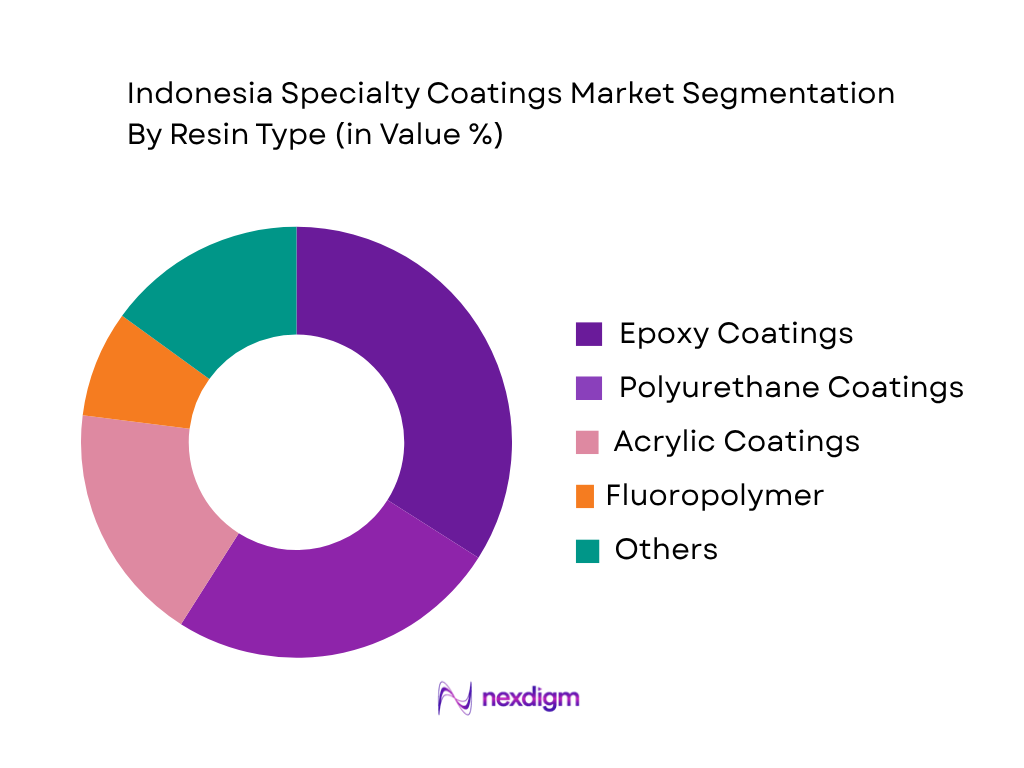
The Indonesia Specialty Coatings Market is segmented by resin type into epoxy coatings, polyurethane coatings, acrylic coatings, fluoropolymer coatings, alkyd coatings and silicone coatings. Epoxy coatings represent the dominant segment due to their extensive use in industrial flooring, marine protection, oil and gas infrastructure and heavy equipment applications. Their high adhesion strength, chemical resistance and corrosion protection properties make them suitable for Indonesia’s humid climate and industrial operating conditions. The country’s expanding mining, manufacturing and infrastructure sectors require durable protective coatings to reduce maintenance requirements and extend asset life. Automotive facilities, shipyards and energy operators increasingly utilize epoxy-based systems for metal protection and industrial applications. The availability of established supply networks and compatibility with multiple industrial substrates further strengthens epoxy coating adoption across Indonesia.
By Application Industry
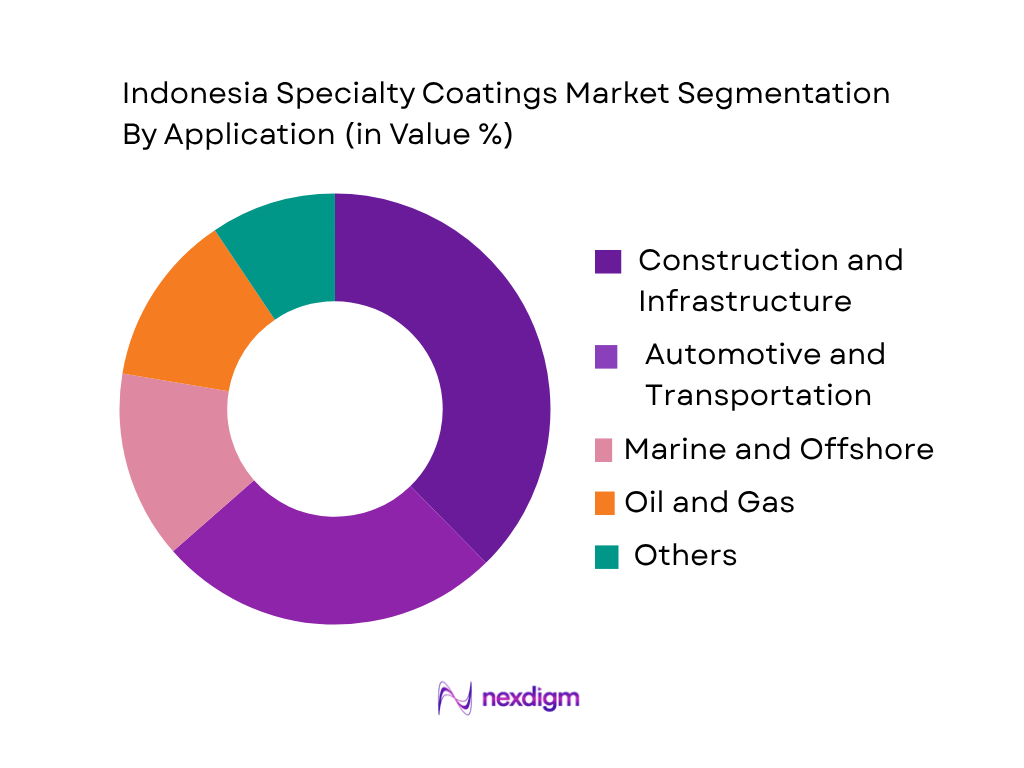
The Indonesia Specialty Coatings Market is segmented by application industry into construction and infrastructure, automotive, marine, oil and gas, industrial equipment and electronics. Construction and infrastructure is expected to represent the leading segment due to Indonesia’s continued urban development, transportation projects and industrial facility expansion. Protective coatings are widely used in bridges, pipelines, commercial buildings and industrial structures to prevent corrosion and improve durability. Indonesia’s infrastructure development agenda has increased demand for high-performance coatings capable of protecting assets under tropical weather conditions. Marine and offshore applications also contribute significantly due to Indonesia’s extensive coastline and shipping activities. Automotive and electronics manufacturing further support demand through requirements for decorative, protective and functional coating solutions used in vehicles, components and precision equipment.
Competitive Landscape
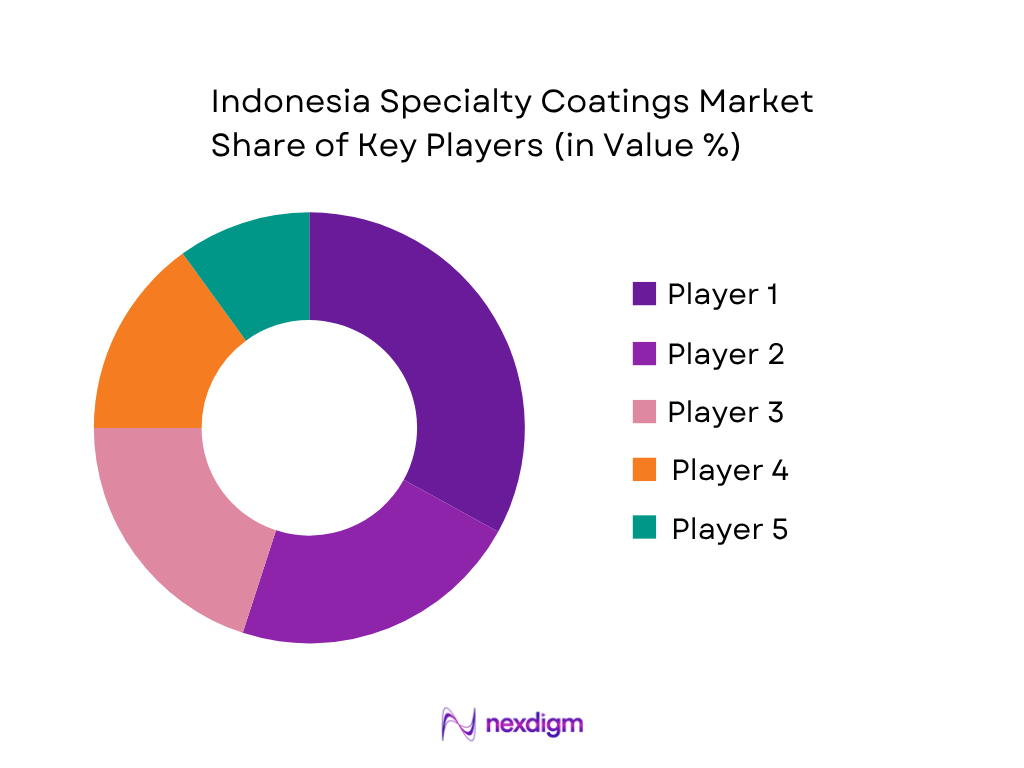
The Indonesia Specialty Coatings Market is moderately consolidated, with global coating manufacturers and regional producers competing across industrial, protective and functional coating applications. Major players focus on expanding product portfolios, developing sustainable coating technologies and strengthening distribution networks to serve Indonesia’s diverse industrial sectors.
| Company | Establishment Year | Headquarters | Specialty Coating Portfolio | Major Application Areas | Indonesia Market Presence | Key Strengths | Technology Focus | Distribution Capability |
| AkzoNobel | 1994 | Amsterdam, Netherlands | ~ | ~ | ~ | ~ | ~ | ~ |
| PPG Industries | 1883 | Pittsburgh, USA | ~ | ~ | ~ | ~ | ~ | ~ |
| Nippon Paint Holdings | 1881 | Tokyo, Japan | ~ | ~ | ~ | ~ | ~ | ~ |
| Jotun | 1926 | Sandefjord, Norway | ~ | ~ | ~ | ~ | ~ | ~ |
| BASF Coatings | 1865 | Ludwigshafen, Germany | ~ | ~ | ~ | ~ | ~ | ~ |
Indonesia Specialty Coatings Market Analysis
Market Growth Drivers
Semiconductor and Electronics Manufacturing Expansion
The Indonesia Specialty Coatings Market is supported by the expansion of electronics manufacturing, semiconductor assembly, and electrical component production, where specialty coatings are required for insulation, corrosion protection, thermal management and contamination control. Indonesia’s economy recorded a GDP of approximately USD 1.37 trillion in 2024, reflecting continued industrial expansion and investment activity. The manufacturing sector remained one of the largest contributors to national economic output, accounting for approximately 18% of GDP in 2024, according to national economic statistics. Indonesia’s electronics industry continues to develop through investments in consumer electronics, electrical components, telecommunications equipment and industrial automation systems. Industrial clusters in Batam, West Java, Jakarta and East Java are creating demand for coatings used in electronic housings, machinery components, cleanroom equipment and production infrastructure. Specialty coatings with properties such as chemical resistance, anti-static performance and moisture protection are increasingly required due to Indonesia’s tropical climate conditions and high-humidity operating environments. Expansion of electronics supply chains and increasing manufacturing localization initiatives are expected to strengthen demand for advanced coating technologies across industrial facilities and electronic production environments.
Infrastructure Development Programs and Industrial Manufacturing Growth
The Indonesia Specialty Coatings Market benefits from infrastructure development and industrial manufacturing expansion, as protective coatings are extensively used in bridges, transportation systems, industrial facilities, pipelines and heavy machinery. Indonesia allocated approximately IDR 423.4 trillion for infrastructure spending in the 2024 national budget, supporting transportation, public facilities and industrial infrastructure projects. The country’s construction sector contributed approximately 10% of GDP in 2024, creating continuous requirements for anti-corrosion and protective coating solutions. Infrastructure assets operating in Indonesia’s tropical climate require coatings capable of resisting humidity, chemical exposure and environmental degradation. Industrial manufacturing growth also supports specialty coating demand through applications in machinery, processing equipment, warehouses and production facilities. Indonesia’s manufacturing base includes automotive, food processing, chemicals, mining and metal industries, all requiring durable coating systems to improve asset lifespan and reduce maintenance requirements. Increased development of industrial estates across Java, Sumatra and Sulawesi is creating additional opportunities for specialty coating suppliers providing high-performance protective solutions.
Market Challenges
Imported Specialty Raw Material Dependency
The Indonesia Specialty Coatings Market faces challenges due to dependence on imported specialty raw materials, including advanced resins, additives, pigments and performance-enhancing chemicals required for high-performance formulations. Indonesia’s industrial sector relies on global chemical supply chains for several specialized coating ingredients that are not produced domestically at sufficient scale. The country recorded total imports of approximately USD 221.9 billion in 2024, highlighting the importance of international supply networks for industrial materials and manufacturing inputs. Specialty coating manufacturers are exposed to fluctuations in global chemical availability, transportation costs and currency movements. Advanced applications such as semiconductor coatings, marine protection systems and aerospace-grade coatings require highly specialized materials with strict technical specifications. Limited domestic production of high-performance resin systems creates challenges for local manufacturers seeking to expand advanced coating capabilities. Dependence on imported raw materials also affects supply reliability, production planning and cost management. Companies operating in Indonesia’s specialty coatings sector need to strengthen supplier diversification, develop localized formulation capabilities and invest in alternative raw material sources to reduce exposure to external supply disruptions.
Environmental Compliance Requirements and VOC Restrictions
The Indonesia Specialty Coatings Market faces increasing challenges related to environmental regulations, VOC restrictions and the transition toward sustainable coating technologies. Industrial users are increasingly demanding coatings that provide high performance while meeting environmental and workplace safety requirements. Indonesia generated approximately 68 million tonnes of municipal solid waste in 2024, increasing government focus on sustainable industrial practices and responsible chemical management. Coating manufacturers are required to develop low-emission solutions, including water-based coatings, powder coatings and bio-based formulations. Traditional solvent-based coatings remain important for several industrial applications due to performance advantages, but regulatory pressure is encouraging technology transformation. Manufacturers must invest in research and development to maintain corrosion resistance, durability and chemical performance while reducing environmental impact. Smaller coating producers may face difficulties related to technology upgrades, compliance costs and technical expertise requirements. Increasing environmental awareness among industrial customers and stricter chemical management standards are expected to accelerate adoption of sustainable specialty coating systems in Indonesia.
Market Opportunities
EV Component Coatings and Semiconductor Protective Coatings
The Indonesia Specialty Coatings Market presents significant opportunities from electric vehicle component protection and semiconductor-related applications as the country develops advanced manufacturing capabilities. Indonesia produced approximately 1.2 million motor vehicles in 2024, creating a strong automotive ecosystem supporting demand for specialized coatings. Electric vehicle components such as battery enclosures, electrical systems, charging infrastructure and lightweight materials require coatings with thermal resistance, corrosion protection and electrical insulation properties. Indonesia’s government has also promoted electric vehicle manufacturing through industrial development initiatives, encouraging investments in battery and vehicle production facilities. Semiconductor and electronics applications represent another opportunity due to increasing demand for protective coatings used in precision equipment, electronic components and manufacturing systems. Indonesia’s electrical and electronics exports reached approximately USD 10 billion in 2024, reflecting continued importance of technology-based manufacturing activities. Specialty coatings suppliers developing thermal management coatings, anti-static coatings and chemical-resistant solutions can address growing requirements from automotive electrification and electronics manufacturing sectors.
Anti-Corrosion Infrastructure Coatings and Sustainable Coating Technologies
The Indonesia Specialty Coatings Market has strong opportunities from anti-corrosion infrastructure coatings and sustainable coating solutions due to the country’s large infrastructure base and environmental requirements. Indonesia operates more than 65,000 kilometers of national and provincial roads, along with extensive bridges, ports and industrial facilities requiring long-term protection against corrosion. Tropical weather conditions, high humidity and coastal exposure create significant demand for protective coating technologies. Offshore energy projects, marine infrastructure and industrial facilities require advanced coatings capable of extending asset life and reducing maintenance frequency. Sustainable technologies including water-based coatings, bio-based coatings and low-VOC formulations are gaining importance as industries focus on environmental compliance. Indonesia’s renewable energy development also creates demand for protective coatings for solar structures, wind components and energy infrastructure. Smart functional coatings, thermal barrier coatings and antimicrobial coatings provide additional growth opportunities across industrial, healthcare and commercial applications. Companies investing in environmentally responsible formulations and application-specific technologies are positioned to benefit from Indonesia’s transition toward advanced material solutions.
Future Outlook
Over the next decade, the Indonesia Specialty Coatings Market is expected to demonstrate steady growth driven by industrial expansion, infrastructure development and increasing adoption of advanced coating technologies. Demand will be supported by automotive manufacturing, electronics production, renewable energy infrastructure and marine applications. Sustainable coating solutions including water-based, bio-based and low-VOC technologies are expected to gain importance as industries focus on environmental compliance. Advanced functional coatings designed for thermal management, corrosion protection and antimicrobial applications will create new opportunities across industrial sectors.
Major Players
- AkzoNobel
- PPG Industries
- Sherwin-Williams
- Nippon Paint Holdings
- Jotun
- Hempel
- BASF Coatings
- Axalta Coating Systems
- Kansai Paint
- Sika Indonesia
- Asian Paints
- Chugoku Marine Paints
- RPM International
- Tnemec Company
- PT Propan Raya ICC
Key Target Audience
- Specialty coatings manufacturers and formulators
- Automotive and electric vehicle manufacturers
- Semiconductor and electronics manufacturing companies
- Marine, offshore and shipbuilding companies
- Oil and gas exploration and production companies
- Construction and infrastructure development companies
- Investments and venture capitalist firms (advanced materials, industrial chemicals and manufacturing sectors)
- Government and regulatory bodies (Ministry of Industry Indonesia, Ministry of Environment and Forestry Indonesia, Indonesia Investment Coordinating Board (BKPM), Ministry of Public Works and Housing Indonesia)
Research Methodology
Step 1: Identification of Key Variables
The initial phase involves developing an ecosystem map of the Indonesia Specialty Coatings Market by identifying coating manufacturers, raw material suppliers, industrial users, distributors, applicators and regulatory institutions. Secondary research is conducted to analyse market structure, coating technologies, end-use industries, supply chain dynamics and factors influencing specialty coating adoption across Indonesia.
Step 2: Market Analysis and Construction
This stage involves analysing historical market conditions, industrial consumption patterns, application demand and production capabilities. The assessment evaluates specialty coating requirements across automotive, construction, marine, electronics, oil and gas, mining and industrial equipment sectors. Market estimation incorporates supply-side evaluation, demand assessment, import dependency analysis and industrial activity indicators.
Step 3: Hypothesis Validation and Expert Consultation
Market assumptions are validated through consultations with coating manufacturers, industrial buyers, application contractors and technical specialists. Expert discussions provide insights into product performance requirements, technology adoption, regulatory compliance, competitive strategies and future application trends in Indonesia’s specialty coatings industry.
Step 4: Research Synthesis and Final Output
The final phase integrates primary and secondary findings to develop a comprehensive market assessment. The analysis combines market segmentation, competitive landscape, industry drivers, challenges, opportunities and future trends to provide strategic insights for stakeholders operating in the Indonesia Specialty Coatings Market.

- Executive Summary
- Research Methodology (Market Definition, Specialty Coating Classification, Market Sizing Framework, Demand-Side Analysis, Supply-Side Assessment, Production Capacity Evaluation, Import-Export Analysis, Primary Industry Interviews, Secondary Data Validation, Bottom-Up Market Estimation, Top-Down Market Validation, Data Triangulation, Forecasting Framework, Research Limitations)

- Definition and Scope of Specialty Coatings Market
- Evolution of Specialty Coatings Industry in Indonesia
- Historical Development of Protective and Functional Coating Applications
- Indonesia Specialty Coatings Value Chain Analysis

- Growth Drivers (Semiconductor and Electronics Manufacturing Expansion, Automotive Production Growth, Infrastructure Development Programs, Industrial Manufacturing Growth, Oil and Gas Asset Protection Requirements, Marine Industry Expansion, Mining Sector Development, Palm Oil Processing Industry Demand)
- Market Challenges (Imported Specialty Raw Material Dependency, Resin Price Volatility, Environmental Compliance Requirements, VOC Restrictions, Limited Advanced Coating Manufacturing Capability, Skilled Application Workforce Shortage, Technology Qualification Barriers, Supply Chain Disruptions)
- Market Opportunities (EV Component Coatings, Semiconductor Protective Coatings, Anti-Corrosion Infrastructure Coatings, Offshore Energy Protection Coatings, Sustainable Water-Based Coatings, Bio-Based Coatings, Smart Functional Coatings, Thermal Barrier Coatings, Antimicrobial Surface Technologies)
- Market Trends (Low-VOC Coating Adoption, Sustainable Coating Development, Powder Coating Expansion, High-Performance Protective Coatings, Functional Surface Technologies, Smart Coating Solutions, Customized Industrial Coating Systems)
- Regulations and Industry Standards (Indonesian Environmental Regulations, VOC Emission Control Requirements, Chemical Management Regulations, Industrial Safety Standards, Marine Coating Standards, Construction Material Compliance Requirements)
- SWOT Analysis
- Porter’s Five Forces Analysis
- PESTLE Analysis

- By Market Value (2020-2025)
- By Volume Consumption (2020-2025)
- By Average Selling Price (2020-2025)

- By Resin Type (In Value %)
Epoxy Coatings
Polyurethane Coatings
Acrylic Coatings
Alkyd Coatings
Fluoropolymer Coatings
Silicone Coatings
Polyaspartic Coatings
Other Specialty Resin Systems - By Technology Type (In Value %)
Water-Based Specialty Coatings
Solvent-Based Specialty Coatings
Powder Coatings
Radiation-Cured Coatings
High-Solid Coatings
Nano-Enhanced Coatings - By Functionality (In Value %)
Anti-Corrosion Coatings
Heat Resistant Coatings
Chemical Resistant Coatings
Anti-Microbial Coatings
Anti-Fouling Coatings
Fire Protection Coatings
Self-Cleaning Coatings
Thermal Management Coatings - By Application Industry (In Value %)
Automotive and Transportation Coatings
Electrical and Electronics Coatings
Marine and Offshore Coatings
Oil and Gas Protective Coatings
Construction and Infrastructure Coatings
Industrial Equipment Coatings
Energy Sector Coatings
Food Processing Equipment Coatings - By Distribution Channel (In Value %)
Direct Industrial Sales
Specialty Chemical Distributors
Coating Applicators and Contractors
OEM Supply Networks
Online Industrial Distribution Platforms - By Region (In Value %)
Java Region
Sumatra Region
Kalimantan Region
Sulawesi Region
Eastern Indonesia

- Market Share Analysis of Major Players (By Revenue, Product Category, Application Industry, Technology Type, Distribution Network)
- Cross Comparison Parameters (Product Portfolio Breadth, Specialty Coating Technology Range, Resin Manufacturing Capability, Industrial Application Expertise, Distribution Network Coverage, Production Capacity, Sustainability-Focused Product Development, Research and Development Capability)
- Pricing Analysis (By Product Type, Resin Category, Application Industry, Performance Grade)
- SWOT Analysis of Major Players
- Detailed Profiles of Major Companies
Major Specialty Coatings Manufacturers
AkzoNobel
PPG Industries
Sherwin-Williams
Nippon Paint Holdings
Jotun
Hempel
BASF Coatings
Axalta Coating Systems
Kansai Paint
Sika Indonesia
Asian Paints
Chugoku Marine Paints
RPM International
Tnemec Company
PT Propan Raya ICC

- Industrial Consumption Assessment
- Automotive Manufacturers
- Electronics and Semiconductor Companies
- Oil and Gas Operators
- Marine and Shipbuilding Companies
- Construction Developers
- Mining Companies
- Industrial Equipment Manufacturers

- By Market Value (2026-2035)
- By Volume Consumption (2026-2035)
- By Average Selling Price (2026-2035)


 Request a Sample
 Ask for Customization
 Get a Quote
 Enquire Now