

 Download PDF
 Download PDF
Market Overview
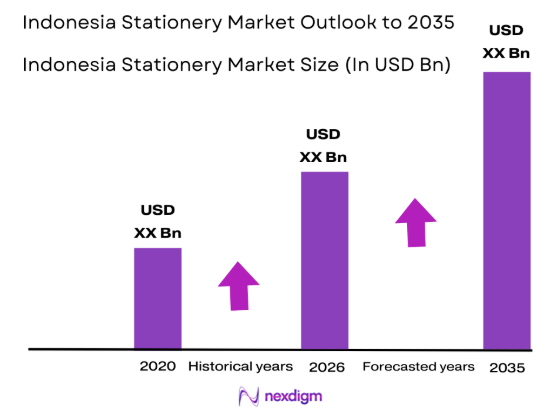
The Indonesia Stationery market current size stands at around USD ~ million and remains supported by recurring school-related purchases, office consumption, home-organization demand, and replacement-led buying patterns across writing instruments, notebooks, art materials, and basic desk supplies. Demand is reinforced by broad product accessibility, strong low-ticket purchase frequency, and a wide mix of branded and economy offerings. The market continues to show resilience because stationery products remain embedded in everyday education, administrative, and household routines throughout the country’s consumption ecosystem.
Jakarta remains the most influential commercial center for stationery demand due to dense corporate activity, modern retail concentration, publishing linkages, and stronger distribution networks. Surabaya and Bandung also contribute meaningfully because of educational density, wholesale movement, and active SME clusters. Central Java cities support notebook and paper product turnover through school-led purchasing cycles, while Denpasar and Makassar benefit from tourism-linked office demand and urban retail expansion. Regions with stronger logistics connectivity, organized trade penetration, and warehousing capacity continue to attract faster brand expansion and broader product availability.
Market Segmentation
By Category
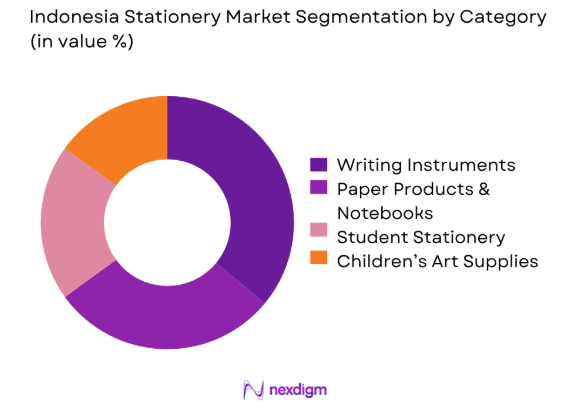
Writing instruments remain the most commercially dominant category within Indonesia’s stationery market because they combine high purchase frequency, low replacement cycle, and broad demand across students, offices, and households. Ballpoint pens, gel pens, pencils, and refills benefit from routine repeat buying and widespread distribution through school stores, general trade, supermarkets, and e-commerce. Paper products and notebooks maintain strong relevance, particularly during school reopening cycles, but tend to face sharper seasonality. Student stationery and children’s art supplies are expanding due to parental spending on school preparedness and creative learning. Overall, writing instruments lead because they serve both necessity-driven and impulse-led demand across formal and informal retail channels nationwide.
By Distribution Channel
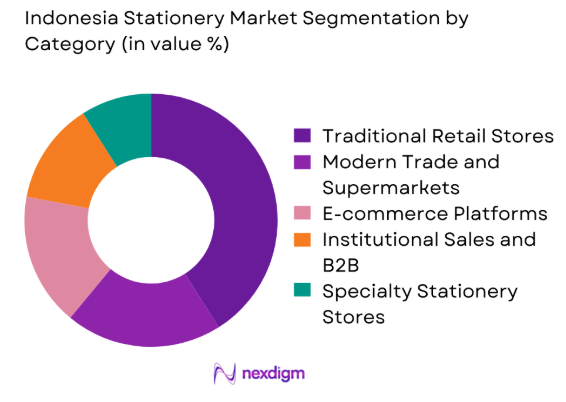
Traditional retail stores continue to dominate Indonesia’s stationery market because neighborhood bookstores, school-adjacent shops, kiosks, and wholesale outlets remain highly accessible and trusted for everyday replenishment purchases. These channels benefit from proximity-based buying, cash transactions, and immediate product availability, especially for low-ticket items such as pens, notebooks, erasers, and refills. Modern trade and specialty stores contribute stronger branded visibility and organized merchandising, while institutional B2B channels are important for offices and schools. E-commerce is expanding rapidly due to assortment depth, bundled deals, and convenience, but offline channels still lead because stationery remains a frequent, urgent, and tactile purchase category for most Indonesian consumers.
Competitive Landscape
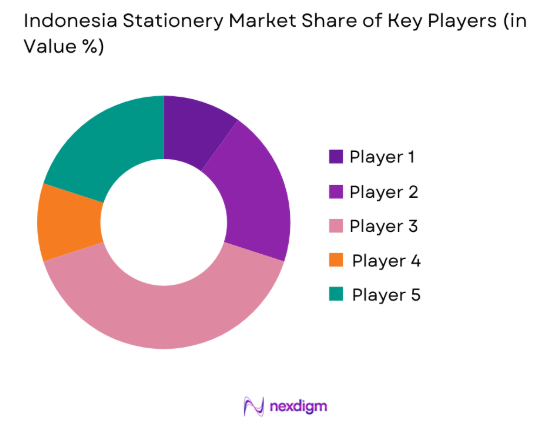
Indonesia’s stationery market is characterized by a mix of domestic manufacturers, imported brands, paper-focused producers, and retail-led private label participants. Competition is shaped by pricing accessibility, SKU breadth, school season visibility, wholesale penetration, and retail execution across urban and secondary city markets.
| Company Name | Establishment Year | Headquarters | Formulation Depth | Distribution Reach | Regulatory Readiness | Service Capability | Channel Strength | Pricing Flexibility |
| PT Standardpen Industries | 1971 | Jakarta, Indonesia | ~ | ~ | ~ | ~ | ~ | ~ |
| PT Faber-Castell International Indonesia | 1978 | Jakarta, Indonesia | ~ | ~ | ~ | ~ | ~ | ~ |
| PT Zebra Asaba Industries | 1994 | Jakarta, Indonesia | ~ | ~ | ~ | ~ | ~ | ~ |
| PT Kokuyo International Indonesia | 2013 | Jakarta, Indonesia | ~ | ~ | ~ | ~ | ~ | ~ |
| PT Sinar Dunia | 1966 | Sidoarjo, Indonesia | ~ | ~ | ~ | ~ | ~ | ~ |
Indonesia Stationery Market Analysis
Growth Drivers
Rising student population and education enrollment rates
Indonesia’s education pipeline continues to support stationery demand through a large school-age population and sustained enrollment participation across basic and secondary education. According to national education statistics, student participation in primary and junior secondary systems remained above 90 during 2024, while senior secondary participation continued improving across urban provinces. Government-backed school operational assistance also sustained routine procurement of notebooks, writing tools, and classroom supplies. In 2025, the Ministry of Religious Affairs and the national school system together served tens of millions of learners across general and religious streams. This recurring academic base directly reinforces annual replenishment cycles for pens, paper products, geometry tools, and student-use stationery.
Expansion of organized retail and e-commerce platforms
The rapid development of organized retail and digital commerce is strengthening stationery accessibility across Indonesia. During 2024 and 2025, major marketplace ecosystems continued broadening seller participation, delivery coverage, and bundled back-to-school merchandising. National digital commerce activity remained among the highest in Southeast Asia, supported by strong mobile internet usage and rising cashless transaction adoption. Convenience-driven purchasing increasingly benefits notebooks, pens, markers, art kits, and office supplies because these items are easy to compare, bundle, and reorder online. Meanwhile, supermarkets, bookstores, and chain retailers continue expanding shelf visibility in metropolitan and tier-two urban centers, enabling stronger brand discovery and broader consumer access.
Challenges
Price sensitivity and dominance of low-cost imports
Price sensitivity remains one of the most persistent structural challenges in Indonesia’s stationery market, particularly in mass-market school and household categories. Low-ticket purchases are heavily influenced by affordability, making consumers and small retailers highly responsive to cheaper imported alternatives. Import flows of low-cost writing and desk accessories continue to pressure domestic brand positioning, especially in generic pens, correction products, and school utility items. During 2024 and 2025, household spending remained selective across lower-income groups, with non-essential trade-down behavior visible in several consumer categories. As a result, many stationery buyers prioritize functional adequacy over premium design, reducing pricing power and limiting branded product upgrade opportunities.
Fluctuating raw material costs such as paper and plastic
Raw material volatility continues to affect the Indonesian stationery market through input exposure to paper pulp, plastic resins, packaging materials, and imported components. Stationery manufacturers remain vulnerable to global commodity shifts, shipping disruptions, and exchange-rate pass-through, especially for products using polymer casings, inks, synthetic packaging, and coated paper. In 2024 and 2025, manufacturers across consumer goods sectors faced ongoing procurement pressure from imported intermediate inputs and freight normalization imbalances. For notebook and paper-heavy product lines, upstream cost changes can disrupt production planning and margin stability. This challenge is particularly important for value-focused suppliers that serve schools, wholesalers, and traditional trade channels.
Opportunities
Growth in eco-friendly and sustainable stationery products
Sustainability-led product development presents a meaningful growth opportunity in Indonesia’s stationery market as consumers, schools, and modern retailers become more receptive to environmentally responsible alternatives. During 2024 and 2025, Indonesia continued implementing broader waste reduction and circular economy priorities, creating a more favorable context for recycled paper notebooks, refill-based pens, biodegradable packaging, and reusable school accessories. Urban middle-income households are increasingly aware of material quality, safety, and packaging waste, particularly in products purchased for children. Retailers also prefer sustainability-linked assortments that improve shelf differentiation. This creates room for brands to expand certified paper ranges, low-plastic designs, and refill-compatible writing systems.
Expansion of premium and branded stationery segments
Premiumization offers a strong opportunity as Indonesian consumers increasingly associate stationery with self-expression, gifting, school identity, and workspace aesthetics. During 2024 and 2025, organized retail and digital channels amplified visibility for design-led notebooks, smooth-writing pens, artistic markers, and curated desk accessories. This trend is especially relevant among urban students, young professionals, creators, and office workers seeking functional yet visually appealing products. Rising participation in journaling, calligraphy, illustration, and productivity planning is also lifting interest in branded and specialty items. As purchasing shifts beyond pure utility, manufacturers can capture higher-value demand through upgraded materials, ergonomic designs, themed collections, and better packaging presentation.
Future Outlook
Indonesia’s stationery market is expected to remain fundamentally resilient through 2035, supported by education-linked consumption, office supply replenishment, retail formalization, and stronger online product discovery. Future expansion is likely to be shaped by premiumization, eco-friendly innovation, school-cycle demand, and broader penetration into secondary cities. Writing instruments and notebooks should continue leading demand, while art supplies and branded lifestyle stationery are expected to gain momentum among younger urban consumers.
Major Players
- PT Standardpen Industries
- PT Faber-Castell International Indonesia
- PT Zebra Asaba Industries
- PT Kokuyo International Indonesia
- PT Kenko Sinar Indonesia
- PT Solo Murni
- PT Sinar Dunia
- PT Mitra Kerinci
- PT Pabrik Kertas Tjiwi Kimia Tbk
- PT Gramedia Asri Media
- PT M&G Stationery Indonesia
- PT Deli Group Indonesia
- PT Lion Stationery Indonesia
- PT Penlenindo Saranabakti
- PT Bantex Indonesia
Key Target Audience
- Stationery manufacturers and brand owners
- Paper and notebook producers
- Importers and national distributors
- Modern retail and bookstore chains
- E-commerce marketplace operators
- Corporate and institutional procurement teams
- Investments and venture capital firms
- Government and regulatory bodies including Ministry of Trade, Ministry of Industry, Ministry of Education, Culture, Research, and Technology, and Directorate General of Customs and Excise
Research Methodology
Step 1: Identification of Key Variables
The study framework was built by identifying the most relevant variables influencing Indonesia’s stationery market, including category demand, school-led purchasing cycles, channel behavior, retail shelf dynamics, and import dependence. Product classes, end-user patterns, and regional demand centers were mapped to establish the analytical structure for market interpretation.
Step 2: Market Analysis and Construction
The market was constructed through structured evaluation of product categories, channel movement, company participation, consumer use cases, and institutional demand patterns. Historic performance across 2024 and 2025 was interpreted through product accessibility, retail spread, purchasing frequency, and supply-side movement to build a robust view of current market conditions.
Step 3: Hypothesis Validation and Expert Consultation
All working assumptions were tested through consultations with channel participants, category specialists, distributors, procurement stakeholders, and trade-side operators. Validation focused on pricing tiers, school demand behavior, retail stocking logic, brand movement, and product substitution patterns across writing instruments, notebooks, student supplies, and art-related stationery.
Step 4: Research Synthesis and Final Output
Final findings were synthesized into a publication-ready market narrative by integrating demand indicators, supply structure, segmentation logic, competition patterns, and forward-looking opportunity themes. Each section was aligned to ensure consistency, strategic usability, and practical decision-making relevance for investors, operators, distributors, and commercial planning teams.

- Executive Summary
- Research Methodology (Market Definitions and product classification framework, Primary interviews with manufacturers distributors and retailers, Trade data analysis and import export benchmarking, Pricing and SKU level tracking across channels, Consumer usage and purchase behavior assessment, Retail audit and channel mapping across urban and rural regions, Validation through industry associations and company reports)

- Definition and Scope
- Market evolution across traditional and modern retail
- Usage patterns across education corporate and personal segments
- Ecosystem structure including manufacturers distributors and retailers
- Supply chain and channel dynamics including offline and e-commerce
- Regulatory environment including import duties and local manufacturing policies

- Growth Drivers
Rising student population and education enrollment rates
Expansion of organized retail and e-commerce platforms
Increasing office setup and SME growth
Growing demand for creative and art supplies
Product innovation and branding by key players
Urbanization and rising disposable income - Challenges
Price sensitivity and dominance of low-cost imports
Fluctuating raw material costs such as paper and plastic
Limited differentiation in commoditized product categories
Counterfeit and unbranded product competition
Supply chain inefficiencies in remote regions
Environmental concerns related to paper usage - Opportunities
Growth in eco-friendly and sustainable stationery products
Expansion of premium and branded stationery segments
Increasing demand for personalized and customized products
Digital integration with smart stationery solutions
Untapped rural and tier 2 and tier 3 markets
Institutional bulk procurement opportunities - Trends
Shift towards eco-friendly and recycled materials
Increasing popularity of aesthetic and premium stationery
Growth of online stationery marketplaces
Bundling of products for school and office use
Rising influence of social media on product choices
Adoption of ergonomic and functional designs - Government Regulations
- SWOT Analysis
- Stakeholder and Ecosystem Analysis
- Porter’s Five Forces Analysis
- Competition Intensity and Ecosystem Mapping

- By Value, 2020–2025
- By Volume, 2020–2025
- By Distribution Channel, 2020–2025
- By Average Selling Price, 2020–2025

- By Category (in Value %)
Writing Instruments
– Gel Pens
– Ballpoint Pens (Medium Oil-Based)
– Heat-Erasable Pens
– Highlighters
– Fountain Pens
– Pencils
– Refills
Paper Products & Notebooks (in Value %)
– Exercise Books / Workbooks
– Notebooks
– Other Paper Products
Student Stationery
– Erasers
– Correction Tape / Liquid
– Sharpeners
– Rulers & Compasses
– Pencil Cases / Bags
Children’s Art Supplies
– Markers / Watercolor Pens
– Paints
– Crayons
– Oil Pastels
– Colored Pencils - By Distribution Channel (in Value %)
Traditional Retail Stores
Modern Trade and Supermarkets
E-commerce Platforms
Institutional Sales and B2B
Specialty Stationery Stores - By End User (in Value %)
Students and Educational Institutions
Corporate Offices
Government Organizations
Artists and Hobbyists
Household Consumers - By Age Group (in Value %)
Children (3–12 Years)
Teenagers (13–18 Years)
Young Adults (19–24 Years)
Adults (25–44 Years)
Mature Adults (45 Years and Above)

- Market structure and competitive positioning
- Market share snapshot of major players
- Cross Comparison Parameters (Product Portfolio Breadth with pricing by SKU, Core Category Strength, Price Positioning, Brand Recognition, Product Quality Perception, Revenue, Revenue split by products, Revenue split by distribution channel, Distribution Reach, Traditional Trade Presence, Modern Trade Presence, E-commerce Presence, Institutional Sales Strength, School Channel Penetration, Corporate / Office Channel Strength, Innovation Pipeline, Localization / Product Adaptation, Sustainability Positioning, Manufacturing Footprint, Sourcing Footprint, Supply Chain Strength, Promotional Strength, Overall Competitive Position)
- SWOT Analysis of Key Players
- Pricing and Commercial Model Benchmarking
- Detailed Profiles of Major Companies
PT Standardpen Industries
PT Faber-Castell Indonesia
PT Zebra Asaba Industries
PT BIC Indonesia
PT Pilot Pen Indonesia
PT Kokuyo Indonesia
PT Dong-A Indonesia
PT Kenko Sinar Abadi
PT Shachihata Indonesia
PT Atali Makmur
PT Gramedia Asri Media
PT Maped Indonesia
PT Deli Indonesia
PT Snowman Indonesia
PT Artline Indonesia

- Demand and Utilization Drivers
- Procurement and Tender Dynamics
- Buying Criteria and Vendor Selection
- Need, Desire, and Pain Points
- Current Product Gap in the Market
- Implementation Barriers and Risk Factors
- Post-Purchase Service Expectations

- By Value, 2026–2035
- By Volume, 2026–2035
- By Distribution Channel, 2026–2035
- By Average Selling Price, 2026–2035


 Request a Sample
 Ask for Customization
 Get a Quote
 Enquire Now