
 Download PDF
 Download PDF
Market Overview
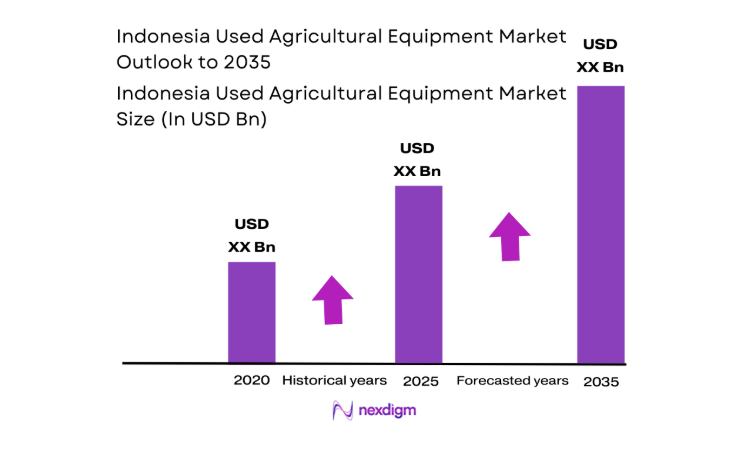
The Indonesia Used Agricultural Equipment market current size stands at around USD ~ million, reflecting steady transactional activity across refurbished tractors, harvesters, and power tillers circulated through dealer networks and informal resale channels. Demand is supported by replacement cycles for aging machinery, constrained access to new equipment financing, and active cross-border inflows of refurbished units. The market operates through a fragmented ecosystem of independent dealers, service workshops, auctions, and peer-to-peer exchanges, with quality variability influencing purchasing confidence and lifecycle value.
Java remains the dominant demand center due to dense farm clusters, superior logistics, and proximity to dealer and service ecosystems. Secondary hubs across Sumatra and Sulawesi benefit from plantation agriculture and contract service providers, while Kalimantan and eastern regions exhibit emerging demand tied to infrastructure access and mechanization programs. Ecosystem maturity varies by province, shaped by availability of refurbishment capabilities, parts distribution, and local policy support for mechanization adoption and aftersales service development.
Market Segmentation
By Equipment Type
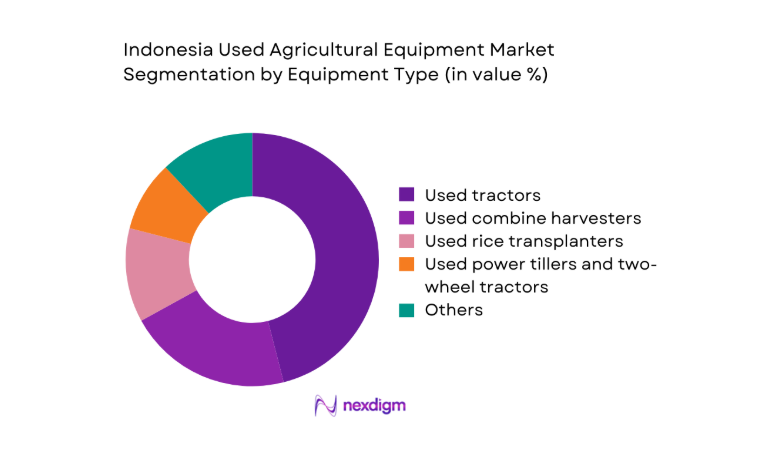
Used tractors dominate transactional activity due to broad applicability across rice, corn, and mixed farming systems, supported by abundant availability from fleet turnover and imports of refurbished compact models. Harvesters and transplanters follow, driven by labor substitution needs in rice-growing regions, while post-harvest equipment demand reflects smallholder efforts to reduce losses and improve throughout. Irrigation pumps and sprayers exhibit resilient turnover because of shorter service lives and frequent replacement cycles. Dealer stocking strategies prioritize fast-moving compact units with standardized parts, while specialized equipment circulates through targeted regional channels.
By Sales Channel
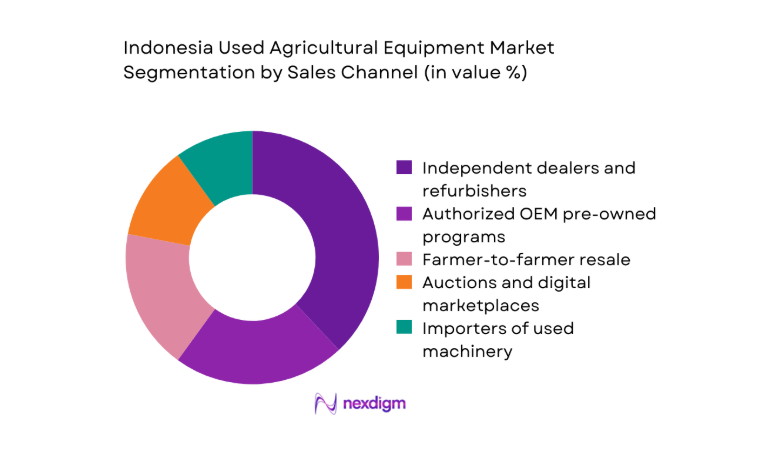
Independent dealers and refurbishers lead transactions due to price flexibility, localized service access, and acceptance of mixed-condition inventory. Authorized pre- owned programs attract risk-averse buyers seeking warranties and standardized refurbishment, particularly among cooperatives and commercial farms. Farmer-to-farmer resale remains active in remote areas where formal channels are thin, while auctions and digital marketplaces improve discovery and price transparency. Importers of used machinery serve regional dealers with bulk supply, influencing channel dynamics through inventory availability, lead times, and compliance readiness.
Competitive Landscape
The competitive landscape is characterized by a mix of authorized pre-owned programs, independent refurbishes, regional distributors, and importers supplying reconditioned machinery. Differentiation centers on refurbishment depth, service coverage, parts availability, financing partnerships, and channel reach across key agricultural provinces.
| Company Name | Establishment Year | Headquarters | Formulation Depth | Distribution Reach | Regulatory Readiness | Service Capability | Channel Strength | Pricing Flexibility |
| Kubota Corporation | 1890 | Osaka, Japan | ~ | ~ | ~ | ~ | ~ | ~ |
| Yanmar Co., Ltd. | 1912 | Osaka, Japan | ~ | ~ | ~ | ~ | ~ | ~ |
| CNH Industrial | 2013 | Amsterdam, Netherlands | ~ | ~ | ~ | ~ | ~ | ~ |
| AGCO Corporation | 1990 | Duluth, United States | ~ | ~ | ~ | ~ | ~ | ~ |
| John Deere | 1837 | Moline, United States | ~ | ~ | ~ | ~ | ~ | ~ |
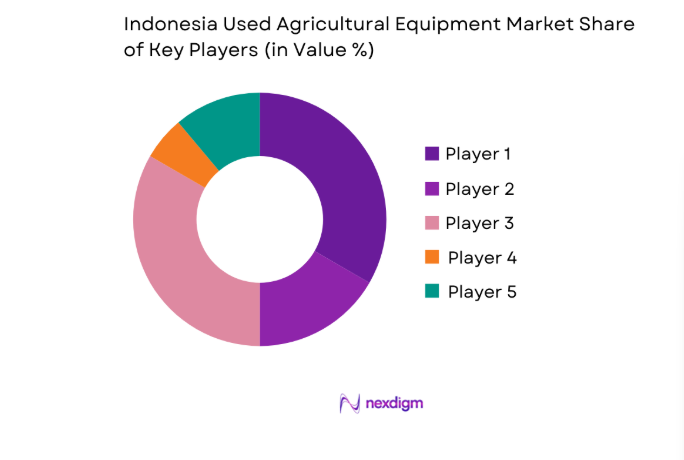
Indonesia Used Agricultural Equipment Market Analysis
Growth Drivers
Rising mechanization needs among smallholders
Smallholders cultivate fragmented plots averaging 2 hectares, with labor shortages accelerating adoption of compact machinery for land preparation and harvesting. Government extension services recorded 124 district mechanization clinics operational in 2024, facilitating equipment access and operator training. Rural wage rates increased by 18 between 2022 and 2024, raising demand for labor-substituting equipment. Import clearances for reconditioned compact tractors reached 6420 units in 2024, improving availability. Road density expanded by 312 kilometers across key agricultural corridors in 2025, reducing transport friction for equipment distribution and service access in peri-urban farming clusters.
High new equipment prices driving secondary market demand
Access to new machinery is constrained by household credit limits and collateral requirements, pushing buyers toward refurbished alternatives. Agricultural credit approvals totaled 194000 accounts in 2024, while rejection rates remained elevated across smallholder segments. Public procurement programs prioritized shared machinery pools, recording 2860 units deployed through district cooperatives in 2023 and 2024. Import lead times for refurbished units averaged 47 days in 2025, enabling faster acquisition than new equipment allocations. Dealer inventory turnover improved to 5 cycles annually in high-demand provinces, reflecting substitution behavior toward used equipment pathways.
Challenges
Limited access to financing for used equipment purchases
Formal lenders favor new assets with standardized documentation, limiting credit for refurbished machinery lacking verifiable condition histories. In 2024, only 31 cooperative-linked financing schemes included used equipment as eligible collateral. Microfinance penetration in rural districts reached 284 institutions in 2025, yet underwriting criteria excluded older serials. Loan tenors averaged 24 months, misaligned with equipment life cycles extending beyond 60 months. Default management protocols tightened following 2023 portfolio stress tests conducted by regulators. Limited insurance coverage options further restrict bankability, dampening purchase conversion among smallholders and contractors.
Inconsistent quality and lack of refurbishment standards
Refurbishment practices vary widely across workshops, creating information asymmetry and performance uncertainty. Provincial industry offices accredited 79 repair centers in 2024, covering only major corridors. Parts traceability remains fragmented, with 412 distinct aftermarket suppliers operating in 2025. Inspection protocols differ by dealer, and standardized grading is absent across regions. Failure rates for hydraulic systems reported by service centers rose by 14 between 2022 and 2024. Regulatory audits increased in 2025, yet enforcement capacity remains constrained by limited inspectors and uneven compliance documentation across provincial jurisdictions.
Opportunities
Expansion of OEM-certified pre-owned programs
Certified programs can address quality risk through standardized inspection, warranties, and parts support. In 2024, authorized service outlets expanded to 268 locations nationwide, enabling scalable certification workflows. Training enrollments for certified technicians reached 1840 in 2025, improving refurbishment consistency. Digital service records adoption across dealer networks increased to 61 sites in 2024, supporting lifecycle tracking. Customs clearance processing for certified imports shortened by 9 days following documentation harmonization in 2025. These institutional improvements create pathways to formal financing acceptance and cooperative procurement inclusion for certified used equipment.
Growth of digital marketplaces for farm machinery resale
Online platforms improve discovery, price transparency, and regional liquidity for used equipment. Platform registrations by agricultural sellers reached 214000 accounts in 2024, with verified listings growing across Java and Sumatra. Mobile broadband coverage expanded to 96 subdistricts in 2025, improving rural access to listings and escrow services. Logistics partnerships onboarded 37 regional carriers in 2024, reducing delivery times for inter-island shipments. E-contract adoption increased to 128 cooperatives in 2025, streamlining transactions and documentation for financing eligibility, strengthening trust and transaction velocity in secondary markets.
Future Outlook
The Indonesia Used Agricultural Equipment market is expected to mature through standardized refurbishment, broader financing acceptance, and deeper digital intermediation across provinces. Policy emphasis on mechanization, coupled with improvements in logistics and service networks, will support wider adoption. Certified pre-owned channels and platform-led discovery will shape buyer confidence. Regional expansion beyond Java will accelerate as infrastructure improves. Cross-border sourcing and localized remanufacturing will influence supply reliability through 2035.
Major Players
- Kubota Corporation
- Yanmar Co., Ltd.
- Mitsubishi Agricultural Machinery
- Iseki & Co., Ltd.
- Mahindra & Mahindra
- CNH Industrial
- AGCO Corporation
- John Deere
- PT Kubota Indonesia
- PT Yanmar Indonesia
- PT Indotraktor Utama
- PT Traktor Nusantara
- PT United Tractors Tbk
- RDO Equipment Indonesia
- Tata Hitachi Construction Machinery Indonesia
Key Target Audience
- Smallholder farmers and farmer cooperatives
- Commercial plantation operators
- Agricultural contractors and custom hiring centers
- Equipment dealers and refurbishers
- Authorized service workshops and parts distributors
- Importers and logistics providers
- Investments and venture capital firms
- Ministry of Agriculture, Directorate General of Agricultural Infrastructure and Facilities
Research Methodology
Step 1: Identification of Key Variables
Core variables included equipment categories, refurbishment depth, service coverage, channel mix, regional access, financing eligibility, and regulatory compliance markers across provinces. Field scoping defined data boundaries and operational definitions for used machinery conditions and transaction pathways. Variables were aligned to mechanization programs and aftermarket service structures.
Step 2: Market Analysis and Construction
Analytical frameworks mapped channel flows, refurbishment capacity distribution, parts availability, and logistics connectivity across major agricultural corridors. Institutional indicators from extension services and customs processing informed supply reliability. Regional adoption dynamics were constructed using mechanization clinic coverage and service network density to assess access frictions.
Step 3: Hypothesis Validation and Expert Consultation
Hypotheses on substitution from new to used equipment were validated through consultations with provincial extension officers, service managers, and cooperative procurement leads. Feedback refined assumptions on financing eligibility, certification acceptance, and refurbishment bottlenecks. Scenario testing assessed impacts of digital intermediation and certified programs on buyer confidence.
Step 4: Research Synthesis and Final Output
Findings were synthesized into coherent market narratives, segment dynamics, and competitive positioning. Cross-validation ensured consistency across regional access, channel structures, and regulatory readiness. Outputs were structured to support strategic planning, investment prioritization, and go-to-market decisions for used equipment stakeholders.

- Executive Summary
- Research Methodology (Market Definitions and classification of used farm machinery, Dealer and refurbisher primary interviews, Farmer and cooperative procurement surveys, Import-export and customs data triangulation, Auction platform and resale price tracking, OEM authorized pre-owned channel analysis, Regional distributor and service network mapping)

- Definition and Scope
- Market evolution
- Usage and replacement pathways
- Ecosystem structure
- Supply chain and channel structure
- Regulatory environment

- Growth Drivers
Rising mechanization needs among smallholders
High new equipment prices driving secondary market demand
Expansion of rice and plantation acreage
Growth of custom hiring and contract farming services
Availability of imported refurbished machinery
Government mechanization support programs and subsidies - Challenges
Limited access to financing for used equipment purchases
Inconsistent quality and lack of refurbishment standards
Scarcity of spare parts for older models
Low transparency in pricing and equipment condition
Fragmented dealer network outside Java
Regulatory uncertainty on used equipment imports - Opportunities
Expansion of OEM-certified pre-owned programs
Growth of digital marketplaces for farm machinery resale
Development of refurbishment and remanufacturing hubs
Bundled financing and insurance for used equipment
Aftermarket service contracts and spare parts packages
Cross-border sourcing partnerships with Japan and China - Trends
Rising preference for reconditioned low-HP tractors
Increased online discovery and price comparison
Shift toward pay-per-use and rental models
Integration of basic telematics in refurbished equipment
Consolidation among regional used-equipment dealers
Growing demand for mechanization in horticulture - Government Regulations
- SWOT Analysis
- Stakeholder and Ecosystem Analysis
- Porter’s Five Forces Analysis
- Competition Intensity and Ecosystem Mapping

- By Value, 2020–2025
- By Volume, 2020–2025
- By Installed Base, 2020–2025
- By Average Selling Price, 2020–2025

- By Equipment Type (in Value %)
Used tractors
Used combine harvesters
Used rice transplanters
Used power tillers and two-wheel tractors
Used sprayers and spreaders
Used irrigation pumps and systems
Used threshers and post-harvest equipment - By Power Range (in Value %)
Below 30 HP
30–50 HP
51–80 HP
Above 80 HP - By Crop Application (in Value %)
Rice
Corn and secondary crops
Plantation crops
Horticulture and vegetables
Mixed farming - By Sales Channel (in Value %)
Authorized OEM pre-owned programs
Independent dealers and refurbishers
Farmer-to-farmer resale
Auctions and digital marketplaces
Importers of used machinery - By Buyer Type (in Value %)
Smallholder farmers
Medium and large commercial farms
Farmer cooperatives and associations
Agricultural contractors and service providers
Plantation operators - By Region (in Value %)
Java
Sumatra
Kalimantan
Sulawesi
Bali and Nusa Tenggara
Papua and Maluku

- Market structure and competitive positioning
Market share snapshot of major players - Cross Comparison Parameters (equipment portfolio breadth, refurbishment quality standards, pricing competitiveness, geographic dealer coverage, financing partnerships, spare parts availability, aftersales service network, digital sales capability)
- SWOT Analysis of Key Players
- Pricing and Commercial Model Benchmarking
- Detailed Profiles of Major Companies
Kubota Corporation
Yanmar Co., Ltd.
Mitsubishi Agricultural Machinery
Iseki & Co., Ltd.
Mahindra & Mahindra
CNH Industrial
AGCO Corporation
John Deere
PT Kubota Indonesia
PT Yanmar Indonesia
PT Indotraktor Utama
PT Traktor Nusantara
PT United Tractors Tbk
RDO Equipment Indonesia
Tata Hitachi Construction Machinery Indonesia

- Demand and utilization drivers
- Procurement and tender dynamics
- Buying criteria and vendor selection
- Budget allocation and financing preferences
- Implementation barriers and risk factors
- Post-purchase service expectations

- By Value, 2026–2035
- By Volume, 2026–2035
- By Installed Base, 2026–2035
- By Average Selling Price, 2026–2035


 Request a Sample
 Ask for Customization
 Get a Quote
 Enquire Now