
 Download PDF
 Download PDF
Market Overview
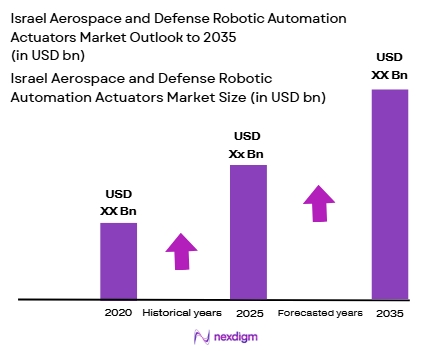
The Israel aerospace and defense robotic automation actuators market is valued at approximately USD ~billion in 2023, with growth driven by the increasing demand for automation and robotics in military and defense systems. Key factors contributing to this growth include technological advancements in actuator systems, the increasing reliance on unmanned systems, and military modernization programs. In 2024, the market is expected to expand further, driven by the adoption of automation in complex defense operations and increased investments in robotics technologies by both public and private entities.
The market is dominated by leading countries such as Israel, the United States, and several European nations. Israel’s prominence is largely due to its robust defense and aerospace sector, combined with its advanced research and development in robotics and automation. The country’s focus on enhancing military capabilities through unmanned systems, drones, and robotic actuators has made it a global leader. The United States, with its vast defense budget and technological infrastructure, also plays a key role in driving the demand for robotic automation actuators in aerospace and defense applications.
Market Segmentation
By System Type
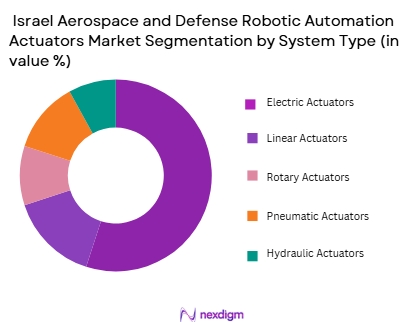
The Israel aerospace and defense robotic automation actuators market is segmented into linear actuators, rotary actuators, electric actuators, pneumatic actuators, and hydraulic actuators. In 2024, electric actuators dominate the market. This dominance is due to their high efficiency, precision, and the ability to operate in a variety of conditions without requiring complex systems like hydraulics or pneumatics. Electric actuators are crucial in unmanned aerial vehicles (UAVs) and military robotics, where power efficiency and compact size are essential. Their widespread adoption is further driven by advancements in electric motors and sensors, which offer improved performance in aerospace and defense systems.
By Platform Type
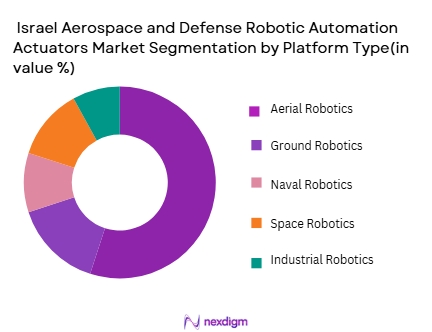
The platform type segmentation includes ground robotics, aerial robotics, naval robotics, space robotics, and industrial robotics. Aerial robotics holds the dominant market share in 2024. The growing reliance on UAVs and drones for military surveillance, reconnaissance, and tactical operations has led to the widespread integration of robotic automation actuators in aerial platforms. These systems are increasingly used in defense for tasks such as bomb disposal, surveillance, and reconnaissance missions. The adoption of unmanned aerial vehicles (UAVs) is expected to continue driving growth in this segment as they become more integral to modern military operations.
Competitive Landscape
The Israel aerospace and defense robotic automation actuators market is highly competitive, with key players including both established aerospace giants and specialized robotics firms. The market is dominated by companies such as Israel Aerospace Industries (IAI), Rafael Advanced Defense Systems, and Elbit Systems, which have a long history of developing advanced defense technologies and robotic systems. These companies, alongside global players like Rockwell Automation and Honeywell Aerospace, drive the market through technological innovation, robust defense contracts, and extensive product portfolios.
| Company | Year of Establishment | Headquarters | R&D Investment | Product Portfolio | Market Presence | Technological Innovations |
| Israel Aerospace Industries (IAI) | 1953 | Israel | ~ | ~ | ~ | ~ |
| Rafael Advanced Defense Systems | 2002 | Israel | ~ | ~ | ~ | ~ |
| Elbit Systems | 1966 | Israel | ~ | ~ | ~ | ~ |
| Rockwell Automation | 1903 | United States | ~ | ~ | ~ | ~ |
| Honeywell Aerospace | 1906 | United States | ~ | ~ | ~ | ~ |
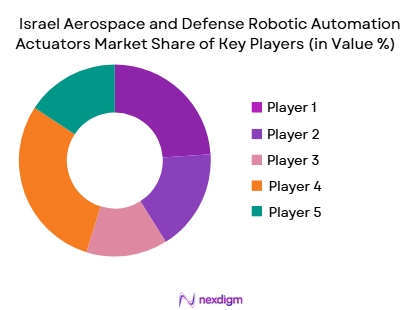
Israel Aerospace and Defense Robotic Automation Actuators Market Analysis
Growth Drivers:
Rising Demand for Unmanned Systems and Robotics in Defense:
The increasing reliance on unmanned systems, such as drones, autonomous ground vehicles, and robotic combat systems, is a key growth driver for the Israel aerospace and defense robotic automation actuators market. These systems require high-performance actuators for precise control, which has boosted the demand for robotic automation actuators. The military’s focus on reducing human intervention in high-risk operations, such as surveillance, reconnaissance, and combat, is further accelerating the adoption of actuators in defense robotics.
Technological Advancements in Actuator Systems:
Ongoing innovations in robotic automation actuator technologies, such as electric and hydraulic actuators, are significantly driving market growth. These advancements are improving the efficiency, precision, and reliability of actuator systems, making them more suitable for complex defense operations. The incorporation of smart actuators with integrated sensors, AI-driven systems, and machine learning is enhancing the performance of robotic platforms, making them more adaptive and capable of carrying out sophisticated tasks autonomously.
Market Challenges:
High Development and Integration Costs:
One of the primary challenges in the market is the significant cost involved in the development and integration of robotic automation actuators into defense systems. These actuators require extensive research and development, as well as high-end manufacturing capabilities, which can result in high production costs. This financial burden is especially challenging for smaller defense contractors and could limit the accessibility of advanced automation technologies to certain sectors.
Complex Integration with Existing Legacy Systems:
Many defense systems still rely on legacy platforms that were not originally designed to accommodate modern robotic automation actuators. Integrating these actuators into older systems can be complex and costly. The need to modify existing infrastructure and ensure compatibility with new actuator technologies often results in longer lead times and increased costs, which can hinder the adoption of newer automation technologies in some regions.
Opportunities:
Expansion in Space Exploration and Satellite Systems:
As space exploration and satellite technologies continue to advance, there is an increasing need for robotic automation actuators to handle complex operations in space. These actuators are critical for applications such as satellite deployment, maintenance, and repair, as well as autonomous operations in space exploration missions. The growing demand for space-related robotic applications offers a significant opportunity for companies in the actuator market to expand their product offerings and enter new markets.
Growth of Industrial Automation in Aerospace and Defense:
The increasing trend towards automation in aerospace manufacturing processes presents a significant opportunity for the market. Robotic automation actuators are being increasingly used in aerospace production lines, including in the assembly of aircraft, testing of avionics, and other manufacturing processes. The ongoing push towards operational efficiency and cost reduction in aerospace manufacturing will drive the demand for automation actuators, particularly in military aircraft and unmanned systems production.
Future Outlook
Over the next ~years, the Israel aerospace and defense robotic automation actuators market is expected to witness significant growth, driven by continued advancements in robotic technology, rising defense budgets, and the growing demand for unmanned systems. The integration of robotics and automation in military operations is becoming increasingly crucial for strategic defense initiatives, particularly in unmanned aerial systems (UAS), robotics for defense, and automation in aerospace applications. Additionally, the increasing use of AI and machine learning in robotic actuators is expected to lead to more sophisticated and autonomous systems, further propelling market growth.
Major Players
- Israel Aerospace Industries (IAI)
- Rafael Advanced Defense Systems
- Elbit Systems
- Rockwell Automation
- Honeywell Aerospace
- Lockheed Martin
- Northrop Grumman
- General Electric Aviation
- BAE Systems
- L3 Technologies
- Raytheon Technologies
- ABB Robotics
- Mitsubishi Electric
- Yaskawa Electric Corporation
- Panasonic Avionics
Key Target Audience
- Military Organizations
- Aerospace Manufacturers
- Defense Contractors
- Government Agencies
- Robotics and Automation Companies
- Investments and Venture Capitalist Firms
- Aerospace Technology Firms
- Regulatory Bodies
Research Methodology
Step 1: Identification of Key Variables
This initial step involves identifying the critical market drivers, challenges, and key technologies that influence the Israel aerospace and defense robotic automation actuators market. Desk research will be employed to analyze historical data, using secondary sources and industry databases to gather comprehensive insights into the market dynamics.
Step 2: Market Analysis and Construction
The next phase includes compiling historical and current data to understand market trends, market penetration, and technological adoption rates. This involves assessing key segments such as actuator systems, platform types, and their relevance to defense applications.
Step 3: Hypothesis Validation and Expert Consultation
Market hypotheses generated from the initial research will be validated through expert consultations, including interviews with industry practitioners, aerospace and defense engineers, and robotics specialists. These interviews will provide valuable insights into market growth, technological challenges, and emerging trends.
Step 4: Research Synthesis and Final Output
In the final phase, all research findings are synthesized into a cohesive report. Direct engagement with key players in the aerospace and defense sector will be used to validate the collected data and ensure the accuracy and reliability of the final report.

- Executive Summary
- Research Methodology (Definitions, Scope, Industry Assumptions, Market Sizing Approach, Primary & Secondary Research Framework, Data Collection & Verification Protocol, Analytic Models & Forecast Methodology, Limitations & Research Validity Checks)

- Market Definition and Scope
- Value Chain & Stakeholder Ecosystem
- Regulatory / Certification Landscape
- Sector Dynamics Affecting Demand
- Strategic Initiatives & Infrastructure Growth

- Growth Drivers
Growing demand for automation in military and defense applications
Technological advancements in robotics and actuator systems
Increasing defense budgets and modernization programs - Market Challenges
High development and production costs of robotic automation actuators
Complex integration with existing legacy systems
Stringent regulatory standards and certification requirements - Market Opportunities
Expansion in unmanned systems and autonomous vehicles
Growth of automation in space exploration missions
Adoption of robotic automation actuators in industrial applications - Trends
Increasing use of electric actuators in aerospace systems
Shift towards lighter and more compact actuator designs
Integration of AI with robotic automation actuators - Government regulations
Aerospace industry standards for robotic automation
Defense procurement regulations
Safety and operational standards for robotic systems - SWOT analysis
- Porters 5 forces

- By Market Value,2020-2025
- By Installed Units,2020-2025
- By Average System Price,2020-2025
- By System Complexity Tier,2020-2025

- By System Type (In Value%)
Linear actuators
Rotary actuators
Electric actuators
Pneumatic actuators
Hydraulic actuators - By Platform Type (In Value%)
Ground robotics
Aerial robotics
Naval robotics
Space robotics
Industrial robotics - By Fitment Type (In Value%)
OEM fitment
Retrofit fitment
Custom fitment
Modular fitment
Universal fitment - By EndUser Segment (In Value%)
Military applications
Aerospace applications
Industrial applications
Commercial applications
Space exploration agencies - By Procurement Channel (In Value%)
Direct purchase
Third-party resellers
OEMs
Government procurement
Online distribution

- Cross Comparison Parameters(Market value, Installed units, Price range, Technology integration, Regional adoption)
- SWOT Analysis of Key Competitors
- Pricing & Procurement Analysis
- Key Players
Elbit Systems
Israel Aerospace Industries
Rafael Advanced Defense Systems
TAU Aerospace
IAI Robotics
Plasan
Uvision Airborne Systems
U-Space Robotics
Yaskawa Electric Corporation
Rockwell Automation
Honeywell Aerospace
L3 Technologies
Teledyne FLIR
GE Aviation
ABB Robotics

- Increased demand for robotic automation in defense applications
- Growth in autonomous vehicle systems in aerospace
- Adoption of robotics in industrial manufacturing
- Integration of robotic actuators in space exploration systems

- Forecast Market Value,2026-2035
- Forecast Installed Units,2026-2035
- Price Forecast by System Tier,2026-2035
- Future Demand by Platform,2026-2035


 Request a Sample
 Ask for Customization
 Get a Quote
 Enquire Now