
 Download PDF
 Download PDF
Market Overview
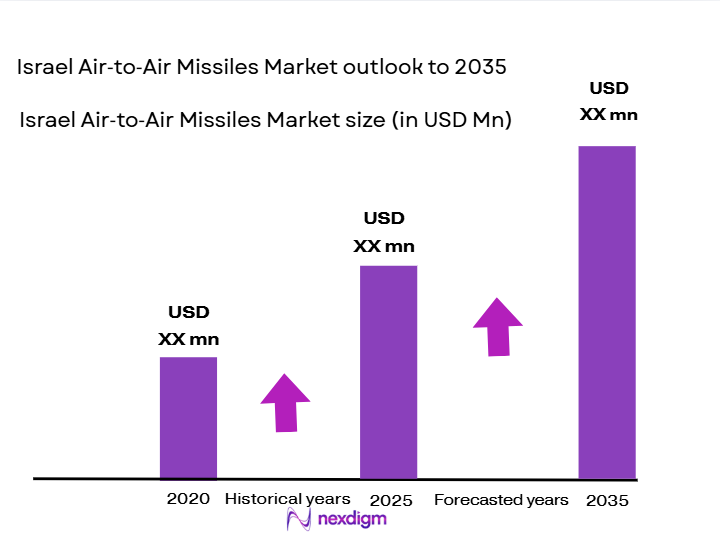
The Israel Air-to-Air Missiles (AAM) market is a critical component of the country’s advanced defense and aerospace industry. Valued at approximately USD ~ billion in 2024, the market is primarily driven by the robust defense budget allocated by the Israeli government, which consistently prioritizes air superiority and missile defense programs. With continuous investments in military modernization, Israel is strengthening its technological capabilities, producing cutting-edge missile systems. This growth is largely attributed to increasing geopolitical tensions in the Middle East and the expansion of Israel’s defense export programs, which have significantly contributed to its market dynamics.
Israel remains the dominant player in the air-to-air missile market, with cities such as Tel Aviv and Herzliya being key hubs for defense technology development and manufacturing. These cities host most of the Israel’s aerospace and defense contractors, such as Rafael Advanced Defense Systems and Israel Aerospace Industries (IAI). Internationally, countries like the United States, India, and several European nations are significant customers, driven by their strategic alliances with Israel and their need to modernize their air defense capabilities. Israel’s established partnerships, advanced R&D infrastructure, and integration with global defense supply chains position it as a market leader in air-to-air missile technologies.
Market Segmentation
By Product Type
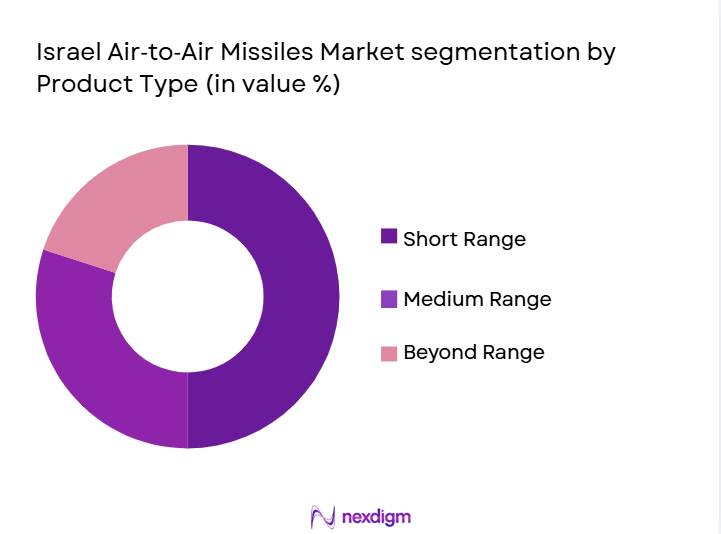
The Israel Air-to-Air Missiles market is segmented by product type into short-range, medium-range, and beyond-visual-range (BVR) missiles. Among these, BVR missiles are leading the market due to their strategic importance in modern air combat. BVR missiles, such as the Python-5 and Derby missile systems, offer superior performance with enhanced radar and infrared seekers, providing Israel’s air forces with a decisive advantage in both offensive and defensive operations. These missiles have been integrated into both Israel’s own fighter jets and those of allied nations, further solidifying their dominance in the market.
By Application
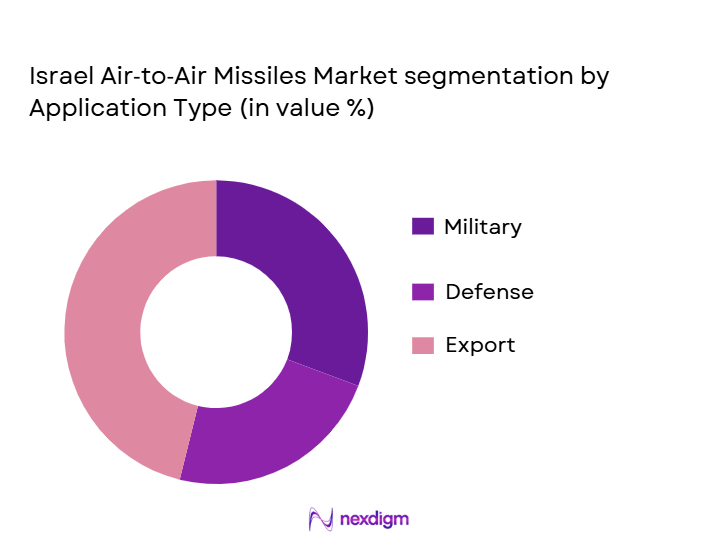
The Israel Air-to-Air Missiles market is also segmented by application, which includes military, defense, and export markets. The military segment holds a dominant share, as the primary consumer of air-to-air missiles in Israel is the Israeli Defense Forces (IDF), particularly the Israeli Air Force (IAF). This segment continues to grow as Israel upgrades its fighter jet fleet, such as the F-35, and continues to enhance its missile defense capabilities to maintain air superiority in the region. In addition, Israel’s increasing missile exports to allied nations bolster this segment’s market share.
Competitive Landscape
The Israel Air-to-Air Missiles market is dominated by a few major players, including domestic giants such as Rafael Advanced Defense Systems and Israel Aerospace Industries (IAI). These companies benefit from the Israeli government’s significant defense spending, as well as their established relationships with international defense forces. The market also features global competitors such as Raytheon and MBDA, which operate in collaboration with Israeli firms to meet the demands of international clients.
| Company Name | Establishment Year | Headquarters | R&D Investment | Product Portfolio | Production Capacity | Export Footprint | Collaboration/Joint Ventures |
| Rafael Advanced Defense Systems | 1958 | Haifa, Israel | ~ | ~ | ~ | ~ | ~ |
| Israel Aerospace Industries (IAI) | 1953 | Lod, Israel | ~ | ~ | ~ | ~ | ~ |
| Raytheon Technologies | 1922 | Waltham, USA | ~ | ~ | ~ | ~ | ~ |
| MBDA | 2001 | Paris, France | ~ | ~ | ~ | ~ | ~ |
| Lockheed Martin | 1912 | Bethesda, USA | ~ | ~ | ~ | ~ | ~ |
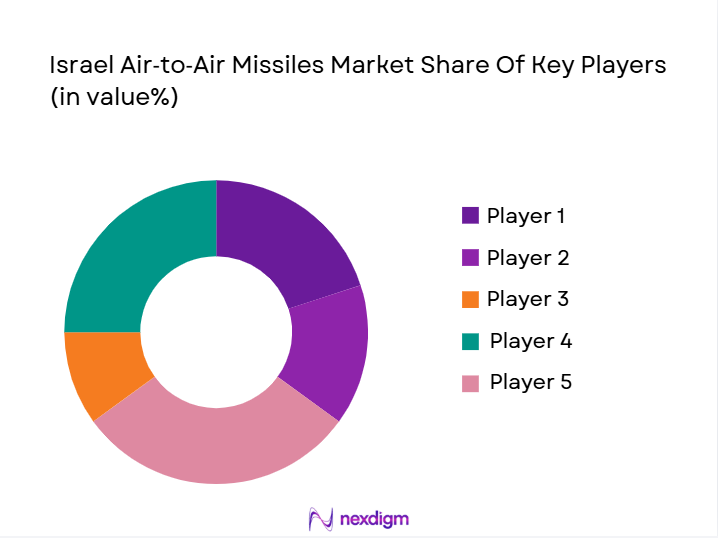
Israel Air-to-Air Missiles Market Analysis
Growth Drivers
Regional Security Threats
The increasing geopolitical instability in the Middle East continues to drive demand for air defense systems, including air-to-air missiles. Israel, located in a volatile region, has witnessed heightened tensions due to conflicts involving neighboring countries such as Iran and Syria. As of 2024, Israel’s defense expenditure stands at approximately USD ~ billion, which includes substantial investments in air defense and missile systems. Israel’s security strategy is shaped by these regional threats, which emphasizes the need for advanced missile systems. The country’s defense spending is aligned with the increasing security concerns in the region, highlighting the necessity of air-to-air missile systems.
Air Superiority Prioritization
Maintaining air superiority is a cornerstone of Israel’s defense strategy. The Israel Defense Forces (IDF) have historically allocated significant resources to modernizing their air force, with a focus on enhancing the capabilities of their air-to-air missile systems. In 2024, Israel’s air force modernization program includes the integration of new missile systems for advanced fighter jets like the F-35. The Israeli Air Force (IAF) has been focusing on the development of more advanced air-to-air missiles to ensure superior combat readiness. This emphasis on air superiority is reflected in the country’s growing defense budget, which has increased by ~% in 2024 compared to the previous year.
Market Challenges
Export Control & MTCR Compliance
Export controls and adherence to the Missile Technology Control Regime (MTCR) continue to be a challenge for Israel’s air-to-air missile manufacturers. The MTCR restricts the transfer of missile systems capable of carrying a payload of over 500 kg to a range of more than 300 km, which directly impacts the export potential of Israel’s missile systems. In 2024, Israel is working closely with international partners to ensure compliance with these regulations, which restricts its ability to expand its missile exports. Despite this, Israel’s strategic alliances with countries like the United States and India help circumvent some export restrictions through joint development programs and intergovernmental agreements.
Cost Escalation
Rising costs for raw materials and production processes are increasingly challenging Israel’s defense industry, including air-to-air missile systems. As of 2024, inflationary pressures have led to an increase in the cost of manufacturing missiles, primarily due to higher prices for materials such as advanced metals and electronic components. In particular, the integration of cutting-edge sensors and seekers has added to the cost. The rise in global inflation, expected to be ~% in Israel for 2024, is putting pressure on defense contractors to balance high-quality missile production with cost-effective pricing.
Opportunities
Foreign Military Sales
Israel’s foreign military sales (FMS) have seen significant growth, with air-to-air missiles being a key export item. Israel has established defense sales agreements with countries such as the United States, India, and Germany, which continue to be major buyers of its missile systems. In 2024, the Israeli Ministry of Defense announced the expansion of its defense export portfolio, including air-to-air missiles, in line with strategic defense relationships. These sales represent a growing opportunity for Israeli defense contractors to increase revenue and market share in international markets, as demand for advanced missile systems continues to rise globally.
ISR Integration
The integration of Intelligence, Surveillance, and Reconnaissance (ISR) capabilities into air-to-air missile systems is becoming increasingly important for Israel’s missile development. As of 2024, Israel is working on integrating ISR technologies into its missile systems to enhance targeting accuracy and operational effectiveness. This trend is driven by the need for real-time intelligence gathering during combat operations, enabling Israel’s air-to-air missiles to engage targets with greater precision. The integration of ISR systems is expected to expand the functionality and effectiveness of missile systems, creating opportunities for further technological advancements.
Future Outlook
Over the next decade, the Israel Air-to-Air Missiles market is expected to show significant growth driven by advancements in missile technology, increased defense budgets, and rising demand for air defense solutions from Israel’s strategic allies. The market is forecasted to grow at a CAGR of ~% from 2026 to 2035. This growth will be fueled by Israel’s continual innovation in missile seekers, propulsion systems, and integration with next-generation fighter jets, alongside increasing global geopolitical instability, driving demand for robust air defense systems.
Major Players in the Israel Air-to-Air Missiles Market
- Israel Aerospace Industries (IAI)
- Rafael Advanced Defense Systems
- Raytheon Technologies
- MBDA
- Lockheed Martin
- Northrop Grumman
- Boeing
- Elbit Systems
- Aselsan
- Diehl Defense
- Kongsberg Defense & Aerospace
- Saab AB
- Thales Group
- General Dynamics
- Tata Advanced Systems
Key Target Audience
- Ministry of Defense, Israel
- Israeli Defense Forces (IDF)
- United States Department of Defense (DoD)
- India Ministry of Defense
- European Union Defense and Procurement Agencies
- Investments and Venture Capitalist Firms
- Government and Regulatory Bodies
- International Air Force Procurement Units
Research Methodology
Step 1: Identification of Key Variables
The research begins with the identification of all key market drivers, stakeholders, and variables influencing the Israel Air-to-Air Missiles market. This involves desk research utilizing proprietary databases, government defense spending reports, and market data from both Israeli and global aerospace sectors.
Step 2: Market Analysis and Construction
Historical market data will be analyzed to track trends in missile deployment, defense spending, and technological innovation in the air-to-air missile sector. This data is used to develop a predictive model of market growth based on the prevailing geopolitical environment and Israel’s defense strategy.
Step 3: Hypothesis Validation and Expert Consultation
Expert consultations, including interviews with defense contractors, government officials, and military procurement specialists, will be conducted to validate assumptions. This helps refine the market model and ensures accuracy in the final projections.
Step 4: Research Synthesis and Final Output
In the final phase, information gathered from primary and secondary sources will be synthesized to create a comprehensive and accurate report. This will include a deep dive into the competitive landscape, market segmentation, and projections for the future growth of the Israel Air-to-Air Missiles market.

- Executive Summary
- Research Methodology (Market Definitions and Scope, Assumptions and Risk Adjustments Data, Normalization and Forecasting Models)

- Definition and Scope (Market Boundaries, Weapon Classification, Operational Doctrine)
- Market Genesis and Strategic Imperatives (Defense Posture, Aerial Threat Environment)
- Evolution of Air‑to‑Air Missile Programs
- National Defense Procurement Cycle and Decision Framework
- Supply Chain and Capability Value Chain

- Growth Drivers
Regional Security Threats
Air Superiority Prioritization
Platform Modernization)
Market Challenges (Export Control & MTCR Compliance
Cost Escalation
Certification Cycle - Trends
Autonomous Targeting & AI‑Augmented Fire Control
ECCM/DECM Resilience
Networked Engagement - Opportunities
Foreign Military Sales
ISR Integration
Co‑Development/Offset Programs - Government Regulations & Defense Policy
FDI Rules
Offset Obligations
Export Licenses - SWOT Analysis (Capability Strengths, Cost Vulnerabilities, Competitive Pressures)
- Porter’s Five Forces (Procurement Power, Supplier Concentration, Substitutes, Barriers to Entry)

- By Contract Value, 2020‑2025
- By Unit Volume, 2020‑2025
- By Average Realized Price, 2020‑2025

- By Guidance/Seeker Technology (In Value %)
RF/AESA
Imaging IR
Dual‑Mode
- By Engagement (In Value %)
Envelope
- By Launcher Platform (In Value %)
Type Fast Jets
UAVs
Helicopters
- By Propulsion Type (In Value %)
Solid Rocket Motor
Ramjet/DUAL‑Pulse
Air‑Breathing
- By End User (In Value %)
IDF Air Force
Export Customers
OEM Integrators

- Market Share of Major Players on Value and Volume (Domestic & Global Contracts)
- Cross‑Comparison Parameters (Product Range & Capabilities, Production Capacity, Export Footprint, R&D Spend, Latency to SOCOM/AF Requirements, Certification & Compliance, After‑Sales Support, Offset Obligations
- SWOT Analysis of Key Competitors Strengths, Dependence, Tech Gaps
- Pricing Analysis across Key SKUs Baseline vs Enhanced Capability Missiles
- Detailed Profiles of Major Players
Israel Aerospace Industries Missiles & Space Group; Sky Sting Program
Rafael Advanced Defense Systems Missiles, Seekers & ECCM
Elbit Systems Avionics & Missile‑Related Sensors
ELTA Systems Advanced Airborne Sensors & Integration
IAI/MBT Combat Missile Divisions
United States OEM Raytheon – AMRAAM variants
European OEM MBDA – Meteor, IRIS‑T
Northrop Grumman SLAMRAAM & Integration
Lockheed Martin Joint Air‑to‑Air Platforms
Boeing (Integration & Test Programs
Rosoboronexport / Russian OEMs
Kongsberg Defense & Aerospace
Aselsan (Regional Partnering
Diehl Defense European Engagement
Bharat Dynamics / HAL Potential Collaborative OEM

- Procurement Decision Criteria (KPPs, KPIs, Reliability/Performance Metrics)
- Budgetary Allocations & Funding Mechanisms (Defense Budget Lines, FMS/Direct Sales)
- Qualification & Certification Requirements (Flight Test, User Operational Evaluation)
- Operational Deployment and Doctrine Requirements
- Integration and Lifecycle Sustainment Considerations

- By Contract Value, 2026‑2035
- By Unit Volume, 2026‑2035
- By Average Realized Price, 2026‑2035


 Request a Sample
 Ask for Customization
 Get a Quote
 Enquire Now