

 Download PDF
 Download PDF
Market Overview
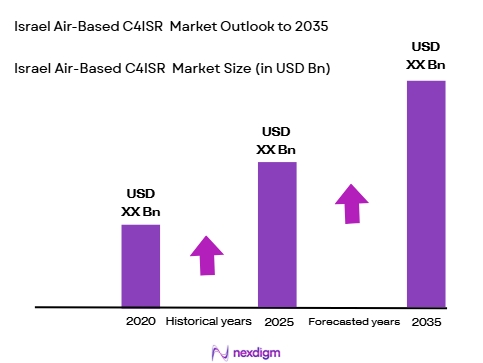
The Israel air-based C4ISR market is valued at approximately USD ~billion in 2024, driven by Israel’s continuous investment in cutting-edge defense technology. The country’s strategic priorities focus on enhancing its air defense and command systems to address evolving security threats, such as missile attacks, drones, and cyber threats. Technological innovations in communication, surveillance, and reconnaissance are key drivers of this market. Israel’s established reputation for developing advanced C4ISR systems underpins its position as a global leader in defense technology.
The dominant cities in the Israel air-based C4ISR market are Tel Aviv, Herzliya, and Haifa. These cities are the primary hubs for Israel’s defense technology sector, hosting defense contractors like Elbit Systems and Israel Aerospace Industries (IAI). Tel Aviv, being the political and economic center, facilitates defense policy formulation and procurement. Herzliya and Haifa are critical for research and development, where most of Israel’s defense innovations, particularly in C4ISR systems, are conceived and tested. This concentration of talent, technology, and infrastructure supports Israel’s leadership in the global air-based C4ISR market.
Market Segmentation
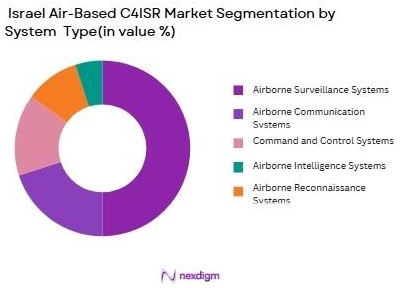
By System Type (In Value%)
The Israel air-based C4ISR market is segmented by system type into airborne surveillance systems, airborne communication systems, command and control systems, airborne intelligence systems, and airborne reconnaissance systems. Airborne surveillance systems hold a dominant position in the market due to their essential role in providing early warning capabilities and continuous monitoring. Israel’s focus on securing its airspace and detecting threats like missiles and drones has led to a significant reliance on these systems. Technologies such as radar and infrared sensors are used to detect and track a wide array of targets, making airborne surveillance systems crucial for defense operations.
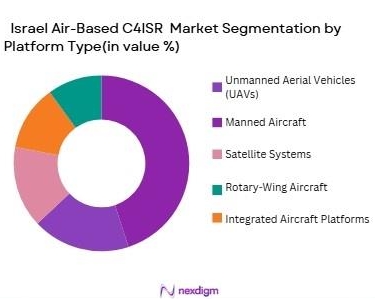
By Platform Type (In Value%)
The platform type segment is divided into unmanned aerial vehicles (UAVs), manned aircraft, satellite systems, rotary-wing aircraft, and integrated aircraft platforms. UAVs dominate the platform type segment in Israel’s air-based C4ISR market. Israel has been a pioneer in UAV technology, which is used extensively in surveillance, reconnaissance, and intelligence gathering. UAVs are highly effective in reducing operational costs, increasing mission flexibility, and providing real-time data, which makes them indispensable in modern air defense systems. Israel’s development of advanced UAV systems, such as the Hermes series, strengthens the market share of UAVs in air-based C4ISR solutions.
Competitive Landscape
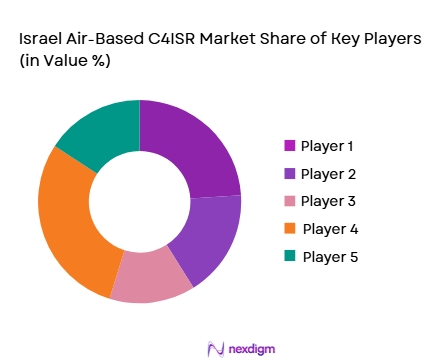
The Israel air-based C4ISR market is dominated by a few key players with significant expertise in defense systems. Companies such as Elbit Systems, Israel Aerospace Industries (IAI), and Rafael Advanced Defense Systems lead the market. These companies benefit from long-standing relationships with the Israeli government and military, which makes them the primary suppliers of C4ISR solutions. Their advanced technologies and deep integration within the defense sector have cemented their dominance in Israel’s air-based C4ISR market.
| Company Name | Year of Establishment | Headquarters | Radar & C4ISR Expertise | Key Defense Systems | Geographical Coverage | Key Partnerships |
| Elbit Systems | 1966 | Haifa, Israel | ~ | ~ | ~ | ~ |
| Israel Aerospace Industries (IAI) | 1953 | Lod, Israel | ~ | ~ | ~ | ~ |
| Rafael Advanced Defense Systems | 1950 | Herzliya, Israel | ~ | ~ | ~ | ` |
| Lockheed Martin | 1912 | Bethesda, US | ~ | ~ | ~ | ~ |
| Thales Group | 2000 | Paris, France | ~ | ~ | ~ | ~ |
Israel Air-Based C4ISR Market Analysis
Growth Drivers
Urbanization
Urbanization is a key driver for the demand of air quality monitoring systems in Indonesia. As of 2024, over ~of Indonesia’s population lives in urban areas, with cities like Jakarta, Surabaya, and Bandung facing rapid population growth. Urban areas are particularly vulnerable to air pollution due to increased vehicular emissions, industrial activities, and construction. The rising population puts additional pressure on infrastructure, intensifying air pollution issues. With growing concerns about air quality and public health, urban areas are seeing greater investments in monitoring systems to address these challenges.
Industrialization
Indonesia’s industrialization has been a major contributor to the demand for air quality monitoring systems. In 2024, the industrial sector contributes approximately ~to the nation’s GDP, with significant activities in manufacturing, energy, and mining. Cities like Batam and Surabaya, home to large industrial zones, experience high levels of air pollution from emissions due to industrial processes. As the government enforces stricter regulations and industries become more aware of their environmental impact, there is a growing need for air quality monitoring systems to ensure compliance and mitigate pollution.
Restraints
High Initial Costs
The high initial costs associated with air quality monitoring systems remain a significant barrier to their widespread adoption in Indonesia. In 2024, the cost of purchasing and installing advanced air quality sensors, monitoring units, and data management platforms can be prohibitive for smaller municipalities and industries. While the government is investing in air quality initiatives, these systems’ substantial upfront costs make it difficult for some regions to implement them, especially in rural areas that are not covered under government programs.
Technical Challenges
Technical challenges continue to hinder the effective implementation of air quality monitoring systems in Indonesia. In 2024, issues such as unreliable system calibration, inconsistent data quality, and the lack of standardization in reporting data remain common. Many areas still lack reliable infrastructure to support real-time data transmission, particularly in remote or rural regions. Additionally, the integration of new systems into existing environmental management frameworks is complex, requiring sophisticated technical solutions that are often beyond the capacity of local authorities.
Opportunities
Technological Advancements
Technological advancements in air quality monitoring systems offer significant opportunities for growth in Indonesia. In 2024, the development of more affordable and accurate IoT-based sensors has made air quality monitoring systems more accessible to municipalities and industries. These sensors can be deployed in both urban and rural areas to provide real-time data on air quality, helping local authorities address pollution more effectively. Moreover, integrating machine learning and artificial intelligence into these systems allows for better prediction and analysis of pollution trends.
International Collaborations
International collaborations present significant opportunities for enhancing Indonesia’s air quality monitoring systems. In 2024, Indonesia is collaborating with global organizations such as the World Health Organization (WHO) and the United Nations Environment Programme (UNEP) to implement more effective air quality management programs. These partnerships provide access to advanced monitoring technologies, best practices in pollution management, and funding support for large-scale monitoring network deployments, allowing Indonesia to address its air quality challenges more efficiently.
Future Outlook
Over the next decade, the Israel air-based C4ISR market is expected to grow substantially. Israel’s defense strategy will continue to focus on advanced radar systems, air surveillance, and integrated command and control systems to address evolving threats from ballistic missiles, drones, and cyberattacks. Technological advancements, particularly in artificial intelligence (AI) and machine learning (ML), are likely to play a major role in improving system efficiency and accuracy. Increased collaboration with international defense organizations, as well as investments in cutting-edge UAVs and C4ISR technologies, will support market growth and solidify Israel’s leadership in the global defense market.
Major Players
- Elbit Systems
- Israel Aerospace Industries (IAI)
- Rafael Advanced Defense Systems
- Lockheed Martin
- Thales Group
- Northrop Grumman
- Raytheon Technologies
- BAE Systems
- Leonardo
- Saab Group
- Boeing
- General Dynamics
- L3 Technologies
- Harris Corporation
- Kongsberg Gruppen
Key Target Audience
- Investments and venture capitalist firms
- Government and regulatory bodies
- Defense contractors and system integrators
- Aerospace manufacturers
- Research and development agencies
- International defense organizations
- Military agencies from countries with defense collaborations with Israel
- Homeland security and defense technology companies
Research Methodology
Step 1: Identification of Key Variables
In the first phase, we identify key drivers such as regional security concerns, defense budgets, and technological innovations in air-based C4ISR systems. Secondary research, including government reports and defense publications, will provide the foundation for identifying these variables.
Step 2: Market Analysis and Construction
We analyze historical market data, including radar system installations, demand for C4ISR solutions, and technological advancements. This data helps build a comprehensive market model that accounts for system adoption rates, platform types, and application areas.
Step 3: Hypothesis Validation and Expert Consultation
Market hypotheses will be validated through consultations with industry experts, including defense officials, military representatives, and technology developers. These insights will provide critical input to refine the market model and ensure accuracy in forecasting.
Step 4: Research Synthesis and Final Output
The final phase involves consolidating data from secondary research, expert interviews, and market analysis to produce a comprehensive report that outlines market trends, competitive dynamics, and future growth projections. This report will guide stakeholders in understanding the Israel air-based C4ISR market’s trajectory.

- Executive Summary
- Research Methodology (Definitions, Scope, Industry Assumptions, Market Sizing Approach, Primary & Secondary Research Framework, Data Collection & Verification Protocol, Analytic Models & Forecast Methodology, Limitations & Research Validity Checks)

- Market Definition and Scope
- Value Chain & Stakeholder Ecosystem
- Regulatory / Certification Landscape
- Sector Dynamics Affecting Demand
- Strategic Initiatives & Infrastructure Growth

- Growth Drivers
Technological advancements in communication and surveillance systems
Increasing geopolitical tensions and security concerns
Rising defense budgets and investments in air-based defense systems - Market Challenges
High operational and maintenance costs
Regulatory constraints and export restrictions
Dependence on highly skilled personnel for operation and maintenance - Market Opportunities
Technological innovations in miniaturized C4ISR systems
Collaboration with international defense organizations
Growing demand for enhanced surveillance capabilities in air defense - Trends
Integration of artificial intelligence in C4ISR systems
Increased adoption of UAVs for reconnaissance and intelligence gathering
Shift towards multi-functional and scalable C4ISR systems
- Government regulations
Defense procurement regulations in Israel
Aviation safety and security compliance
International regulations for satellite communication systems - SWOT analysis
Strength: Israel’s leadership in advanced defense technologies
Weakness: Dependency on international collaborations and suppliers
Opportunity: Expanding global defense partnerships for C4ISR technologies
Threat: Geopolitical instability affecting market dynamics - Porters 5 forces
Threat of new entrants: Moderate
Bargaining power of suppliers: High
Bargaining power of buyers: Moderate
Threat of substitute products: Low
Industry rivalry: High

- By Market Value ,2020-2025
- By Installed Units ,2020-2025
- By Average System Price ,2020-2025
- By System Complexity Tier ,2020-2025

- By System Type (In Value%)
Airborne Surveillance Systems
Airborne Communication Systems
Command and Control Systems
Airborne Intelligence Systems
Airborne Reconnaissance Systems - By Platform Type (In Value%)
Unmanned Aerial Vehicles (UAVs)
Manned Aircraft
Satellite Systems
Rotary-Wing Aircraft
Integrated Aircraft Platforms - By Fitment Type (In Value%)
Standalone Systems
Integrated Systems
Modular Systems
Upgraded Systems
Compact Systems - By EndUser Segment (In Value%)
Defense Ministries
Private Sector Contractors
International Military Agencies
Aerospace Contractors
Research and Development Agencies - By Procurement Channel (In Value%)
Direct Procurement from Manufacturers
Government Procurement
Private Sector Procurement
International Defense Procurement
Leasing and Third-party Procurement

- CrossComparison Parameters(Market Share, Service Type, Technology Adoption, Geographic Presence, Customer Base)
- SWOT Analysis of Key Competitors
- Pricing & Procurement Analysis
- Key Players
Elbit Systems
Rafael Advanced Defense Systems
Israel Aerospace Industries (IAI)
Lockheed Martin
Thales Group
Northrop Grumman
Raytheon Technologies
BAE Systems
Leonardo
Saab Group
Boeing
General Dynamics
L3 Technologies
Harris Corporation
Kongsberg Gruppen

- Defense ministries expanding air surveillance capabilities
- Aerospace contractors incorporating advanced C4ISR technologies
- International military agencies integrating Israeli technology into defense strategies
- R&D agencies developing next-generation surveillance systems

- Forecast Market Value ,2026-2035
- Forecast Installed Units ,2026-2035
- Price Forecast by System Tier, 2026-2035
- Future Demand by Platform ,2026-2035


 Request a Sample
 Ask for Customization
 Get a Quote
 Enquire Now