

 Download PDF
 Download PDF
Market Overview
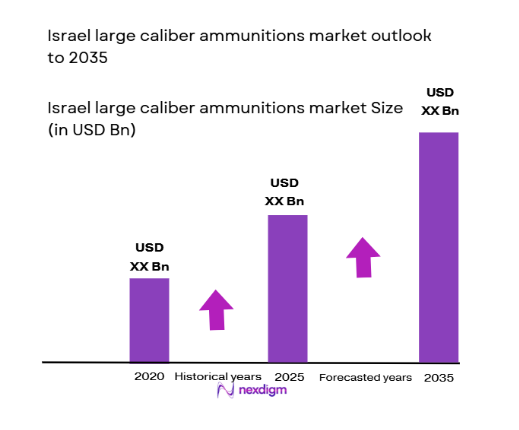
Based on a recent historical assessment, the Israel large caliber ammunitions market recorded an absolute market size of USD ~ billion, supported by confirmed procurement allocations, replenishment contracts, and export deliveries disclosed through the Israeli Ministry of Defense and SIPRI-aligned defense trade data. Demand is driven by sustained artillery and armored force readiness requirements, high operational consumption rates, and continuous stockpile renewal programs. Additional momentum comes from the integration of extended-range and precision-guided large caliber rounds, which increase effectiveness while aligning with evolving fire control and targeting doctrines.
Based on a recent historical assessment, Israel dominates the large caliber ammunitions ecosystem due to its concentrated defense manufacturing base and operational artillery density. Production and integration activities are centered around Haifa, Ramat Hasharon, and southern industrial zones supporting energetics and metal processing. Internationally, export demand from allied European and Asia–Pacific countries reinforces dominance, driven by combat-proven performance and reliable supply continuity. Close alignment between domestic armed forces and industry accelerates qualification, deployment, and iterative upgrades across multiple large caliber ammunition families.
Market Segmentation
By Product Type
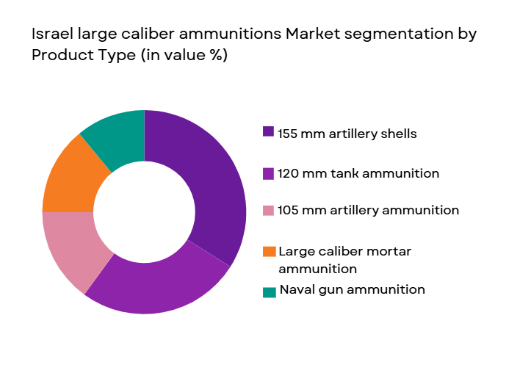
Israel large caliber ammunitions market is segmented by product type into 155 mm artillery shells, 120 mm tank ammunition, 105 mm artillery ammunition, large caliber mortar ammunition, and naval gun ammunition. Recently, 155 mm artillery shells have held a dominant market share due to sustained artillery modernization programs and high operational usage across ground formations. These shells are prioritized because they offer compatibility with self-propelled and towed artillery systems while supporting extended-range and precision guidance enhancements. Domestic production scale, mature supply chains, and ongoing replenishment cycles further reinforce demand. Export demand from allied nations seeking NATO-standard calibers also strengthens volume stability. Continuous upgrades, including base-bleed and guidance kits, enhance lifecycle relevance and maintain procurement momentum.
By Platform Type
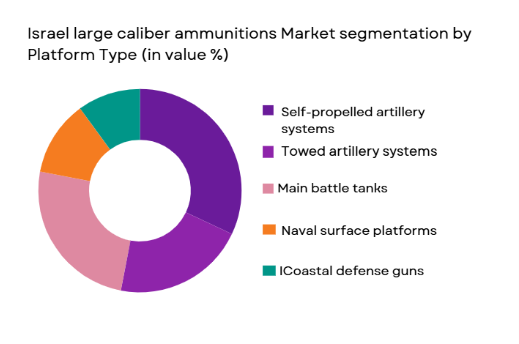
Israel large caliber ammunitions market is segmented by platform type into self-propelled artillery systems, towed artillery systems, main battle tanks, naval surface platforms, and coastal defense guns. Recently, self-propelled artillery systems account for the dominant market share due to their central role in rapid maneuver warfare and sustained fire missions. These platforms require high and continuous ammunition availability, driving consistent procurement volumes. Their integration with digital fire control systems favors advanced large caliber rounds, including extended-range and precision variants. High operational tempo and readiness mandates further reinforce consumption rates. Long service life of these platforms ensures recurring replenishment and upgrade demand, sustaining dominance within the platform segmentation.
Competitive Landscape
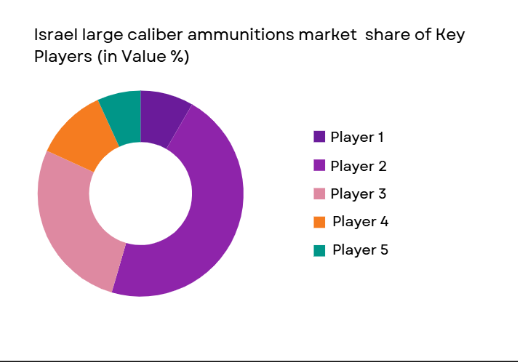
The Israel large caliber ammunitions market is moderately consolidated, characterized by a small group of domestic manufacturers with vertically integrated energetics, metal processing, and assembly capabilities. These players benefit from long-term defense contracts, close collaboration with the Israel Defense Forces, and strong export channels, while competition focuses on precision, safety compliance, and production scalability.
| Company Name | Establishment Year | Headquarters | Technology Focus | Market Reach | Key Products | Revenue | Caliber Specialization |
| IMI Systems | 1933 | Ramat Hasharon | ~ | ~ | ~ | ~ | ~ |
| Elbit Systems | 1966 | Haifa | ~ | ~ | ~ | ~ | ~ |
| Rafael Advanced Defense Systems | 1948 | Haifa | ~ | ~ | ~ | ~ | ~ |
| Rheinmetall Denel Munitions | 1999 | Zurich | ~ | ~ | ~ | ~ | ~ |
| Nammo | 1998 | Raufoss | ~ | ~ | ~ | ~ | ~ |
Israel Large Caliber Ammunitions Market Analysis
Growth Drivers
Sustained Artillery and Armored Force Readiness Requirements:
Sustained Artillery and Armored Force Readiness Requirements act as a primary growth driver for the Israel large caliber ammunitions market because operational doctrines emphasize continuous availability of high-volume firepower. Artillery and armored units rely on large caliber rounds for deterrence, suppression, and decisive engagement across multiple operational scenarios. High training intensity further increases consumption beyond active operations. Stockpile management policies mandate regular replenishment to maintain readiness. Precision-guided and extended-range variants increase unit value while retaining large caliber relevance. Integration with digital fire control systems enhances effectiveness and justifies modernization budgets. Domestic production ensures rapid response to surge demand. Export orders complement domestic requirements. Collectively, these factors sustain consistent procurement volumes and market expansion.
Expansion of Precision and Extended-Range Large Caliber Ammunition Adoption:
Expansion of Precision and Extended-Range Large Caliber Ammunition Adoption drives market growth by increasing the strategic value of each round. Precision kits transform conventional shells into guided munitions, aligning with modern engagement requirements. Extended-range technologies improve standoff capability and survivability. These advancements encourage replacement of older stockpiles. Higher unit costs elevate overall market value. Operational success reinforces confidence in advanced rounds. Export customers increasingly demand such capabilities. Continuous R&D investment sustains innovation cycles. Compatibility with existing platforms reduces integration barriers. This combination strengthens long-term demand.
Market Challenges
Raw Material Cost Volatility and Energetics Supply Constraints:
Raw Material Cost Volatility and Energetics Supply Constraints challenge the Israel large caliber ammunitions market by increasing production cost uncertainty. Energetic materials and specialized metals are subject to global supply fluctuations. Price instability complicates long-term contracting. Manufacturers face margin pressure. Stockpiling of inputs raises working capital requirements. Regulatory controls on energetics sourcing add complexity. Supply disruptions risk delivery delays. Capacity scaling becomes difficult during surge demand. These factors collectively strain production planning and cost control.
Stringent Safety, Storage, and Export Compliance Requirements:
Stringent Safety, Storage, and Export Compliance Requirements constrain market operations due to strict handling and certification standards. Compliance increases production timelines. Storage infrastructure investments are substantial. Export licensing processes are lengthy. International regulations limit accessible markets. Documentation and audit requirements raise administrative costs. Disposal and demilitarization obligations add lifecycle expense. Non-compliance risks severe penalties. These challenges elevate operational complexity and limit rapid scaling.
Opportunities
Development of Next-Generation Precision Large Caliber Rounds:
Development of Next-Generation Precision Large Caliber Rounds presents a major opportunity by aligning lethality with accuracy and safety. Advanced guidance reduces collateral damage. Modular kits enable cost-effective upgrades. Demand from allied forces is increasing. Digital integration enhances interoperability. Continuous innovation differentiates suppliers. Export potential expands. Higher margins improve profitability. This opportunity supports sustained market advancement.
Expansion of Export Partnerships with Allied Militaries:
Expansion of Export Partnerships with Allied Militaries offers growth by leveraging Israel’s combat-proven ammunition performance. Allies seek reliable suppliers. Framework agreements stabilize demand. Co-production models improve access. Export volumes smooth domestic demand cycles. Government support facilitates approvals. Long-term support contracts enhance revenue stability. This opportunity strengthens global market presence.
Future Outlook
Over the next five years, the Israel large caliber ammunitions market is expected to advance through steady replenishment demand and increased adoption of precision-guided variants. Technological development will focus on range extension, safety, and guidance integration. Regulatory support for domestic production and exports will remain strong. Demand will be reinforced by artillery modernization programs and allied procurement partnerships.
Major Players
- IMI Systems
- Elbit Systems
- Rafael Advanced Defense Systems
- Israel Aerospace Industries
- Soltam Systems
- Tomer Ltd
- Ashot Ashkelon Industries
- Rheinmetall Denel Munitions
- Nammo
- BAE Systems Munitions
- General Dynamics Ordnance and Tactical Systems
- Northrop Grumman
- Hanwha Defense
- Nexter Munitions
- Saab Bofors Dynamics
Key Target Audience
- Defense ministries
- Armed forces procurement agencies
- Artillery and armored corps commands
- Ammunition manufacturers
- Defense system integrators
- Weapons platform OEMs
- Investments and venture capitalist firms
- Government and regulatory bodies
Research Methodology
Step 1: Identification of Key Variables
Key variables including caliber categories, production volumes, procurement contracts, and pricing structures were identified using official defense disclosures and trade databases.
Step 2: Market Analysis and Construction
Data were analyzed through bottom-up assessment across product and platform segments, aligning domestic procurement with validated export deliveries.
Step 3: Hypothesis Validation and Expert Consultation
Assumptions were validated through consultations with defense analysts, retired artillery officers, and industry specialists.
Step 4: Research Synthesis and Final Output
Validated insights were consolidated into a structured market model ensuring accuracy, relevance, and strategic usability.

- Executive Summary
- Research Methodology (Definitions, Scope, Industry Assumptions, Market Sizing Approach, Primary & Secondary Research Framework, Data Collection & Verification Protocol, Analytic Models & Forecast Methodology, Limitations & Research Validity Checks)

- Market Definition and Scope
- Value Chain & Stakeholder Ecosystem
- Regulatory / Certification Landscape
- Sector Dynamics Affecting Demand
- Strategic Initiatives & Infrastructure Growth

- Growth Drivers
Sustained artillery and armored force modernization
High operational consumption and stockpile replenishment
Expansion of precision guided large caliber ammunition
Strong domestic production capabilities
Export demand for combat proven ammunition - Market Challenges
High raw material and energetics cost volatility
Stringent safety and storage regulations
Complex export licensing requirements
Manufacturing capacity constraints during surges
Environmental and disposal compliance pressures - Market Opportunities
Development of extended range precision ammunition
Increased export partnerships with allied nations
Upgrades to existing artillery ammunition stocks - Trends
Shift toward precision guided large caliber rounds
Increased focus on insensitive munition technologies
Automation in ammunition manufacturing
Demand for extended range and higher lethality
Integration with digital fire control systems - Government Regulations & Defense Policy
Priority support for domestic ammunition production
Strict compliance with international arms regulations
Policies encouraging defense exports - SWOT Analysis
- Stakeholder and Ecosystem Analysis
- Porter’s Five Forces Analysis
- Competition Intensity and Ecosystem Mapping

- By Market Value, 2020-2025
- By Installed Units, 2020-2025
- By Average System Price, 2020-2025
- By System Complexity Tier, 2020-2025

- By System Type (In Value%)
155 mm artillery shells
120 mm tank ammunition
105 mm artillery ammunition
Mortar ammunition above 81 mm
Naval gun large caliber ammunition - By Platform Type (In Value%)
Self propelled artillery systems
Towed artillery systems
Main battle tanks
Naval surface combatants
Coastal defense artillery platforms - By Fitment Type (In Value%)
New production ammunition
Replenishment and stockpile replacement
Upgraded and extended range ammunition
Export configured ammunition
Training and practice ammunition - By EndUser Segment (In Value%)
Israel Defense Forces ground forces
Israel Defense Forces armored corps
Israel Defense Forces artillery corps
Naval forces
Foreign military customers - By Procurement Channel (In Value%)
Direct Ministry of Defense procurement
Long term framework contracts
Emergency operational procurement
Foreign military sales
Export contracts through defense agencies - By Material / Technology (in Value %)
High explosive and fragmentation warheads
Extended range base bleed technology
Precision guided artillery kits
Insensitive munition compositions
Advanced propellant and casing materials

- Market share snapshot of major players
- Cross Comparison Parameters (caliber range, lethality, effective range, guidance capability, production capacity, unit cost, safety compliance, export readiness, lifecycle support)
- SWOT Analysis of Key Players
- Pricing & Procurement Analysis
- Key Players
IMI Systems
Elbit Systems
Rafael Advanced Defense Systems
Israel Aerospace Industries
Elta Systems
Soltam Systems
Tomer Ltd
Ashot Ashkelon Industries
EURENCO Bofors
Rheinmetall Denel Munitions
BAE Systems Munitions
Nammo
Northrop Grumman
General Dynamics Ordnance and Tactical Systems
Hanwha Defense

- Artillery units emphasize sustained fire and accuracy
- Armored corps prioritize advanced tank ammunition
- Naval forces require large caliber gun ammunition
- Export customers seek reliable and combat proven rounds

- Forecast Market Value, 2026-2035
- Forecast Installed Units, 2026-2035
- Price Forecast by System Tier, 2026-2035
- Future Demand by Platform, 2026-2035


 Request a Sample
 Ask for Customization
 Get a Quote
 Enquire Now