

 Download PDF
 Download PDF
Market Overview
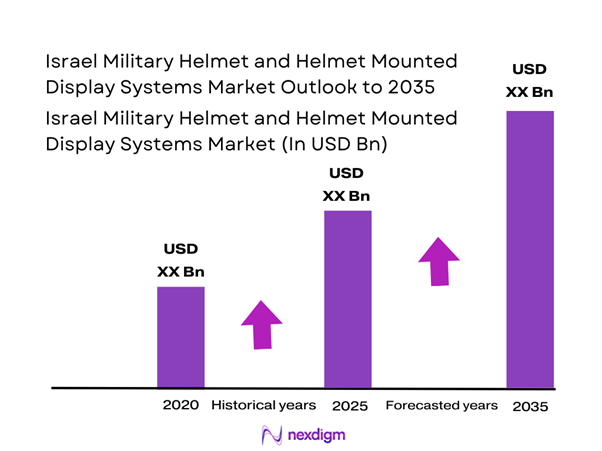
The Israel Military Helmet and Helmet Mounted Display Systems market current size stands at around USD ~ million, reflecting steady expansion from earlier levels near USD ~ million driven by modernization cycles and elevated operational readiness requirements. Recent procurement programs have supported the deployment of ~ systems across frontline and reserve units, while cumulative installed base has crossed ~ systems nationally. Annual capital allocation linked to wearable combat technologies has reached USD ~ million, underpinned by consistent upgrade cycles in aviation and special operations forces.
Demand concentration remains strongest around Tel Aviv, Haifa, and Beersheba due to proximity to major defense primes, air bases, and advanced R&D clusters. These regions benefit from dense integration between military units, avionics laboratories, and optoelectronics manufacturing hubs. Mature testing infrastructure, rapid prototyping ecosystems, and streamlined defense procurement channels reinforce regional dominance. Policy alignment toward indigenous innovation and export readiness further strengthens local adoption, making these centers the primary drivers of system integration and lifecycle support.
Market Segmentation
By Platform Type
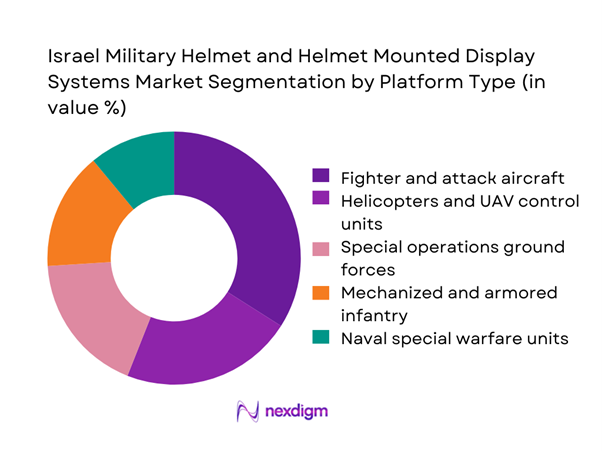
The market is dominated by air and special operations platforms, where advanced helmet mounted display systems are critical for mission success in complex threat environments. Fighter and rotary-wing aviation units account for a substantial portion of total deployments, driven by the integration of sensor fusion, night vision, and precision cueing into pilot helmets. Ground forces, particularly special operations and urban warfare units, are also increasing adoption as wearable displays become lighter and more ergonomic. Ongoing replacement of legacy optical systems with digital and augmented reality-enabled helmets is accelerating penetration across elite units. With ~ systems added annually through modernization programs, platform-based demand continues to skew toward high-performance operational segments rather than mass infantry deployment.
By End-Use Application
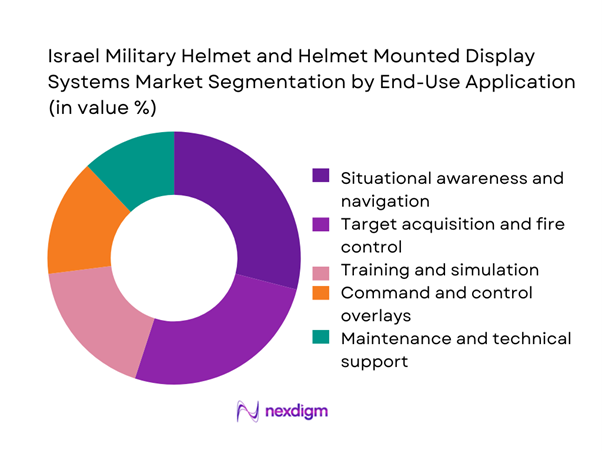
Operational use cases centered on situational awareness and targeting dominate overall adoption patterns. Helmet mounted displays are increasingly deployed to enable real-time battlefield visualization, reducing response times and improving coordination across units. Training and simulation applications are also gaining traction, as defense institutions invest in immersive environments to shorten learning curves and improve mission readiness. Command and control overlays for urban and asymmetric warfare are emerging as a high-growth segment, supported by network-centric doctrine. With annual deployment volumes exceeding ~ units across active formations, application-driven demand is shifting from basic vision enhancement to advanced decision-support roles, positioning the technology as a core component of digital soldier and pilot ecosystems.
Competitive Landscape
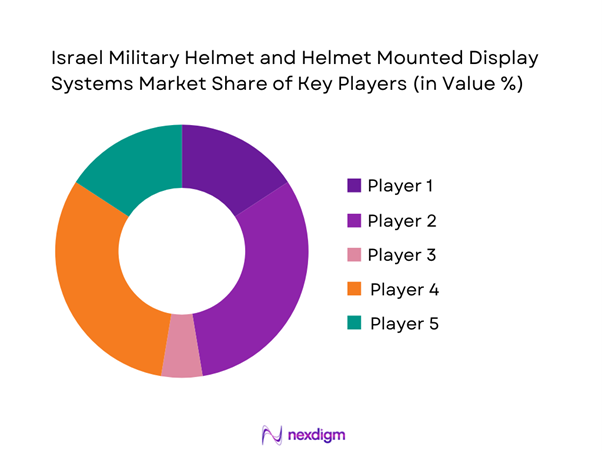
The market is moderately concentrated, led by a small group of defense technology leaders with deep integration into national military programs and strong export pipelines. High entry barriers related to certification, avionics integration, and cybersecurity compliance limit new competition, reinforcing the dominance of established players with proven operational track records and long-term defense contracts.
| Company Name | Establishment Year | Headquarters | Formulation Depth | Distribution Reach | Regulatory Readiness | Service Capability | Channel Strength | Pricing Flexibility |
| Elbit Systems | 1966 | Israel | ~ | ~ | ~ | ~ | ~ | ~ |
| Rafael Advanced Defense Systems | 1948 | Israel | ~ | ~ | ~ | ~ | ~ | ~ |
| Israel Aerospace Industries | 1953 | Israel | ~ | ~ | ~ | ~ | ~ | ~ |
| L3Harris Technologies | 2019 | United States | ~ | ~ | ~ | ~ | ~ | ~ |
| Thales Group | 1893 | France | ~ | ~ | ~ | ~ | ~ | ~ |
Israel Military Helmet and Helmet Mounted Display Systems Market Analysis
Growth Drivers
Rising emphasis on soldier situational awareness and survivability
Enhanced battlefield complexity has driven the deployment of ~ advanced helmet and display systems across frontline units, with operational programs supporting the integration of digital vision, threat alerts, and real-time navigation aids. National defense budgets have allocated USD ~ million annually toward wearable combat technologies, enabling the rollout of ~ systems for infantry, aviation, and special forces. Field exercises involving ~ personnel each year increasingly rely on helmet mounted displays to reduce reaction times and improve mission coordination. This operational shift has elevated demand for lightweight, ruggedized systems capable of functioning in extreme environments while maintaining uninterrupted data flow across tactical networks.
Modernization of combat aviation and helicopter fleets
Fleet upgrade initiatives involving ~ aircraft platforms have accelerated adoption of next-generation helmet mounted displays in both fixed-wing and rotary segments. Aviation modernization programs have directed USD ~ million toward cockpit digitization, with helmet-based cueing systems becoming standard for navigation and targeting. Each new aircraft induction cycle supports the installation of ~ helmet systems, expanding the installed base across squadrons. Training pipelines processing ~ pilots annually now incorporate advanced display helmets as a core requirement, reinforcing demand continuity. This modernization trajectory positions aviation as the largest single contributor to system upgrades over the medium term.
Challenges
High unit costs and constrained defense budgets
Advanced helmet mounted display systems involve per-unit expenditures near USD ~ million for fully integrated configurations, limiting large-scale deployment across conventional forces. Annual procurement cycles typically support only ~ systems due to competing priorities such as armored vehicles, missiles, and cyber defense. Budgetary trade-offs have delayed replacement schedules, extending the service life of ~ legacy helmets beyond optimal operational thresholds. Smaller units often face allocation gaps, reducing uniformity of equipment across formations. These fiscal constraints slow penetration in non-elite segments despite clear operational benefits.
Complex integration with legacy platforms and avionics
Integration challenges persist as ~ aircraft and armored platforms continue to operate on legacy avionics architectures incompatible with modern display interfaces. Retrofitting requires system-level upgrades costing USD ~ million per platform, adding to program timelines and certification complexity. Each integration cycle can involve ~ months of testing and validation, delaying field deployment. In ground forces, ~ communication standards remain fragmented, complicating seamless data flow to helmet displays. These technical hurdles increase project risk and deter rapid scaling across mixed-generation fleets.
Opportunities
Next-generation augmented reality and AI-assisted displays
The shift toward augmented reality and AI-enabled cueing opens pathways for the deployment of ~ advanced helmet systems capable of predictive threat identification and automated navigation guidance. Development programs have attracted USD ~ million in annual innovation funding focused on sensor fusion and machine learning overlays. Pilot trials involving ~ operators demonstrate measurable improvements in task completion times and situational accuracy. As computing modules shrink and power efficiency improves, next-generation helmets are expected to reach broader units, creating sustained demand for upgrades and new installations.
Upgrades and retrofits for existing pilot and soldier fleets
With an installed base exceeding ~ helmet systems across services, retrofit programs represent a major growth avenue. Upgrade packages priced near USD ~ million per batch enable the addition of night vision, thermal imaging, and secure connectivity without full system replacement. Annual retrofit cycles covering ~ units allow defense planners to extend asset lifecycles while improving operational capability. This approach reduces capital strain and accelerates adoption of incremental innovations, positioning retrofits as a strategic lever for modernization in budget-constrained environments.
Future Outlook
The market is set to evolve toward fully networked, AI-enabled wearable combat systems that integrate seamlessly with national digital battlefield architectures. Over the coming decade, procurement strategies will increasingly favor modular upgrades and software-driven capability expansion. Export demand is expected to reinforce domestic production volumes, while collaboration with allied defense programs will shape technology standards. As operational doctrines emphasize speed, precision, and survivability, helmet mounted display systems will remain central to force modernization initiatives.
Major Players
- Elbit Systems
- Rafael Advanced Defense Systems
- Israel Aerospace Industries
- L3Harris Technologies
- Thales Group
- BAE Systems
- Collins Aerospace
- Honeywell Aerospace
- Gentex Corporation
- Safran Electronics & Defense
- Leonardo
- Rheinmetall Defence
- Aselsan
- Hensoldt
- Teledyne FLIR Defense
Key Target Audience
- Israel Ministry of Defense procurement divisions
- Israeli Defense Forces ground, air, and naval command units
- Defense electronics and avionics manufacturers
- Homeland security and border protection agencies
- Export control and defense trade authorities
- System integrators and MRO providers
- Investments and venture capital firms focused on defense technology
- Government and regulatory bodies including SIBAT and the Defense Export Controls Agency
Research Methodology
Step 1: Identification of Key Variables
Assessment of operational deployment patterns, modernization cycles, and procurement volumes across air, land, and naval forces. Mapping of technology adoption rates for helmet mounted displays and wearable combat electronics. Evaluation of funding flows and policy priorities shaping defense equipment upgrades.
Step 2: Market Analysis and Construction
Compilation of installation volumes, installed base estimates, and upgrade frequencies across major platforms. Structuring of demand scenarios based on fleet renewal and retrofit pathways. Alignment of market boundaries with operational and budgetary frameworks.
Step 3: Hypothesis Validation and Expert Consultation
Consultation with defense technology specialists and former procurement officers. Validation of integration timelines, certification barriers, and lifecycle cost dynamics. Cross-checking of demand assumptions with field deployment realities.
Step 4: Research Synthesis and Final Output
Integration of quantitative indicators with qualitative operational insights. Development of coherent market narratives and strategic implications. Final validation to ensure consistency across segmentation, analysis, and outlook.

- Executive Summary
- Research Methodology (Market definitions and scope boundaries, military helmet and HMD system taxonomy across pilot and ground soldier applications, market sizing logic by force modernization programs and unit deployment, revenue attribution across equipment upgrades spares and support services, primary interview program with defense forces OEMs and system integrators, data triangulation validation assumptions and limitations)

- Definition and Scope
- Market evolution
- Operational and mission usage pathways
- Defense ecosystem structure
- Supply chain and procurement channel structure
- Regulatory and export control environment

- Growth Drivers
Rising emphasis on soldier situational awareness and survivability
Modernization of combat aviation and helicopter fleets
Integration of network-centric warfare and digital battlefield concepts
Increased special operations and urban warfare requirements
Government focus on indigenous defense technology development
Export demand for Israeli-developed helmet and HMD solutions - Challenges
High unit costs and constrained defense budgets
Complex integration with legacy platforms and avionics
Cybersecurity and data integrity risks in networked systems
Weight, ergonomics, and user fatigue concerns
Supply chain dependence on advanced optics and semiconductors
Stringent export control and international compliance barriers - Opportunities
Next-generation augmented reality and AI-assisted displays
Upgrades and retrofits for existing pilot and soldier fleets
Growing demand from allied and partner nations
Dual-use applications in homeland security and law enforcement
Modular open-architecture systems for faster customization
Lifecycle service, MRO, and software upgrade revenues - Trends
Shift toward panoramic and wide field-of-view HMDs
Increasing use of sensor fusion and AI-based threat cueing
Adoption of lightweight composite and smart materials
Expansion of simulation-linked training helmets
Move toward open systems architecture and interoperability
Greater emphasis on cyber-hardened wearable electronics - Government Regulations
- SWOT Analysis
- Stakeholder and Ecosystem Analysis
- Porter’s Five Forces Analysis
- Competition Intensity and Ecosystem Mapping

- By Value, 2020–2025
- By Volume, 2020–2025
- By Installed Base, 2020–2025
- By Average Selling Price, 2020–2025

- By Fleet Type (in Value %)
Infantry ground forces
Special operations forces
Armored and mechanized units
Army aviation units
Air force fast-jet squadrons
Naval and maritime special units - By Application (in Value %)
Day and night situational awareness
Target acquisition and fire control cueing
Pilotage and navigation
Training and simulation
Command and control integration
Augmented reality mission overlays - By Technology Architecture (in Value %)
Monocular HMD systems
Binocular and panoramic HMD systems
Optical see-through displays
Video see-through displays
Hybrid AR display architectures
Integrated sensor-fused helmets - By End-Use Industry (in Value %)
Army and ground combat units
Air force and combat aviation
Naval forces and special warfare
Homeland security and border protection
Defense training institutions - By Connectivity Type (in Value %)
Wired tethered systems
Wireless low-latency RF systems
Mesh network-enabled helmets
Platform-integrated avionics links
Edge-compute enabled systems - By Region (in Value %)
Northern Command
Central Command
Southern Command
Air bases and aviation commands
Naval bases and maritime zones

- Market structure and competitive positioning
Market share snapshot of major players - Cross Comparison Parameters (field of view, system weight, sensor fusion capability, night vision integration, latency performance, ruggedization standards, interoperability with C4ISR, lifecycle support model)
- SWOT Analysis of Key Players
- Pricing and Commercial Model Benchmarking
- Detailed Profiles of Major Companies
Elbit Systems
Rafael Advanced Defense Systems
Israel Aerospace Industries
L3Harris Technologies
Thales Group
BAE Systems
Collins Aerospace
Honeywell Aerospace
Gentex Corporation
Safran Electronics & Defense
Leonardo
Rheinmetall Defence
Aselsan
Hensoldt
Teledyne FLIR Defense

- Demand and utilization drivers
- Procurement and tender dynamics
- Buying criteria and vendor selection
- Budget allocation and financing preferences
- Implementation barriers and risk factors
- Post-purchase service expectations

- By Value, 2026–2035
- By Volume, 2026–2035
- By Installed Base, 2026–2035
- By Average Selling Price, 2026–2035


 Request a Sample
 Ask for Customization
 Get a Quote
 Enquire Now