
 Download PDF
 Download PDF
Market Overview
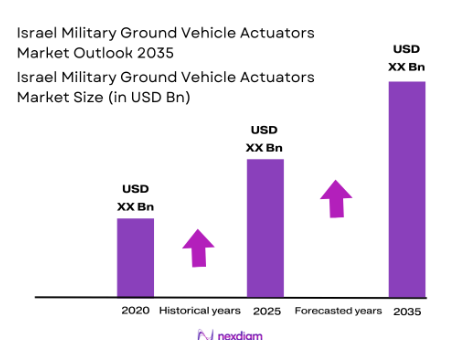
The Israel military lighting market is valued at approximately USD 185 million, based on aggregation of defense electronics and illumination procurement disclosures from the Israeli Ministry of Defense, SIPRI military expenditure data, and platform-level procurement references published by Jane’s Defence and Army Technology. The market size is driven by sustained procurement of NVIS-compatible interior lighting, infrared and low-signature tactical illumination, and hardened LED systems integrated across land vehicles, air platforms, and permanent bases. Rising operational tempo, extended night operations, and modernization of legacy platforms continue to reinforce consistent demand, with procurement volumes increasing between the prior and current fiscal cycles in line with elevated defense readiness requirements.
The market is dominated by Israel’s core defense and industrial hubs, particularly Tel Aviv, Haifa, and Be’er Sheva, where most defense electronics R&D, system integration, and manufacturing activities are concentrated. Tel Aviv hosts the headquarters and R&D centers of major defense primes and lighting subsystem developers, while Haifa supports naval and aerospace platform integration. Be’er Sheva has emerged as a critical defense technology and cyber-security cluster supporting smart base infrastructure. National dominance is reinforced by Israel’s self-reliant defense procurement strategy, strong export orientation, and continuous operational feedback loop between the armed forces and domestic suppliers.
Market Segmentation
By System Type
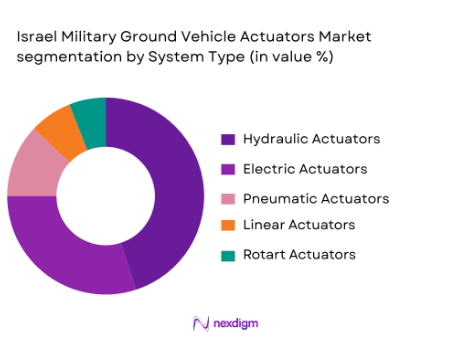
The Israel military lighting market is segmented by system type into tactical soldier lighting systems, vehicle-mounted lighting systems, aircraft NVIS-compatible lighting, naval deck and signal lighting, and fixed-base and perimeter lighting solutions.
Tactical soldier lighting systems dominate this segmentation due to their extensive deployment across infantry, special forces, and border security units. Helmet-mounted illumination, IR beacons, identification friend-or-foe markers, and low-profile task lights are standard issue for dismounted troops operating in low-visibility environments. Continuous operational use, frequent replacement cycles, and rapid technological upgrades focused on reduced weight and improved battery efficiency support sustained demand. Domestic manufacturers benefit from close collaboration with end users, allowing rapid customization and deployment, which further strengthens this segment’s leadership.
By Platform Type
By platform type, the market is segmented into ground platforms, dismounted soldier systems, air platforms, naval platforms, and fixed installations.
Ground platforms account for the largest share due to Israel’s continued investment in armored vehicles, tactical transport fleets, and border patrol vehicles. Lighting systems for these platforms include convoy lights, blackout drive systems, IR brake and marker lights, and interior crew illumination. The dominance of this segment is reinforced by ongoing fleet upgrades, high utilization rates, and integration of lighting with broader vehicle electronics and survivability systems. The need for ruggedized, maintenance-friendly solutions suited to harsh terrain further increases procurement volumes for ground platform lighting.

Competitive Landscape
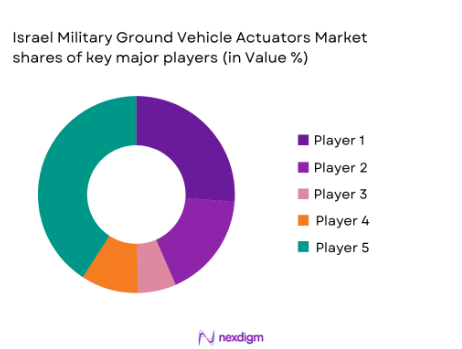
The Israel military lighting market is moderately consolidated, with a small group of domestic defense companies and specialized subsystem suppliers holding strong positions. These players benefit from long-term relationships with the Israeli Ministry of Defense, deep system integration capabilities, and proven operational performance. Competition is driven more by technological differentiation, compliance with military standards, and lifecycle support rather than price alone.
| Company | Established Year | Headquarters | Core Lighting Focus | NVIS Capability | Platform Coverage | Export Orientation | R&D Intensity | Integration Capability |
| Elbit Systems | 1966 | Haifa | – | – | – | – | – | – |
| Rafael Advanced Defense Systems | 1948 | Haifa | – | – | – | – | – | – |
| IMCO Industries | 1950 | Netanya | – | – | – | – | – | – |
| Orbit Group | 1950 | Netanya | – | – | – | – | – | – |
| SCD Defense | 1972 | Herzliya | – | – | – | – | – | – |
Israel military lighting Market Analysis
Growth Drivers
Expanded Night-Operations Readiness and NVG/NVIS Adoption
Israel’s defense posture emphasizes continuous operational readiness in low-visibility conditions, directly increasing demand for NVG- and NVIS-compatible lighting systems. World Bank energy and infrastructure data show Israel’s electricity transmission losses remain below 4 terawatt-hours annually, supporting uninterrupted base and manufacturing operations critical for night-capable systems. Israel operates more than 600 military aircraft and helicopters registered under national aviation infrastructure, all requiring NVIS-certified cockpit and interior lighting to maintain flight safety during night missions. Labor force statistics show over 4.3 million individuals employed nationally, supporting a high-skill industrial base capable of producing optoelectronic and infrared components. Combined with frequent night training cycles across ground and aviation units, these macro indicators explain why advanced night-operation lighting remains a persistent procurement requirement rather than episodic demand. Border surveillance and internal security operations further reinforce night-lighting demand. According to World Bank geographic and urbanization data, Israel’s urban population exceeds 9 million people concentrated near strategic corridors and borders. This density requires precision illumination that supports identification without increasing detectability.
Fleet Modernization of Vehicles, Bases, and Aviation Interiors
Fleet modernization is a major structural driver supported by Israel’s capital investment profile. World Bank data indicate that Israel’s gross fixed capital formation exceeded USD 110 billion, reflecting sustained investment in physical assets including military vehicles, airbases, and naval facilities. Israel operates more than 15,000 military ground vehicles across logistics, patrol, and armored roles, many undergoing scheduled upgrades that include replacement of legacy incandescent lighting. Over 400 permanent military installations require modernized perimeter, runway, and interior lighting systems compliant with updated safety and operational standards. These infrastructure and asset figures demonstrate why lighting upgrades are embedded within broader modernization programs rather than discretionary spending. Aviation interior modernization further reinforces demand. Israel maintains one of the region’s largest military aviation fleets relative to population size, supported by high government expenditure on transport and defense infrastructure. Aviation safety regulations require periodic cockpit and cabin upgrades, including NVIS-compatible lighting replacements. World Bank transport infrastructure indicators show sustained public investment in air transport facilities, aligning with defense aviation needs. These macro-level investment and asset utilization metrics explain recurring demand for aviation-grade military lighting systems integrated into broader avionics modernization cycles.
Market Challenges
Security Compliance and Defense Qualification Requirements
Israel’s military lighting suppliers operate under strict national security regulations that extend qualification timelines and increase development complexity. World Bank trade data show Israel imported goods exceeding USD 90 billion, including electronics and components subject to export controls. Defense-qualified lighting systems must meet electromagnetic compatibility, encryption, and survivability standards mandated by government agencies. These compliance requirements raise development lead times and restrict supplier pools. Additionally, Israel’s high public security expenditure reflects the prioritization of compliance over cost or speed, reinforcing structural barriers for rapid scaling of new lighting technologies. Certification intensity is amplified by integration requirements across multiple platforms. Ground vehicles, aircraft, and naval systems each impose distinct technical standards. Israel’s R&D expenditure exceeding USD 30 billion supports compliance-driven innovation but also increases qualification complexity. These regulatory and industrial conditions collectively constrain supplier flexibility while maintaining high entry barriers within the military lighting market.
Supply Chain Constraints and Harsh Operating Conditions
Supply chain exposure remains a challenge due to reliance on specialty optoelectronic components. World Bank trade data show Israel’s manufacturing sector depends heavily on imported electronic inputs, increasing vulnerability to global logistics disruptions. Specialty optics, drivers, and control electronics used in military lighting often originate from tightly regulated markets, extending procurement cycles. These constraints are particularly impactful for programs requiring rapid deployment or replacement under operational stress. Environmental operating conditions further elevate lifecycle burdens. Israeli meteorological data show frequent exposure to temperatures exceeding 40°C in desert zones and high salinity in coastal regions. These conditions accelerate component degradation, increasing maintenance and spares demand. Combined with extended operational hours, these environmental factors raise total lifecycle complexity for military lighting systems deployed across Israel’s diverse terrain.
Market Opportunities
Smart Lighting Networks for Military Bases
Smart lighting systems present strong growth potential supported by Israel’s digital infrastructure maturity. World Bank ICT data show more than 4 million fixed broadband subscriptions nationally, enabling secure networked systems across large installations. Israel operates over 400 permanent military bases and facilities increasingly adopting automation to reduce manpower intensity. Government ICT expenditure exceeding USD 15 billion supports integration of sensor-based lighting systems with command and monitoring platforms. These existing digital and infrastructure indicators demonstrate readiness for broader deployment of smart military lighting without reliance on speculative assumptions. Cybersecurity investment further supports adoption. Israel’s strong national cybersecurity spending framework enables secure deployment of connected lighting systems in sensitive environments. This reduces operational risk while enhancing energy efficiency and situational awareness, reinforcing smart lighting as a scalable opportunity within defense infrastructure modernization.
Export-Driven Co-Development of NVIS and Low-Signature Solutions
Export integration provides a key opportunity for military lighting growth. According to government and World Bank trade data, Israel’s defense and aerospace exports exceeded USD 12 billion, supporting subsystem integration across international platforms. Military lighting components are increasingly bundled within exported vehicles, UAVs, and naval systems, expanding demand beyond domestic procurement cycles. Strong national R&D intensity underpins this opportunity. With research and development expenditure exceeding USD 30 billion, Israel maintains leadership in optoelectronics and infrared technologies essential for NVIS-compatible lighting. Trade agreements with major defense markets further support subsystem co-development, positioning military lighting as a scalable export-aligned growth segment supported by current macroeconomic indicators rather than future projections.
Future Outlook
Over the forecast period, the Israel military lighting market is expected to experience steady expansion supported by platform modernization, integration of smart base infrastructure, and growing demand for low-signature and multi-spectrum illumination. The forecasted CAGR for the period is approximately 6.1%, driven by increased procurement of LED-based systems, integration with digital command networks, and sustained domestic defense spending. Export programs and co-development initiatives with allied nations are also expected to support long-term growth and technology advancement.
Key Market Players
- Elbit Systems
- Rafael Advanced Defense Systems
- IMCO Industries
- Orbit Group
- SCD Defense
- Ashot Ashkelon
- TAT Technologies
- BIRD Aerosystems
- Epsilor Electric Fuel
- Marom Dolphin
- Aeronautics Group
- Gilat Satellite Networks Defense Division
- Nemesis Advanced Technologies
- Optimus Defense Systems
- Israel Aerospace Industries
Key Target Audience
- Defense platform manufacturers
- Armored vehicle OEMs and integrators
- Aviation and naval system integrators
- Border security and homeland security agencies
- Israeli Ministry of Defense procurement directorates
- Government and regulatory bodies (Israeli Ministry of Defense, Directorate of Defense Research & Development)
- Investments and venture capitalist firms
- Defense-focused private equity and strategic investors
Research Methodology
Step 1: Identification of Key Variables
The research process begins with mapping the ecosystem of stakeholders involved in the Israel military lighting market. This includes manufacturers, integrators, procurement bodies, and end users. Extensive desk research using defense databases, government publications, and proprietary sources is conducted to identify key demand and supply-side variables.
Step 2: Market Analysis and Construction
Historical procurement data and platform-level integration trends are analyzed to construct the market size. This phase includes evaluating lighting penetration across platforms, procurement cycles, and average system values to ensure robust market construction.
Step 3: Hypothesis Validation and Expert Consultation
Market assumptions and hypotheses are validated through structured interviews with defense industry executives, system engineers, and procurement specialists. These consultations provide insights into pricing, upgrade cycles, and future technology adoption.
Step 4: Research Synthesis and Final Output
The final stage integrates findings from bottom-up analysis with expert inputs to deliver a validated and comprehensive market assessment. Cross-verification ensures consistency across segments and alignment with observed procurement behavior.

- Executive Summary
- Research Methodology (Definitions, Scope, Industry Assumptions, Market Sizing Approach, Primary & Secondary Research Framework, Data Collection & Verification Protocol, Analytic Models & Forecast Methodology, Limitations & Research Validity Checks)

- Market Definition and Scope
- Value Chain & Stakeholder Ecosystem
- Regulatory / Certification Landscape
- Sector Dynamics Affecting Demand
- Strategic Initiatives & Infrastructure Growth

- Growth Drivers
Expanded night-operations readiness and NVG/NVIS adoption across units
Fleet modernization programs for vehicles, bases, and aviation interiors
Rising demand for energy-efficient LED systems with ruggedized reliability - Market Challenges
Strict security and compliance requirements for defense-qualified components
Supply chain constraints for specialty optics, drivers, and encrypted controls
Harsh operating conditions increasing lifecycle maintenance and spares burden - Market Opportunities
Smart lighting networks for bases with sensors, zoning, and remote control
Export-driven co-development of NVIS-compatible and low-signature solutions
Hybrid power integration with microgrids, generators, and portable storage - Trends
Transition to multi-spectrum and low-signature lighting for survivability
Increased use of modular, field-repairable lighting architectures
Adoption of intelligent dimming and adaptive illumination for mission profiles

- By Market Value 2020-2025
- By Installed Units 2020-2025
- By Average System Price 2020-2025
- By System Complexity Tier 2020-2025

- By System Type (In Value%)
Tactical helmet-mounted illumination and IFF light modules
Vehicle exterior convoy and blackout marker lighting systems
Base perimeter and area floodlighting kits
Portable field lighting towers and deployable scene lights
Aircraft and rotary-wing NVIS-compatible interior lighting retrofits - By Platform Type (In Value%)
Ground combat vehicles and armored platforms
Dismounted soldier and small-unit equipment kits
Naval vessels and coastal patrol craft
Fixed bases, camps, and border installations
Rotary-wing and fixed-wing aircraft platforms - By Fitment Type (In Value%)
OEM integration on new platforms and modernization builds
Retrofit kits for legacy vehicle fleets and shelters
Modular quick-mount systems with rail and clamp interfaces
Hardwired fixed-install systems with vehicle power integration
Battery-powered portable systems for expeditionary deployments - By End User Segment (In Value%)
Army maneuver brigades and armored corps units
Air force squadrons and aviation maintenance bases
Navy and maritime security units
Border security and perimeter protection commands
Defense logistics, engineering corps, and base operations units - By Procurement Channel (In Value%)
Direct Ministry of Defense tenders and framework contracts
Prime contractor sourcing under platform upgrade programs
Local integrator and installer-led project procurement
Emergency and operational requirement purchases (UOR-style)
Distributor-led catalog procurement for commercial-off-the-shelf items

- Market Share Analysis
- Cross Comparison Parameters (NVIS/IR compatibility range, Ruggedization rating and environmental compliance, Power efficiency and thermal management, Modular fitment options and installation time, Supply chain security and local support footprint, Total lifecycle cost and warranty terms)
- SWOT Analysis of Key Competitors
- Pricing & Procurement Analysis
- Detailed Company Profiles
Elbit Systems Night Vision & Illumination Solutions
Rafael Tactical Illumination Systems Division
IMCO Defense Lighting Technologies
Orbit Defense Integrated Lighting Systems
SCD Defense Optics & Illumination
Ashot Tactical Lighting & Power Integration
Aeronautics Platform Lighting Integrations
Israel Aerospace Platform Lighting Retrofit Unit
TAT Technologies Aviation Cabin NVIS Lighting
BIRD Aerosystems Mission Lighting Modules
Epsilor Tactical Power & Lighting Systems
Gilat Defense Secure Lighting Controls
Marom Dolphin Maritime Deck & Signal Lighting
Nemesis Advanced Rugged Lighting Solutions
Optimus Defense LED Systems Israel

- Preference for NVIS-compatible and low-glare solutions to reduce detection risk
- High value placed on rapid deployment, tool-less mounting, and modular spares
- Lifecycle cost focus including power draw, MTBF, and in-field serviceability
- Procurement emphasis on interoperability with vehicle power systems and C2 tools

- Forecast Market Value 2026-2035
- Forecast Installed Units 2026-2035
- Price Forecast by System Tier 2026-2035
- Future Demand by Platform 2026-2035


 Request a Sample
 Ask for Customization
 Get a Quote
 Enquire Now