
 Download PDF
 Download PDF
Market Overview
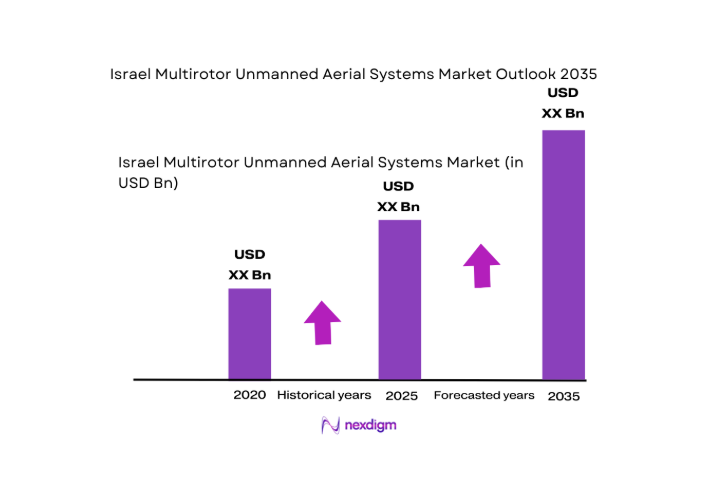
The Israel Multirotor Unmanned Aerial Systems market is valued at USD ~, based on historical data and market analysis. This growth is driven by technological advancements in drone capabilities, including increased flight times, better cameras, and more efficient energy use. A rise in military, surveillance, and commercial applications such as infrastructure inspection and agriculture also contributes to market expansion. With significant support from government-backed research and development (R&D) investments, the demand for UAVs is expected to continue growing in the coming years, particularly in sectors like defense and security.
Israel leads the global multirotor UAS market due to its advanced technological expertise, particularly in defense and surveillance applications. Cities such as Tel Aviv and Haifa are key hubs for UAV research and development, hosting major manufacturers and startups. Additionally, Israel’s regulatory framework for drone operations, along with its military applications, significantly contributes to the dominance of the market. The country’s position as a global leader in drone technology is strengthened by its collaboration with international partners and significant military investments in UAVs.
Market Segmentation
By System Type
The Israel Multirotor Unmanned Aerial Systems market is segmented by system type into fixed-wing multirotor UAVs, vertical take-off and landing (VTOL) UAVs, multirotor UAVs with advanced autonomy, hydrogen-powered UAVs, and electric propulsion UAVs. Among these, VTOL UAVs hold a dominant market share. VTOL technology offers the advantage of vertical take-off and landing capabilities, making it ideal for use in urban and confined spaces. This subsegment benefits from the increasing demand for urban air mobility solutions, where space constraints require flexible operation. The ability of VTOL UAVs to operate in both urban and rural environments, combined with advances in automation, continues to drive the growth of this subsegment.

By Platform Type
The platform type segmentation for the Israel Multirotor Unmanned Aerial Systems market includes military UAVs, commercial UAVs, industrial UAVs, agricultural UAVs, and consumer UAVs. Military UAVs dominate this market, as Israel has a well-established defense sector that extensively uses drones for surveillance, reconnaissance, and combat. The high-performance standards required for military UAVs drive significant technological advancements in the field. Additionally, the Israeli government’s focus on UAV technology for defense applications continues to ensure that military UAVs lead the market share in both domestic and international markets.

Competitive Landscape
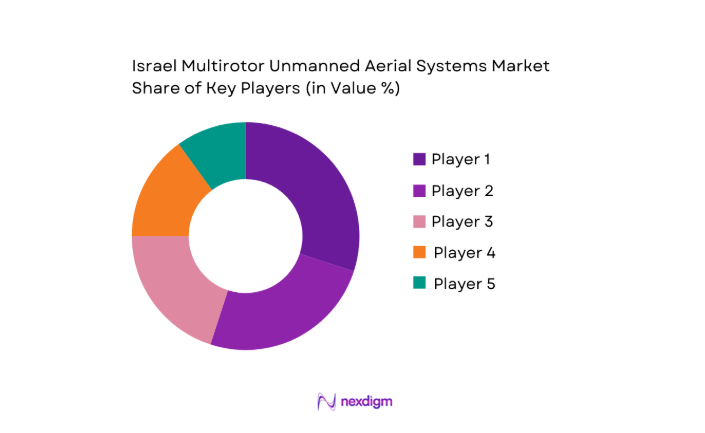
The Israel Multirotor Unmanned Aerial Systems market is dominated by several key players, including both local and international manufacturers. The market is characterized by innovation, with companies focused on increasing drone capabilities for both commercial and defense applications. Leading players in the market are Aeronautics Ltd., Elbit Systems, Bluebird Aero Systems, and Airobotics, which have maintained their market presence by continuously advancing their technology and expanding their global reach.
| Company Name | Establishment Year | Headquarters | Product Focus | Technology | Revenue (USD Million) | Global Reach |
| Aeronautics Ltd. | 1997 | Yavne, Israel | ~ | ~ | ~ | ~ |
| Elbit Systems | 1966 | Haifa, Israel | ~ | ~ | ~ | ~ |
| Bluebird Aero Systems | 2002 | Herzliya, Israel | ~ | ~ | ~ | ~ |
| Airobotics | 2014 | Petah Tikva, Israel | ~ | ~ | ~ | ~ |
| FlyTech UAV | 2010 | Tel Aviv, Israel | ~ | ~ | ~ | ~ |
Israel Multirotor Unmanned Aerial Systems Market Analysis
Growth Drivers
Advancements in UAV Battery Technology
The development of more efficient and long-lasting UAV battery technologies is one of the key factors driving the Israel Multirotor Unmanned Aerial Systems (UAS) market. As per the International Energy Agency (IEA), global energy storage capacity is expected to increase by ~ annually from 2024 onwards, enabling the development of batteries that support longer flight durations for UAVs. Innovations in solid-state batteries and lithium-sulfur batteries are also expected to improve performance significantly. These advancements are critical for Israel’s defense and commercial UAV sectors, allowing drones to cover larger areas and operate more autonomously for extended periods. In particular, battery performance directly impacts both military surveillance missions and the viability of UAVs for agricultural applications. These advancements enable drones to handle more complex tasks, contributing significantly to the overall growth of the sector.
Government Investments in UAV Applications
Israel has continuously bolstered its investments in unmanned aerial vehicle applications, particularly in the defense sector. According to the Israeli Ministry of Defense, over USD ~ was allocated in 2024 for the development and enhancement of UAV technologies, supporting both military and commercial innovations. The Israeli government is also actively promoting UAVs for border security, agriculture, and infrastructure monitoring. Government initiatives such as these are key enablers of growth, ensuring that Israel maintains its technological leadership and global competitiveness. The expansion of UAVs in civilian applications is further supported by government-backed research and regulatory changes, reinforcing Israel’s position as a leading market for UAV adoption.
Market Challenges
Regulatory Hurdles in UAV Airspace Management
Israel faces challenges regarding UAV airspace management, which could limit the sector’s potential. In 2024, the Israeli Civil Aviation Authority (ICAA) released guidelines for UAV operations, which restrict drone flights in certain urban and military zones. The regulatory framework is still evolving to accommodate the rapid growth of UAV operations. As of 2025, Israel’s airspace is only partially open to commercial UAVs, with several no-fly zones and airspace restrictions in place, making widespread commercial use of drones more challenging. While the ICAA is working on expanding airspace for UAVs, regulatory barriers remain an obstacle that could slow down the adoption of drones in more densely populated areas or for certain commercial applications.
High Operational Costs of Advanced UAV Systems
Despite the growth in the UAV sector, high operational costs remain a challenge. Advanced UAV systems, particularly those used in defense and surveillance, can incur substantial maintenance and operational expenses. The Israeli Ministry of Defense reported that operational costs of high-end UAV systems, such as the Heron TP drone, exceed USD ~ per flight hour, which can limit the scale at which these drones are used. These high costs are attributed to expensive components such as specialized sensors, communication equipment, and energy systems. As technology progresses, efforts to reduce these costs are essential for further UAV adoption in commercial sectors like logistics and agriculture.
Market Opportunities
Expansion of UAV Applications in Agricultural Monitoring
UAVs are increasingly being used in Israel for agricultural monitoring, a market that is poised for significant growth. With Israel’s agricultural industry valued at over USD ~ in 2025, drones have proven to be a valuable tool in precision farming, offering farmers enhanced crop monitoring, pest detection, and irrigation management. UAVs equipped with multispectral sensors can gather real-time data, helping to optimize farming practices and increase yield productivity. According to the Israeli Ministry of Agriculture, UAV technology is expected to be a key enabler in achieving national goals of improving agricultural efficiency by ~ by 2026. As water scarcity remains a challenge in the region, UAVs help in efficient water use by precisely monitoring irrigation systems, creating new opportunities for growth in agricultural UAV applications.
Growth of UAV Usage in Urban Planning and Smart Cities
The adoption of UAVs for urban planning and smart city applications presents a substantial opportunity in the Israel market. With Israel’s cities such as Tel Aviv and Haifa leading the charge in smart city development, UAVs are increasingly being utilized for infrastructure inspection, construction site monitoring, and mapping services. According to the World Bank, global smart city investments are expected to surpass USD 500 billion by 2025, with a significant portion directed toward adopting technologies like UAVs for urban management. UAVs are proving invaluable in monitoring the condition of buildings, bridges, and roads, helping to streamline urban development and reduce maintenance costs. In Israel, where urban areas are expanding rapidly, UAVs are positioned to play a pivotal role in supporting smart city goals.
Future Outlook
Over the next decade, the Israel Multirotor Unmanned Aerial Systems market is expected to see significant growth, driven by continued advancements in drone technology and increased adoption of UAVs in both military and commercial sectors. The demand for UAVs in agriculture, defense, and urban infrastructure inspection will further fuel market expansion. Additionally, government investments in UAV R&D and military applications will continue to support the growth of the market. As regulatory frameworks evolve to accommodate more widespread UAV use, the market is poised for continued development.
Major Players
- Aeronautics Ltd.
- Elbit Systems
- Bluebird Aero Systems
- Airobotics
- FlyTech UAV
- Urban Aeronautics
- Horizon Unmanned Systems
- Quadcopter Aerial Systems
- Aerialtronics
- RT LTA Systems Ltd.
- Smart Drone
- Pix4D
- DroneVision Technologies
- DroneShield
- Skycore Technologies
Key Target Audience
- Investments and Venture Capitalist Firms
- Government and Regulatory Bodies
- Military and Defense Organizations
- Commercial Drone Operators
- Infrastructure Companies
- Agricultural Technology Companies
Research Methodology
Step 1: Identification of Key Variables
In this initial phase, key stakeholders within the Israel Multirotor Unmanned Aerial Systems market are identified. Desk research is conducted using secondary data and proprietary sources to gather comprehensive information. Key variables influencing market dynamics are defined, including regulatory impacts, technological advancements, and industry demand drivers.
Step 2: Market Analysis and Construction
Data is analyzed for historical performance, market penetration, and revenue generation across different sectors. Detailed segmentation analysis is performed, including system and platform types, to understand the market’s structure. Trends in UAV technology, such as battery improvements and autonomous systems, are also explored.
Step 3: Hypothesis Validation and Expert Consultation
The market hypotheses developed are validated through consultations with industry experts and stakeholders. Telephone interviews with professionals from key players such as UAV manufacturers and military procurement officials provide qualitative insights into current market conditions and future forecasts.
Step 4: Research Synthesis and Final Output
The final phase includes engagement with UAV manufacturers to verify product segment details, market performance, and consumer preferences. Insights from these engagements are integrated with data collected from bottom-up research to ensure a comprehensive and accurate market analysis.

- Executive Summary
- Research Methodology (Definitions, Scope, Industry Assumptions, Market Sizing Approach, Primary & Secondary Research Framework, Data Collection & Verification Protocol, Analytic Models & Forecast Methodology, Limitations & Research Validity Checks)

- Definition and Scope
- Market dynamics
- Historical overview
- Timeline

- Growth Drivers
Advancements in UAV battery technology
Government investments in UAV applications
Rising demand for autonomous UAV operations - Market Challenges
Regulatory hurdles in UAV airspace management
High operational costs of advanced UAV systems
Limited availability of skilled UAV operators - Opportunities
Expansion of UAV applications in agricultural monitoring
Growth of UAV usage in urban planning and smart cities
Technological innovations in AI and machine learning for UAVs - Trends
Increased integration of AI for autonomous flight systems
Adoption of sustainable technologies in UAV propulsion systems - Government Regulations
- SWOT Analysis
- Porters 5 forces

- By Market Value, 2020-2025
- By Volume, 2020-2025
- By Average Price, 2020-2025

- By System Type (In Value%)
Fixed-Wing Multirotor UAVs
Vertical Take-Off and Landing (VTOL) UAVs
Multirotor UAVs with Advanced Autonomy
Hydrogen-Powered UAVs
Electric Propulsion UAVs - By Platform Type (In Value%)
Military UAVs
Commercial UAVs
Industrial UAVs
Agricultural UAVs
Consumer UAVs - By Fitment Type (In Value%)
OEM UAVs
Aftermarket UAV Components
Customization-Focused UAVs
Standardized UAVs
Integrated UAV Systems - By EndUser Segment (In Value%)
Defense and Security Agencies
Agriculture and Forestry
Infrastructure Inspection and Monitoring
Logistics and Delivery Services
Film and Media Production - By Procurement Channel (In Value%)
Direct Purchase from Manufacturers
Online UAV Marketplaces
Third-Party Distributors

- Market Share Analysis
- Cross Comparison Parameters (Price, Technological Advancement, Battery Life, Payload Capacity, Regulatory Compliance)
- SWOT Analysis of Key Players
- Pricing analysis of major players
- Key Players
Aeronautics Ltd.
Elbit Systems
Bluebird Aero Systems
FlyTech UAV
Skycore Technologies
Urban Aeronautics
Horizon Unmanned Systems
Quadcopter Aerial Systems
Airobotics
Dronamics
RT LTA Systems Ltd.
Smart Drone
DroneVision Technologies
Pix4D
DroneShield

- Growing demand for UAVs in search and rescue operations
- Increase in agricultural drone usage for precision farming
- Expanding commercial delivery services with UAVs
- UAVs enhancing safety and monitoring in critical infrastructure

- By Market Value, 2026-2035
- By Volume, 2026-2035
- By Average Price, 2026-2035


 Request a Sample
 Ask for Customization
 Get a Quote
 Enquire Now