

 Download PDF
 Download PDF
Market Overview
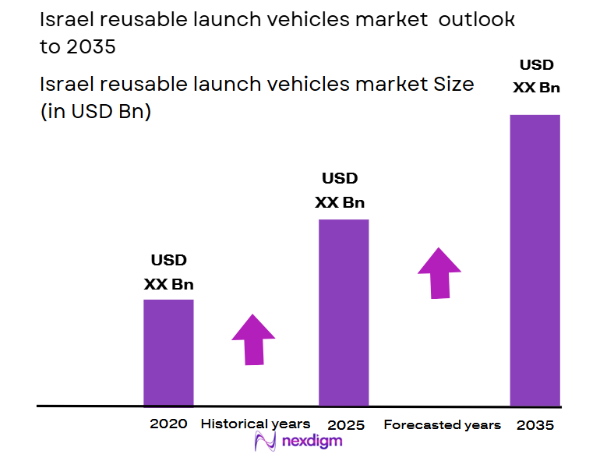
The Israel reusable launch vehicles market is expected to experience significant growth, driven by advancements in space exploration technology and the increasing demand for cost-effective and reliable launch solutions. Based on a recent historical assessment, the market size is projected to be valued at USD ~ billion. The market’s growth is propelled by investments in reusable spacecraft technologies, primarily supported by government and private sector partnerships. These factors collectively fuel the increasing deployment of reusable systems designed to reduce the costs of access to space, driving the market’s expansion.
The dominant cities and countries in this market include Tel Aviv, Herzliya, and other key Israeli cities that have become hubs for aerospace technology and innovation. Israel’s dominance in this field is attributed to the country’s significant technological capabilities, its well-established aerospace industry, and strategic collaborations with leading space agencies and private companies. Israel has also benefited from its strong government support and its robust defense sector, which has contributed to the rapid development of reusable launch vehicle systems.
Market Segmentation
By Product Type
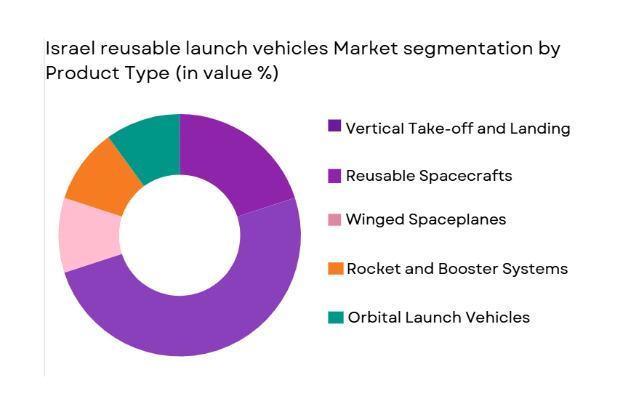
The Israel reusable launch vehicles market is segmented by product type into vertical take-off and landing (VTOL) systems, reusable spacecrafts, winged spaceplanes, rocket and booster systems, and orbital launch vehicles. Recently, the reusable spacecrafts sub-segment has dominated the market share due to factors such as superior reusability, cost-effectiveness, and advancements in space technology. These spacecrafts are increasingly used for missions to low earth orbit (LEO) and beyond, offering lower costs per launch and reducing the frequency of new vehicle production. With improved technology, reusable spacecrafts have proven to be more reliable, resulting in substantial growth in their market share within the reusable launch vehicle industry.
By Platform Type
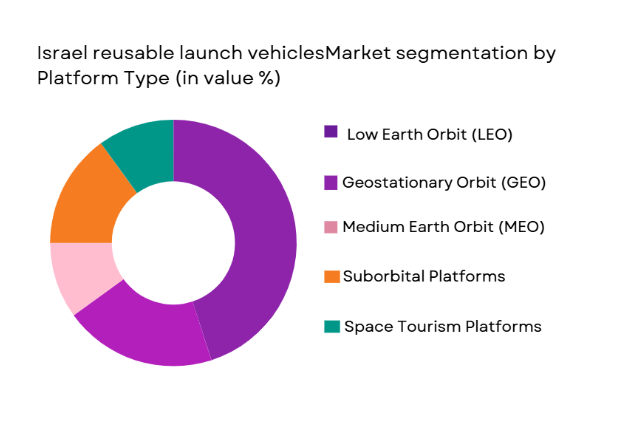
The market is segmented by platform type into low earth orbit (LEO), geostationary orbit (GEO), medium earth orbit (MEO), suborbital platforms, and space tourism platforms. The LEO sub-segment is dominating the market due to the increasing demand for satellite launches, research missions, and cargo delivery. LEO platforms are considered the most cost-effective for small satellite deployment, as they require lower energy to access and maintain, and they have a relatively shorter turnaround time between launches. This has positioned LEO as the leading platform type in the reusable launch vehicles market, with ongoing advancements in technologies making launches even more affordable.
Competitive Landscape
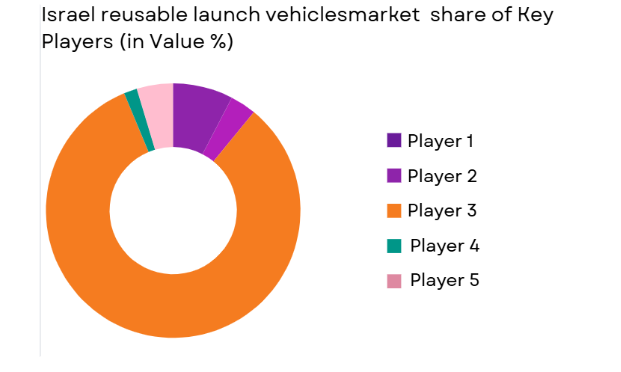
The Israel reusable launch vehicles market is highly competitive, with significant participation from both government and private sector companies. The market is marked by technological advancements and increasing investment in reusable vehicle development. Major players in this sector focus on expanding their technological expertise, forming strategic partnerships, and developing cutting-edge launch systems. The competitive landscape is defined by a mix of large, established aerospace firms and agile, innovation-driven startups, contributing to both consolidation and competitive pressures in the market.
| Company Name | Establishment Year | Headquarters | Technology Focus | Market Reach | Key Products | Revenue | Additional Market-Specific Parameter |
| SpaceX | 2002 | USA | ~ | ~ | ~ | ~ | ~ |
| Blue Origin | 2000 | USA | ~ | ~ | ~ | ~ | ~ |
| Rocket Lab | 2006 | New Zealand | ~ | ~ | ~ | ~ | ~ |
| Israel Space Agency | 1983 | Israel | ~ | ~ | ~ | ~ | ~ |
| Orbital Sciences | 1982 | USA | ~ | ~ | ~ | ~ | ~ |
Israel Reusable Launch Vehicles Market Analysis
Growth Drivers
Technological Advancements in Reusable Launch Vehicles
Technological advancements in reusable launch vehicle systems are a key driver of growth in the Israel reusable launch vehicles market. With the continuous development of more efficient and reliable propulsion technologies, the industry has seen considerable progress in reducing the cost of launches. These improvements in technology have resulted in vehicles capable of multiple launches, significantly reducing the cost per mission. Additionally, the development of more advanced materials and innovative reusability designs has further enhanced the efficiency and sustainability of launch systems. The potential to reuse components such as rocket boosters and spacecraft means that companies can launch more frequently, offering a more sustainable business model in an industry that has historically been marked by high operational costs. As more private and government-backed space missions come to fruition, this technology is expected to drive substantial growth in the Israel reusable launch vehicles market.
Government and Private Sector Investments
Another growth driver for the Israel reusable launch vehicles market is the growing investment from both government agencies and private companies in space technologies. The Israeli government has committed significant resources to advancing space capabilities, with a strong focus on developing reusable space technologies. Partnerships with global aerospace firms, combined with substantial investments from venture capitalists and private companies, have accelerated research and development in the reusable launch vehicle sector. As more investment flows into the industry, it is expected that the development of new technologies and systems will be expedited, fostering increased adoption of reusable space technologies. This growing financial backing, particularly in Israel’s booming private space sector, ensures that Israel remains at the forefront of innovation in this market. With strong financial support from multiple sources, the industry is set to continue its rapid expansion.
Market Challenges
High Initial Capital Expenditure
One of the major challenges faced by the Israel reusable launch vehicles market is the high initial capital expenditure associated with developing and manufacturing reusable launch vehicles. While reusability significantly reduces costs over the long term, the upfront investment required to design, build, and test reusable spacecraft is substantial. This challenge is particularly pronounced for smaller companies and startups looking to enter the market, as they may struggle to secure the necessary funding for such large-scale projects. Moreover, the development of advanced propulsion systems and the infrastructure needed for reusable rockets often requires extensive research and testing, further driving up costs. These high initial costs can deter potential investors and slow the growth of the industry, despite the long-term benefits that reusability offers.
Regulatory and Safety Challenges
Another challenge facing the Israel reusable launch vehicles market is the regulatory and safety challenges that come with the commercialization of space travel. Government agencies such as the Israel Space Agency and international regulators impose strict safety standards and regulations to ensure the reliability and safety of launch systems. Reusable launch vehicles must undergo rigorous certification processes, which can delay the development and deployment of new systems. Additionally, regulations governing environmental impact and airspace control further complicate the regulatory landscape. As the market grows, it will be crucial for both government and private sector stakeholders to navigate these challenges to ensure the smooth commercialization of reusable launch vehicles while adhering to international safety and environmental standards.
Opportunities
Commercial Space Tourism
One of the most promising opportunities in the Israel reusable launch vehicles market is the growing commercial space tourism sector. As technology advances and costs decrease, the potential for private individuals to experience space travel has become increasingly feasible. Israel, with its burgeoning aerospace sector and strong technological foundation, is well-positioned to capitalize on this opportunity. The rise of private space tourism companies, supported by both government and private investments, creates a lucrative market for reusable launch vehicles. With a growing demand for suborbital flights and orbital tourism, Israel’s reusable launch vehicle market could see significant growth in the coming years. As tourism-based missions become more commonplace, the industry is expected to diversify its offerings, providing opportunities for Israel-based companies to dominate this niche market.
Space-Based Internet and Satellite Deployment
Another significant opportunity for growth lies in the increasing demand for space-based internet and satellite deployment. Reusable launch vehicles play a key role in the deployment of small satellite constellations that enable global connectivity. As satellite operators look to deploy vast networks of satellites to provide internet access in remote areas, the need for frequent and affordable launches will increase. Israel’s reusable launch vehicle market is poised to benefit from this trend, as the country has a strong presence in the satellite technology sector. With the demand for reliable and cost-effective satellite launches on the rise, reusable vehicles will be a preferred solution due to their affordability and turnaround time. As the space-based internet market continues to expand, Israel’s reusable launch vehicle market is expected to play a critical role in the deployment of new satellite technologies.
Future Outlook
The future of the Israel reusable launch vehicles market looks promising, with continued technological advancements driving growth. Over the next five years, the market is expected to witness substantial development as new reusable systems are deployed, offering lower-cost alternatives to traditional launch vehicles. As space missions, including satellite deployments, space tourism, and scientific exploration, increase, the demand for reusable launch vehicles will continue to rise. Technological innovation in propulsion systems and materials will further reduce operational costs and enhance reusability. Additionally, regulatory support from both Israeli and international authorities will help facilitate the commercialization of reusable space technologies, ensuring a favorable market environment for growth.
Major Players
- SpaceX
- Blue Origin
- Rocket Lab
- Israel Space Agency
- Orbital Sciences
- Arianespace
- Lockheed Martin
- Boeing
- Northrop Grumman
- Relativity Space
- Planet Labs
- Sierra Nevada Corporation
- Firefly Aerospace
- Virgin Galactic
- SpaceX Starship
Key Target Audience
- Investments and venture capitalist firms
- Government and regulatory bodies
- Space agencies
- Private space companies
- Aerospace manufacturers
- Satellite operators
- Commercial space tourism providers
- Military and defense contractors
Research Methodology
Step 1: Identification of Key Variables
Identifying and defining the core factors affecting the market’s dynamics, including technological, economic, and regulatory aspects.
Step 2: Market Analysis and Construction
Analyzing market data, trends, and historical patterns to create an accurate and reliable market model.
Step 3: Hypothesis Validation and Expert Consultation
Consulting industry experts and validating market assumptions through feedback from leading players.
Step 4: Research Synthesis and Final Output
Compiling research findings into a comprehensive and structured report, ensuring all data is verified and actionable.

- Executive Summary
- Research Methodology (Definitions, Scope, Industry Assumptions, Market Sizing Approach, Primary & Secondary Research Framework, Data Collection & Verification Protocol, Analytic Models & Forecast Methodology, Limitations & Research Validity Checks)

- Market Definition and Scope
- Value Chain & Stakeholder Ecosystem
- Regulatory / Certification Landscape
- Sector Dynamics Affecting Demand
- Strategic Initiatives & Infrastructure Growth

- Growth Drivers
Technological advancements in reusable systems
Increasing demand for cost-effective space launches
Government investments in space exploration
Development of autonomous and automated systems
Improvement in rocket reusability and reentry mechanisms - Market Challenges
High development and operational costs
Regulatory and safety concerns for new technologies
Complexity in ensuring repeatable performance
Limited infrastructure for spaceports and testing
Lack of a standardized global space policy - Market Opportunities
Expanding satellite deployment capabilities
International collaborations in space missions
Integration with emerging space tourism sectors - Trends
Shift towards environmentally sustainable propulsion systems
Increased focus on modular design for reusability
Advancements in AI and machine learning for launch systems
Growth of private spaceports and commercial launch services
Rising demand for global internet connectivity via satellites - Government Regulations & Defense Policy
Government support for reusable space technologies
Space debris mitigation policies
International space treaties and collaborations - SWOT Analysis
- Stakeholder and Ecosystem Analysis
- Porter’s Five Forces Analysis
- Competition Intensity and Ecosystem Mapping

- By Market Value, 2020-2025
- By Installed Units, 2020-2025
- By Average System Price, 2020-2025
- By System Complexity Tier, 2020-2025

- By System Type (In Value%)
Reusable rockets
Hybrid reusable launch systems
Single-stage reusable vehicles
Vertical launch vehicles
Horizontal takeoff vehicles - By Platform Type (In Value%)
Orbital platforms
Suborbital platforms
Lunar platforms
Martian platforms
Experimental test platforms - By Fitment Type (In Value%)
Air-launched systems
Ground-launched systems
Spaceport-based systems
Mobile-launch systems
High-altitude launch systems - By EndUser Segment (In Value%)
Commercial spaceflight companies
Government and defense agencies
Research institutions
Private space ventures
International space organizations - By Procurement Channel (In Value%)
Direct purchase from manufacturers
Public-private partnerships
Government procurement
Third-party space contractors
Joint venture-based procurement - By Material / Technology (In Value%)
Carbon composite materials
Aluminum alloys
Cryogenic propulsion systems
Solid rocket boosters
Electromagnetic launch systems

- Market structure and competitive positioning
Market share snapshot of major players - Cross Comparison Parameters (Technological capabilities, Market reach, Regulatory compliance, Innovation in propulsion, Pricing strategy, Partnership networks, Product development speed, Customer loyalty, Investment potential, Supply chain efficiency)
- SWOT Analysis of Key Players
- Pricing & Procurement Analysis
- Key Players
SpaceIL
IAI (Israel Aerospace Industries)
Rafael Advanced Defense Systems
Bluebird Aero Systems
Sky and Space Global
Orbital ATK
Virgin Galactic
SpaceX
ArianeGroup
Sierra Nevada Corporation
Rocket Lab
Firefly Aerospace
Northrop Grumman Innovation Systems
MDA (MacDonald, Dettwiler and Associates)
Lockheed Martin Space Systems

- Increased interest from commercial spaceflight ventures
- Growing demand from defense and military applications
- Rising interest from space tourism sectors
- Collaborations between public and private entities

- Forecast Market Value, 2026-2035
- Forecast Installed Units, 2026-2035
- Price Forecast by System Tier, 2026-2035
- Future Demand by Platform, 2026-2035


 Request a Sample
 Ask for Customization
 Get a Quote
 Enquire Now