
 Download PDF
 Download PDF
Market Overview
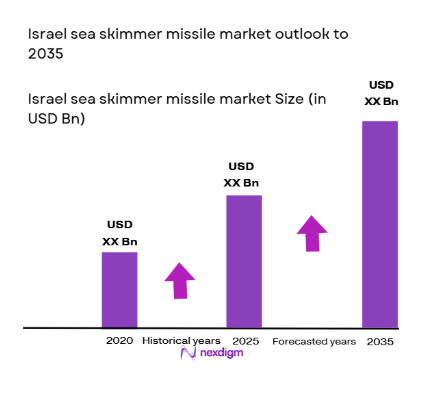
Based on a recent historical assessment, the Israel sea skimmer missile market was valued at USD ~ billion, driven by sustained naval force modernization, rising maritime threat perception, and continuous investment in advanced anti-ship strike capabilities. Procurement is supported by requirements for low-altitude penetration, high survivability against naval air defense systems, and precision engagement across littoral and blue-water environments. Ongoing development of indigenous missile technologies, coupled with system upgrades for range, guidance, and countermeasure resistance, continues to reinforce steady demand from national defense programs.
Based on a recent historical assessment, Haifa and central defense industrial zones emerged as dominant centers within the Israel sea skimmer missile market due to the concentration of naval command structures, missile development facilities, and system integration infrastructure. These locations host core activities related to design, testing, and validation of advanced maritime strike weapons. Close coordination between the Israeli Navy, defense research organizations, and domestic missile manufacturers accelerates deployment. Proximity to naval bases, test ranges, and secure logistics networks further reinforces national dominance in sea skimmer missile development and integration.
Market Segmentation
By Product Type
Israel sea skimmer missile market is segmented by product type into active radar guided sea skimmer missiles, imaging infrared guided sea skimmer missiles, dual mode seeker sea skimmer missiles, fire and forget sea skimmer missiles, and network enabled sea skimmer missiles. Recently, active radar guided sea skimmer missiles have a dominant market share due to their proven reliability, long engagement ranges, and effectiveness in complex maritime environments. These missiles provide autonomous mid-course guidance and terminal homing, enabling precise targeting under adverse weather and electronic warfare conditions. Strong operational familiarity, established logistics support, and compatibility with multiple launch platforms reinforce preference. Continuous upgrades in seeker sensitivity, electronic counter-countermeasures, and guidance accuracy further sustain dominance. Domestic manufacturing maturity and successful deployment across naval platforms strengthen procurement confidence and long-term adoption.

By Platform Type
Israel sea skimmer missile market is segmented by platform type into surface combatant ships, fast attack craft, coastal defense batteries, aircraft launched maritime strike platforms, and unmanned maritime platforms. Recently, surface combatant ships have a dominant market share due to their central role in naval strike operations, sea control missions, and deterrence posture. These platforms require robust anti-ship capabilities to counter surface threats at extended ranges. Integration with advanced combat management systems enables coordinated targeting and engagement. High readiness requirements and frequent modernization cycles support sustained missile deployment. Dedicated naval strike doctrines and continuous platform upgrades reinforce dominant installation of sea skimmer missiles on surface combatants.

Competitive Landscape
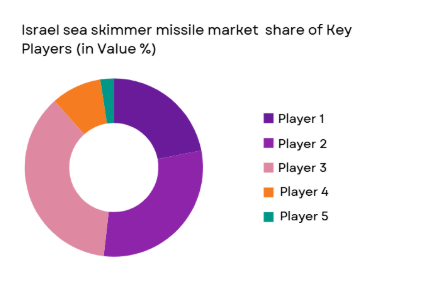
The Israel sea skimmer missile market is highly consolidated, dominated by a small number of domestic defense primes with deep expertise in missile design, guidance technologies, and naval integration. Long-term government funding, strategic national security priorities, and high technological entry barriers concentrate market influence among established players with vertically integrated development and production capabilities.
| Company Name | Establishment Year | Headquarters | Technology Focus | Market Reach | Key Products | Revenue | Missile Guidance Expertise |
| Rafael Advanced Defense Systems | 1948 | Haifa, Israel | ~ | ~ | ~ | ~ | ~ |
| Israel Aerospace Industries | 1953 | Lod, Israel | ~ | ~ | ~ | ~ | ~ |
| Elbit Systems | 1966 | Haifa, Israel | ~ | ~ | ~ | ~ | ~ |
| Elta Systems | 1967 | Ashdod, Israel | ~ | ~ | ~ | ~ | ~ |
| Tomer Ltd | 1982 | Haifa, Israel | ~ | ~ | ~ | ~ | ~ |
Israel Sea Skimmer Missile Market Analysis
Growth Drivers
Naval Strike Modernization and Maritime Deterrence Requirements
Naval strike modernization and maritime deterrence requirements are a primary growth driver for the Israel sea skimmer missile market as regional maritime security challenges continue to intensify. Protection of offshore economic assets and sea lines of communication necessitates credible anti-ship strike capability. Sea skimmer missiles offer low-altitude penetration to evade radar detection and naval defenses. Continuous upgrades enhance range, accuracy, and survivability. Integration with advanced command and control systems improves coordinated engagement. Indigenous development ensures rapid adaptation to evolving threats. Sustained defense budget allocation prioritizes naval strike readiness. These factors collectively support long-term procurement momentum.
Technological Advancements in Guidance, Seeker, and Survivability Systems
Technological advancements in guidance, seeker, and survivability systems significantly drive the Israel sea skimmer missile market by enhancing operational effectiveness. Multi-mode seekers improve target discrimination in cluttered environments. Advanced electronic counter-countermeasures increase resistance to jamming. Improved propulsion systems extend engagement envelopes. Low observable airframe designs reduce detection probability. Network-enabled capabilities support real-time targeting updates. Continuous R&D investment accelerates innovation cycles. Domestic expertise shortens development timelines. These advancements sustain replacement and upgrade demand.
Market Challenges
High Development, Testing, and Validation Costs
High development, testing, and validation costs represent a major challenge for the Israel sea skimmer missile market due to the complexity of missile systems. Extensive flight testing and sea trials are required to ensure reliability. Advanced materials and electronics increase unit costs. Long development cycles strain program budgets. Specialized infrastructure is needed for testing. Skilled engineering workforce requirements elevate expenses. Cost overruns can delay procurement schedules. These factors limit rapid scaling of new missile variants.
Stringent Export Controls and Geopolitical Constraints
Stringent export controls and geopolitical constraints challenge market expansion by restricting international sales opportunities. Missile technologies are subject to strict regulatory regimes. Licensing processes are lengthy and complex. Geopolitical sensitivities influence approval decisions. Export limitations reduce economies of scale. Compliance requirements increase administrative burden. Domestic priorities often supersede export ambitions. These constraints reduce flexibility for market growth.
Opportunities
Next Generation Low Observable and Network Enabled Missile Development
Next generation low observable and network enabled missile development presents a significant opportunity for the Israel sea skimmer missile market as naval warfare evolves. Reduced radar cross section designs improve penetration. Networked missiles enable cooperative targeting. Real-time data links enhance engagement accuracy. Integration with unmanned sensors expands situational awareness. Modular architectures support rapid upgrades. Government R&D funding accelerates development. These innovations open future procurement pathways.
Integration with Unmanned and Multi Domain Strike Platforms
Integration with unmanned and multi domain strike platforms offers strong opportunity by expanding operational concepts. Unmanned surface and aerial platforms require lightweight strike weapons. Sea skimmer missiles provide effective payload options. Cross-domain targeting enhances flexibility. Reduced risk to personnel improves mission viability. Indigenous platform development supports integration. Export interest in unmanned systems grows. This opportunity broadens market scope.
Future Outlook
The Israel sea skimmer missile market is expected to maintain steady growth over the next five years, supported by ongoing naval modernization and deterrence priorities. Advances in low observability, seeker fusion, and network-centric warfare will shape future developments. Regulatory backing for indigenous missile programs will remain strong. Increasing integration with unmanned and multi-domain platforms will further drive demand.
Major Players
- Rafael Advanced Defense Systems
- Israel Aerospace Industries
- Elbit Systems
- Elta Systems
- Tomer Ltd
- IMI Systems
- UVision Air
- Aeronautics Group
- Controp Precision Technologies
- NextVision Stabilized Systems
- RT LTA Systems
- Orbit Communication Systems
- SightX
- Septier Communication
- Magal Security Systems
Key Target Audience
- Naval procurement agencies
- Defense ministries
- Maritime strike commands
- Coastal defense forces
- Defense system integrators
- Missile technology developers
- Investments and venture capitalist firms
- Government and regulatory bodies
Research Methodology
Step 1: Identification of Key Variables
Key variables including naval force structure, missile inventories, procurement budgets, technology requirements, and regulatory frameworks were identified through structured secondary research.
Step 2: Market Analysis and Construction
Collected data were analyzed to construct market size, segmentation, and competitive structure using validated analytical models and cross-checks.
Step 3: Hypothesis Validation and Expert Consultation
Preliminary findings were validated through consultations with naval officers, missile engineers, and defense industry specialists.
Step 4: Research Synthesis and Final Output
All validated insights were synthesized into a comprehensive report with consistency and reliability checks applied.

- Executive Summary
- Research Methodology (Definitions, Scope, Industry Assumptions, Market Sizing Approach, Primary & Secondary Research Framework, Data Collection & Verification Protocol, Analytic Models & Forecast Methodology, Limitations & Research Validity Checks)

- Market Definition and Scope
- Value Chain & Stakeholder Ecosystem
- Regulatory / Certification Landscape
- Sector Dynamics Affecting Demand
- Strategic Initiatives & Infrastructure Growth

- Growth Drivers
Naval force modernization and maritime deterrence requirements
Rising emphasis on anti ship strike capability
Technological advances in guidance and seeker systems - Market Challenges
High development and testing costs
Stringent export control and regulatory constraints
Integration complexity across diverse launch platforms - Market Opportunities
Next generation low observable sea skimmer missile development
Integration with unmanned and autonomous platforms
Expansion of export partnerships and joint programs - Trends
Shift toward multi mode seeker configurations
Growing focus on reduced radar cross section profiles
Increased emphasis on network centric targeting
Adoption of modular launcher architectures
Integration with advanced command and control networks - Government Regulations & Defense Policy
Strengthening of naval strike capability mandates
Support for indigenous missile development programs
Export regulation alignment with strategic policy objectives - SWOT Analysis
- Stakeholder and Ecosystem Analysis
- Porter’s Five Forces Analysis
- Competition Intensity and Ecosystem Mapping

- By Market Value, 2020-2025
- By Installed Units, 2020-2025
- By Average System Price, 2020-2025
- By System Complexity Tier, 2020-2025

- By System Type (In Value%)
Active radar guided sea skimmer missiles
Imaging infrared guided sea skimmer missiles
Dual mode seeker sea skimmer missiles
Fire and forget sea skimmer missiles
Network enabled sea skimmer missiles - By Platform Type (In Value%)
Surface combatant ships
Fast attack craft
Coastal defense batteries
Aircraft launched maritime strike platforms
Unmanned surface and aerial platforms - By Fitment Type (In Value%)
New platform integration
Mid life upgrade retrofits
Modular launcher based fitments
Permanent naval installation
Mobile coastal deployment fitments - By EndUser Segment (In Value%)
Israeli Navy
Coastal defense forces
Joint maritime strike units
Special operations maritime units
Defense research and test agencies - By Procurement Channel (In Value%)
Direct government defense procurement
Domestic defense prime contracts
System integrator led acquisition programs
Export oriented defense sales
Emergency and rapid capability procurement - By Material / Technology (in Value %)
Advanced composite airframe materials
Low observable shaping and coatings
High precision guidance and navigation electronics
Seeker and sensor fusion technologies
Solid fuel propulsion systems

- Market share snapshot of major players
- CrossComparison Parameters (Range Performance, Sea Skimming Altitude, Seeker Technology, Target Discrimination Accuracy, Platform Integration Flexibility, Survivability Against Countermeasures, Guidance Precision, Lifecycle Support, Export Readiness)
- SWOT Analysis of Key Players
- Pricing & Procurement Analysis
- Key Players
Rafael Advanced Defense Systems
Israel Aerospace Industries
Elbit Systems
Elta Systems
UVision Air
Aeronautics Group
Controp Precision Technologies
Tomer Ltd
IMI Systems
Orbit Communication Systems
NextVision Stabilized Systems
RT LTA Systems
SightX
Septier Communication
Magal Security Systems

- Operational focus on coastal and blue water strike missions
- Preference for high survivability and low observable missiles
- Demand for interoperability with naval combat systems
- Growing reliance on precision maritime strike capabilities

- Forecast Market Value, 2026-2035
- Forecast Installed Units, 2026-2035
- Price Forecast by System Tier, 2026-2035
- Future Demand by Platform, 2026-2035


 Request a Sample
 Ask for Customization
 Get a Quote
 Enquire Now