
 Download PDF
 Download PDF
Market Overview
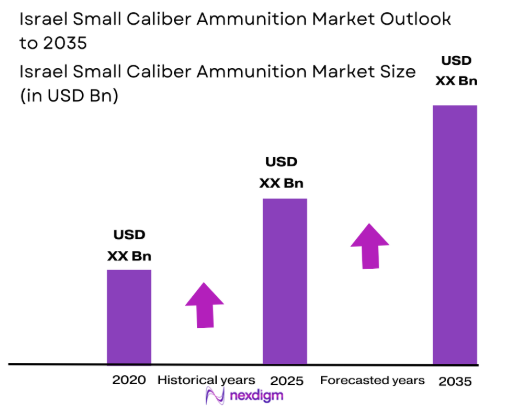
Based on a recent historical assessment, the Israel Small Caliber Ammunition market recorded a total market value of USD ~ billion, reflecting sustained procurement across military, internal security, and training applications. Demand is driven by continuous operational readiness requirements, high live fire training intensity, and routine replenishment of standard NATO caliber ammunition. Strong domestic manufacturing capacity, supported by government contracts, ensures supply continuity, while export orders aligned with allied interoperability standards reinforce production utilization and revenue stability for national defense.
Based on a recent historical assessment, market activity is concentrated in Israel, with Tel Aviv, Haifa, and Be’er Sheva serving as core hubs due to proximity to defense headquarters, manufacturing plants, and testing ranges. These locations benefit from integrated supply chains, skilled labor availability, and secure logistics infrastructure. Israel’s dominance is reinforced by indigenous technology development, close coordination between armed forces and producers, and consistent government procurement cycles supporting uninterrupted production and distribution across domestic and export fulfillment networks nationwide.
Market Segmentation
By Product Type
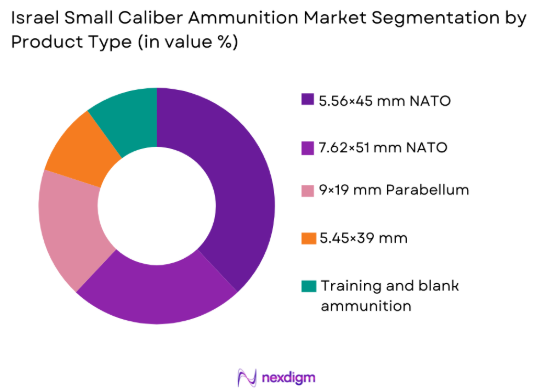
Israel Small Caliber Ammunition Market is segmented by product type into 5.56×45 mm NATO, 7.62×51 mm NATO, 9×19 mm Parabellum, 5.45×39 mm, and training and blank ammunition. Recently, 5.56×45 mm NATO ammunition has a dominant market share due to standardized infantry rifle adoption, sustained operational deployment, and high training consumption across active and reserve forces. The caliber benefits from interoperability requirements, established manufacturing lines, and consistent procurement cycles. Its dominance is reinforced by compatibility with assault rifles, light machine guns, and allied weapon platforms. Continuous replenishment needs, export demand, and logistics efficiency further strengthen its position. Domestic producers prioritize this caliber due to predictable volumes and lower per unit production risk. Stable government contracts and export alignment support recurring demand. The product remains central to readiness doctrines and training doctrines nationwide.
By Platform Type
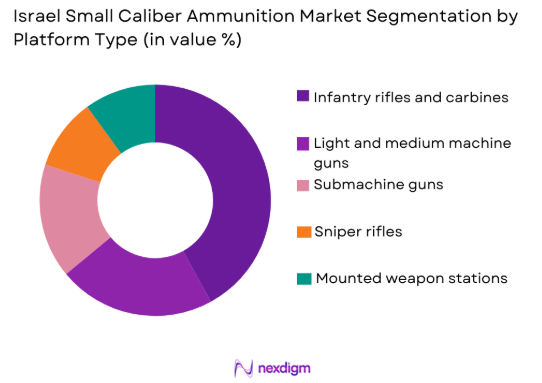
Israel Small Caliber Ammunition Market is segmented by platform type into infantry rifles and carbines, light and medium machine guns, submachine guns, sniper rifles, and mounted weapon stations. Recently, infantry rifles and carbines have a dominant market share due to widespread deployment across regular forces, reserves, and internal security units. These platforms consume the highest ammunition volumes during routine training and operational readiness cycles. Standard issue rifles drive consistent demand patterns supported by long term procurement frameworks. Platform dominance is reinforced by modernization programs, interoperability needs, and continuous force readiness requirements. Domestic production lines are optimized for rifle ammunition volumes. Export programs aligned with rifle platforms further sustain demand. High utilization rates and replacement cycles ensure sustained consumption across security agencies nationwide.
Competitive Landscape
The Israel Small Caliber Ammunition market is moderately consolidated, with a limited number of domestic manufacturers holding long term government contracts and strong relationships with defense and security agencies. Market competition is shaped by technological capability, production reliability, and compliance with strict military standards rather than price alone. Major players benefit from vertically integrated operations, allowing control over design, testing, and large-scale manufacturing. Export credibility, alignment with allied standards, and consistent fulfillment during high demand periods strengthen the position of leading companies, while smaller participants operate in niche or specialized ammunition segments.
| Company Name | Establishment Year | Headquarters | Technology Focus | Market Reach | Key Products | Revenue | Additional Parameter |
| Elbit Systems | 1966 | Haifa, Israel | ~ | ~ | ~ | ~ | ~ |
| Israel Weapon Industries | 1933 | Ramat HaSharon, Israel | ~ | ~ | ~ | ~ | ~ |
| Rafael Advanced Defense Systems | 1948 | Haifa, Israel | ~ | ~ | ~ | ~ | ~ |
| IMI Systems | 1933 | Ramat HaSharon, Israel | ~ | ~ | ~ | ~ | ~ |
| Emsan Israel | 1975 | Tel Aviv, Israel | ~ | ~ | ~ | ~ | ~ |
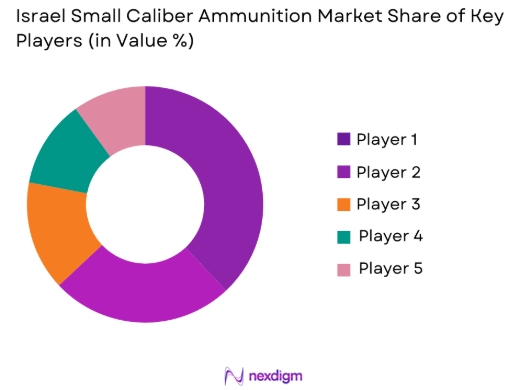
Israel Small Caliber Ammunition Market Analysis
Growth Drivers
Operational Readiness and Continuous Force Mobilization Requirements
Operational readiness and continuous force mobilization requirements are a primary growth driver for the Israel Small Caliber Ammunition market, as national defense doctrine emphasizes permanent preparedness across active duty, reserve forces, and internal security units. The Israel Defense Forces maintain high training intensity levels, which directly translate into sustained ammunition consumption volumes throughout the year. Live fire drills, qualification exercises, and operational simulations require constant replenishment of standard calibers to maintain combat readiness. The integration of reserve forces into routine training cycles further expands baseline demand beyond standing units. Ongoing border security operations and internal threat monitoring create steady ammunition utilization outside scheduled training programs. Ammunition stockpiling policies aimed at strategic resilience also support recurring procurement activity. Domestic manufacturers benefit from predictable order flows aligned with readiness planning frameworks. This driver remains structurally embedded in national defense planning and is not dependent on short term geopolitical fluctuations.
Domestic Manufacturing Strength and Export Interoperability Alignment
Domestic manufacturing strength combined with export interoperability alignment significantly drives growth in the Israel Small Caliber Ammunition market by ensuring reliable supply and international relevance. Israel maintains mature ammunition production infrastructure supported by state linked defense enterprises and long standing industrial know how. Manufacturing lines are optimized for NATO compatible calibers, allowing seamless integration with allied forces and export customers. This alignment enhances production volumes by balancing domestic consumption with foreign orders. Export qualification standards reinforce consistent quality, indirectly strengthening domestic procurement confidence. Localized production reduces supply chain vulnerabilities and shortens delivery cycles for military customers. Technology transfer within domestic industry accelerates efficiency improvements and cost control. Sustained export credibility stabilizes revenues and supports reinvestment into capacity and modernization. This driver anchors long term market resilience and competitive positioning.
Market Challenges
Raw Material Volatility and Propellant Supply Constraints
Raw material volatility and propellant supply constraints represent a significant challenge for the Israel Small Caliber Ammunition market, affecting cost stability and production planning. Ammunition manufacturing relies heavily on metals, chemical compounds, and energetic materials that are exposed to global commodity price fluctuations. Disruptions in international supply chains can directly impact availability of critical inputs. Propellant formulation requires strict quality consistency, limiting alternative sourcing options during shortages. Cost variability complicates long term contract pricing with government customers. Inventory buffering increases working capital requirements for manufacturers. Compliance with safety and storage regulations further restricts procurement flexibility. These factors collectively pressure margins while increasing operational complexity. Managing input volatility remains a persistent structural challenge for the industry.
Stringent Regulatory Compliance and Quality Assurance Requirements
Stringent regulatory compliance and quality assurance requirements pose another major challenge for the Israel Small Caliber Ammunition market due to the sensitive nature of defense products. Ammunition production is subject to rigorous safety, testing, and certification protocols enforced by military authorities. Compliance processes extend production timelines and increase overhead costs. Any deviation from specification can result in batch rejection and financial losses. Export controls and end user certification add administrative burdens for internationally oriented manufacturers. Continuous audits demand dedicated compliance resources. Regulatory evolution requires ongoing process updates and staff training. Smaller manufacturers face higher proportional compliance costs. These constraints limit operational flexibility while raising barriers to rapid scaling.
Opportunities
Advanced Lightweight Ammunition and Material Innovation
Advanced lightweight ammunition and material innovation present a strong opportunity for the Israel Small Caliber Ammunition market as armed forces seek improved soldier mobility and performance. Development of polymer cased and hybrid ammunition can reduce load weight without compromising ballistic effectiveness. Such innovations align with modernization programs focused on endurance and operational efficiency. Domestic R&D capabilities support rapid prototyping and testing cycles. Lightweight solutions can also reduce logistics and transportation costs. Export markets increasingly value advanced materials for next generation infantry systems. Intellectual property development strengthens competitive differentiation. Successful adoption can unlock premium pricing potential. This opportunity aligns technology leadership with evolving operational requirements.
Expansion of Specialized and Precision Ammunition Segments
Expansion of specialized and precision ammunition segments offers another growth opportunity for the Israel Small Caliber Ammunition market as operational environments become more complex. Special forces and internal security units demand ammunition tailored for accuracy, penetration control, and reduced collateral impact. Precision engineered rounds address urban combat and counterterrorism scenarios. Customization capabilities strengthen supplier relationships with elite units. Higher value per unit improves revenue mix. Export demand for specialized ammunition is rising among allied security forces. Advanced testing and analytics enhance product credibility. This opportunity supports margin expansion while leveraging existing manufacturing expertise.
Future Outlook
The Israel Small Caliber Ammunition market is expected to maintain steady growth over the next five years, supported by sustained defense readiness priorities and consistent training intensity. Technological advancements in lightweight materials and precision engineering will shape product development trajectories. Regulatory stability and continued government procurement support will underpin domestic demand. Export opportunities aligned with allied interoperability standards are expected to complement internal consumption. Overall market momentum will remain anchored in operational preparedness and industrial self reliance.
Major Players
- Elbit Systems
- Rafael Advanced Defense Systems
- Israel Weapon Industries
- IMI Systems
- Emsan Israel
- Tomer Defense
- Mifram Security
- Silver Shadow
- Meprolight Systems
- Global Ordnance Israel
- NRC Industries
- Givon Ammunition
- UVisionDefense
- Kalashnikov Israel
- TACAM Israel
Key Target Audience
- Investments and venture capitalist firms
- Government and regulatory bodies
- Defense ministries
- Armed forces procurement units
- Internal security agencies
- Homeland security organizations
- Defense manufacturers and suppliers
- Export control authorities
Research Methodology
Step 1: Identification of Key Variables
This step involved identifying demand drivers, supply constraints, pricing dynamics, and regulatory influences affecting the Israel Small Caliber Ammunition market. Both quantitative and qualitative variables were mapped. Emphasis was placed on defense procurement behavior. Market boundaries were clearly defined.
Step 2: Market Analysis and Construction
Data was analyzed to construct a coherent market framework reflecting production, consumption, and trade flows. Supply chain relationships were evaluated. Demand patterns were aligned with operational requirements. Structural market characteristics were validated.
Step 3: Hypothesis Validation and Expert Consultation
Initial assumptions were tested through expert consultations and secondary source validation. Defense industry specialists provided contextual insights. Discrepancies were reconciled through iterative review. Confidence levels were assessed.
Step 4: Research Synthesis and Final Output
Findings were synthesized into a structured narrative ensuring consistency and accuracy. Data points were cross verified. Analytical insights were refined for clarity. The final output reflects validated market intelligence.

- Executive Summary
- Research Methodology (Definitions, Scope, Industry Assumptions, Market Sizing Approach, Primary & Secondary Research Framework, Data Collection & Verification Protocol, Analytic Models & Forecast Methodology, Limitations & Research Validity Checks)

- Market Definition and Scope
- Value Chain & Stakeholder Ecosystem
- Regulatory / Certification Landscape
- Sector Dynamics Affecting Demand
- Strategic Initiatives & Infrastructure Growth

- Growth Drivers
Sustained national defense readiness requirements
Continuous infantry modernization programs
High training intensity across active and reserve forces
Domestic manufacturing and R&D capabilities
Export demand aligned with allied standards - Market Challenges
Fluctuating raw material and propellant costs
Stringent safety and quality compliance requirements
Capacity constraints during surge demand
Export control and licensing restrictions
Lifecycle management of legacy calibers - Market Opportunities
Adoption of lightweight and advanced casing technologies
Expansion of precision and special purpose ammunition
Increased co-development with allied defense partners - Trends
Shift toward standardized NATO calibers
Rising focus on accuracy and consistency
Integration of advanced quality control systems
Growth in simulation and training ammunition
Incremental automation of production lines - Government Regulations & Defense Policy
Strict national ammunition safety regulations
Defense export control and end-use monitoring
Support for domestic defense manufacturing

- By Market Value, 2020-2025
- By Installed Units, 2020-2025
- By Average System Price, 2020-2025
- By System Complexity Tier, 2020-2025

- By System Type (In Value%)
5.56×45 mm NATO ammunition
7.62×51 mm NATO ammunition
9×19 mm Parabellum ammunition
5.45×39 mm ammunition
Special purpose training and blank rounds - By Platform Type (In Value%)
Infantry rifles and carbines
Light and medium machine guns
Submachine guns
Sniper rifles
Mounted weapon stations - By Fitment Type (In Value%)
Standard military issue
Special forces customized loads
Training and simulation fitment
Export-specific configurations
Law enforcement fitment - By End User Segment (In Value%)
National armed forces
Border security forces
Internal security and police
Special operations units
Defense training institutions - By Procurement Channel (In Value%)
Direct government contracts
Long-term framework agreements
Emergency and wartime procurement
Defense offset and co-production programs
Foreign military sales support - By Material / Technology (in Value %)
Lead core copper jacket ammunition
Steel core penetrator rounds
Frangible ammunition
Tracer and incendiary rounds
Polymer-cased ammunition

- Market share snapshot of major players
- Cross Comparison Parameters (Caliber range, Production capacity, Technology maturity, Quality certifications, Domestic supply capability, Export footprint, R&D intensity, Cost efficiency, Delivery lead time, Contract flexibility)
- SWOT Analysis of Key Players
- Pricing & Procurement Analysis
- Porter’s Five Forces
- Key Players
Israel Military Industries Systems
Elbit Systems Land
TACAM Israel
UVision Defense
NRC Industries
Emsan Israel
Givon Ammunition
Mifram Security
Tomer Defense
Rafael Advanced Defense Systems
Silver Shadow Advanced Security Systems
IWI US
Global Ordnance Israel
Kalashnikov Israel
Meprolight Ammunition Systems

- Operational readiness requirements drive steady demand
- Training cycles consume significant ammunition volumes
- Special units require customized performance profiles
- Interoperability with allied forces influences specifications

- Forecast Market Value, 2026-2035
- Forecast Installed Units, 2026-2035
- Price Forecast by System Tier, 2026-2035
- Future Demand by Platform, 2026-2035


 Request a Sample
 Ask for Customization
 Get a Quote
 Enquire Now