

 Download PDF
 Download PDF
Market Overview
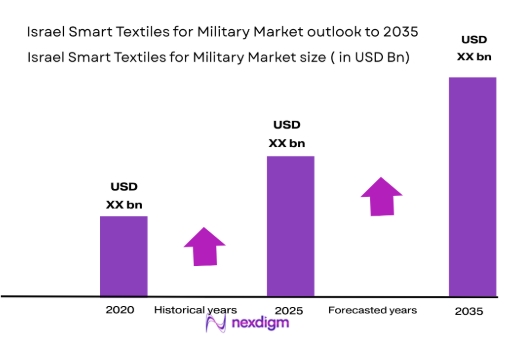
Based on a recent historical assessment, the Israel smart textiles for military market recorded spending of approximately USD ~ million, reflecting confirmed defense allocations toward advanced soldier systems, survivability solutions, and wearable battlefield technologies. The market size is driven by continuous modernization of infantry equipment, integration of real-time physiological monitoring, and demand for lightweight multifunctional protection. Strong domestic defense of R&D, rapid prototyping cycles, and close collaboration between the military and technology firms further support sustained procurement of smart fabrics, sensor-embedded garments, and adaptive textile systems.
Based on a recent historical assessment, Israel dominates this market through concentrated activity in Tel Aviv, Haifa, and Beersheba, supported by the country’s dense defense innovation ecosystem. Tel Aviv leads due to its role as the primary hub for defense startups, electronics, and wearable technology development. Haifa benefits from proximity to major defense manufacturers and advanced materials research centers. Beersheba’s dominance is driven by military bases, cybersecurity expertise, and defense technology incubators, enabling rapid testing, integration, and deployment of smart military textile solutions.
Market Segmentation
By Product Type
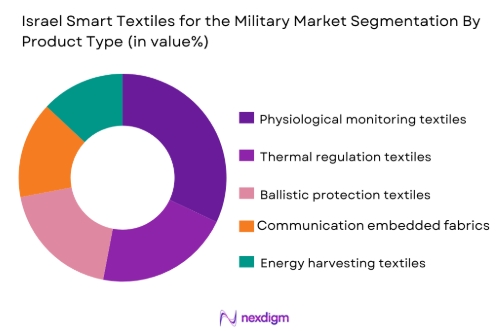
Israel Smart Textiles for Military market is segmented by product type into physiological monitoring textiles, thermal regulation textiles, ballistic protection textiles, communication embedded fabrics, and energy harvesting textiles. Recently, physiological monitoring textiles have had a dominant market share due to operational demand for real health data, fatigue assessment, and injury prevention during prolonged deployments. These textiles integrate biosensors that transmit heart rate, hydration, and stress indicators to command systems, improving decision making. Israeli defense forces prioritize soldier performance optimization, driving consistent procurement. Domestic firms possess strong expertise in medical sensors, enabling reliable military grade solutions. Continuous field validation strengthens user trust. Integration of compatibility with existing uniforms further supports dominance. Research funding alignment accelerates upgrades. Export potential reinforces production scale. These factors collectively sustain leadership of this sub segment across operational units.
By Platform Type
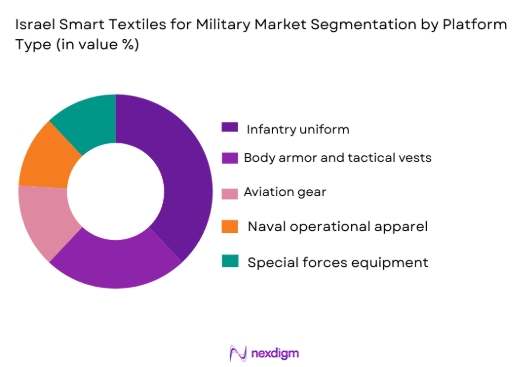
Israel Smart Textiles for Military market is segmented by platform type into infantry uniforms, body armor and tactical vests, aviation gear, naval operational apparel, and special forces equipment. Recently, infantry uniforms had a dominant market share due to broad deployment across active and reserve forces and continuous upgrade cycles. Infantry units represent the largest operational base, requiring scalable solutions. Smart uniforms enhance endurance, situational awareness, and safety in varied terrains. Standardization across brigades supports volume procurement. Training and combat integration are prioritized. Modular designs allow rapid replacement. Budget allocation favors infantry readiness. Domestic manufacturing ensures supply continuity. These drivers collectively secure dominance for infantry uniform platforms.
Competitive Landscape
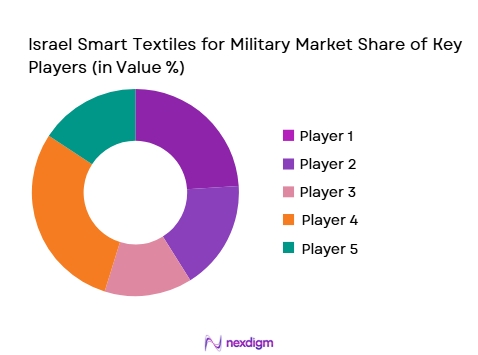
The Israel smart textiles for military market are highly consolidated and dominated by domestic defense primes and specialized advanced-material companies with deep ties to the national defense establishment. Long-term procurement contracts, strict defense certification requirements, and high R&D intensity create substantial entry barriers. Major players influence technology standards and integration architecture through close collaboration with the armed forces, while smaller firms typically operate as niche innovators or subsystem suppliers within larger defense programs.
| Company Name | Establishment Year | Headquarters | Technology Focus | Market Reach | Key Products | Revenue | Military Textile Strength |
| Elbit Systems | 1966 | Haifa, Israel | ~ | ~ | ~ | ~ | ~ |
| Rafael Advanced Defense Systems | 1948 | Haifa, Israel | ~ | ~ | ~ | ~ | ~ |
| Israel Aerospace Industries | 1953 | Lod, Israel | ~ | ~ | ~ | ~ | ~ |
| DuPont | 1802 | Lod, Israel | ~ | ~ | ~ | ~ | ~ |
| Teijin Aramid | 1972 | Lod, Israel | ~ | ~ | ~ | ~ | ~ |
Israel Smart Textiles for Military Market Analysis
Growth Drivers
Infantry Soldier Modernization and Survivability Enhancement
Infantry soldier modernization and survivability enhancement is a primary growth driver for the Israel smart textiles for military market, as defense forces prioritize protecting personnel operating in high-risk environments while improving combat effectiveness. Smart textiles enable continuous physiological monitoring, environmental sensing, and adaptive protection, which are critical in modern asymmetric warfare. The Israeli military places strong emphasis on reducing casualties through early detection of injury, heat stress, and fatigue. Embedded sensors within uniforms provide commanders with actionable health and status data in real time. These capabilities support faster medical intervention and improved mission planning. Integration with existing soldier systems enhances situational awareness without increasing cognitive or physical load. Continuous field testing accelerates adoption and refinement. Sustained defense budgets focused on personnel protection further reinforce demand.
Domestic Defense Innovation Ecosystem and Rapid Prototyping
Domestic defense innovation ecosystems and rapid prototyping drive sustained growth by enabling fast development, testing, and deployment of smart military textiles. Israel’s close collaboration between the military, startups, universities, and defense primes shortens innovation cycles. Smart textile solutions can be rapidly adapted based on battlefield feedback. Government-supported defense incubators and funding programs lower development risk. Advanced materials science and electronics expertise support multifunctional textile design. Local manufacturing capabilities ensure supply chain security. Proven export success further incentivizes investment. This ecosystem sustains continuous market expansion.
Market Challenges
High Development Costs and Manufacturing Complexity
High development costs and manufacturing complexity present a major challenge for the Israel smart textiles for military market due to the advanced materials, embedded electronics, and testing requirements involved. Smart military textiles must meet strict durability, reliability, and safety standards under extreme conditions. Integrating sensors and conductive materials into fabrics without compromising comfort increases production complexity. Extensive field trials extend development timelines. Low-volume specialized production limits economies of scale. Certification and qualification processes add cost. Continuous upgrades increase lifecycle expenses. These factors constrain rapid scaling despite strong demand.
Data Security and System Integration Risks
Data security and system integration risks challenge market growth as smart textiles increasingly generate sensitive operational and health data. Secure transmission and storage of data are critical in combat environments. Vulnerabilities could expose troop movements or health status. Ensuring encryption and resilience increases system cost and complexity. Integration with multiple commands and control platforms adds technical risk. Compliance with military cybersecurity protocols slows deployment. User trust and operational acceptance depend on proven security. These challenges require cautious implementation strategies.
Opportunities
Export-Oriented Defense Textile Programs
Export-oriented defense textile programs present significant opportunities as allied nations seek advanced soldier protection solutions proven in operational environments. Israeli smart textiles benefit from combat validation and strong defense reputation. Modular designs enable customization for foreign requirements. Defense export agreements support scaling production. Partnerships with global defense primes expand market access. Technology transfer arrangements increase adoption. Rising global focus on soldier survivability strengthens demand. This creates strong long-term growth potential beyond domestic procurement.
Multifunctional Adaptive Textile Development
Multifunctional adaptive textile development offers opportunities to integrate protection, sensing, communication, and energy management into single garments. Such integration reduces soldier load and improves efficiency. Advances in nanomaterials and flexible electronics enable new cap=abilities. Adaptive camouflage and thermal regulation enhance survivability. Energy-harvesting textiles reduce battery dependence. Israeli R&D strengths support rapid innovation. These advancements position smart textiles as core future soldier systems.
Future Outlook
Over the next five years, the Israel smart textiles for military market is expected to grow steadily, supported by continued infantry modernization, strong defense R&D investment, and export demand. Technological progress will focus on lighter, more durable, and multifunctional textile systems. Regulatory and procurement support will remain favorable due to national security priorities. Demand will increasingly shift toward integrated solutions combining protection, sensing, and data connectivity.
Major Players
- Elbit Systems
- Rafael Advanced Defense Systems
- Israel Aerospace Industries
- DuPont
- Teijin Aramid
- 3M Defense Solutions
- Honeywell Advanced Materials
- BAE Systems
- Saab Group
- Textron Systems
- Armor Source
- Point Blank Enterprises
- Polartec
- Kolon Industries
- Protective Textile Technologies
Key Target Audience
- Defense ministries and armed forces
- Government and regulatory bodies
- Investments and venture capitalist firms
- Military equipment procurement agencies
- Defense OEMs and prime contractors
- Advanced materials manufacturers
- Soldier system integrators
- Export-focused defense distributors
Research Methodology
Step 1: Identification of Key Variables
Key variables such as defense spending patterns, soldier modernization programs, material innovation, and operational requirements were identified. Demand drivers and technology adoption indicators were mapped. Market boundaries were clearly defined.
Step 2: Market Analysis and Construction
Data from defense budgets, procurement disclosures, and industry sources were analyzed. Market segmentation was constructed by product type and end user. Cross-validation ensured consistency.
Step 3: Hypothesis Validation and Expert Consultation
Findings were validated through consultation with defense technology experts and materials specialists. Assumptions were refined based on operational and regulatory insights.
Step 4: Research Synthesis and Final Output
Validated insights were synthesized into structured narratives. Quantitative and qualitative findings were aligned. Final outputs were reviewed for coherence and accuracy.

- Executive Summary
- Research Methodology (Definitions, Scope, Industry Assumptions, Market Sizing Approach, Primary & Secondary Research Framework, Data Collection & Verification Protocol, Analytic Models & Forecast Methodology, Limitations & Research Validity Checks)

- Market Definition and Scope
- Value Chain & Stakeholder Ecosystem
- Regulatory / Certification Landscape
- Sector Dynamics Affecting Demand
- Strategic Initiatives & Infrastructure Growth

- Growth Drivers
Rapid modernization of infantry soldier systems
Rising demand for real-time health and status monitoring
Increased focus on operational survivability and performance
Government defense technology funding and strategic initiatives
Export demand growth from allied nations - Market Challenges
High R&D and production costs of advanced textiles
Integration complexity with legacy military systems
Cybersecurity and signal integrity risks
Supply chain sensitivity and material sourcing constraints
Regulatory hurdles and export control compliance - Market Opportunities
Development of multifunctional adaptive textile systems
Partnerships with global defense OEMs for co-development
Commercial spin-off applications in protective gear markets - Trends
Adoption of biofeedback-enabled soldier garments
Use of AI for predictive maintenance of wearable systems
Modular smart textile architectures for rapid configuration
Integration of textile systems with C4ISR networks
Focus on lightweight, low-power textile solutions - Government Regulations & Defense Policy
National defense procurement modernization directives
Export control policy frameworks for smart textile technologies
Funding initiatives under strategic defense technology programs - SWOT Analysis
- Stakeholder and Ecosystem Analysis
- Porter’s Five Forces Analysis
- Competition Intensity and Ecosystem Mapping

- By Market Value, 2020-2025
- By Installed Units, 2020-2025
- By Average System Price, 2020-2025
- By System Complexity Tier, 2020-2025

- By System Type (In Value%)
Flexible wearable sensors
Adaptive camouflage and smart concealment fabrics
Integrated health monitoring smart garments
Tactical communication-enabled textile systems
Thermal regulation and energy harvesting textiles - By Platform Type (In Value%)
Wearable soldier systems
Vehicle-integrated textile systems
Base camp and shelter smart textile platforms
Medical and casualty management textile systems
Unmanned systems textile integration platforms - By Fitment Type (In Value%)
New procurement programs
Upgrade and retrofit projects
Field support and logistics fitments
Training and simulation textile systems
Prototype and R&D trial deployments - By End User Segment (In Value%)
Ground forces infantry units
Special operations units
Armored and mechanized divisions
Military medical corps
Defense research and training establishments - By Procurement Channel (In Value%)
Direct government defense procurement
Defense prime contractor integration contracts
Public-private technology partnerships
Foreign military sales and export channels
Technology licensing and service-based procurement - By Material / Technology (in Value%)
Conductive polymers and fibers
Nanotechnology-enhanced smart textiles
Embedded sensor arrays and IoT modules
Phase change materials and thermal regulatory tech
Energy storage and harvesting fabrics

- Cross Comparison Parameters (technology maturity, integration capability, defense certification, production scalability, export footprint, partnership ecosystem, cost competitiveness, innovation pipeline, material sourcing strength, lifecycle support)
- SWOT Analysis of Key Competitors
- Pricing & Procurement Analysis
- Key Players
Elbit Systems
Israel Aerospace Industries (IAI)
Rafael Advanced Defense Systems
Textron Systems
Honeywell Advanced Materials
3M Defense and Commercial Solutions
DuPont Performance Materials
Polartec LLC
Point Blank Enterprises
BAE Systems
Gav-Yam Military Textiles
ArmorSource Inc.
Protective Textile Technologies Ltd.
Teijin Aramid
Kolon Industries

- Demand for enhanced situational awareness in infantry units
- Requirements for soldier health monitoring and performance analytics
- Need for adaptive concealment in diverse operational environments
- Integration preferences for interoperable wearable systems

- Forecast Market Value, 2026-2035
- Forecast Installed Units, 2026-2035
- Price Forecast by System Tier, 2026-2035
- Future Demand by Platform, 2026-2035


 Request a Sample
 Ask for Customization
 Get a Quote
 Enquire Now