

 Download PDF
Market Overview
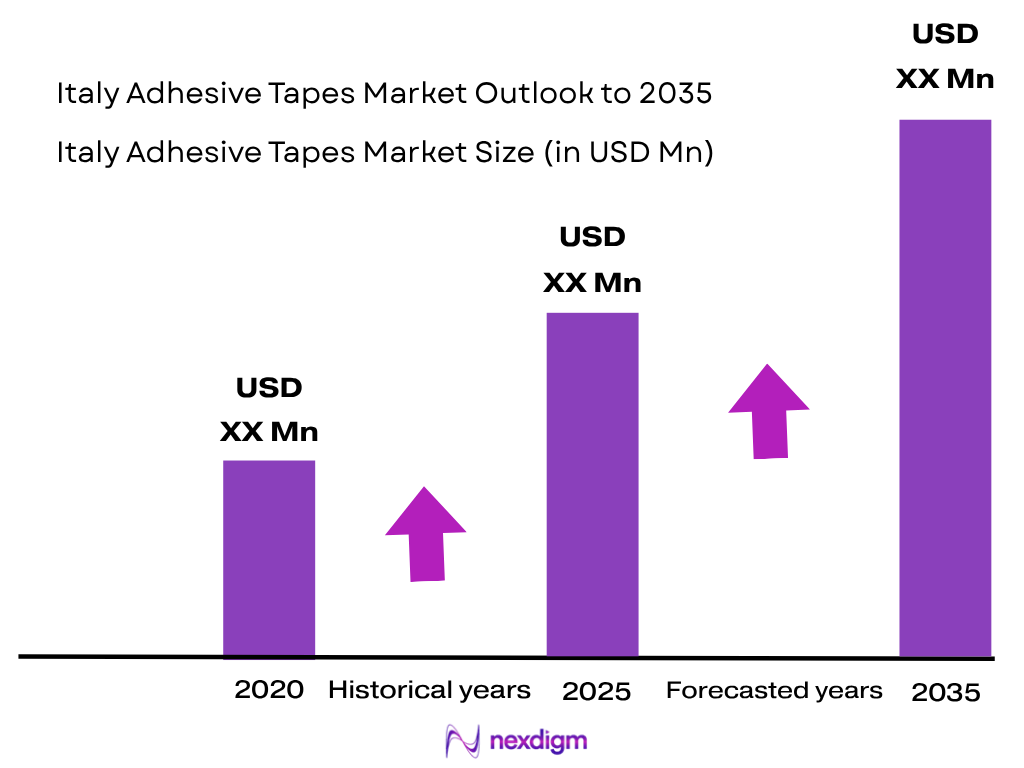
The Italy adhesive tapes market is estimated at ~USD XX million in 2025, compared with ~USD XX million in 2024, with demand supported by packaging, industrial manufacturing, automotive components, construction and electrical applications. Italy’s industrial production index declined 3.4 points on an annual basis in 2024, while automotive production remained substantial at approximately 591,000 vehicles. These industrial activities sustain recurring requirements for carton sealing, mounting, insulation, masking, splicing and component assembly tapes.
Northern Italy remains the principal demand concentration for adhesive tapes because Lombardy, Veneto, Emilia-Romagna and Piedmont contain dense clusters of machinery, automotive, packaging, furniture and industrial-component manufacturers. Milan and the wider Lombardy manufacturing ecosystem are particularly important, while Turin remains strategically linked to automotive production and engineering. Bologna and Modena benefit from machinery and automotive-component activity, and Veneto combines manufacturing with furniture and packaging production. Italy’s logistics network further supports nationwide tape distribution, with professional third-party carriers handling about 87% of road-freight tonnage.
Market Segmentation
By Adhesive Technology
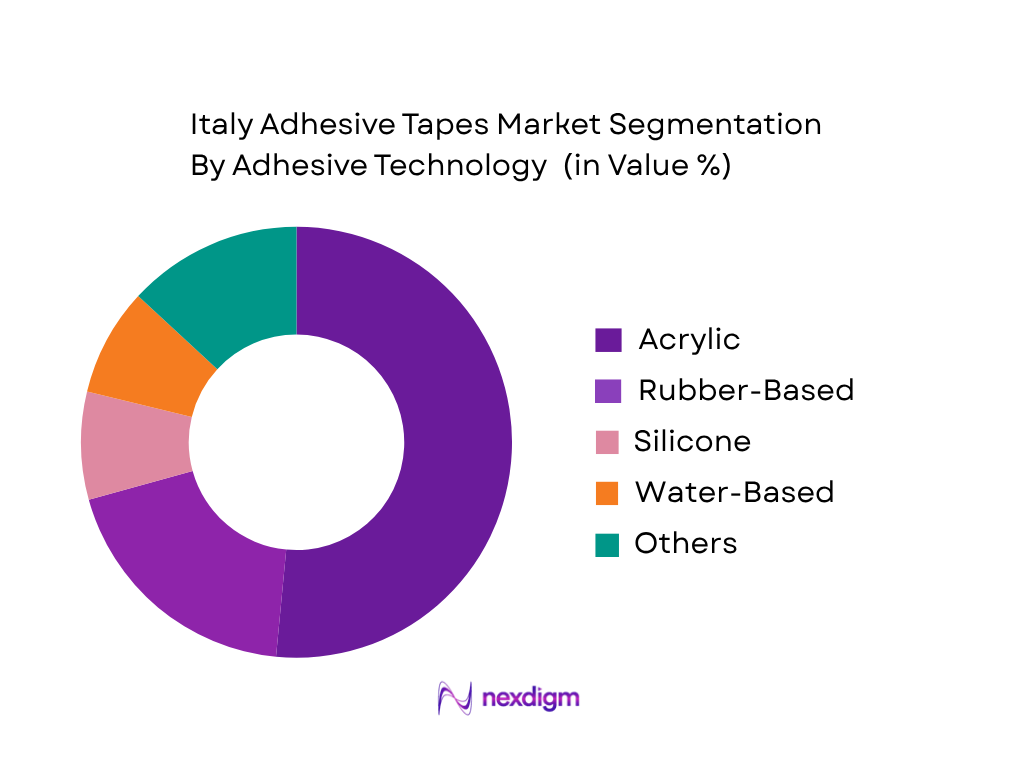
Italy adhesive tapes are segmented by adhesive technology into acrylic, rubber-based, silicone, water-based, solvent-based and hot-melt systems. Acrylic tapes are expected to hold the dominant share, supported by their broad suitability for industrial mounting, automotive assembly, packaging, construction and durable bonding applications. Acrylic chemistry provides a strong balance of adhesion, ageing resistance, temperature performance and substrate compatibility, making it suitable for applications requiring longer service life. Rubber-based technologies remain important where high initial tack and rapid adhesion are priorities, particularly in packaging and general-purpose applications. Silicone systems occupy a more specialized position in high-temperature, electrical and demanding industrial applications. Water-based and hot-melt technologies benefit from process and environmental considerations, while solvent-based systems remain relevant for applications requiring specific coating characteristics. The breadth of Italian manufacturing means that adhesive selection is increasingly application-driven, with customers evaluating peel strength, shear resistance, temperature stability, UV exposure, moisture resistance and substrate compatibility rather than relying solely on tape category.
By End-Use Industry
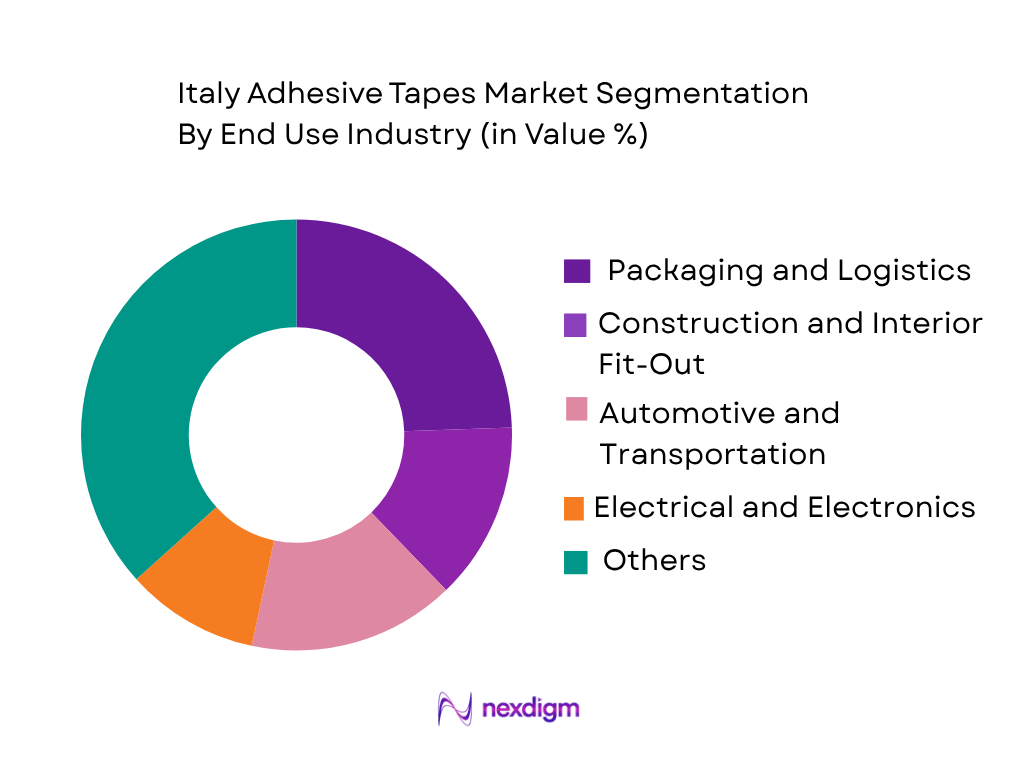
Italy adhesive tapes are segmented by end-use industry into packaging and logistics, construction and interior fit-out, automotive and transportation, electrical and electronics, HVAC and MEP, healthcare and pharmaceuticals, industrial manufacturing, aerospace and defense, furniture and interiors, food and beverage, and marine and specialty applications. Packaging and logistics are expected to represent the leading end-use segment, supported by recurring requirements for carton sealing, bundling, palletizing, splicing and automated packaging. Italy’s extensive manufacturing supply chain generates additional demand from automotive, machinery and industrial users, where tapes are increasingly used for lightweight assembly, component fixation, insulation and surface protection. Industrial customers typically require more technically qualified products, whereas packaging buyers place greater emphasis on application speed, consistent unwind and production-line compatibility. The growing differentiation between commodity and specialty applications is therefore reshaping the Italian market, with high-performance double-sided, foam, film, electrical and customized die-cut tapes gaining relevance alongside conventional packaging products.
Competitive Landscape
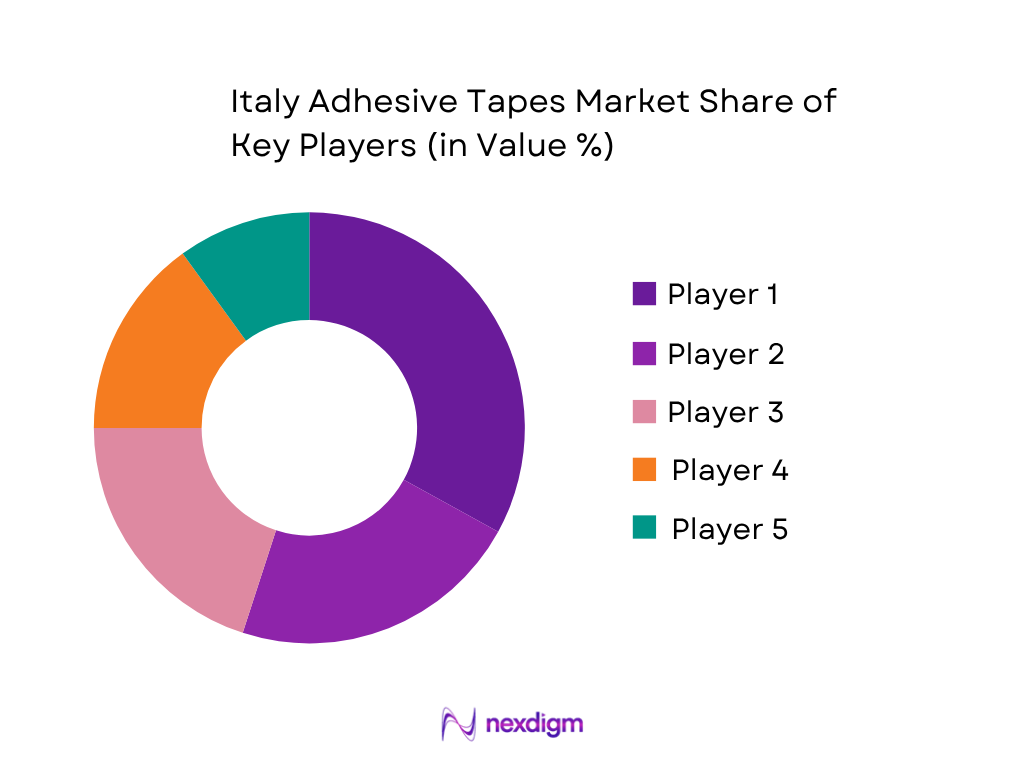
The Italy adhesive tapes market is characterized by the presence of global adhesive-material companies alongside specialized Italian manufacturers and regional converters. Competition is differentiated by adhesive chemistry, converting capabilities, technical qualification, application engineering and distribution reach. Automotive, electronics and industrial customers generally require greater technical support and product qualification, while packaging and general-purpose users are more availability- and price-sensitive. Italy also has an established manufacturing and converting ecosystem, including tesa’s Concagno facility, which serves automotive, industrial, packaging and other applications.
| Company | Est. | Headquarters | Core Tape Technologies | Key End-Use Exposure | Product Differentiation | Distribution Reach | Customization / Converting |
| 3M | 1902 | St. Paul, Minnesota, USA | ~ | ~ | ~ | ~ | ~ |
| tesa | 1896 | Norderstedt, Germany | ~ | ~ | ~ | ~ | ~ |
| Nitto Denko | 1918 | Osaka, Japan | ~ | ~ | ~ | ~ | ~ |
| Lintec | 1934 | Tokyo, Japan | ~ | ~ | ~ | ~ | ~ |
| Scapa | 1927 | Manchester, UK | ~ | ~ | ~ | ~ | ~ |
Italy Adhesive Tapes Market Analysis
Growth Drivers
Packaging & E-Commerce Demand
Italy’s broad manufacturing and distribution base continues to create multiple recurring applications for adhesive tapes across carton sealing, product assembly, component mounting, insulation, masking, splicing and surface protection. ISTAT reported that Italy’s industrial production declined 3.4% across 2024, but the underlying industrial base remained substantial, while construction production increased 5.0%, supporting applications for mounting, insulation, HVAC, glazing and protective tapes. The automotive ecosystem also remains strategically important: ANFIA recorded 591,000 motor vehicles produced domestically, alongside 2,134 component companies generating €55.5 billion in turnover and €24.6 billion in exports. This manufacturing concentration creates demand for both high-volume packaging tapes and higher-specification automotive and industrial solutions. E-commerce is adding another demand channel: ISTAT reported that 20.4% of Italian enterprises with at least 10 employees sold online, compared with 19.1% in the previous year, while online sales represented 16.9% of their total turnover. This supports recurring requirements for carton closure, bundling, labeling and shipment preparation. Construction also reached its highest annual production index since 2008, at 137.3, reinforcing demand for mounting, sealing and insulation tapes. The combination of manufacturing, logistics, construction and digital commerce therefore provides a diversified demand base rather than dependence on a single application.
Automotive & Industrial Manufacturing
The transition toward technically differentiated bonding solutions is supported by Italy’s unusually broad industrial ecosystem, particularly automotive components, machinery, metalworking, electrical equipment, furniture and construction products. Automotive production reached 591,000 vehicles in 2024, while the component industry comprised 2,134 companies and 168,000 employees, creating a substantial installed base for wire-harness wrapping, interior mounting, trim attachment, surface protection and component fixation. Although total automotive production fell 32.3% from 2023, the scale of the component ecosystem continues to support specialized tape requirements and creates opportunities for suppliers able to qualify products for OEM and Tier-1 applications. Industrial manufacturing also remains central to tape consumption despite a 3.4% decline in overall industrial production during 2024, because tapes are embedded in numerous production processes rather than being limited to finished-product assembly. Construction provides a separate positive demand channel: production increased 5.0% during 2024 and the annual index reached 137.3, the highest level since 2008. This supports mounting, insulation, HVAC, sealing and surface-protection applications. E-commerce further reinforces packaging demand, with 20.4% of enterprises employing at least 10 people reporting online sales, while electronic commerce accounted for 16.9% of their total turnover. These conditions favor suppliers offering application-specific acrylic, foam, double-sided, electrical, foil and high-temperature tapes instead of undifferentiated commodity products.
Market Challenges
Raw Material & Supply-Chain Dependence
Italy’s adhesive-tape supply chain remains exposed to international flows of polymer films, resins, specialty chemicals, release liners and other intermediate materials, making upstream availability and logistics important operating considerations for converters and manufacturers. ISTAT reported that total Italian imports declined 3.9% in 2024 compared with 2023, while import prices declined 1.5%; this does not eliminate supply-chain exposure because specialty inputs can remain dependent on international suppliers even when aggregate import values moderate. The market is particularly sensitive to acrylic monomers, synthetic rubber, silicone materials, PET and BOPP films and specialty liners, where technical substitution can require additional qualification. Energy remains another structural consideration for coating, drying, slitting and converting operations, particularly where production involves temperature-controlled processes and solvent-management systems. Industrial demand also became more difficult in 2024: overall industrial production decreased 3.4%, while the automotive industry production index declined 22.7%. This weak industrial environment can intensify purchasing scrutiny and increase pressure on standardized tape categories. At the same time, specialty applications cannot always compete solely on price because automotive, electrical and industrial customers require controlled adhesion, shear strength, temperature resistance, ageing performance and substrate compatibility. Consequently, manufacturers must balance inventory resilience, technical qualification, production efficiency and product differentiation.
Qualification & Performance Requirements
Technical qualification represents a major barrier in Italy because adhesive tapes increasingly function as engineered components rather than simple consumables. Automotive, electronics, machinery and electrical users may require documented peel adhesion, shear performance, temperature resistance, chemical resistance, UV stability, dimensional consistency and ageing characteristics before approving a tape for production. The importance of qualification is reinforced by the scale of Italy’s automotive-component industry, which recorded 2,134 companies and €55.5 billion in turnover, making OEM and Tier-supplier specifications an important commercial gateway for specialty tape suppliers. At the same time, industrial weakness can increase buyer sensitivity: ISTAT recorded a 3.4% decline in industrial production during 2024, while automotive production fell 22.7% on the index basis. Suppliers therefore face the dual challenge of maintaining technical investment while serving customers under tighter procurement conditions. Environmental and process requirements can further complicate product development because manufacturers increasingly need to manage solvent emissions, adhesive chemistry and material recyclability while maintaining the required bond performance. For converters, the fragmented nature of demand creates additional operational complexity because customers may require different widths, roll formats, adhesive systems and die-cut geometries. These factors increase the value of technical support and application engineering but can also lengthen customer-acquisition cycles and increase qualification costs for new entrants.
Market Opportunities
Advanced Automotive & EV Tapes
Italy’s transition toward higher-value manufacturing creates a strong platform for advanced adhesive tapes that deliver lightweight assembly, insulation, mounting and surface-protection functions. The opportunity is supported by the scale of the country’s industrial and automotive ecosystem: the automotive component sector alone included 2,134 companies, 168,000 employees, €55.5 billion in turnover and €24.6 billion in exports in 2024. This creates an installed base of manufacturers capable of adopting higher-performance acrylic foam, double-sided, high-temperature and electrically functional tapes where technical qualification is achievable. Construction provides another immediate application platform, with production increasing 5.0% in 2024 and the annual production index reaching 137.3, the highest level since 2008. This supports demand for HVAC foil tapes, insulation tapes, mounting systems and weather-resistant bonding solutions. Sustainable packaging is another opportunity because Italian companies are increasingly integrating digital commerce and modern distribution into their operations: 20.4% of enterprises with at least 10 employees sold online in 2024, and online sales generated 16.9% of their total turnover. This creates opportunities for packaging tapes designed around automated application, paper-based substrates, optimized BOPP constructions and improved recyclability. The combination of automotive engineering, construction activity, digital commerce and industrial specialization creates multiple pathways for premium tape adoption without relying solely on volume expansion.
Sustainable & Specialty Tape Solutions
The strongest future-facing opportunity lies in moving from standardized tape consumption toward application-engineered bonding systems for electrification, automation, electronics, renewable energy and advanced manufacturing. Italy’s existing automotive supply chain provides an important foundation: despite a 32.3% decline in total domestic vehicle production to 591,000 units in 2024, the country retained a large component ecosystem with 2,134 companies and €24.6 billion of component exports. This installed industrial capability can support migration toward lightweight bonding, battery-component fixation, thermal-management insulation, wire management and high-performance electrical applications as vehicle architectures evolve. Electronics and precision manufacturing can similarly increase demand for thin double-sided, polyimide, specialty-film and functional tapes where dimensional stability and controlled adhesion are essential. Renewable-energy and building applications provide another route: construction production increased 5.0% in 2024, creating a current base for insulation, HVAC and mounting products that can increasingly incorporate higher-performance adhesive systems. Sustainability also creates an innovation pathway rather than merely a compliance burden. Packaging users can adopt paper-backed tapes, recyclable constructions, water-based systems and optimized hot-melt technologies where application requirements permit. Italy’s 20.4% enterprise online-sales penetration further supports continued packaging and fulfilment activity. These existing industrial indicators provide a current demand foundation for suppliers developing specialty tapes, customized converting, die-cut components and low-emission adhesive technologies.
Future Outlook
The Italy adhesive tapes market is expected to expand as manufacturers increasingly substitute mechanical fastening with lightweight adhesive bonding and as packaging, automotive, electronics, machinery and construction applications require more specialized tape solutions. Growth should increasingly shift toward high-performance acrylic foam tapes, automotive assembly tapes, electronics tapes, sustainable packaging tapes, die-cut components and low-VOC adhesive systems. The transition toward electrified vehicles, automation and higher-value industrial manufacturing should support technically differentiated tape applications, while sustainability requirements will encourage development of lower-emission adhesive systems and recyclable or paper-based constructions.
Major Players
- 3M
- tesa
- Nitto Denko
- Lintec
- Scapa
- Avery Dennison
- Saint-Gobain
- Lohmann
- Intertape Polymer Group
- Berry Global
- Scotch
- Advance Tapes
- Gergonne
- Poli-Film
- Eurocel
Key Target Audience
- Automotive OEMs and Tier-1/Tier-2 Component Manufacturers
- Packaging Manufacturers and Contract Packaging Operators
- Industrial Machinery and Equipment Manufacturers
- Electrical, Electronics and Appliance Manufacturers
- Construction, HVAC and Interior Fit-Out Material Suppliers
- Investments and Venture Capitalist Firms (Industrial Materials, Adhesives, Advanced Manufacturing)
- Government and Regulatory Bodies (Italian Ministry of Enterprises and Made in Italy, Ministry of Environment and Energy Security, European Chemicals Agency)
- Industrial Adhesive Tape Distributors, Converters and Specialty Material Processors
Research Methodology
Step 1: Identification of Key Variables
The research begins by mapping the Italian adhesive tapes ecosystem across manufacturers, adhesive-material suppliers, film producers, converters, distributors and end users. Product-level variables include adhesive chemistry, backing material, tape construction, thickness, width, application and technical-performance requirements. Demand variables are mapped across packaging, automotive, industrial manufacturing, construction, electronics and other major consuming industries.
Step 2: Market Analysis and Construction
Historical market information is structured through a combination of production, trade, industrial-activity and end-use indicators. The bottom-up assessment evaluates adhesive tape consumption across major application categories and purchasing channels, while the top-down approach benchmarks demand against relevant manufacturing and packaging activity. Market estimates are subsequently reconciled through product-category and end-user validation.
Step 3: Hypothesis Validation and Expert Consultation
Market hypotheses are validated through interviews with adhesive tape manufacturers, Italian converters, distributors, procurement professionals and industrial users. Discussions focus on technology adoption, application requirements, qualification processes, substitution patterns, purchasing criteria and supplier positioning. Technical inputs are used to validate the segmentation structure and identify differences between commodity and specialty tape demand.
Step 4: Research Synthesis and Final Output
The final research framework integrates supply-side, demand-side and trade evidence into a consolidated Italy adhesive tapes market model. Competitive benchmarking evaluates product portfolios, technical capabilities, end-use exposure, converting capacity and financial indicators. The resulting analysis provides an application-level assessment of current demand and the strategic opportunities emerging from lightweight bonding, electrification, automation and sustainable adhesive technologies.

- Executive Summary
- Research Methodology (Market Definition and Scope, Adhesive Tape Taxonomy, Market Boundary Conditions, HS-Code and Product Mapping, Top-Down Market Sizing, Bottom-Up Demand Reconstruction, Domestic Production Assessment, Import–Export Reconciliation, Consumption Build-Up, Demand-Side Assessment, Supply-Side Assessment, Primary Interviews, Manufacturer Validation, Converter Mapping, Distributor Mapping, Data Triangulation, Forecasting Framework, Scenario Modelling, Sensitivity Analysis, Research Limitations)

- Definition and Scope
- Evolution of the Italian Adhesive Tapes Industry
- Italian Adhesive Tape Industry Ecosystem
- Adhesive Tape Value Chain
- Domestic Manufacturing and Converting Landscape
- Italian Adhesive Tape Production Infrastructure
- Import and Export Trade Structure

- Growth Drivers(Packaging and Carton Sealing Demand, E-Commerce Fulfilment, Automotive Production and Component Assembly, Industrial Machinery Manufacturing, Construction and Renovation Activity, Electrical and Electronics Manufacturing, HVAC and Insulation Installation, Furniture and Interior Manufacturing, Lightweight Bonding Adoption, Expansion of Specialty Tape Applications)
- Market Challenges (Dependence on Imported Polymer Films and Adhesive Feedstocks, Volatility in Acrylic and Rubber-Based Raw Materials, Energy-Intensive Coating and Converting Operations, Stringent Automotive and Industrial Qualification Requirements, Performance Degradation Under Heat and Humidity, Limited Domestic Production of Advanced Specialty Tapes, Fragmented Converter and Distributor Landscape, Commodity-Tape Price Competition, Supply-Chain Disruptions, Skilled Technical Application Requirements)
- Market Opportunities (Advanced Acrylic Foam Tapes, EV and Battery Assembly Tapes, Electronics and Semiconductor Applications, Low-VOC Adhesive Systems, Sustainable Paper and BOPP Packaging Tapes, Bio-Based Adhesive Chemistries, High-Temperature Industrial Tapes, HVAC Foil and Insulation Tapes, Solar and Renewable-Energy Applications, Specialty Tape Converting and Die-Cutting, Medical and Healthcare Tapes, Lightweight Automotive Bonding Solutions)
- Market Trends (Shift from Mechanical Fastening to Adhesive Bonding, Premiumization of High-Performance Tapes, Growth of Double-Sided and Foam Tapes, Sustainable Substrate Adoption, Low-VOC and Solvent-Free Adhesive Development, Electrification-Driven Automotive Tape Demand, Automation-Compatible Packaging Tapes, Customized Die-Cut Tape Components, High-Temperature Electronics Tapes, Lightweight Material Bonding, Recyclability-Oriented Packaging Solutions)
- Government Regulations (EU REACH Chemical Compliance, CLP Classification and Labelling Requirements, EU Packaging and Packaging Waste Requirements, VOC Emission Controls, Industrial Emissions Requirements, Product Safety and Chemical Substance Restrictions, Automotive Material Compliance Requirements, Food-Contact Packaging Requirements, Medical-Device Regulatory Requirements, Waste and Recycling Obligations)
- SWOT Analysis
- Porter’s Five Forces Analysis
- PESTLE Analysis

- By Market Value (2020-2025)
- By Tape Consumption Volume (2020-2025)
- By Average Selling Price (2020-2025)
- By Domestic Production Volume (2020-2025)
- By Import Volume (2020-2025)
- By Export Volume (2020-2025)

- By Adhesive Technology (in value %)
Acrylic Adhesive Tapes
Rubber-Based Adhesive Tapes
Silicone Adhesive Tapes
Water-Based Adhesive Tapes
Solvent-Based Adhesive Tapes
Hot-Melt Adhesive Tapes
Reactive and Specialty Adhesive Tapes - By Backing Material (in value %)
BOPP Tapes
PVC Tapes
PET Tapes
PE Tapes
Paper-Based Tapes
Nonwoven Tapes
Foam Tapes
Polyimide Tapes
Aluminum Foil Tapes
Fabric and Specialty Film Tapes - By Tape Construction (in value %)
Single-Sided Tapes
Double-Sided Tapes
Transfer Tapes
Foam Tapes
Filament-Reinforced Tapes
Masking Tapes
Protective Tapes
Electrical Insulation Tapes
Functional Specialty Tapes - By Product Format (in value %)
Jumbo Rolls
Slit Rolls
Narrow-Width Industrial Rolls
Adhesive Sheets
Laminated Tape Structures
Die-Cut Adhesive Components
Customized Converted Tape Products - By End-Use Industry ( in value % )
Packaging and Logistics
Construction and Interior Fit-Out
Automotive and Transportation
Electrical and Electronics
HVAC and MEP
Healthcare and Pharmaceuticals
Industrial Manufacturing
Aerospace and Defense
Furniture and Interiors
Food and Beverage
Marine and Specialty Applications - By Application (in value %)
Carton Sealing and Case Closing
Permanent Mounting and Bonding
Splicing and Web Joining
Masking and Surface Protection
Electrical Insulation and Wire Management
Component Assembly
Lamination and Composite Bonding
Labelling and Graphic Applications
Packaging Reinforcement
HVAC Insulation and Sealing

- Market Share of Major Players (By Value, Volume, Adhesive Technology, Backing Material, Tape Construction, End-Use Industry, Application, Product Format, Distribution Channel)
- Cross Comparison Parameters (Adhesive Technology Breadth, Tape Construction Portfolio, Automotive OEM Qualification Capability, Electronics-Grade Tape Capability, Italian Manufacturing Footprint, Precision Converting Capability, Distribution Network Reach, R&D and Product Innovation Capability)
- SWOT Analysis of Major Players
- Detailed Profiles of Major Companies
3M Company
tesa SE
Avery Dennison Corporation
Nitto Denko Corporation
LINTEC Corporation
Saint-Gobain
Lohmann GmbH & Co. KG
Intertape Polymer Group
Berry Global
Nichiban Co., Ltd.
GERGONNE
Sicad Group
NAR S.p.A.
Proxima Tecnologie Adesive
PPM Industries

- Consumption Behavior
- End-User Purchase Preferences
- Product Attribute Preference
- Sustainability-Oriented Purchasing
- Brand and Supplier Selection
- Purchasing Channel Behavior

- By Market Value (2026-2035)
- By Tape Consumption Volume (2026-2035)
- By Average Selling Price (2026-2035)
- By Domestic Production Volume (2026-2035)
- By Import Volume (2026-2035)
- By Export Volume (2026-2035)


 Request a Sample
 Ask for Customization
 Get a Quote
 Enquire Now