
 Download PDF
Market Overview
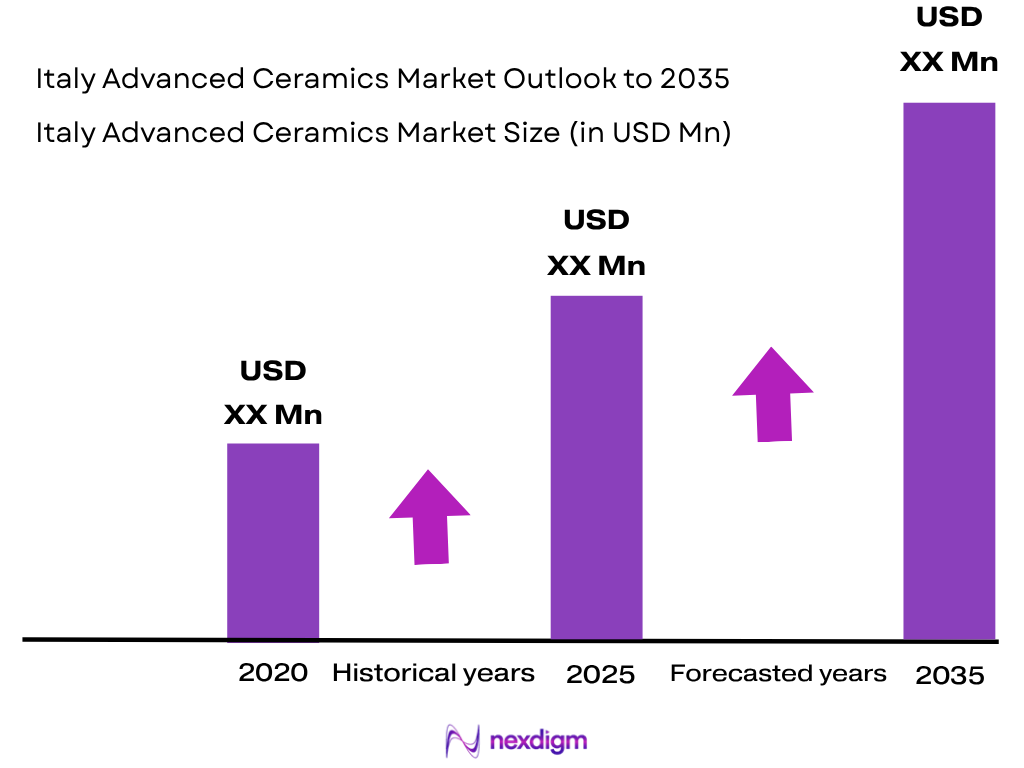
The Italy Advanced Ceramics Market represents the high-performance segment of the Italian technical-ceramics ecosystem, serving electronics, automotive, industrial machinery, healthcare, energy and aerospace applications. For report purposes, the 2024 market value is ~USD ~ billion, with the 2026–2035 CAGR estimated at ~%. Italy’s broader ceramic industry provides an established manufacturing base: 248 ceramic companies employed 26,211 direct workers and generated more than EUR 7.5 billion in 2024, while ceramic-industry investment reached EUR 380 million. These conditions support specialized advanced-ceramic production and application development.
Northern Italy is the principal industrial center relevant to advanced ceramics because of its concentration of automotive, machinery, electronics, medical-device and precision-manufacturing activities. The Emilia-Romagna ceramic district is particularly important: Modena and Reggio Emilia hosted 68 of Italy’s 122 industrial tile producers, demonstrating the depth of the country’s ceramic manufacturing ecosystem. Milan and Turin additionally provide strong engineering, automotive, electronics and industrial-technology demand, while established international suppliers operate Italian or European technical-ceramics networks.
Market Segmentation
By Material Type
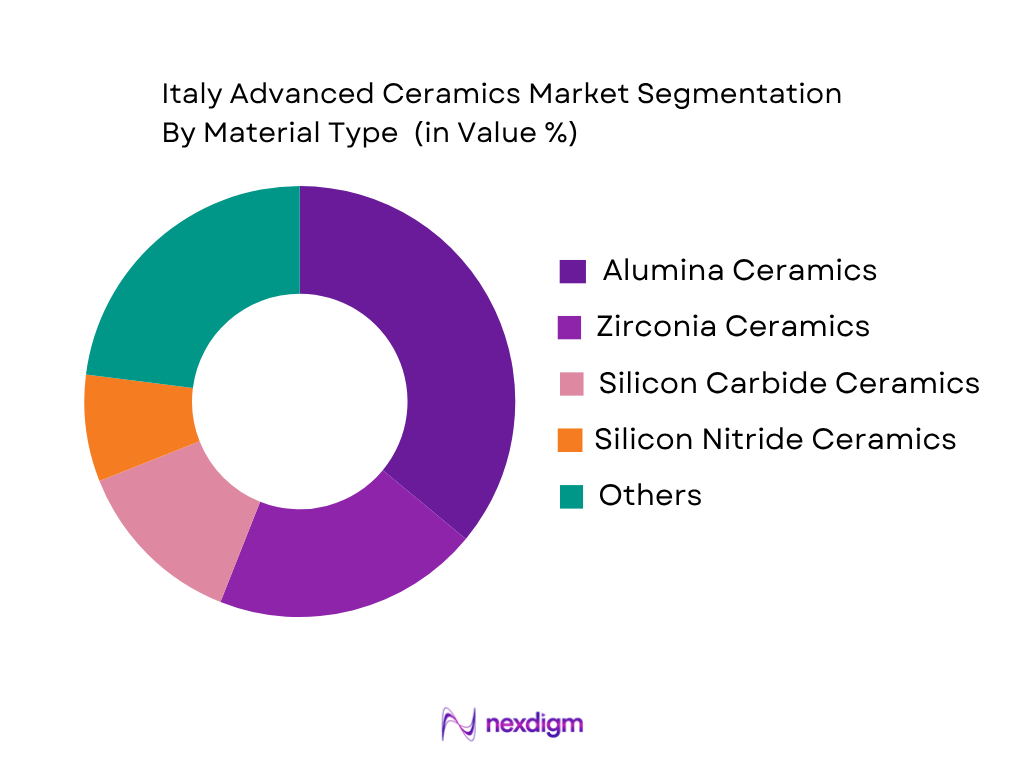
The Italy Advanced Ceramics Market is segmented by material type into alumina, zirconia, silicon carbide, silicon nitride, aluminum nitride, piezoelectric ceramics, ferrites, cordierite, mullite and other advanced ceramic materials. Alumina is expected to represent the dominant sub-segment, supported by its broad combination of electrical insulation, hardness, wear resistance, chemical stability and comparatively established processing routes. Its applicability spans electrical insulators, electronic substrates, industrial wear parts, mechanical components and medical applications, giving suppliers access to several industrial demand pools rather than a single end-use market. Zirconia maintains strong relevance in dental and medical applications as well as precision components, while silicon carbide and silicon nitride benefit from requirements for high-temperature performance, thermal stability and wear resistance. Aluminum nitride is particularly relevant to thermal-management applications because of its combination of electrical insulation and thermal conductivity. Italy’s broader technical-ceramics ecosystem and the presence of international suppliers with portfolios covering multiple ceramic materials reinforce the availability of these material technologies. Kyocera, for example, states that its fine-ceramics business supports more than 200 ceramic materials globally.
By End-Use Industry
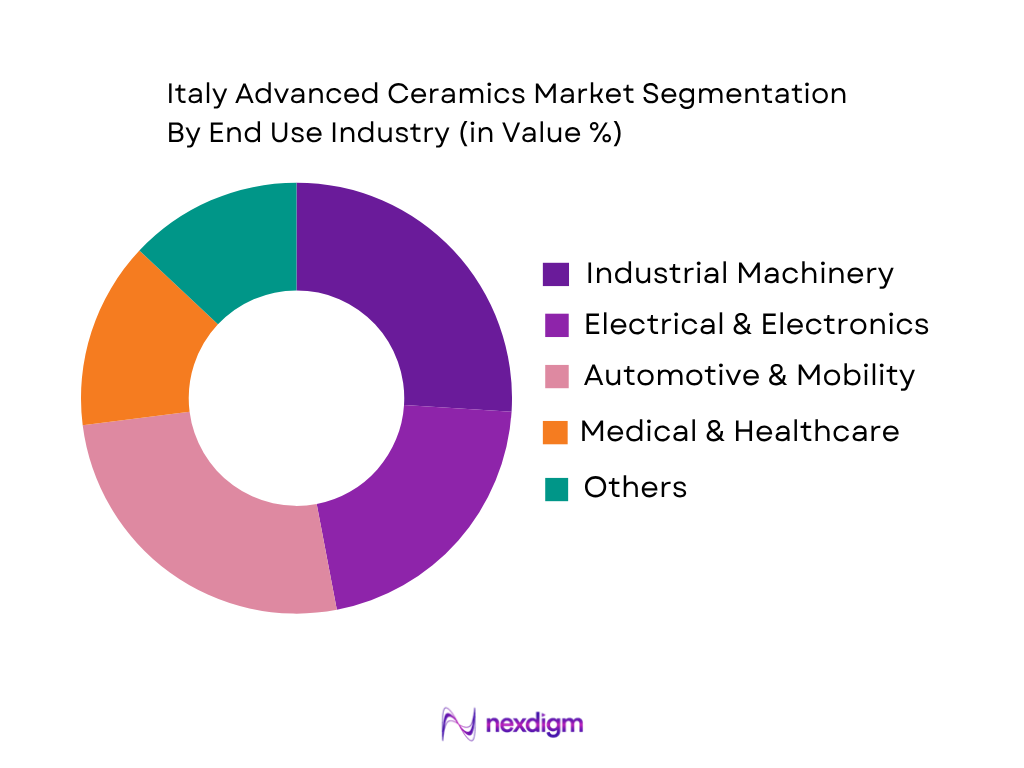
The Italy Advanced Ceramics Market is segmented by end-use industry into electrical and electronics, automotive and mobility, industrial machinery, medical and healthcare, aerospace and defense, energy and power, semiconductor manufacturing, telecommunications, chemical processing and other industrial applications. Industrial machinery is positioned as a leading sub-segment because Italy has a deep manufacturing base requiring wear-resistant, thermally stable, electrically insulating and dimensionally precise components. Advanced ceramics are used in bearings, seals, nozzles, guides, cutting components, insulating elements and high-temperature equipment, allowing ceramic components to address multiple machine-system requirements. Automotive and mobility represent another major demand center because ceramics support sensors, electrical insulation, wear components, thermal-management systems and electronic assemblies. Electronics and semiconductor applications offer additional high-value demand for ceramic substrates, packages, insulators and precision components. The presence of specialized technical-ceramics suppliers and international manufacturers in Italy also supports application engineering and localized customer service. Kyocera Italy specifically identifies fine ceramic components, automotive components and semiconductor components among its activities, illustrating the breadth of advanced-ceramics applications relevant to Italian industry.
Competitive Landscape
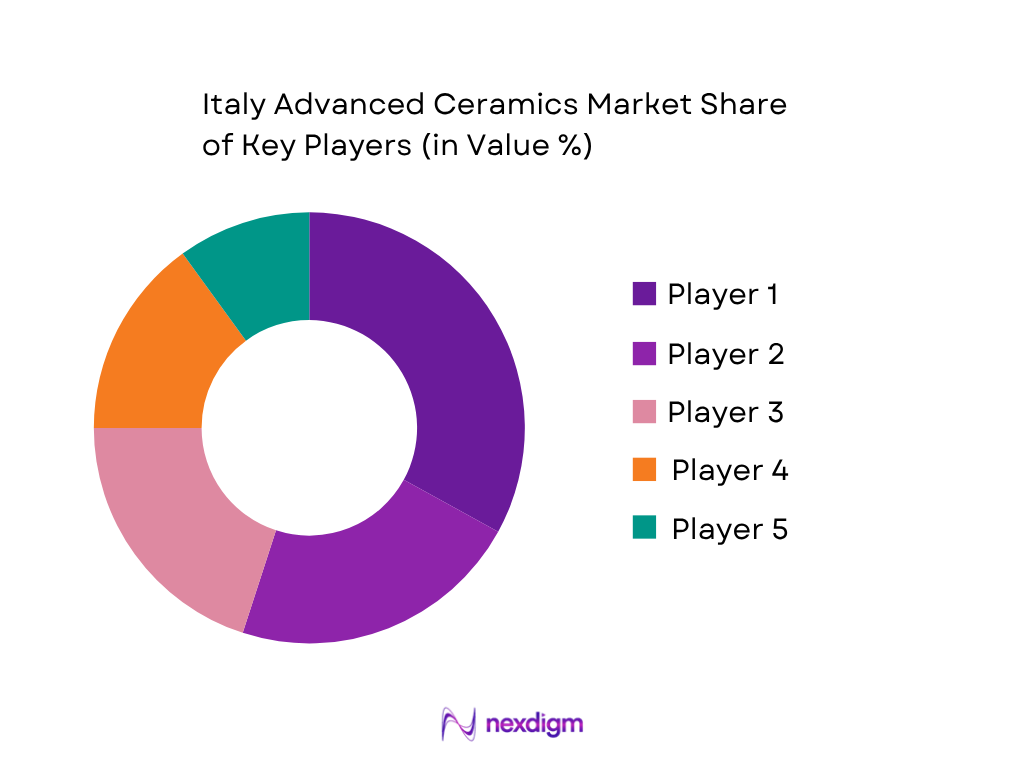
The Italy Advanced Ceramics Market has a combination of international advanced-material manufacturers, specialist technical-ceramics producers and companies serving specific high-performance applications. Competition is shaped less by commodity-scale production and more by material formulation, precision manufacturing, application engineering, qualification capability, product customization and reliability. International companies such as KYOCERA, CeramTec, CoorsTek, Morgan Advanced Materials and Saint-Gobain provide broad technical-ceramics capabilities, while the Italian ecosystem provides access to established ceramic manufacturing, engineering and industrial supply chains.
| Company | Establishment Year | Headquarters | Core Ceramic Materials | Key Applications | Manufacturing Capability | Italian Market Relevance | Customization Capability |
| KYOCERA Corporation | 1959 | Kyoto, Japan | ~ | ~ | ~ | ~ | ~ |
| CeramTec GmbH | 1903 | Plochingen, Germany | ~ | ~ | ~ | ~ | ~ |
| CoorsTek Inc. | 1910 | Golden, Colorado, USA | ~ | ~ | ~ | ~ | ~ |
| Morgan Advanced Materials | 1856 | Windsor, UK | ~ | ~ | ~ | ~ | ~ |
| Saint-Gobain | 1665 | Paris, France | ~ | ~ | ~ | ~ | ~ |
Italy Advanced Ceramics Market Analysis
Growth Drivers
Automotive Electronics Integration
Italy’s automotive ecosystem creates a direct demand pathway for advanced ceramics used in electronic control units, sensors, ignition systems, thermal-management components, electrical insulation and high-temperature applications. The Italian new-car market recorded 1,563,682 registrations in 2024, providing a substantial installed and replacement base for ceramic-enabled automotive electronics. Italy also recorded 64,983 battery-electric vehicle registrations during the same period, reinforcing requirements for power-electronics substrates, insulation components and thermal-management ceramics as vehicle architectures become increasingly electrified. The broader European automotive market recorded 12,963,614 new registrations in 2024, supporting Italy’s role within an integrated European component supply chain. Italy’s vehicle fleet is also structurally significant: ACEA reported that Italy had the highest number of cars per 1,000 inhabitants in the European Union in 2024, sustaining demand for replacement electronics, sensors and high-temperature components even when new-vehicle production is subdued. The industrial backdrop remains supported by public investment: IMF data show Italian real GDP expanded by 0.7 percent in 2024, while the National Recovery and Resilience Plan continued supporting investment. These conditions strengthen opportunities for alumina, zirconia, silicon nitride, aluminum nitride and other engineered ceramics in automotive electronic modules, charging systems, power conversion and next-generation mobility platforms.
Industrial Automation and Advanced Manufacturing
Italy’s extensive machinery and manufacturing base supports advanced ceramics through applications requiring electrical insulation, wear resistance, dimensional stability, corrosion resistance and operation under high temperatures. Istat classifies machinery and equipment manufacturing, electrical equipment, electronics and optical equipment, automotive manufacturing, chemicals, pharmaceuticals and other industrial activities as distinct manufacturing sectors, demonstrating the breadth of the domestic industrial ecosystem relevant to engineered ceramic components. The macroeconomic investment environment also remains important: IMF data indicate that Italian investment represented 21.7 units per 100 units of GDP in 2024, while the National Recovery and Resilience Plan continued directing investment toward infrastructure, digitalization and industrial modernization. Italy’s construction production reached an index level of 137.3 in 2024, the highest level recorded since 2008 according to Istat, creating additional requirements for automation equipment, electrical systems, cutting tools, wear-resistant components and industrial machinery. The country’s industrial-export orientation further increases the relevance of high-performance components capable of meeting international operating specifications. Istat reported that Italian exports of pharmaceutical products increased strongly and that exports of medical instruments and related products also contributed positively to external trade in 2024. These conditions support demand for alumina, zirconia, silicon carbide, silicon nitride and other advanced ceramics across robotic systems, precision machinery, semiconductor equipment, process-control systems and industrial automation platforms.
Market Challenges
High Processing Complexity and Energy-Intensive Sintering
Advanced ceramics manufacturing in Italy faces technical constraints arising from powder preparation, forming, debinding, sintering, machining, surface finishing and quality control. Unlike conventional commodity materials, advanced ceramic components frequently require tightly controlled processing conditions to achieve specified density, dimensional tolerances, electrical properties and mechanical performance. The broader industrial environment adds pressure because energy remains an important input for Italian manufacturing. Istat reported that industrial production contracted during parts of 2024, while the IMF highlighted Italy’s exposure to imported fossil fuels and the vulnerability of the economy to changes in global energy conditions. The IMF also reported that Italy’s energy dependence contributes to domestic inflationary pressures when international energy conditions deteriorate. For ceramic manufacturers, this environment is particularly relevant because thermal processing can involve prolonged high-temperature furnace operations, while precision machining of sintered components requires specialized equipment and process controls. The challenge extends beyond furnace operation: high-purity powders, controlled-atmosphere processing and post-sintering grinding can require additional process stages before components meet specifications. The resulting manufacturing complexity can lengthen qualification cycles for automotive, aerospace, semiconductor and medical applications. Smaller domestic producers can therefore face difficulty achieving the production consistency, process automation and capital intensity required for demanding applications, particularly when competing with larger international ceramic manufacturers.
Imported High-Purity Material Dependency and Fragmented Domestic Production
Italy’s advanced-ceramics industry operates within a highly integrated European and global materials supply chain, leaving manufacturers exposed to the availability of specialized powders, additives, binders, substrates and processing equipment. This is particularly important for high-purity alumina, silicon carbide, silicon nitride, aluminum nitride and specialized piezoelectric materials, where qualification requirements can restrict the number of acceptable suppliers. Istat reported that Italy’s overall goods exports declined modestly in value in 2024, while specific industrial categories showed divergent performance; automotive exports declined by €16.7 billion-equivalent relative value points represented in the reported category change, while pharmaceutical, chemical-medicinal and botanical product exports increased by 9.5 units per 100 units of the prior-year export base. More strategically, Italy’s semiconductor supply-chain development illustrates the scale of external technology and investment required to strengthen domestic high-tech manufacturing. The Italian government approved support of €1.3 billion for Silicon Box’s advanced-packaging project, linked to a total planned investment of €3.2 billion, while STMicroelectronics announced a €5 billion manufacturing investment in Catania. These projects demonstrate the emerging demand base for advanced ceramic substrates, thermal-management materials and semiconductor equipment components, but also highlight the need for stronger domestic supply capabilities. Fragmented production, limited specialization and reliance on internationally sourced high-purity inputs can therefore increase supply-chain exposure and qualification complexity.
Market Opportunities
Ceramic Substrate Manufacturing and EV Power Electronics Ceramics
Italy has an expanding strategic opportunity to deepen domestic capabilities in ceramic substrates, electrical insulation and thermal-management components as automotive and industrial electronics become more power-dense. The country recorded 64,983 battery-electric vehicle registrations in 2024, while the total Italian new-car market reached 1,563,682 registrations, creating a sizeable platform for electrification-related component demand. European demand provides an additional addressable manufacturing ecosystem, with 12,963,614 new passenger-car registrations across the EU in 2024. Advanced ceramics can serve power modules, inverters, charging equipment, high-voltage insulation systems and thermal-management assemblies because materials such as aluminum nitride and silicon nitride combine electrical insulation with thermal-performance characteristics required by demanding electronic architectures. The semiconductor ecosystem is also becoming strategically important. Italy’s Ministry of Enterprises and Made in Italy reported more than €9 billion of semiconductor-related investment in Italy during 2024, including the €3.2 billion Silicon Box project and STMicroelectronics’ €5 billion Catania project. Silicon Box’s planned facility is expected to create 1,600 direct jobs at full operation. These investments create an ecosystem in which advanced ceramic substrates, packages, thermal interfaces, inspection components and precision ceramic parts can become increasingly important. Current automotive electrification and semiconductor investment therefore provide a concrete industrial foundation for developing higher-value domestic ceramic capabilities rather than limiting Italy to conventional ceramic applications.
Medical, Semiconductor and High-Performance Ceramic Components
Italy’s strong pharmaceutical, medical-instrument and high-technology manufacturing base creates opportunities for specialized advanced ceramics where biocompatibility, dimensional stability, electrical insulation, chemical resistance and thermal performance are critical. Istat reported that Italian exports of pharmaceutical products increased by 9.5 units per 100 units of the previous-year export base in 2024, while medical instruments and other related products also made a positive contribution to national export performance. Italy’s pharmaceutical trade has become increasingly internationally significant, with pharmaceuticals accounting for 8.7 units per 100 units of total Italian exports in 2024, according to Istat. This industrial concentration supports opportunities for ceramic components used in medical and dental systems, analytical equipment, laboratory instruments, surgical technologies and specialized manufacturing equipment. Semiconductor investment provides another high-value pathway. Italy’s semiconductor ecosystem attracted more than €9 billion of investment during 2024, while the Silicon Box project alone represented €3.2 billion of planned investment and the STMicroelectronics Catania project represented €5 billion. Such facilities require high-purity, chemically resistant and thermally stable components for semiconductor processing, packaging, inspection and manufacturing infrastructure. The opportunity therefore extends beyond finished ceramic products toward engineered substrates, wafer-handling components, high-purity alumina parts, silicon-carbide components, ceramic coatings and thermal-management assemblies. Italy’s existing pharmaceutical, medical, machinery and semiconductor capabilities provide multiple industrial routes for advanced-ceramics suppliers to move toward higher-specification applications and strengthen domestic participation in strategic technology supply chains.
Future Outlook
The Italy Advanced Ceramics Market is expected to develop through increasing demand for materials capable of operating under high temperature, electrical, mechanical, chemical and dimensional-performance requirements. Automotive electrification should create additional requirements for insulating and thermal-management ceramics, while electronics miniaturization supports ceramic substrates, packages and precision components. Semiconductor equipment, medical devices, industrial automation and energy technologies are also expected to broaden the addressable application base. Italy’s established manufacturing infrastructure, together with its integration into European automotive, machinery and electronics supply chains, provides a foundation for specialized ceramic component production.
The future competitive environment is therefore expected to emphasize high-purity materials, application-specific formulations, precision machining, advanced sintering, ceramic injection molding, additive manufacturing and co-development with OEMs. International suppliers are already positioning advanced ceramics across semiconductor, automotive and fine-component applications, reinforcing the strategic importance of technical ceramics within high-performance manufacturing.
Major Players
- KYOCERA Corporation
- CeramTec GmbH
- CoorsTek Inc.
- Morgan Advanced Materials
- Saint-Gobain
- 3M
- Murata Manufacturing Co., Ltd.
- NGK Insulators, Ltd.
- Niterra Co., Ltd.
- MARUWA Co., Ltd.
- Materion Corporation
- Ferrotec Corporation
- Rauschert Group
- Vesuvius
- Industrie Bitossi S.p.A.
Key Target Audience
- Advanced ceramics manufacturers and technical-ceramics component producers
- Automotive OEMs and Tier-1 component manufacturers
- Electronics, semiconductor and power-electronics manufacturers
- Industrial machinery and precision-engineering companies
- Medical-device and dental-ceramics manufacturers
- Energy, power-generation and thermal-management equipment manufacturers
- Investments and venture capitalist firms focused on advanced materials, industrial technology and manufacturing
- Government and regulatory bodies (Ministry of Enterprises and Made in Italy, Ministry of Health, Ministry of Environment and Energy Security, Italian Trade Agency)
Research Methodology
Step 1: Identification of Key Variables
The initial phase establishes the Italy Advanced Ceramics Market ecosystem covering material producers, ceramic-component manufacturers, distributors, OEMs and end-use industries. The research identifies material types, product forms, manufacturing processes, application areas, import dependence, domestic production and technology requirements.
Step 2: Market Analysis and Construction
Historical market information is compiled using production, trade, industrial-output and company-level information alongside application-specific demand indicators. The market is constructed from both demand-side consumption and supply-side production perspectives, with reconciliation performed across material, product and end-use categories.
Step 3: Hypothesis Validation and Expert Consultation
Market hypotheses are validated through discussions with manufacturers, component suppliers, procurement professionals and application specialists. Expert inputs are used to assess material substitution, qualification requirements, technology adoption, manufacturing constraints and application-specific purchasing behavior.
Step 4: Research Synthesis and Final Output
The final analysis integrates company intelligence, industry statistics, trade information and application-level findings. Bottom-up estimates are cross-checked against top-down industry indicators, while inconsistencies are investigated before producing market segmentation, competitive analysis and future outlook conclusions.

- Executive Summary
- Research Methodology (Market Definition and Scope, Advanced Ceramics Classification, Market Boundary Conditions, Primary and Secondary Data Sources, Top-Down Market Sizing, Bottom-Up Market Sizing, Production-Side Assessment, Consumption-Side Assessment, Import–Export Reconciliation, Application-Level Demand Mapping, Company-Level Revenue Analysis, Capacity Mapping, Primary Industry Interviews, Expert Validation, Data Triangulation, Forecasting Framework, Scenario Analysis, Assumptions, Limitations)

- Definition and Scope
- Advanced Ceramics Industry Evolution and Technology Development
- Italian Technical Ceramics Manufacturing Ecosystem
- Advanced Ceramics Value Chain Analysis
- Raw Material-to-Component Value Chain
- Advanced Ceramics Supply Chain Structure
- Domestic Manufacturing Footprint
- Italian Advanced Ceramics Production Capabilities

- Growth Drivers (Automotive Electronics Integration, Industrial Automation, Advanced Manufacturing, Electronics Miniaturization, Power Electronics Adoption, Medical Device Manufacturing, Aerospace Engineering, EV Electrification)
- Market Challenges (High Processing Complexity, Specialized Powder Requirements, Energy-Intensive Sintering, Precision Machining Requirements, Skilled Manufacturing Requirements, Qualification Lead Times, Imported High-Purity Material Dependency, Fragmented Domestic Production)
- Market Opportunities (Ceramic Substrate Manufacturing, EV Power Electronics Ceramics, Semiconductor Equipment Components, Medical and Dental Ceramics, Piezoelectric Components, Thermal Management Ceramics, Ceramic Matrix Composites, High-Purity Alumina, Silicon Carbide Components, Advanced Ceramic Coatings)
- Market Trends (Electronics Miniaturization, EV Component Electrification, High-Thermal-Conductivity Ceramics, Precision Ceramic Machining, Ceramic Injection Molding, Advanced Sintering, Ceramic Additive Manufacturing, Functional Ceramics, High-Purity Materials, Application-Specific Ceramic Formulations)
- SWOT Analysis
- Porter’s Five Forces Analysis
- PESTLE Analysis

- By Market Value (2020-2025)
- By Consumption Volume (2020-2025)
- By Domestic Production Volume (2020-2025)
- By Import Volume (2020-2025)
- By Export Volume (2020-2025)
- By Material Consumption (2020-2025)

- By Material Type (In Value %)
Alumina
Zirconia
Silicon Carbide
Silicon Nitride
Aluminum Nitride
Titanate Ceramics
Ferrite Ceramics
Piezoceramics
Cordierite
Mullite
Other Advanced Ceramic Materials - By Product Type (In Value %)
Monolithic Ceramics
Ceramic Powders
Ceramic Substrates
Ceramic Packages
Ceramic Coatings
Ceramic Tubes and Rods
Ceramic Plates and Discs
Ceramic Seals and Bearings
Ceramic Insulators
Precision Ceramic Components
Ceramic Matrix Composites - By Manufacturing Process (In Value %)
Dry Pressing
Wet Pressing
Isostatic Pressing
Ceramic Injection Molding
Tape Casting
Extrusion
Slip Casting
Hot Pressing
Reaction Bonding
Pressureless Sintering - By Application (In Value %)
Electrical Insulation Components
Electronic Components
Ceramic Substrates
Semiconductor Manufacturing Components
Wear-Resistant Components
Ceramic Seals and Bearings
Thermal Management Components
Piezoelectric Components
High-Temperature Components - By End-Use Industry (In Value %)
Electrical and Electronics
Automotive and Mobility
Industrial Machinery
Medical and Healthcare
Aerospace and Defense
Energy and Power
Semiconductor Manufacturing
Chemical Processing
Mechanical Engineering
Telecommunications
Ceramics and Manufacturing Equipment
Textile Machinery

- Market Share of Major Players (By Value, Volume, Material Type, Product Type, Application, End-Use Industry)
- Cross Comparison Parameters (Advanced Ceramic Material Portfolio, Product Portfolio Breadth, Manufacturing Process Capability, Precision Machining Capability, High-Purity Material Capability, Thermal and Electrical Performance Range, Customization and Application Engineering Capability, Italian Manufacturing and
- Technical Support Footprint)
- SWOT Analysis of Major Players
- Detailed Profiles of Major Companies
CeramTec GmbH
Morgan Advanced Materials
CoorsTek Inc.
KYOCERA Corporation
Saint-Gobain Ceramics
3M
Murata Manufacturing Co., Ltd.
NGK Insulators, Ltd.
Niterra Co., Ltd.
Tosoh Corporation
Rauschert Group
Industrie Bitossi S.p.A.
SINTERALL S.r.l.
ISOTALCO S.r.l.
IT-KeramiK S.r.l.

- Consumption and Demand Behavior
- End-User Purchasing Priorities
- Procurement Decision-Making Process
- Material Preference by End Use
- Geographic Concentration of Demand

- By Market Value (2026-2035)
- By Consumption Volume (2026-2035)
- By Domestic Production Volume (2026-2035)
- By Import Volume (2026-2035)
- By Export Volume (2026-2035)
- By Material Consumption (2026-2035)


 Request a Sample
 Ask for Customization
 Get a Quote
 Enquire Now