

 Download PDF
 Download PDF
Market Overview
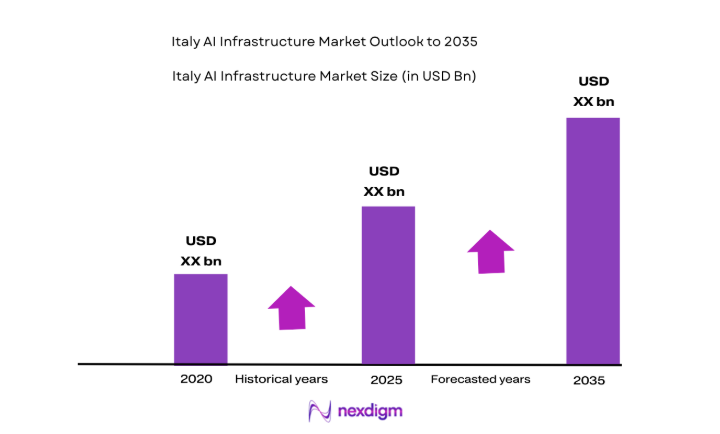
Italy AI infrastructure market reached approximately USD ~ billion in value based on a recent historical assessment, supported by accelerated enterprise adoption of generative AI computing, hyperscale data center expansion, and sovereign cloud investments aligned with European digital autonomy programs. Growth is driven by increasing GPU dense server deployments, edge AI integration across industrial automation clusters, and national digital transition funding that prioritizes high performance computing and secure data infrastructure modernization across sectors.
Northern Italy cities such as Milan, Turin, and Bologna dominate AI infrastructure deployment due to concentration of data centers, telecom exchanges, manufacturing clusters, and financial institutions requiring advanced compute capacity. Milan leads as a digital hub with hyperscale and colocation campuses, while Turin and Bologna benefit from automotive, robotics, and semiconductor ecosystems that accelerate industrial AI workloads and edge computing adoption across production networks and research facilities.
Market Segmentation
By Product Type
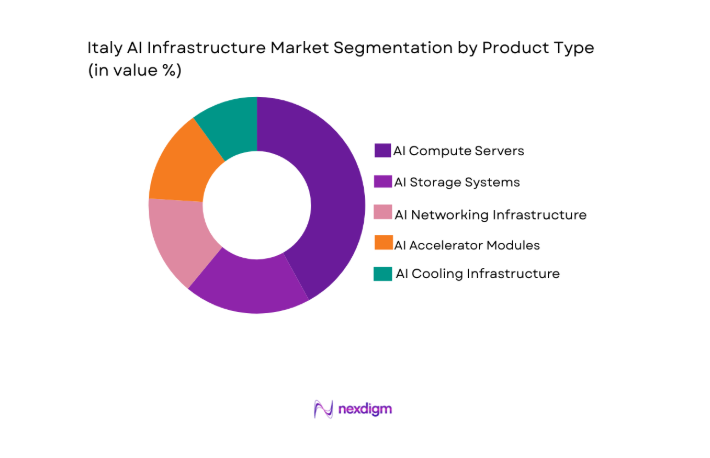
Italy AI Infrastructure market is segmented by product type into AI compute servers, AI storage systems, AI networking infrastructure, AI accelerator modules, and AI cooling infrastructure. Recently, AI compute servers has a dominant market share due to factors such as concentration of GPU clusters in hyperscale and enterprise data centers, strong demand from generative AI training workloads, expansion of sovereign cloud nodes, and industrial AI deployments requiring high parallel processing capacity. Domestic system integrators and telecom operators prioritize compute layer investments before storage and networking scaling, reinforcing server dominance.
By Platform Type
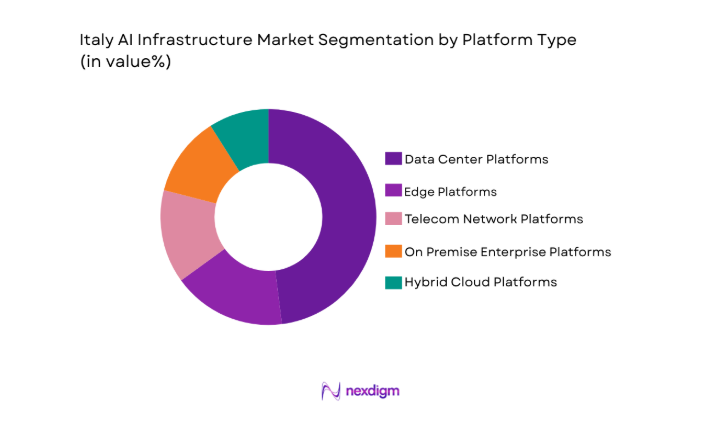
Italy AI Infrastructure market is segmented by platform type into data center platforms, edge platforms, telecom network platforms, on premise enterprise platforms, and hybrid cloud platforms. Recently, data center platforms has a dominant market share due to factors such as hyperscale campus expansion in Milan region, sovereign cloud node deployments, colocation growth, and enterprise migration of AI training workloads to centralized high density compute environments. National digitalization funding and cloud localization policies further prioritize large scale data center infrastructure over distributed edge rollouts.
Competitive Landscape
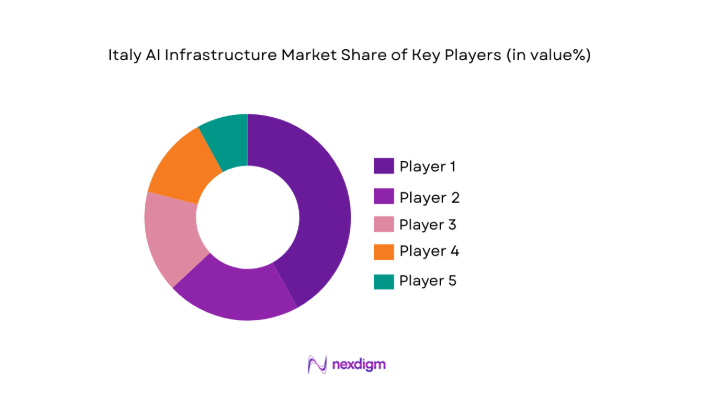
Italy AI infrastructure market shows moderate consolidation with telecom operators, national system integrators, and European semiconductor linked firms shaping deployment ecosystems while global hyperscale partnerships influence technology standards and procurement models across sovereign cloud and enterprise AI projects.
| Company Name | Establishment Year | Headquarters | Technology Focus | Market Reach | Key Products | Revenue | Deployment Model |
| Leonardo | 1948 | Rome | ~ | ~ | ~ | ~ | ~ |
| STMicroelectronics | 1987 | Geneva | ~ | ~ | ~ | ~ | ~ |
| TIM | 1994 | Rome | ~ | ~ | ~ | ~ | ~ |
| Aruba | 1994 | Bergamo | ~ | ~ | ~ | ~ | ~ |
| Almaviva | 1983 | Rome | ~ | ~ | ~ | ~ | ~ |
Italy AI Infrastructure Market Analysis
Growth Drivers
Industrial AI Adoption Across Manufacturing Clusters
Italy’s manufacturing base spanning automotive, machinery, robotics, and precision engineering sectors increasingly embeds AI driven quality control, predictive maintenance, and autonomous production optimization systems that require localized high performance compute infrastructure close to factory operations. Industrial firms are modernizing legacy automation systems toward AI integrated digital factories, which necessitates deployment of edge AI servers and centralized training clusters connected through low latency industrial networks. Government backed Industry 4.0 incentives encourage capital investment in AI capable machinery and digital twins, accelerating demand for GPU dense infrastructure across northern industrial corridors. Automotive electrification and robotics expansion further increase machine vision and simulation workloads that depend on scalable compute environments. Domestic system integrators collaborate with manufacturing conglomerates to build private AI clouds that retain intellectual property locally, reinforcing national infrastructure demand. Semiconductor and electronics ecosystems around Turin and Lombardy also require AI modeling and design simulation capacity, extending infrastructure needs beyond production floors. Export oriented manufacturers adopt AI to maintain competitiveness against Asian producers, creating sustained infrastructure investment cycles. These factors collectively position industrial AI as a structural driver of Italy’s AI infrastructure expansion.
Sovereign Cloud and Data Localization Initiatives
European digital sovereignty policies and national cloud strategies emphasize domestic control of critical data and AI processing capacity, leading Italy to invest in localized AI infrastructure operated by national telecoms, cloud providers, and defense aligned technology firms. Public sector modernization programs shift administrative and security workloads to sovereign clouds, requiring high security AI compute clusters within national borders. Financial services, healthcare, and government agencies adopt compliant AI environments that cannot rely on foreign hyperscale jurisdictions, increasing domestic infrastructure buildouts. Telecom operators expand edge and core data centers to host sovereign AI services integrated with 5G networks, enabling distributed intelligence while maintaining regulatory compliance. European funding programs support HPC and AI infrastructure partnerships among research institutes and industry, expanding national compute capacity. Strategic autonomy concerns around semiconductor supply and data governance further reinforce domestic deployment priorities. Enterprises handling sensitive industrial or citizen data prefer sovereign AI platforms, accelerating migration from external cloud dependence. This policy driven infrastructure demand establishes long term growth momentum independent of cyclical enterprise IT spending.
Market Challenges
Energy Constraints and Data Center Power Availability
AI infrastructure requires extremely high electrical density for GPU clusters and cooling systems, yet Italy faces structural energy cost pressures and grid capacity limitations that restrict large scale data center expansion in key regions. Hyperscale campuses and enterprise AI clusters compete for limited industrial power allocations, delaying deployments and increasing operating costs relative to Northern European locations. Renewable integration and grid reinforcement projects progress gradually, creating uncertainty for investors planning multi megawatt AI facilities. Cooling infrastructure for high density AI racks also increases water and energy consumption, raising environmental permitting complexity and community resistance. Operators must invest in advanced liquid cooling and efficiency optimization technologies that elevate capital expenditure. Energy price volatility affects long term cost modeling for AI infrastructure operations, reducing predictability for investors. Regions suitable for data centers may lack adequate transmission infrastructure, requiring additional grid investments. These constraints collectively slow AI infrastructure scaling and reduce Italy’s competitiveness as a hyperscale AI location.
Limited Domestic AI Semiconductor Manufacturing Capacity
Italy relies heavily on imported GPUs and advanced AI accelerators due to limited domestic fabrication of leading edge semiconductor nodes, exposing AI infrastructure projects to global supply chain disruptions and geopolitical technology controls. European semiconductor initiatives focus on long term capacity building, but near term availability of advanced AI chips remains constrained relative to demand growth. Infrastructure providers face procurement delays and pricing volatility when sourcing accelerators from global vendors. Domestic electronics and semiconductor firms specialize more in power electronics and embedded chips than high performance AI processors, limiting local ecosystem depth. Dependence on external technology suppliers also raises sovereignty concerns for sensitive government or defense AI applications. Integration of imported accelerators into national infrastructure requires compliance with export controls and security frameworks that add complexity. Smaller Italian integrators lack scale purchasing power compared with global hyperscalers, further constraining access. These structural supply limitations challenge rapid expansion of national AI infrastructure capacity.
Opportunities
Expansion of Edge AI Infrastructure in Industrial and Urban Systems
Italy’s dense network of manufacturing zones, logistics hubs, transportation corridors, and smart city initiatives creates significant opportunity for distributed edge AI infrastructure deployment that complements centralized data center clusters. Autonomous inspection, traffic management, energy optimization, and urban security analytics require localized processing near data sources to minimize latency and bandwidth usage. Telecom operators deploying 5G networks can host edge AI nodes within existing exchanges and base station facilities, creating nationwide distributed compute layers. Industrial automation vendors integrate AI modules into production equipment that connect to nearby edge servers for inference workloads. Municipal digitalization programs across metropolitan regions increasingly adopt AI enabled surveillance, mobility, and environmental monitoring platforms needing local compute. Edge deployments reduce dependence on large hyperscale campuses, alleviating energy and land constraints while expanding coverage. Domestic system integrators and telecom providers possess strong positioning in localized infrastructure deployment, enabling national ecosystem growth. This distributed architecture opportunity supports scalable AI adoption across sectors beyond major data center regions.
Public Sector and Research HPC AI Infrastructure Modernization
Government and academic research institutions operate numerous high performance computing facilities for scientific modeling, climate analysis, healthcare research, and defense simulations, many of which are undergoing modernization toward AI accelerated architectures. National funding programs and European collaborations support upgrades of supercomputing centers with AI capable processors and storage networks, expanding domestic infrastructure capacity. Universities and research consortia increasingly require GPU clusters for machine learning experimentation and innovation programs linked with industry partnerships. Defense and security agencies invest in sovereign AI compute environments for intelligence analysis and cybersecurity operations. Public sector procurement frameworks enable long term infrastructure investments that provide stable demand for national technology firms. Collaboration between research HPC centers and enterprises accelerates technology transfer and shared infrastructure utilization. Modernized HPC AI facilities also attract international research projects and innovation ecosystems to Italy. This institutional modernization wave presents sustained infrastructure growth opportunities independent of commercial hyperscale cycles.
Future Outlook
Italy AI infrastructure market is expected to expand steadily as sovereign cloud programs, industrial AI adoption, and HPC modernization initiatives accelerate domestic compute deployment. Growth will be supported by liquid cooling technologies, edge AI architectures, and national data localization policies. Telecom edge integration and manufacturing digitalization will further stimulate distributed infrastructure expansion. Regulatory alignment with European AI and data frameworks will reinforce sovereign infrastructure investment across sectors.
Major Players
- Leonardo
- STMicroelectronics
- TIM
- Aruba
- Almaviva
- Engineering Ingegneria Informatica
- Reply
- E4 Computer Engineering
- Deda Group
- Var Group
- Fastweb
- Noovle
- Olidata
- Elmec Informatica
- Selex ES
Key Target Audience
- Hyperscale cloud providers
- Telecom operators
- Manufacturing conglomerates
- Financial institutions
- Government and regulatory bodies
- Data center developers
- Investments and venture capitalist firms
- Semiconductor and AI hardware vendors
Research Methodology
Step 1: Identification of Key Variables
Key infrastructure components, deployment models, end user sectors, and technology layers were mapped across Italy’s AI ecosystem. Demand drivers such as industrial AI adoption, sovereign cloud policies, and HPC modernization were identified through secondary databases and policy reviews.
Step 2: Market Analysis and Construction
Supply side capacity of data centers, telecom nodes, AI hardware vendors, and integrators was quantified and correlated with demand indicators from enterprise AI adoption and public digitalization programs. Market sizing models were constructed using infrastructure investment benchmarks and deployment density factors.
Step 3: Hypothesis Validation and Expert Consultation
Industry experts from telecom, manufacturing automation, HPC research, and system integration domains validated infrastructure demand assumptions and technology adoption timelines. Regulatory and energy constraint scenarios were incorporated to refine projections.
Step 4: Research Synthesis and Final Output
Quantitative modeling and qualitative insights were synthesized to produce segmented market structure, competitive landscape, and growth outlook. Cross validation ensured consistency across infrastructure layers, deployment platforms, and end user sectors.

- Executive Summary
- Research Methodology (Definitions, Scope, Industry Assumptions, Market Sizing Approach, Primary & Secondary Research Framework, Data Collection & Verification Protocol, Analytic Models & Forecast Methodology, Limitations & Research Validity Checks)

- Market Definition and Scope
- Value Chain & Stakeholder Ecosystem
- Regulatory / Certification Landscape
- Sector Dynamics Affecting Demand
- Strategic Initiatives & Infrastructure Growth

- Growth Drivers
Expansion of hyperscale and colocation data centers across Italy
Rising enterprise adoption of generative AI workloads
Government backed digitalization and AI sovereignty initiatives
Telecom edge computing expansion for AI applications
Growth of Industry 4.0 and smart manufacturing deployments - Market Challenges
High energy consumption and power availability constraints
Shortage of advanced AI semiconductor supply chains in Europe
Data sovereignty and compliance complexity
High capital intensity of AI infrastructure deployment
Skills gap in AI infrastructure engineering and operations - Market Opportunities
Development of sovereign AI cloud infrastructure in Italy
Adoption of edge AI infrastructure in industrial clusters
AI infrastructure modernization of public sector data centers - Trends
Shift toward GPU dense AI server architectures
Rapid adoption of liquid cooling in AI data centers
Integration of AI infrastructure with 5G edge networks
Growth of modular and prefabricated AI data centers
Emergence of sustainable and green AI infrastructure designs - Government Regulations & Defense Policy
EU AI Act compliance requirements for infrastructure providers
Italian national cloud and data localization policies
Energy efficiency regulations for data center infrastructure - SWOT Analysis
- Stakeholder and Ecosystem Analysis
- Porter’s Five Forces Analysis
- Competition Intensity and Ecosystem Mapping

- By Market Value, 2020-2025
- By Installed Units, 2020-2025
- By Average System Price, 2020-2025
- By System Complexity Tier, 2020-2025

- By System Type (In Value%)
AI Compute Servers
AI Storage Systems
AI Networking Infrastructure
Edge AI Systems
AI Cloud Infrastructure Platforms - By Platform Type (In Value%)
Data Center Infrastructure
Edge Infrastructure
On Premise Enterprise Infrastructure
Hybrid Cloud AI Infrastructure
Telecom Network Infrastructure - By Fitment Type (In Value%)
New Build AI Infrastructure
AI Infrastructure Retrofit
Modular AI Infrastructure
Integrated AI Stack Deployments
Hyperconverged AI Systems - By End User Segment (In Value%)
Hyperscale Cloud Providers
Telecom Operators
Government and Public Sector
Manufacturing Enterprises
Financial Services Institutions - By Procurement Channel (In Value%)
Direct OEM Procurement
System Integrator Contracts
Cloud Marketplace Procurement
Government Framework Agreements
Telecom Vendor Partnerships

- Market structure and competitive positioning
Market share snapshot of major players - Cross Comparison Parameters (Compute Performance Density, Energy Efficiency, Cooling Technology, AI Accelerator Integration, Deployment Scalability, Edge Compatibility, Software Stack Integration, Total Cost of Ownership, Data Sovereignty Compliance)
- SWOT Analysis of Key Competitors
- Pricing & Procurement Analysis
- Key Players
Leonardo
STMicroelectronics
TIM
Noovle
Almaviva
Engineering Ingegneria Informatica
Reply
Selex ES
E4 Computer Engineering
Deda Group
Var Group
Olidata
Elmec Informatica
Fastweb
Aruba

- Hyperscale operators expanding AI regions within Italy for data sovereignty
- Manufacturing sector deploying edge AI for automation and robotics
- Public sector modernizing digital infrastructure for AI services
- Telecom operators integrating AI into network and edge platforms

- Forecast Market Value, 2026-2035
- Forecast Installed Units, 2026-2035
- Price Forecast by System Tier, 2026-2035
- Future Demand by Platform, 2026-2035


 Request a Sample
 Ask for Customization
 Get a Quote
 Enquire Now