
 Download PDF
Market Overview
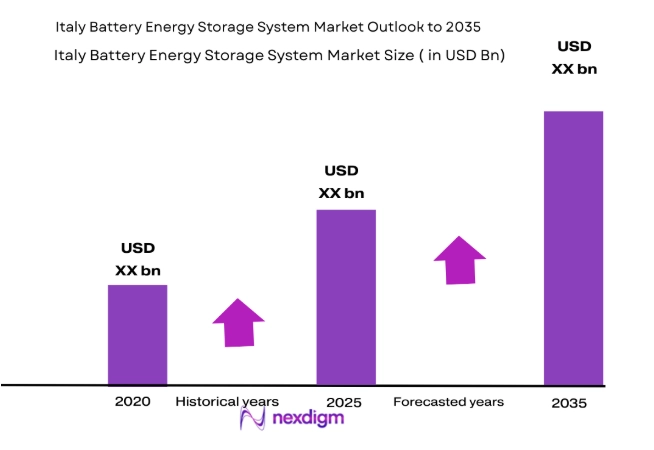
The Italy Battery Energy Storage System market is valued at USD ~ billion based on a recent historical assessment, driven primarily by the rapid integration of renewable energy sources into the national grid, increased industrial adoption of energy storage for peak load management, and government incentives promoting sustainable energy solutions. Continuous technological advancements in lithium-ion and flow battery systems, alongside declining costs and enhanced system efficiency, contribute to market expansion. Private sector investment in commercial and residential storage further fuels adoption, while utility-scale projects and smart grid development strengthen overall infrastructure demand. Rising electricity demand and the push for decarbonization create a favorable environment for energy storage systems, supporting long-term market growth.
Key cities and regions dominate Italy’s battery energy storage market due to concentrated industrial activity, renewable energy deployment, and infrastructure availability. Northern Italian hubs such as Milan and Turin benefit from dense industrial and commercial operations, while coastal regions and islands leverage solar and wind resources to deploy utility-scale storage. The presence of major energy firms and established grid operators facilitates rapid project implementation, and regional regulatory frameworks support energy storage integration. Urban centers attract residential storage installations owing to increasing energy-conscious households, while southern regions focus on large-scale renewable projects. Italy’s geographic diversity, coupled with government-backed initiatives, ensures robust market activity across multiple locations.
Market Segmentation
By Product Type
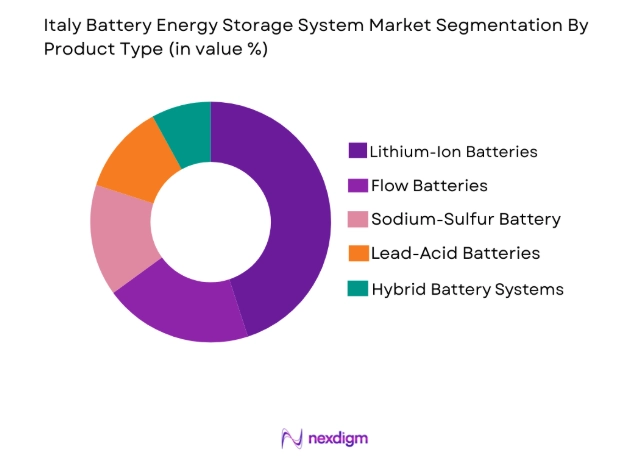
Italy Battery Energy Storage System market is segmented by product type into lithium-ion battery systems, flow battery systems, sodium-sulfur battery systems, lead-acid battery systems, and hybrid battery systems. Recently, lithium-ion battery systems have a dominant market share due to factors such as high energy density, longer lifecycle, declining manufacturing costs, broad industrial and residential adoption, extensive vendor support, and compatibility with smart grid technologies. The widespread availability of lithium resources, well-established supply chains, and rapid deployment timelines further strengthen their preference. Consumers and utilities prioritize reliability, efficiency, and reduced maintenance, making lithium-ion systems the preferred choice. Continuous technological advancements, coupled with governmental subsidies for renewable integration, reinforce lithium-ion systems’ leading position in both large-scale and small-scale energy storage deployments across Italy.
By Platform Type
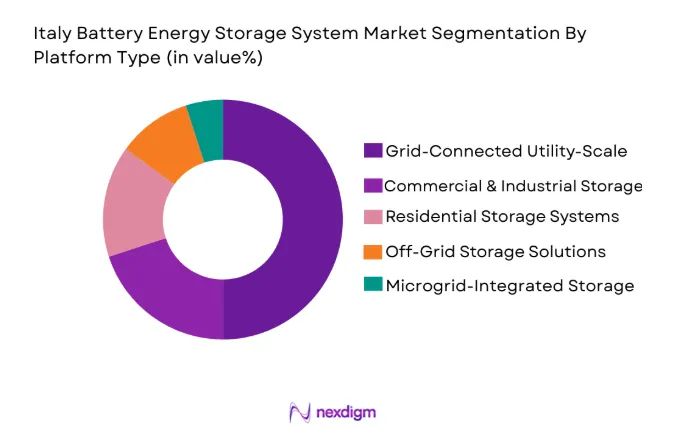
Italy Battery Energy Storage System market is segmented by platform type into grid-connected utility-scale storage, commercial & industrial storage, residential storage systems, off-grid storage solutions, and microgrid-integrated storage. Recently, grid-connected utility-scale storage has a dominant market share due to its critical role in balancing intermittent renewable energy generation, providing frequency regulation, and supporting national grid stability. The large-scale deployment capability, access to government incentives, and preference by energy utilities enhance adoption. Industrial integration, centralized monitoring, and optimized energy dispatch make utility-scale systems favorable compared to smaller-scale platforms. Investments in smart grids, coupled with Italy’s renewable energy policies, further promote this platform. High scalability, longer lifespan, and favorable ROI metrics establish utility-scale storage as the backbone of Italy’s energy storage infrastructure.
Competitive Landscape
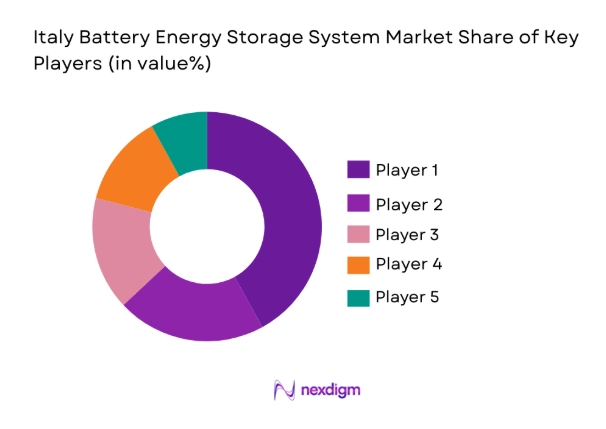
The Italy Battery Energy Storage System market is moderately consolidated with a mix of multinational and regional players influencing market growth. Major players invest heavily in research, expand their production capacities, and form strategic partnerships to maintain technological leadership. Market consolidation is visible through mergers, acquisitions, and joint ventures aimed at improving grid integration and renewable project collaboration. Competitive dynamics focus on system efficiency, lifecycle management, and after-sales service. Key companies leverage strong distribution networks and brand recognition to secure large-scale contracts with utilities and industrial clients, ensuring a robust presence across Italy’s energy storage sector.
| Company Name | Establishment Year | Headquarters | Technology Focus | Market Reach | Key Products | Revenue (USD) | Energy Storage Capacity (MWh) |
| Enel X | 2017 | Rome, Italy | ~ | ~ | ~ | ~ | ~ |
| Saft Groupe | 1925 | Paris, France | ~ | ~ | ~ | ~ | ~~ |
| FIMER | 1942 | Vimercate, Italy | ~ | ~ | ~ | ~ | ~ |
| Tesla Energy | 2003 | Palo Alto, USA | ~ | ~ | ~ | ~ | ~ |
| ABB | 1988 | Zurich, Switzerland | ~ | ~ | ~ | ~ | ~ |
Italy Battery Energy Storage System Market Analysis
Growth Drivers
Rapid Renewable Energy Integration
The expansion of solar, wind, and other renewable energy projects across Italy has created an unprecedented demand for battery energy storage systems. Rapid Renewable Energy Integration ensures grid stability, mitigates intermittency, and allows surplus energy storage for peak consumption periods, enhancing system reliability and reducing the dependency on fossil fuel peaking plants. Utilities leverage storage solutions to balance load and maintain frequency, enabling efficient energy dispatch. Industrial sectors adopt storage for self-consumption and cost savings, further increasing deployment. Government incentives, renewable energy targets, and favorable regulations accelerate large-scale projects, promoting private and public investments in storage technologies. Technological advancements in lithium-ion, flow, and hybrid batteries enhance efficiency, lifecycle, and scalability. Enhanced energy management systems and AI-driven monitoring allow real-time optimization, ensuring reliability and cost-effectiveness. Expanding smart grid initiatives in Italy encourage the integration of advanced storage systems into existing infrastructure. Cross-sector collaboration between energy developers, industrial operators, and municipalities strengthens deployment pipelines. Rising electricity demand and decarbonization initiatives combined with the push for energy resilience make rapid renewable energy integration a sustained growth driver in the Italy Battery Energy Storage System market.
Industrial and Commercial Adoption
Industrial and commercial entities are increasingly investing in battery energy storage systems to optimize energy consumption, reduce operational costs, and maintain continuous power supply. Industrial and Commercial Adoption drives market growth as factories, warehouses, and large commercial complexes install utility-scale and modular storage solutions. These deployments allow peak shaving, load shifting, and backup power, mitigating grid interruptions and improving operational resilience. Government subsidies, tax incentives, and regulatory frameworks for energy efficiency encourage adoption in the private sector. Integration with on-site renewable energy sources enables cost reduction and carbon footprint minimization. Industrial facilities leverage data analytics and energy management software for predictive maintenance and real-time monitoring. Commercial building operators adopt storage for energy arbitrage, demand response, and microgrid participation. Strategic partnerships with energy storage technology providers accelerate deployment speed and ensure system reliability. Energy cost optimization and sustainability mandates compel organizations to prioritize storage solutions, making industrial and commercial adoption a key factor in market expansion and technological advancement.
Market Challenges
High Capital Investment Requirements
High Capital Investment Requirements restrict widespread adoption of battery energy storage systems due to substantial upfront costs associated with procurement, installation, and commissioning. High Capital Investment Requirements create financial barriers for small and medium enterprises, limiting deployment primarily to large-scale utility and industrial projects. Cost-intensive technologies like lithium-ion and flow batteries require specialized infrastructure, safety compliance, and skilled personnel for installation and maintenance. Financing mechanisms, though evolving, remain complex, delaying project execution. Market participants face pressure to demonstrate rapid ROI and efficiency improvements to justify expenditures. Maintenance, replacement cycles, and integration with existing grid infrastructure add to total costs, making project planning critical. Rapid technological evolution increases obsolescence risk, further deterring investments. High Capital Investment Requirements also influence procurement strategies and necessitate governmental subsidies, grants, or financial partnerships to mitigate costs. Navigating these financial challenges is essential to expand market penetration and ensure sustainable growth.
Integration with Existing Grid Infrastructure
Integration with Existing Grid Infrastructure presents technical and operational challenges for battery energy storage systems. Integration with Existing Grid Infrastructure requires compatibility with legacy grids, adherence to safety and performance standards, and seamless synchronization with existing energy management systems. Variability in regional grid conditions, load demands, and regulatory compliance adds complexity. Utilities and private operators must ensure voltage stability, frequency regulation, and efficient energy dispatch. Integration often involves extensive planning, advanced monitoring, and skilled personnel for installation and maintenance. Interconnection delays, permitting issues, and interoperability concerns can extend project timelines. Real-time control systems, cybersecurity measures, and predictive maintenance tools are necessary to mitigate risks. Integration with Existing Grid Infrastructure challenges necessitate collaboration between technology providers, grid operators, and regulators. Overcoming these barriers is crucial for achieving scalable deployment, operational efficiency, and reliable energy storage performance across Italy.
Opportunities
Deployment of Large-Scale Utility Storage Projects
Deployment of Large-Scale Utility Storage Projects presents substantial growth potential by enabling grid-scale energy management and renewable integration. Deployment of Large-Scale Utility Storage Projects facilitates frequency regulation, load balancing, peak shaving, and emergency backup, enhancing national energy reliability. Government incentives, renewable energy targets, and private sector investments encourage large-scale storage installations across northern and southern Italian regions. Utilities leverage these projects to optimize dispatch, reduce fossil fuel dependency, and support smart grid development. Economies of scale lower system costs, making projects financially viable and attractive to investors. Advanced lithium-ion and flow battery technologies provide enhanced efficiency, longer lifecycles, and minimal maintenance, ensuring project sustainability. Large-scale projects integrate AI-driven energy management systems to optimize performance, monitor system health, and forecast energy demand. Cross-sector collaboration with industrial consumers, municipalities, and renewable developers ensures successful deployment and maximized utilization. Deployment of Large-Scale Utility Storage Projects expands Italy’s energy storage footprint, strengthens grid resilience, and drives technological innovation.
Integration with Electric Vehicle Charging Networks
Integration with Electric Vehicle Charging Networks offers opportunities for synergistic energy storage deployment, supporting fast-charging infrastructure, load management, and renewable energy utilization. Integration with Electric Vehicle Charging Networks enables utilities and private operators to buffer grid demand, store off-peak energy, and provide rapid power delivery for high-capacity EV chargers. Expansion of electric mobility in Italy necessitates compatible storage solutions to prevent grid overload and ensure charging reliability. Companies can combine commercial and residential storage systems with EV networks for cost optimization, energy arbitrage, and sustainability. Government policies promoting electric vehicle adoption, subsidies, and renewable energy integration further enhance opportunity attractiveness. Technological innovation in battery chemistries, AI-driven energy dispatch, and predictive load forecasting supports seamless integration. Integration with Electric Vehicle Charging Networks reduces peak demand stress, improves grid efficiency, and accelerates adoption of both EVs and energy storage solutions. Collaborative initiatives between automotive manufacturers, charging operators, and energy providers amplify deployment scale and impact. This opportunity positions Italy to achieve energy transition goals while fostering sustainable transport and energy convergence.
Future Outlook
The Italy Battery Energy Storage System market is expected to expand significantly over the next five years, driven by continued renewable energy adoption, smart grid deployment, and industrial electrification. Technological innovations in battery efficiency, long-duration storage, and hybrid solutions will further enhance system performance. Government policies, incentives, and regulatory frameworks are anticipated to support large-scale adoption, while residential and commercial users increasingly invest in energy independence and resilience. Market dynamics indicate strong growth trends and rising demand across all segments.
Major Players
- Enel X
- Saft Groupe
- FIMER
- Tesla Energy
- ABB
- Siemens Energy
- Fluence
- LG Energy Solution
- BYD Company
- Next Kraftwerke
- EDF Renewables
- Cypress Semiconductor
- RedT Energy
- Northvolt
- VARTA AG
Key Target Audience
- Utilities and grid operators
- Industrial energy consumers
- Commercial building operators
- Renewable energy developers
- Investments and venture capitalist firms
- Government and regulatory bodies
- Energy infrastructure developers
- Technology integrators
Research Methodology
Step 1: Identification of Key Variables
Critical market variables including energy demand, battery technology adoption, regulatory policies, and deployment drivers were identified to construct the research framework.
Step 2: Market Analysis and Construction
Comprehensive market analysis was performed using historical data, financial reports, and industry publications to quantify market size, segmentation, and growth patterns.
Step 3: Hypothesis Validation and Expert Consultation
Industry experts, energy analysts, and key stakeholders were consulted to validate assumptions, forecast models, and market hypotheses ensuring accuracy and reliability.
Step 4: Research Synthesis and Final Output
Data from multiple sources were synthesized, cross-verified, and integrated into final market outputs, including segmentation, competitive landscape, and growth projections.

- Executive Summary
- Research Methodology
(Definitions, Scope, Industry Assumptions, Market Sizing Approach, Primary & Secondary Research Framework, Data Collection & Verification Protocol, Analytic Models & Forecast Methodology, Limitations & Research Validity Checks)

- Market Definition and Scope
- Value Chain & Stakeholder Ecosystem
- Regulatory / Certification Landscape
- Sector Dynamics Affecting Demand
- Strategic Initiatives & Infrastructure Growth

- Growth Drivers
Rising Renewable Energy Integration Across Italy
Government Incentives for Energy Storage Deployment
Expansion of Smart Grid Infrastructure
Increasing Demand for Grid Stability and Peak Shaving
Technological Advancements in Battery Efficiency and Lifespan - Market Challenges
High Capital Costs for Large-Scale Installations
Recycling and End-of-Life Battery Management
Grid Integration Complexity
Intermittent Policy Support
Competition from Alternative Storage Solutions - Market Opportunities
Deployment of Large-Scale Utility Storage Projects
Integration with Electric Vehicle Charging Networks
Private Sector Investment in Industrial Energy Storage - Trends
Adoption of AI-Based Battery Management Systems
Hybridization of Multiple Battery Chemistries
Increased Public-Private Partnerships in Storage Projects
Expansion of Community and Microgrid Storage Initiatives
Focus on Long-Duration Energy Storage Solutions - Government Regulations & Defense Policy
National Energy Strategy Incentives
EU Renewable Energy Directives and Storage Targets
Safety and Certification Standards for Energy Storage Systems - SWOT Analysis
Stakeholder and Ecosystem Analysis
Porter’s Five Forces Analysis
Competition Intensity and Ecosystem Mapping

- By Market Value, 2020-2025
- By Installed Units, 2020-2025
- By Average System Price, 2020-2025
- By System Complexity Tier, 2020-2025

- By System Type (In Value%)
Lithium-ion Battery Systems
Flow Battery Systems
Sodium-Sulfur Battery Systems
Lead-Acid Battery Systems
Hybrid Battery Systems - By Platform Type (In Value%)
Grid-Connected Utility-Scale Storage
Commercial & Industrial Storage
Residential Storage Systems
Off-Grid Storage Solutions
Microgrid-Integrated Storage - By Fitment Type (In Value%)
On-Premise Installations
Containerized Modular Systems
Rack-Mounted Solutions
Mobile & Transportable Units
Hybrid Installations - By EndUser Segment (In Value%)
Utilities & Grid Operators
Industrial & Manufacturing Facilities
Commercial Buildings
Residential Households
Renewable Energy Project Developers - By Procurement Channel (In Value%)
Direct Procurement
Government Tenders
Private Sector Procurement
Online Bidding Platforms
Third-Party Distributors - By Material / Technology (in Value%)
Lithium Nickel Manganese Cobalt Oxide
Lithium Iron Phosphate
Sodium-Based Chemistries
Advanced Lead-Acid Technologies
Flow Battery Electrolytes

- Market structure and competitive positioning
Market share snapshot of major players
CrossComparison Parameters (System Type, Platform Type, Procurement Channel, EndUser Segment, Fitment Type, Material / Technology, Installation Size, Revenue Model, Geography)
SWOT Analysis of Key Competitors
Pricing & Procurement Analysis - Key Players
Enel X
Saft Groupe
FIMER
Tesla Energy
ABB
Siemens Energy
Fluence
LG Energy Solution
BYD Company
Next Kraftwerke
EDF Renewables
Cypress Semiconductor
RedT Energy
Northvolt
VARTA AG

- Utilities Prioritizing Grid Reliability and Peak Management
- Industrial Facilities Seeking Energy Cost Optimization
- Commercial Buildings Integrating On-Site Storage for Resilience
- Residential Users Investing in Home Energy Independence

- Forecast Market Value, 2026-2035
- Forecast Installed Units, 2026-2035
- Price Forecast by System Tier, 2026-2035
- Future Demand by Platform, 2026-2035


 Request a Sample
 Ask for Customization
 Get a Quote
 Enquire Now