

 Download PDF
Market Overview
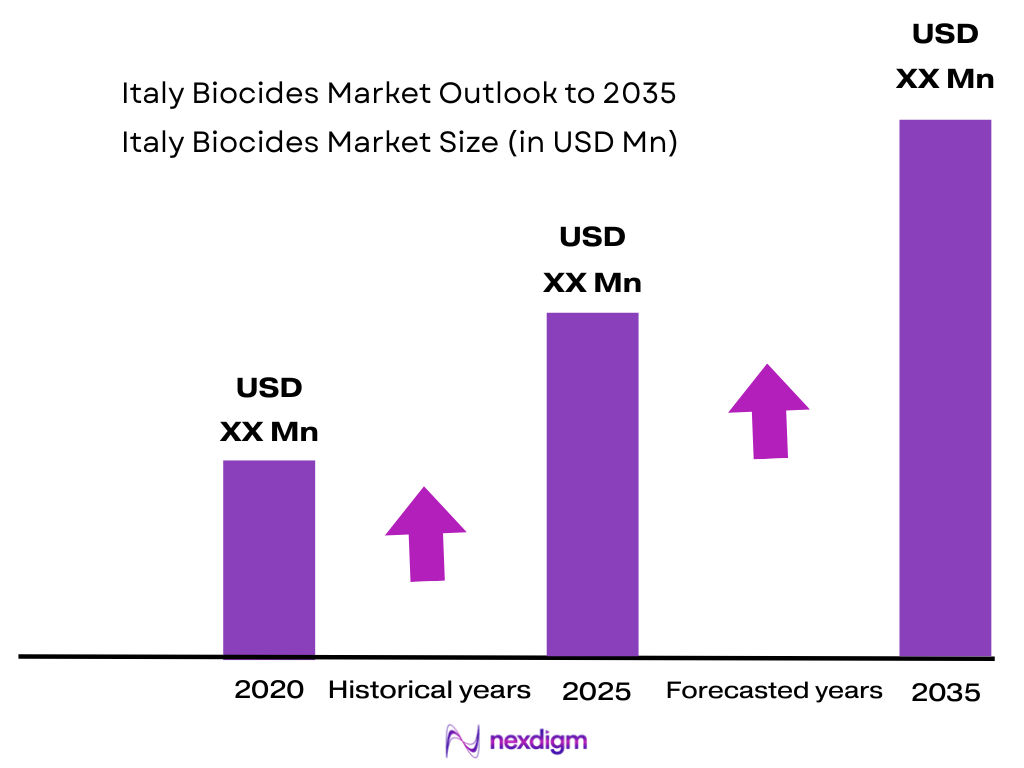
The Italy Biocides Market generated USD 240.4 million in 2024, according to Grand View Research’s country-level market database, with demand spanning water treatment, cleaning products, food and beverage, paints and coatings, personal care, plastics, HVAC, pulp and paper, wood preservation and oil and gas applications. The broader Italian economy generated USD 2.383 trillion in GDP in the latest World Bank observation, compared with USD 2.317 trillion in the preceding observation, providing a substantial industrial and commercial base for microbial-control chemicals.
Italy’s strongest biocide demand centers are concentrated around Milan and Lombardy, Turin and Piedmont, Bologna and Emilia-Romagna, Rome and Lazio, and Veneto’s industrial corridor because these areas combine dense manufacturing, food processing, healthcare, construction, chemicals and water-intensive industrial activity. Lombardy had 10,033,918 residents, while Veneto had 4,853,472 and Emilia-Romagna 4,461,998, creating large commercial and industrial ecosystems. The North-West also recorded EUR 46,100 GDP per capita, versus EUR 43,600 in the North-East, reinforcing purchasing capacity and industrial concentration.
Market Segmentation
By Product Type
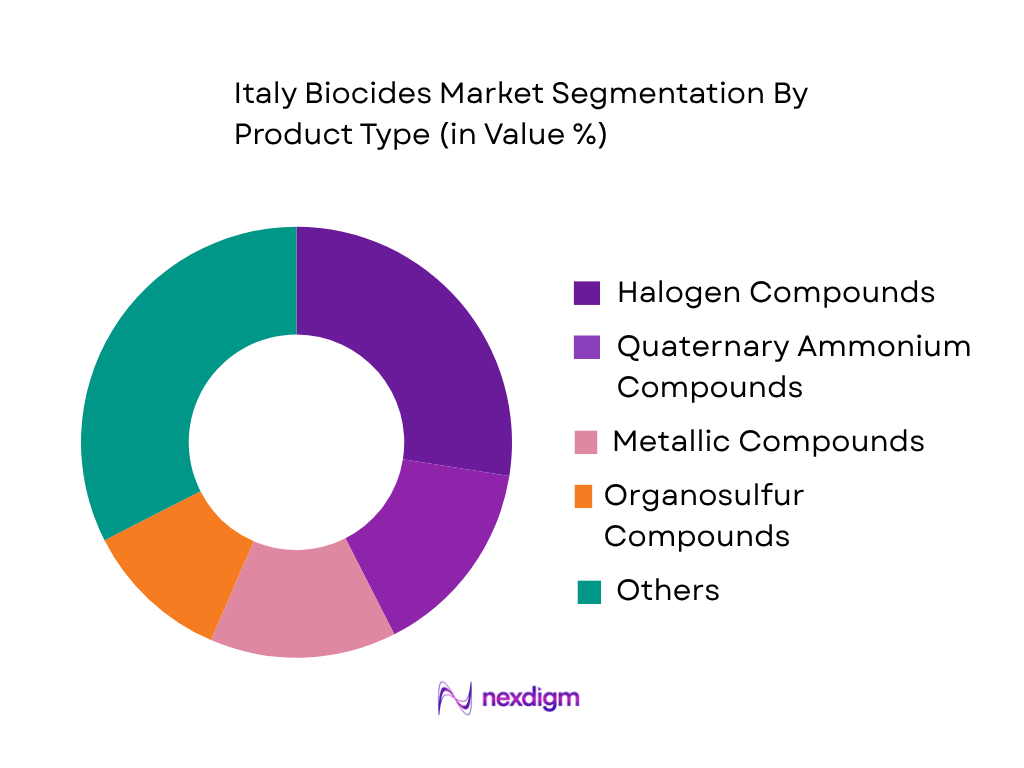
The Italy Biocides Market is segmented by product type into halogen compounds, metallic compounds, organosulfur compounds, organic acids, quaternary ammonium compounds, phenolic compounds, nitrogen-based biocides and glutaraldehyde. Halogen compounds represented the dominant product category, accounting for 27.5% of 2024 market revenue, according to the available Italy country-level market database. Halogen chemistry benefits from its established role in water treatment, disinfection and microbial control, where rapid action and broad-spectrum efficacy are commercially important. Chlorine- and bromine-based technologies are particularly relevant to industrial water and sanitation systems because they can address bacterial, fungal and algal contamination across diverse operating environments. The segment also benefits from established dosing infrastructure and familiarity among industrial users. Quaternary ammonium compounds represent an important complementary chemistry because of their use in disinfection and surface hygiene, while organosulfur compounds, organic acids and glutaraldehyde serve specialized preservation and industrial-process applications. The availability of multiple chemistries allows Italian formulators and end users to select products according to microbial spectrum, operating conditions, material compatibility, regulatory status and environmental requirements.
By Application
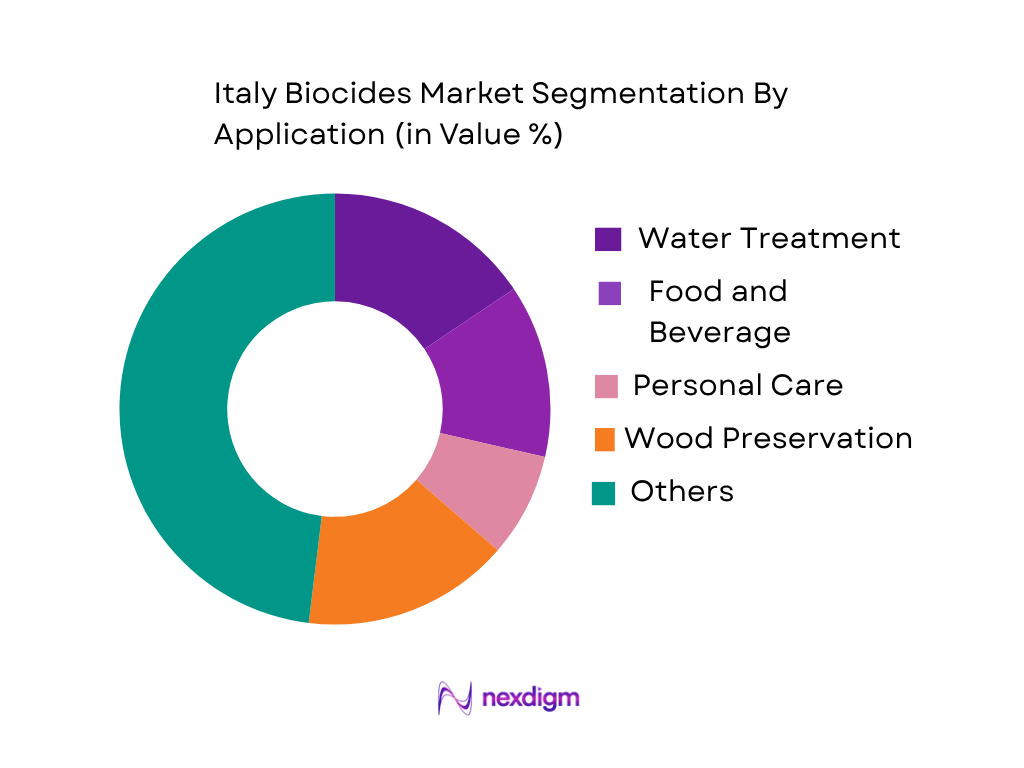
The Italy Biocides Market is segmented by application into water treatment, food and beverage, personal care, wood preservation, paints and coatings, plastics, HVAC, boilers, oil and gas, fuels, pulp and paper and cleaning products. Water treatment is a strategically dominant demand area because microbial growth directly affects water quality, membrane performance, cooling efficiency, process stability and equipment reliability. Italy’s industrial water-treatment chemicals market generated USD 532.4 million in 2024, with cooling and boiler applications representing 47.11% of that adjacent market, demonstrating the scale of water-intensive industrial systems that can consume microbial-control chemicals. Demand is reinforced by wastewater treatment, cooling-water systems, process-water preservation and industrial cleaning. Food and beverage processing represents another important application because microbial contamination can affect product safety and manufacturing hygiene. Paints and coatings require in-can preservation and dry-film protection, while pulp and paper operations require slime and microbial-fouling control. Personal care and pharmaceutical-related formulations require preservation systems compatible with increasingly restrictive regulatory requirements. Consequently, application demand is increasingly determined not only by chemical efficacy but also by active-substance approval, residual limits, environmental profile, material compatibility and treatment-specific performance.
Competitive Landscape
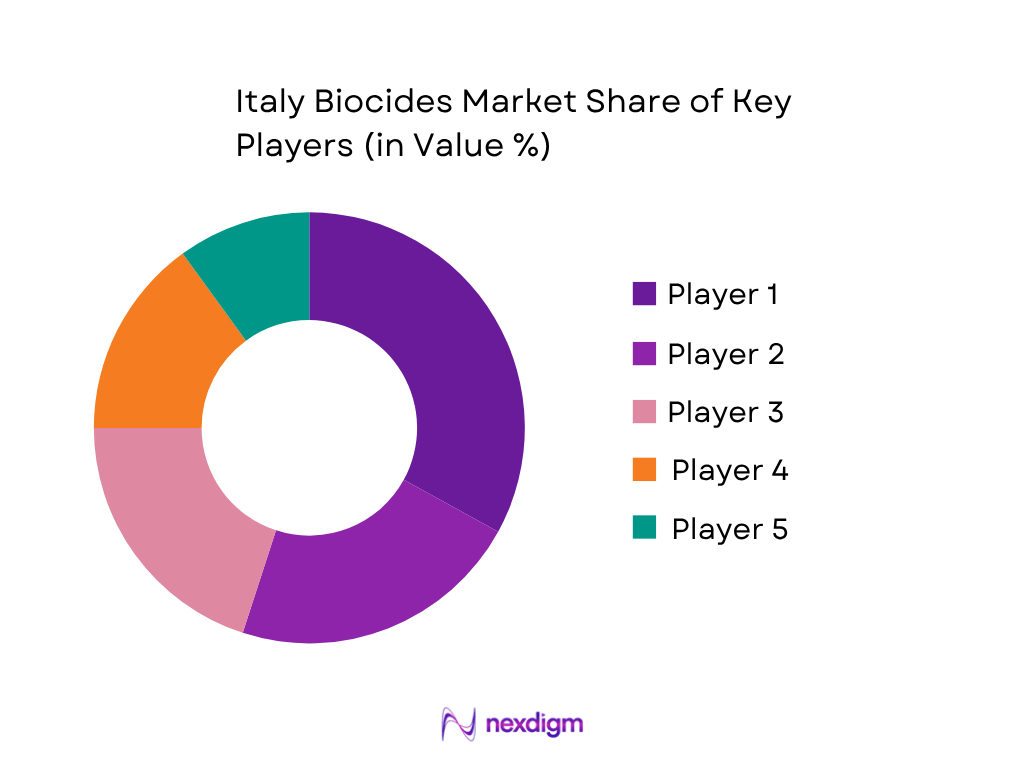
The Italy Biocides Market is characterized by multinational specialty-chemical companies with broad active-substance portfolios, established regulatory capabilities and application-specific technical services. BASF, LANXESS, Arxada, Ecolab and Clariant represent important competitive benchmarks because they participate across preservation, disinfection, industrial water treatment, paints and coatings, personal care, food processing and other microbial-control applications. Competition is increasingly shaped by active-substance approvals, formulation expertise, technical support, sustainability positioning and the ability to provide application-specific microbial-control programs rather than by commodity chemical supply alone.
| Company | Establishment | Headquarters | Biocide Portfolio | Key Italy-Relevant Applications | Regulatory Capability | Technical Differentiation | Distribution / Market Position |
| BASF SE | 1865 | Ludwigshafen, Germany | ~ | ~ | ~ | ~ | ~ |
| LANXESS AG | 2004 | Cologne, Germany | ~ | ~ | ~ | ~ | ~ |
| Arxada | 2021 | Basel, Switzerland | ~ | ~ | ~ | ~ | ~ |
| Ecolab | 1923 | St. Paul, Minnesota, USA | ~ | ~ | ~ | ~ | ~ |
| Clariant AG | 1996 | Muttenz, Switzerland | ~ | ~ | ~ | ~ | ~ |
Italy Biocides Market Analysis
Growth Drivers
Industrial and Municipal Water Treatment
Italy’s water-treatment intensity creates a substantial recurring requirement for microbial-control solutions used in municipal networks, wastewater treatment, cooling systems and industrial process water. Istat reports that Italy withdrew 8.87 billion cubic meters of water for public supply in 2024, the lowest level recorded in 25 years, while more than 1 million residents in provincial and metropolitan capitals were affected by water-rationing measures across 17 municipalities. Istat also reported that output from wastewater and water-management activities reached €15 billion in the latest available sector account, with wastewater management representing the dominant activity. These conditions strengthen demand for biocides because water-intensive systems require microbial control to manage biofilm formation, fouling and sanitation risks. Italy’s GDP reached approximately US$2.38 trillion in 2024, demonstrating the scale of the underlying economy supporting municipal and industrial infrastructure. The combination of high freshwater withdrawals, extensive wastewater-management activity and persistent regional water stress supports continued investment in treatment systems where biocidal solutions can be deployed. The requirement extends across drinking-water infrastructure, industrial utilities, wastewater plants and closed-loop process systems, creating multiple recurring application points for Italy’s biocides industry.
Food and Beverage Processing
Italy’s large food and beverage manufacturing base provides a direct demand channel for disinfectants, preservatives and other microbial-control products used in production environments, process water, equipment sanitation and product protection. Istat reported that manufacturing value added remained broadly stable in 2024, while food, beverage and tobacco industries were the only major manufacturing grouping to record growth during the year. The importance of this sector is reinforced by Italy’s overall industrial structure and its extensive network of food-processing activities serving both domestic consumption and exports. Istat’s 2024 industrial-production assessment specifically identified food, beverages and tobacco as the manufacturing activities that increased relative to the previous year, contrasting with declines in several other industrial categories. Italy’s economy generated approximately €2.20 trillion of GDP at current prices in 2024, while household final consumption increased by €0.6 billion in chained-volume terms according to the national-accounts framework. Food-processing facilities require controlled microbial environments across raw-material handling, production lines, storage and cleaning operations, making biocides relevant to both hygiene and preservation applications. The combination of sustained food-industry activity, extensive processing infrastructure and stringent hygiene requirements creates recurring demand for effective microbial-control chemistry across Italy’s food and beverage value chain.
Market Challenges
Strict EU Biocidal Product Regulation Compliance
Regulatory compliance represents a structural challenge for Italy’s biocides market because products placed on the European market must operate within the EU biocidal-products framework, including requirements concerning active substances, product authorization, permitted uses and risk management. This creates additional technical and documentation requirements for manufacturers, importers and downstream formulators. The challenge is particularly relevant for specialty biocides where formulation changes, active-substance restrictions or authorization requirements can affect product availability and application suitability. Italy’s broader industrial base adds complexity because biocides are supplied across water treatment, manufacturing, food processing, healthcare, coatings and other applications with different exposure profiles. Italy’s economy generated approximately €2.20 trillion of GDP in 2024, while gross fixed capital formation reached approximately €400 billion in the national-accounts framework, indicating the scale of industrial assets and facilities potentially subject to chemical-management requirements. At the same time, Istat recorded 8.87 billion cubic meters of public water withdrawals, demonstrating the importance of environmental and water-system protection when microbial-control chemistry is used. Regulatory compliance therefore affects not only product registration but also formulation selection, labeling, safe handling, environmental assessment and application control. These requirements can lengthen commercialization processes and increase technical complexity for suppliers serving Italy’s diverse end-use industries.
Environmental and Aquatic Toxicity
Environmental protection requirements create an important constraint for biocide suppliers because Italy combines intensive water use with extensive aquatic and wastewater-management infrastructure. Istat recorded 8.87 billion cubic meters of water withdrawn for public supply in 2024 and reported that more than 1 million residents were affected by water-rationing measures across 17 municipalities, highlighting the strategic importance of water resources. Biocides used in cooling systems, wastewater treatment, industrial process water and other applications must therefore balance microbial-control performance with environmental considerations surrounding discharge, persistence and aquatic exposure. Italy also recorded approximately €15 billion of output from wastewater and water-management activities in the latest available sector accounts, demonstrating the economic scale of systems where treated water and chemical discharge management intersect. The country’s industrial production declined overall during 2024, but food, beverage and tobacco manufacturing increased, maintaining demand from processing facilities that operate under stringent hygiene and wastewater requirements. These conditions increase the importance of lower-residual formulations, controlled dosing, treatment optimization and technologies capable of targeting biofilms without creating unnecessary environmental loading. Suppliers therefore face a dual requirement: maintaining sufficient antimicrobial efficacy while meeting increasingly demanding environmental-management expectations across municipal, industrial and commercial applications.
Market Opportunities
Advanced Water-Treatment Biocides
Italy’s substantial water-management infrastructure creates an opportunity for advanced biocides designed specifically for wastewater, industrial process water, cooling systems and membrane-based treatment. Istat recorded 8.87 billion cubic meters of public water withdrawals in 2024 and identified Italy as the European Union country with the highest freshwater withdrawals for public water supply. More than 1 million residents experienced water-rationing measures across 17 municipalities, demonstrating the operational importance of water-resource efficiency and treatment reliability. Istat also reported approximately €15 billion of output from wastewater and water-management activities, with wastewater management representing the overwhelming component of that activity. These figures indicate a substantial installed infrastructure base in which microbial fouling, biofilm formation and sanitation control remain relevant technical issues. Opportunity areas include membrane-compatible biocides, non-oxidizing microbial-control systems, biofilm-specific treatments and products optimized for wastewater-reuse applications. Italy’s broader economy generated approximately €2.38 trillion of GDP in 2024, supporting continued industrial and infrastructure activity around water-intensive processes. Suppliers capable of combining microbial efficacy with controlled environmental profiles can address the requirements of municipal utilities, industrial wastewater operators and manufacturing facilities. The opportunity is therefore linked to improving treatment reliability and water-resource efficiency rather than simply increasing chemical consumption, creating scope for more specialized, application-specific biocide technologies.
Cooling-Tower Microbial Control
Italy’s industrial and commercial infrastructure creates opportunities for specialized biocides used in cooling towers, closed-loop systems and industrial water circuits. Istat reported approximately €2.20 trillion of Italian GDP at current prices in 2024, alongside an economy containing extensive manufacturing, services, construction and utility infrastructure. Although overall industrial production declined during the year, the food, beverage and tobacco industries recorded growth, maintaining demand from facilities that depend on process-water and temperature-control systems. Cooling-water circuits require microbial management because uncontrolled biological growth can contribute to biofilm formation, fouling and operational deterioration. The opportunity extends beyond traditional manufacturing into food processing, pharmaceutical facilities, commercial buildings and other installations with centralized cooling systems. Italy also withdrew 8.87 billion cubic meters of water for public supply in 2024, while water-management output reached approximately €15 billion, emphasizing the strategic importance of efficient water use and treatment. Advanced cooling-tower biocides can therefore support water conservation by enabling controlled operation of recirculating systems and reducing biological fouling. Future commercial potential is particularly relevant for formulations that combine microbial efficacy with lower environmental persistence, compatibility with water-treatment programs and precise dosing. These characteristics can help suppliers address increasingly sophisticated industrial-water-management requirements across Italy.
Future Outlook
The Italy Biocides Market is expected to develop through a combination of industrial microbial-control requirements, regulatory-driven product reformulation and increased demand for application-specific preservation and disinfection technologies. Water treatment, cooling systems, food processing, paints and coatings, personal care and industrial formulations should remain important demand centers. The competitive environment is likely to increasingly favor suppliers capable of combining approved active substances with optimized formulations, dosing expertise, environmental-risk management and technical support. Low-residual, efficient and application-specific microbial-control technologies should gain strategic importance as European regulatory requirements become more stringent. Water-treatment applications should remain a central growth avenue because Italy’s industrial water-treatment chemicals market already represents a substantial adjacent demand base, with cooling and boiler systems identified as its largest application.
Food and beverage applications should benefit from continued requirements for hygienic production environments, process-water control and preservation. Italy’s official industrial statistics indicate that food, beverage and tobacco manufacturing was the only major manufacturing grouping to record growth within the broader contraction in industrial production, highlighting its relative resilience. The regulatory environment will remain a major competitive differentiator. Italian biocidal products must comply with Regulation (EU) No. 528/2012, with active substances required to be approved for the relevant Product Type and product authorisations processed through the EU regulatory framework. Italy’s Ministry of Health is the national authority for relevant biocidal-product authorisation processes.
Major Players
- BASF SE
- LANXESS AG
- Arxada
- Ecolab Inc.
- Clariant AG
- Solvay SA
- Lonza Group Ltd.
- Albemarle Corporation
- The Lubrizol Corporation
- Neogen Corporation
- Kemira Oyj
- Solenis LLC
- Nouryon
- Evonik Industries AG
- Buckman Laboratories International
Key Target Audience
- Biocides manufacturers and active-substance producers
- Specialty chemical formulators and industrial microbial-control solution providers
- Water and wastewater treatment operators and industrial water users
- Paints, coatings, plastics, adhesives and construction-material manufacturers
- Food, beverage, pharmaceutical and personal-care manufacturers
- Investments and venture capitalist firms
- Government and regulatory bodies (Italian Ministry of Health, Ministry of Environment and Energy Security, Istituto Superiore di Sanità, ISPRA, ECHA)
- Chemical distributors, importers and specialty-chemical supply-chain companies
Research Methodology
Step 1: Identification of Key Variables
The initial phase involves constructing an Italy-specific biocides ecosystem covering active-substance manufacturers, formulators, distributors, industrial users, water-treatment operators and regulatory authorities. Desk research will map Product Types, active-substance categories, applications, end-use industries, formulation formats, import dependencies and regulatory status. Particular attention will be given to EU Biocidal Products Regulation requirements and Italian authorisation procedures.
Step 2: Market Analysis and Construction
Historical market information will be compiled across product chemistry, application and end-use categories. The analysis will triangulate market revenue with active-substance demand, industrial water-treatment activity, manufacturing conditions, food-processing activity, chemical production and trade flows. Italy-specific industrial and territorial statistics will be incorporated to distinguish structural demand from short-term industrial fluctuations.
Step 3: Hypothesis Validation and Expert Consultation
Market hypotheses will be developed around microbial-control demand, product substitution, regulatory restrictions, active-substance availability, formulation trends and application-specific adoption. Interviews with biocide manufacturers, formulators, distributors, water-treatment specialists, industrial users and regulatory specialists will be used to validate demand patterns, purchasing criteria and competitive positioning.
Step 4: Research Synthesis and Final Output
The final stage will reconcile top-down market estimates with bottom-up application and end-use calculations. Company-level intelligence, regulatory records, industrial indicators, import-export information and expert validation will be combined to establish the final market framework. Discrepancies between publicly available market estimates will be reviewed before finalizing the forecast and segmentation model.

- Executive Summary
- Research Methodology (Market Definition and Scope, Biocide Classification, Product-Type Mapping, Active-Substance Assessment, Market Sizing Framework, Top-Down Analysis, Bottom-Up Analysis, Demand-Side Assessment, Supply-Side Assessment, Primary Industry Interviews, Import-Export Validation, Regulatory Database Review, Data Triangulation, Forecasting Framework, Scenario Analysis, Assumptions and Limitations)

- Definition and Scope
- Italy Biocides Industry Structure
- Biocidal Active-Substance Ecosystem
- Biocide Formulation and Manufacturing Landscape
- Evolution of Microbial-Control Applications in Italy
- Italy Biocides Value Chain Analysis

- Market Growth Drivers (Industrial and Municipal Water Treatment, Food and Beverage Processing, Pharmaceutical Manufacturing, Healthcare Hygiene, Paints and Coatings Production, Pulp and Paper Processing, Agriculture and Animal Hygiene, Marine Activity)
- Market Challenges (Strict EU Biocidal Product Regulation Compliance, Active-Substance Approval Restrictions, Environmental and Aquatic Toxicity, Biocide Resistance, Hazardous Chemical Handling, Registration Complexity, Imported Specialty-Active Dependency, Product Stewardship Requirements)
- Market Opportunities (Advanced Water-Treatment Biocides, Wastewater-Reuse Applications, Cooling-Tower Microbial Control, Food-Processing Sanitation, Pharmaceutical Preservation, Low-Toxicity Formulations, Biofilm-Specific Technologies, Marine Biofouling Control, Local Formulation and Specialty Distribution)
- Market Trends(Low-Residual Biocide Chemistry, Biofilm-Specific Treatment, Sustainable Active Substances, Automated Chemical Dosing, Industrial Water Recycling, Advanced Disinfection, Microbial Monitoring, Membrane Protection, Integrated Microbial Management, Treated-Article Compliance)
- Italy Regulatory Authority Mapping (Ministry of Health, Ministry of Environment and Energy Security, Ministry of Agriculture, Food Sovereignty and Forestry, Istituto Superiore di Sanità, ISPRA, ECHA, European Commission)
- SWOT Analysis
- Porter’s Five Forces Analysis
- PESTLE Analysis

- By Market Value (2020-2025)
- By Biocidal Active-Substance Consumption Volume (2020-2025)
- By Formulated Biocide Consumption Volume (2020-2025)
- By Domestic Production (2020-2025)
- By Imports and Exports (2020-2025)
- By Application (2020-2025)
- By End-Use Industry (2020-2025)

- By Product Type (In Value %)
Oxidizing Biocides
Non-Oxidizing Biocides
Disinfectants and Sanitizers
Antimicrobial Additives
Algaecides
Biofilm-Control Agents
Antifouling Biocides
Rodenticides - By Active Substance (In Value %)
Chlorine-Based Biocides
Bromine-Based Biocides
Chlorine Dioxide
Glutaraldehyde
Isothiazolinones
Quaternary Ammonium Compounds
DBNPA
Bronopol
Peracetic Acid - By Application (In Value %)
Water Treatment
Wastewater Treatment
Cooling-Water Treatment
Industrial and Institutional Cleaning
Paints and Coatings
Personal Care and Cosmetics
Pulp and Paper
Oil and Gas and Petrochemicals
Wood Preservation
Construction Materials
Agriculture and Animal Hygiene
Aquaculture
Marine and Antifouling
Healthcare and Institutional Disinfection - By End-Use Industry (In Value %)
Municipal Water and Wastewater
Industrial Water Treatment
Food and Beverage Manufacturing
Pharmaceutical Manufacturing
Agriculture and Animal Production
Aquaculture and Fisheries
Oil and Gas and Petrochemicals
Paints and Coatings
Pulp and Paper
Textiles
Chemical Manufacturing
Automotive and Metalworking
Construction Materials
Healthcare Facilities
Personal Care and Household Products
Marine and Shipbuilding - By Formulation Type (In Value %)
Liquid Biocides
Powder and Granular Biocides
Concentrated Formulations
Ready-to-Use Disinfectants
Water-Soluble Formulations
Emulsion and Dispersion Formulations
Controlled-Release Formulations - By Functional Requirement (In Value %)
Bacterial Control
Fungal Control
Algae Control
Biofilm Control
Slime Control
Preservation
Disinfection
Membrane Protection

- Market Share of Major Players (By Value, Volume, Product Type, Active Substance, Application, End-Use Industry, Distribution Channel)
- Cross Comparison Parameters (Active-Substance Portfolio Breadth, Formulation Portfolio Breadth, Industrial Water-Treatment Capability, Food and Beverage Sanitation Capability, Pharmaceutical and Healthcare Capability, Paints and Coatings Preservation Capability, Regulatory and Technical-Service Expertise, Italian Manufacturing and Distribution Reach)
- SWOT Analysis of Major Players
- Detailed Profiles of Major Companies
LANXESS
BASF
Arxada
Ecolab
Solenis
Kemira
Clariant
Evonik Industries
Thor Group
Buckman
Nouryon
Italmatch Chemicals
IFF
Lubrizol
Italmatch Biocides

- Industrial Water-Treatment Demand Assessment
- Food and Beverage Customer Analysis
- Pharmaceutical and Life-Sciences Customer Analysis
- Paints and Coatings Customer Analysis
- Pulp and Paper Customer Analysiss

- By Market Value (2026-2035)
- By Biocidal Active-Substance Consumption Volume (2026-2035)
- By Formulated Biocide Consumption Volume (2026-2035)
- By Domestic Production (2026-2035)
- By Imports and Exports (2026-2035)
- By Application (2026-2035)
- By End-Use Industry (2026-2035)


 Request a Sample
 Ask for Customization
 Get a Quote
 Enquire Now