

 Download PDF
 Download PDF
Market Overview
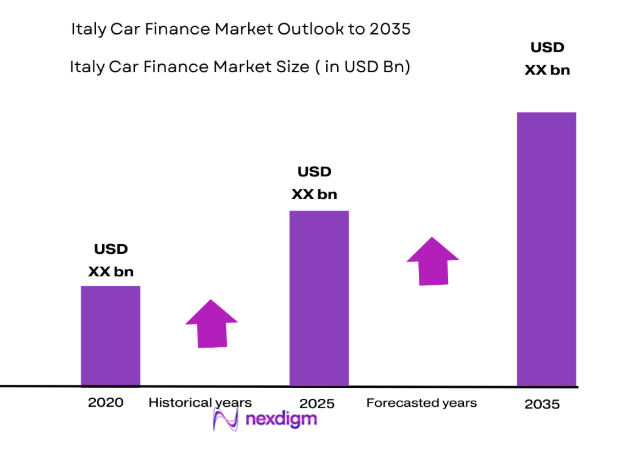
The Italy car finance market is expected to witness significant growth, driven by the rising demand for automobiles and the increasing availability of flexible financing options. Based on a recent historical assessment, the market value is projected to reach approximately USD ~ billion. The growth is primarily fueled by the evolving consumer preferences for ownership flexibility and the increasing penetration of digital finance platforms. Additionally, government incentives and the expansion of loan products tailored to the automotive sector are bolstering market growth.
The dominant regions driving the market are Milan, Rome, and Turin. These cities are known for their robust economic performance, higher income levels, and the concentration of automotive dealerships and financial institutions. Their dominance is also attributed to significant investments in infrastructure, coupled with a strong automotive manufacturing base. These areas offer better financing options, supported by both traditional financial institutions and emerging fintech solutions, making them key players in shaping the car finance market landscape in Italy.
Market Segmentation
By Product Type
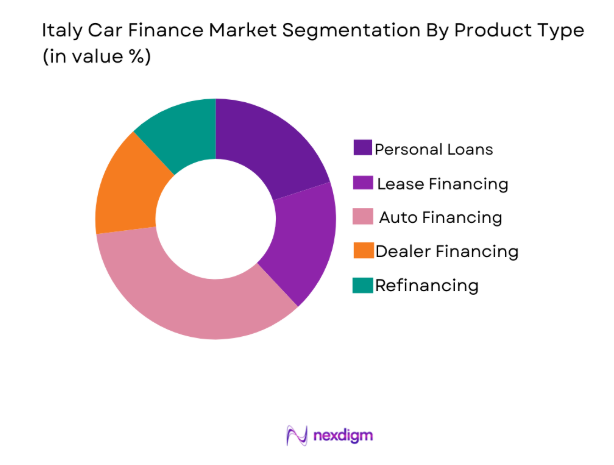
The Italy car finance market is segmented by product type into personal loans, lease financing, auto financing, dealer financing, and refinancing. Recently, auto financing has a dominant market share due to factors such as high demand for vehicle ownership, ease of access to loans, and the growing inclination towards flexible repayment plans. As consumers increasingly prioritize ownership over leasing, auto financing products have been structured to offer more attractive interest rates and longer loan terms, which cater to the evolving needs of vehicle buyers. This, in turn, has led to a surge in market share for auto financing as the preferred option for car buyers.
By Platform Type
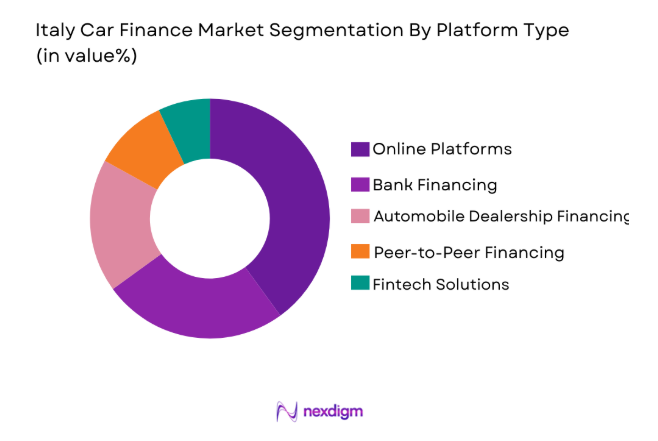
The market for Italy car finance is segmented by platform type into online platforms, bank financing, automobile dealership financing, peer-to-peer financing, and fintech solutions. Online platforms have gained dominance, accounting for the largest market share due to their convenience, speed, and accessibility. Consumers are increasingly opting for digital financing platforms because they allow them to compare multiple loan products, apply for financing, and receive approvals without visiting a physical branch. The ease of use, coupled with the growing trust in fintech solutions, has made online platforms the preferred choice for car financing in Italy.
Competitive Landscape
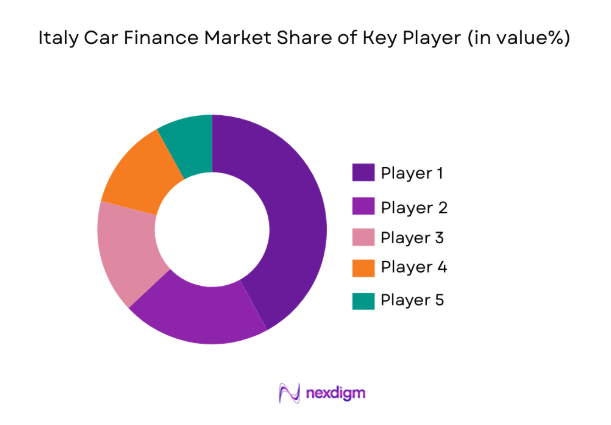
The competitive landscape of the Italy car finance market is shaped by a mix of traditional financial institutions, automobile manufacturers offering their own financing products, and new-age fintech players. Consolidation in the market is driven by the growing influence of major players such as Fiat Chrysler Automobiles, Volkswagen, and Santander Consumer Bank, which are adopting advanced digital platforms and forming strategic partnerships with fintech companies. These partnerships are enhancing market competition and providing consumers with a wide range of financing options that cater to their varying needs.
| Company Name | Establishment Year | Headquarters | Technology Focus | Market Reach | Key Products | Revenue | Additional Parameter |
| Unicredit S.p.A. | 1998 | Milan, Italy | ~ | ~ | ~ | ~ | ~ |
| Intesa Sanpaolo S.p.A. | 2007 | Turin, Italy | ~ | ~ | ~ | ~ | ~ |
| Fiat Chrysler Automobiles | 1899 | Turin, Italy | ~ | ~ | ~ | ~ | ~ |
| Volkswagen Financial Services | 1990 | Berlin, Germany | ~ | ~ | ~ | ~ | ~ |
| Santander Consumer Bank | 1983 | Madrid, Spain | ~ | ~ | ~ | ~ | ~ |
Italy Car Finance Market Analysis
Growth Drivers
Expansion of Digital Finance Platforms
The expansion of digital finance platforms is one of the key growth drivers for the Italy car finance market. The increasing reliance on technology for financial services has made car financing more accessible and user-friendly for consumers. The rise of mobile banking and the growing popularity of online loan applications have played a crucial role in expanding access to car financing options. These digital platforms enable consumers to compare various financing products, evaluate terms, and even receive approval almost instantaneously, reducing the traditional barriers to entry for car buyers. As the adoption of these digital platforms continues to grow, the market for car financing is set to expand even further.
Government Support for Green Mobility
Another significant growth driver in the Italy car finance market is government support for green mobility. With Italy’s commitment to reducing carbon emissions and meeting EU climate targets, the demand for electric vehicles (EVs) has surged. Government incentives and subsidies for EV purchases, coupled with financing options tailored to eco-friendly vehicles, have driven the adoption of electric cars in the market. This trend is expected to continue, with more financing products being designed to accommodate the growing number of environmentally conscious consumers seeking electric and hybrid vehicle ownership. The continued government backing is expected to accelerate growth in the market for car financing, particularly in the electric vehicle segment.
Market Challenges
High Interest Rates
One of the major challenges facing the Italy car finance market is the rising interest rates. As the European Central Bank has increased rates to combat inflation, borrowing costs have surged for consumers seeking car loans. Higher interest rates make car financing more expensive, which may deter some potential buyers from entering the market. This challenge is particularly impactful for lower-income individuals who are more sensitive to borrowing costs, potentially reducing the number of people able to afford vehicle loans. While some consumers may still opt for financing, the increase in rates could lead to a slowdown in market growth in the short term.
Regulatory and Compliance Issues
Another challenge in the Italy car finance market is the increasingly complex regulatory environment. Stricter regulations on lending practices, such as higher credit score requirements and limits on the loan-to-value (LTV) ratio, are making it more difficult for consumers to access financing. Compliance with these regulations is adding costs to lenders, and some may become more selective in offering financing products. This tightening of credit could limit the availability of car loans, particularly for those with lower credit scores, slowing down market growth.
Opportunities
Rise in Consumer Demand for Flexible Financing Solutions
One of the key opportunities in the Italy car finance market is the rising consumer demand for flexible financing solutions. Consumers are increasingly seeking personalized loan terms, including lower interest rates, longer repayment periods, and customized payment schedules. As car buyers look for financing that accommodates their individual financial situations, car finance providers are adapting by offering more flexible options. This trend is creating new opportunities for financial institutions to capture a larger share of the market by catering to consumer preferences for tailored financing products that make car ownership more accessible.
Growth in Electric Vehicle Financing
With the growing shift towards electric vehicles (EVs), there is a significant opportunity in the market for specialized car financing products targeted at eco-conscious consumers. Financial institutions are beginning to offer tailored financing products designed to meet the specific needs of EV buyers, such as lower interest rates for electric vehicle loans and longer repayment periods. This growing focus on sustainability is not only driven by environmental concerns but also by government incentives that encourage the adoption of electric vehicles. The continued rise in consumer demand for EVs presents a long-term growth opportunity in the car finance sector.
Future Outlook
The future outlook for the Italy car finance market is positive, with steady growth expected over the next five years. Technological advancements in digital financing and government support for green mobility will continue to drive the market forward. The increasing shift towards electric vehicles will also contribute to the market’s growth, supported by regulatory frameworks and incentives for both manufacturers and consumers. With consumer demand for more flexible financing options and the rise of innovative digital platforms, the market is set to evolve and expand in the coming years.
Major Players
- UnicreditS.p.A.
- Intesa Sanpaolo S.p.A.
- Banca Nazionale del Lavoro
- Fiat Chrysler Automobiles
- Volkswagen Financial Services
- BMW Financial Services
- Mercedes-Benz Financial Services
- Volkswagen Bank GmbH
- Ford Credit
- Santander Consumer Bank
- Raiffeisen Bank International
- Cofidis S.A.
- Leasys S.p.A.
- AlphaCredit
- Mediobanca
Key Target Audience
- Investments and venture capitalist firms
- Government and regulatory bodies
- Automotive manufacturers
- Banks and lending institutions
- Car dealerships and leasing companies
- Fintech companies offering car loans
- Insurance companies
Research Methodology
Step 1: Identification of Key Variables
We identify the key factors that drive the market, such as interest rates, consumer behavior, and government policies.
Step 2: Market Analysis and Construction
We analyze historical data, industry trends, and key market players to build a comprehensive market model.
Step 3: Hypothesis Validation and Expert Consultation
We consult with industry experts, including financial analysts and car manufacturers, to validate our market hypothesis.
Step 4: Research Synthesis and Final Output
We synthesize the collected data and insights to produce a detailed market report with actionable recommendations.

- Executive Summary
- Research Methodology
(Definitions, Scope, Industry Assumptions, Market Sizing Approach, Primary & Secondary Research Framework, Data Collection & Verification Protocol, Analytic Models & Forecast Methodology, Limitations & Research Validity Checks)

- Market Definition and Scope
- Value Chain & Stakeholder Ecosystem
- Regulatory / Certification Landscape
- Sector Dynamics Affecting Demand
- Strategic Initiatives & Infrastructure Growth

- Growth Drivers
Increase in Vehicle Sales
Expansion of Financing Options
Technological Advancements in Fintech
Government Policies Promoting Electric Vehicles
Growth of the Middle-Class Population - Market Challenges
High Interest Rates
Stringent Regulations on Auto Financing
Lack of Consumer Awareness
Economic Instability and its Impact on Financing
Credit Risk and Default Rates - Market Opportunities
Rising Demand for Electric Vehicles
Growth of Peer-to-Peer Lending Platforms
Collaboration Between Banks and Dealerships - Trends
Digital Transformation in Car Financing
Integration of Artificial Intelligence in Credit Scoring - Government Regulations
Regulatory Standards for Vehicle Financing
Tax Incentives for Electric Vehicles Financing
Consumer Protection Laws for Auto Loans - SWOT Analysis
- Porter’s Five Forces

- By Market Value, 2020-2025
- By Installed Units, 2020-2025
- By Average System Price, 2020-2025
- By System Complexity Tier, 2020-2025

- By System Type (In Value%)
Personal Loans
Lease Financing
Auto Financing
Dealer Financing
Refinancing - By Platform Type (In Value%)
Online Platforms
Bank Financing
Automobile Dealership Financing
Peer-to-Peer Financing
Fintech Solutions - By Fitment Type (In Value%)
Direct Financing
Indirect Financing
Hybrid Financing
Buy Now Pay Later - By End User Segment (In Value%)
Private Vehicle Owners
Fleet Owners
Leasing Companies
Financial Institutions

- Market Share Analysis
- Cross Comparison Parameters
(System Type, Platform Type, Procurement Channel, End User Segment, Fitment Type, System Complexity, Financing Rates) - SWOT Analysis of Key Competitors
- Pricing & Procurement Analysis
- Key Players
Unicredit S.p.A.
Intesa Sanpaolo S.p.A.
Banca Nazionale del Lavoro
Fiat Chrysler Automobiles
Volkswagen Financial Services
BMW Financial Services
Mercedes-Benz Financial Services
Volkswagen Bank GmbH
Ford Credit
Santander Consumer Bank
Raiffeisen Bank International
Cofidis S.A.
Leasys S.p.A.
AlphaCredit
Mediobanca
Société Générale

- Private Vehicle Owners’ Growing Interest in Flexible Payment Options
- Fleet Owners’ Demand for Bulk Financing Deals
- Leasing Companies’ Shift Towards Electric Vehicle Financing
- Financial Institutions’ Expanding Role in Digital Financing

- Forecast Market Value, 2026-2035
- Forecast Installed Units, 2026-2035
- Price Forecast by System Tier, 2026-2035
- Future Demand by Platform, 2026-2035


 Request a Sample
 Ask for Customization
 Get a Quote
 Enquire Now