

 Download PDF
 Download PDF
Market Overview
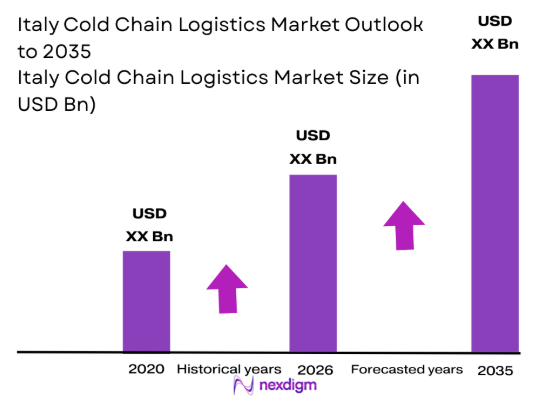
The Italy Cold Chain Logistics market demonstrates strong growth supported by expanding pharmaceutical distribution, frozen food consumption, and temperature-sensitive agricultural exports. Based on a recent historical assessment, the Italy Cold Chain Logistics market generated approximately USD ~ billion in market value according to industry datasets compiled from sources such as Eurostat, the Italian Ministry of Economic Development, and logistics sector reports. Growth is driven by increasing demand for temperature-controlled transportation, refrigerated warehousing infrastructure, and pharmaceutical distribution networks that require strict thermal compliance across supply chains.
Major logistics hubs such as Milan, Bologna, Verona, and Rome dominate Italy Cold Chain Logistics operations because of their strategic location within European freight corridors and proximity to large consumer markets. Northern Italy benefits from advanced logistics infrastructure, extensive refrigerated warehousing clusters, and strong pharmaceutical manufacturing activity. Cities such as Genoa and Venice also serve as key maritime gateways facilitating refrigerated container trade. High concentration of food processing industries and pharmaceutical companies further strengthens regional demand for advanced cold storage and refrigerated transportation networks.
Market Segmentation
By Product Type
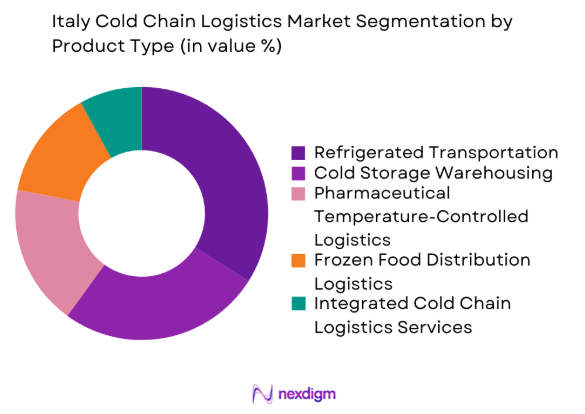
Italy Cold Chain Logistics market is segmented by product type into refrigerated transportation, cold storage warehousing, pharmaceutical temperature-controlled logistics, frozen food distribution logistics, and integrated cold chain logistics services. Recently, refrigerated transportation has a dominant market share due to extensive demand from pharmaceutical distributors, frozen food manufacturers, and agricultural exporters requiring consistent temperature control during long-distance transport. Expansion of pharmaceutical logistics and vaccine distribution networks has strengthened the need for validated refrigerated transport systems equipped with real-time temperature monitoring. Food retail supply chains across supermarkets and food service providers also rely heavily on refrigerated trucking fleets to maintain product freshness and safety. Increasing export volumes of dairy products, processed food, and seafood further strengthen demand for refrigerated transport solutions connecting producers with European distribution networks and international markets.
By End User Industry
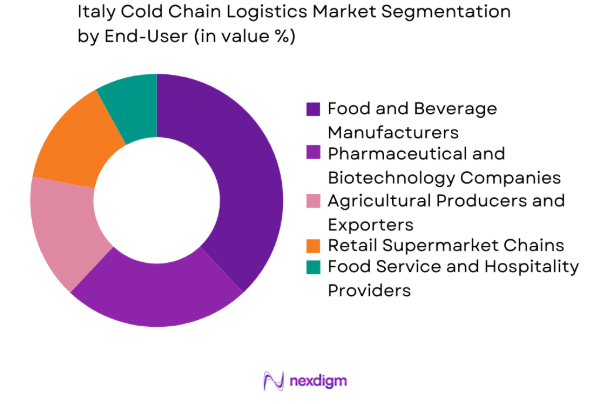
Italy Cold Chain Logistics market is segmented by end user industry into food and beverage manufacturers, pharmaceutical and biotechnology companies, agricultural producers and exporters, retail supermarket chains, and food service and hospitality providers. Recently, food and beverage manufacturers have a dominant market share due to Italy’s strong food processing industry producing dairy products, frozen meals, seafood, and processed foods that require continuous refrigerated handling during storage and transportation. Large food manufacturers operate extensive distribution networks supplying supermarkets, wholesalers, and export markets across Europe, increasing demand for refrigerated warehousing and logistics services. Rising consumer demand for frozen and ready-to-eat foods also drives logistics requirements. Additionally, strict food safety regulations require controlled storage environments and traceability systems across the supply chain, strengthening dependence on advanced cold chain logistics infrastructure operated by specialized logistics providers.
Competitive Landscape
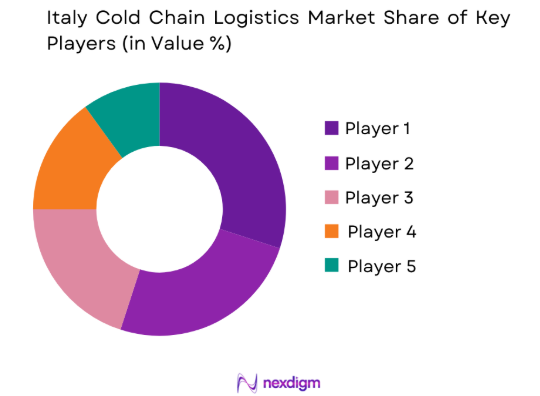
The Italy Cold Chain Logistics market remains moderately consolidated with several multinational logistics companies operating large refrigerated transportation fleets and automated cold storage facilities across Europe. Major players invest heavily in pharmaceutical-grade logistics infrastructure, digital temperature monitoring systems, and automated warehousing technologies. Strategic acquisitions and partnerships continue to strengthen regional logistics networks, enabling companies to expand their refrigerated storage capacity and improve supply chain efficiency. Large multinational operators maintain strong competitive advantages due to their global logistics networks, advanced technology capabilities, and integrated distribution services.
| Company Name | Establishment Year | Headquarters | Technology Focus | Market Reach | Key Products | Revenue | Cold Storage Capacity |
| DHL Supply Chain | 1969 | Germany | ~ | ~ | ~ | ~ | ~ |
| Kuehne+Nagel | 1890 | Switzerland | ~ | ~ | ~ | ~ | ~ |
| DB Schenker | 1872 | Germany | ~ | ~ | ~ | ~ | ~ |
| Lineage Logistics | 2012 | United States | ~ | ~ | ~ | ~ | ~ |
| STEF Group | 1920 | France | ~ | ~ | ~ | ~ | ~ |
Italy Cold Chain Logistics Market Analysis
Growth Drivers
Expansion of Pharmaceutical Distribution and Biologics Supply Chains
Expansion of pharmaceutical manufacturing and biologics distribution networks significantly increases demand for specialized cold chain logistics across Italy because advanced medicines require strict temperature control during storage and transportation. Pharmaceutical products such as vaccines, insulin, monoclonal antibodies, and biotechnology therapies depend on validated logistics infrastructure capable of maintaining narrow temperature ranges to preserve efficacy and regulatory compliance. Logistics providers therefore invest in pharmaceutical grade refrigerated warehouses, temperature monitoring systems, and validated transport containers that ensure continuous thermal stability across distribution networks. Growing biotechnology manufacturing and pharmaceutical research activities further increase demand for reliable cold chain transportation supporting clinical trials and commercial medicine distribution across hospitals, pharmacies, and healthcare facilities nationwide.
Rapid Growth of Frozen and Processed Food Supply Chains
Expansion of frozen food consumption and processed food production significantly increases demand for refrigerated transportation and cold storage logistics infrastructure across Italy because modern food supply chains depend on temperature controlled distribution systems to maintain product quality and safety. Food manufacturers produce large volumes of frozen seafood, dairy products, ready meals, and packaged foods that require strict refrigeration during storage and transport. Supermarkets operate large distribution centers that depend on reliable cold storage capacity for perishable goods. Logistics providers expand refrigerated warehouses and specialized transport fleets to support these supply chains. Growth in food exports and online grocery delivery services further strengthens demand for temperature controlled logistics.
Market Challenges
High Capital Investment Requirements for Cold Chain Infrastructure
The development and operation of cold chain logistics infrastructure require substantial capital investment because refrigerated warehouses, temperature controlled transport fleets, and monitoring technologies involve complex engineering systems designed to maintain stable thermal conditions throughout logistics operations. Refrigerated storage facilities require specialized insulation, industrial refrigeration units, temperature sensors, and backup power systems to ensure continuous cooling performance. Transport fleets must also include advanced refrigeration equipment capable of preserving temperature stability during long distance distribution. High energy consumption associated with refrigeration significantly increases operational expenses. Smaller logistics operators often face financial limitations when competing with multinational firms capable of investing heavily in advanced cold chain infrastructure and compliance systems.
Stringent Regulatory Compliance and Temperature Monitoring Requirements
Cold chain logistics operations must comply with strict regulatory standards governing food safety, pharmaceutical handling, and temperature controlled distribution because product integrity depends on maintaining precise thermal conditions during storage and transportation. Pharmaceutical logistics providers must follow Good Distribution Practice standards requiring validated storage facilities, real time temperature monitoring, and detailed documentation across supply chains. Food logistics must also comply with food safety regulations mandating refrigerated transportation and controlled storage environments for perishable goods. Compliance requires advanced monitoring technologies such as digital sensors, tracking systems, and data recording platforms. Regular regulatory audits increase operational complexity while continuous investment in monitoring infrastructure and training remains essential.
Opportunities
Expansion of Biopharmaceutical Logistics and Vaccine Distribution Networks
Rapid expansion of biotechnology medicines and advanced pharmaceutical therapies creates significant opportunities for cold chain logistics providers because these products require highly controlled temperature environments during manufacturing, distribution, and storage. Biopharmaceutical products such as gene therapies, monoclonal antibodies, and specialty vaccines depend on validated logistics systems capable of maintaining precise temperature stability. Pharmaceutical companies increasingly rely on specialized logistics providers offering compliant distribution services and advanced temperature controlled packaging solutions. Logistics operators continue investing in validated cold storage infrastructure and digital monitoring technologies to support long distance pharmaceutical transport. Growing pharmaceutical exports and clinical research activities further increase demand for reliable healthcare cold chain logistics systems.
Adoption of Automated High Density Cold Storage Technologies
Increasing adoption of automated warehousing technologies creates strong opportunities for logistics providers operating cold chain infrastructure because automated cold storage facilities significantly enhance operational efficiency and storage utilization within temperature controlled environments. Advanced storage systems enable operators to maximize warehouse capacity through robotic retrieval systems and high density pallet configurations that accommodate large volumes of refrigerated goods within limited space. Automation reduces manual handling and improves order processing speed across refrigerated facilities. Logistics companies increasingly deploy automated guided vehicles, robotic pallet systems, and digital warehouse management platforms to coordinate storage operations. Continuous digital monitoring of temperature and inventory further strengthens reliability across temperature sensitive supply chains.
Future Outlook
The Italy Cold Chain Logistics market is expected to expand steadily as pharmaceutical distribution, frozen food consumption, and agricultural exports continue increasing across Europe. Technological innovation such as automated refrigerated warehouses and digital temperature monitoring platforms will improve logistics efficiency and supply chain transparency. Government regulations supporting pharmaceutical distribution standards and food safety compliance will strengthen infrastructure development. Growing e-commerce grocery distribution and biotechnology medicine logistics will further expand demand for advanced cold chain logistics solutions across Italy.
Major Players
- DHL Supply Chain
- Kuehne+Nagel
- DB Schenker
- Lineage Logistics
- Americold Logistics
- NewColdAdvanced Cold Logistics
- STEF Group
- XPO Logistics
- UPS Healthcare
- FedEx Logistics
- Nagel-Group
- Frigo-Trans
- Gruppo Marconi Logistica
- Number1 Logistics Group
- CavalieriTrasportiRefrigerati
Key Target Audience
- Pharmaceutical manufacturers
- Food and beverage manufacturers
- Agricultural exporters
- Retail supermarket chains
- Logistics infrastructure investors
- Investments and venture capitalist firms
- Government and regulatory bodies
- Biotechnology companies
Research Methodology
Step 1: Identification of Key Variables
Market variables including refrigerated warehouse capacity, temperature controlled transport fleet size, pharmaceutical distribution requirements, and food logistics demand were identified. Supply chain infrastructure and regulatory compliance factors were also evaluated.
Step 2: Market Analysis and Construction
Market data was analyzed using logistics industry reports, government trade statistics, and supply chain datasets. Market structure and competitive positioning were constructed using multiple cross-verification sources.
Step 3: Hypothesis Validation and Expert Consultation
Industry specialists, logistics professionals, and supply chain experts validated assumptions regarding cold chain infrastructure development and pharmaceutical logistics demand across Italy.
Step 4: Research Synthesis and Final Output
All validated datasets were synthesized to construct a comprehensive market assessment covering segmentation, competitive landscape, growth drivers, and strategic market outlook.

- Executive Summary
- Research Methodology (Definitions, Scope, Industry Assumptions, Market Sizing Approach, Primary & Secondary Research Framework, Data Collection & Verification Protocol, Analytic Models & Forecast Methodology, Limitations & Research Validity Checks)

- Market Definition and Scope
- Value Chain & Stakeholder Ecosystem
- Regulatory / Certification Landscape
- Sector Dynamics Affecting Demand
- Strategic Initiatives & Infrastructure Growth

- Growth Drivers
Expansion of Pharmaceutical and Biologics Distribution Networks
Growth of Frozen and Processed Food Consumption
Increasing Export of Temperature Sensitive Agricultural Products - Market Challenges
High Capital Investment in Refrigerated Infrastructure
Strict Temperature Compliance and Regulatory Requirements
Energy Intensive Operations and Rising Electricity Costs - Market Opportunities
Expansion of Biopharmaceutical Cold Chain Logistics
Adoption of Automated High Density Cold Storage Facilities
Development of Digitally Integrated Temperature Monitoring Systems - Trends
Integration of IoT Based Temperature Monitoring Systems
Expansion of Automated Refrigerated Warehousing Technologies
Growth of Sustainable Refrigeration and Energy Efficient Cooling Systems - Government Regulations
- SWOT Analysis of Key Competitors
- Porter’s Five Forces

- By Market Value, 2020-2025
- By Installed Units, 2020-2025
- By Average System Price, 2020-2025
- By System Complexity Tier, 2020-2025

- By System Type (In Value%)
Refrigerated Transportation Services
Cold Storage Warehousing
Pharmaceutical Temperature Controlled Logistics
Frozen Food Distribution Logistics
Integrated End to End Cold Chain Solutions - By Platform Type (In Value%)
Road Based Refrigerated Logistics
Rail Integrated Cold Chain Transport
Air Cargo Temperature Controlled Logistics
Maritime Reefer Container Logistics
Multimodal Cold Chain Logistics Networks - By Fitment Type (In Value%)
Standalone Refrigerated Warehouses
Integrated Distribution Cold Storage Facilities
Mobile Refrigerated Transport Units
Modular Temperature Controlled Storage Systems
Automated High Density Cold Storage Systems - By End User Segment (In Value%)
Food and Beverage Manufacturers
Pharmaceutical and Biotechnology Companies
Agricultural Producers and Exporters
Retail Supermarket Chains
Food Service and Hospitality Providers - By Procurement Channel (In Value%)
Direct Logistics Contracts
Third Party Logistics Providers
Integrated Supply Chain Service Providers
Government Healthcare Distribution Contracts
Retail and Food Distributor Partnerships

- Market Share Analysis
- Cross Comparison Parameters (Cold Storage Capacity, Refrigerated Fleet Size, Pharmaceutical Logistics Capability, Geographic Coverage, Automation Level, Temperature Monitoring Technology, Multimodal Transport Integration, EU GDP Compliance Capability, Warehouse Automation Systems, Last Mile Cold Chain Distribution)
- SWOT Analysis of Key Competitors
- Pricing & Procurement Analysis
- Key Players
DHL Supply Chain
Kuehne+Nagel
DB Schenker
Lineage Logistics
Americold Logistics
NewCold Advanced Cold Logistics
STEF Group
XPO Logistics
UPS Healthcare
FedEx Logistics
Nagel-Group
Frigo-Trans
Gruppo Marconi Logistica
Number1 Logistics Group
Cavalieri Trasporti Refrigerati

- Pharmaceutical manufacturers increasing demand for validated temperature controlled logistics
- Food exporters requiring reliable cold chain infrastructure for international trade
- Supermarket chains expanding refrigerated distribution networks
- Healthcare providers strengthening vaccine and biologics logistics capacity

- Forecast Market Value, 2026-2035
- Forecast Installed Units, 2026-2035
- Price Forecast by System Tier, 2026-2035
- Future Demand by Platform, 2026-2035


 Request a Sample
 Ask for Customization
 Get a Quote
 Enquire Now