
 Download PDF
Market Overview
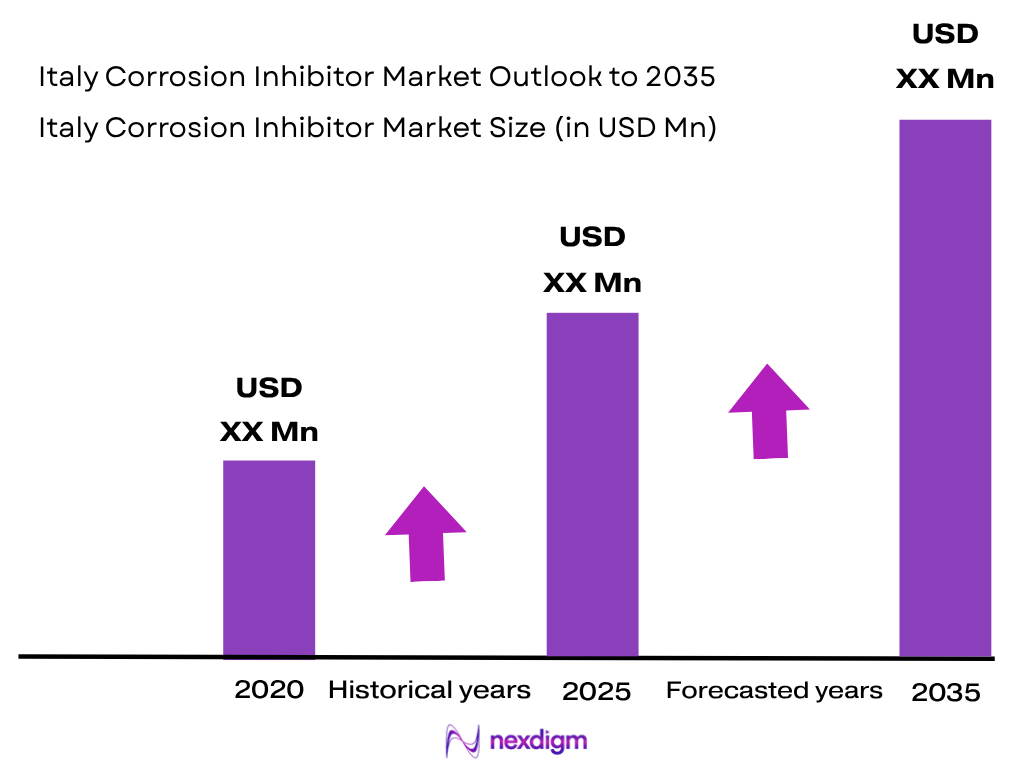
The Italy Corrosion Inhibitor Market is valued at USD 263.8 million, supported by demand from industrial water treatment, power generation, oil and gas, chemical processing, metal processing and other asset-intensive industries. The underlying Italian chemical industry moved from approximately EUR 67 billion in production value and 112,000 employees to EUR 65 billion and more than 113,000 employees. Corrosion-control demand is sustained by requirements to extend equipment life, control maintenance expenditure and protect metallic process infrastructure.
Northern Italy, particularly Lombardy and the Milan industrial area, represents the country’s strongest demand and supply ecosystem for specialty industrial chemicals. Northern Italy accounts for nearly 78% of Italian chemical-sector employment, while Lombardy alone has more than 45,000 chemical employees and around EUR 27 billion in chemical-sector turnover. Italy also hosts more than 2,800 chemical companies across approximately 3,700 local units, creating a substantial installed customer base for water-treatment, metalworking and process corrosion-control formulations.
Market Segmentation
By Product Type
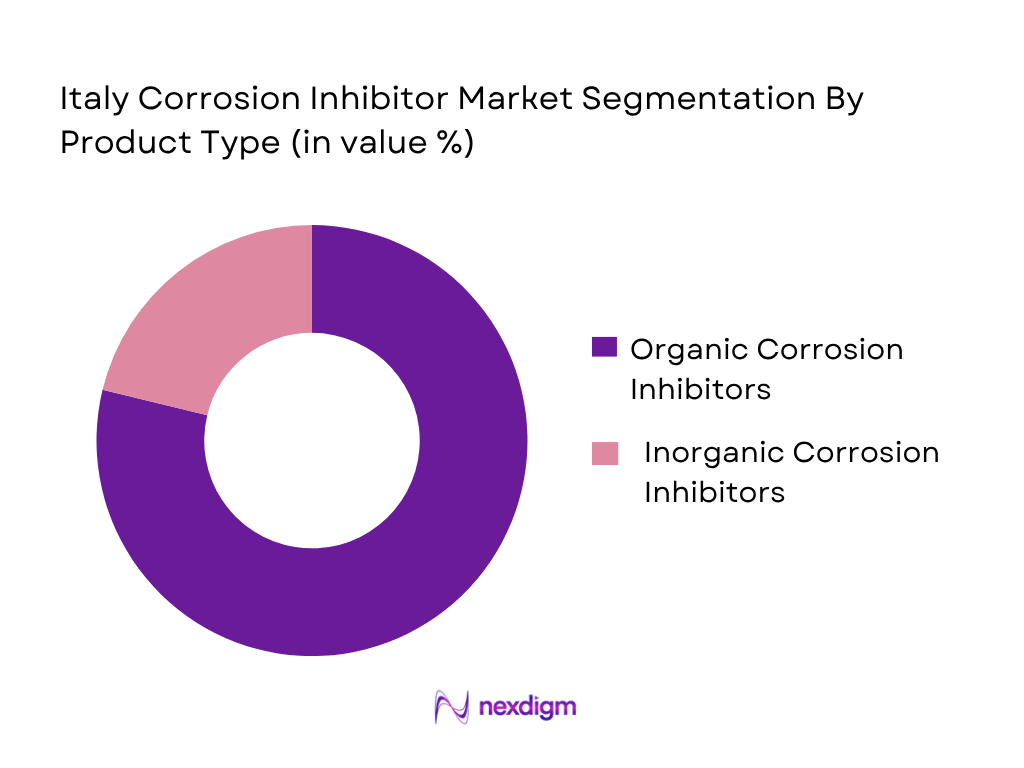
The Italy Corrosion Inhibitor Market is segmented by product type into organic corrosion inhibitors and inorganic corrosion inhibitors. Organic corrosion inhibitors hold the dominant position, accounting for 78.01% of market revenue. Their leadership reflects their applicability across oil and gas systems, industrial water circuits, metalworking fluids, lubricants and chemical-processing equipment. Organic molecules can protect metallic surfaces through adsorption and protective-film formation while supporting formulations designed around increasingly stringent environmental and occupational requirements. The transition toward lower-hazard and multifunctional treatment packages further reinforces their position. Italy’s strong specialty-chemical and lubricant-additive ecosystem also supports organic inhibitor adoption. Suppliers increasingly offer carboxylates, amines, imidazoline-derived chemistry and multifunctional organic packages capable of providing corrosion protection alongside dispersion, lubrication or scale-control functionality. Grand View Research identifies organic chemistry as both Italy’s largest product segment and its fastest-growing product category.
By Formulation Type
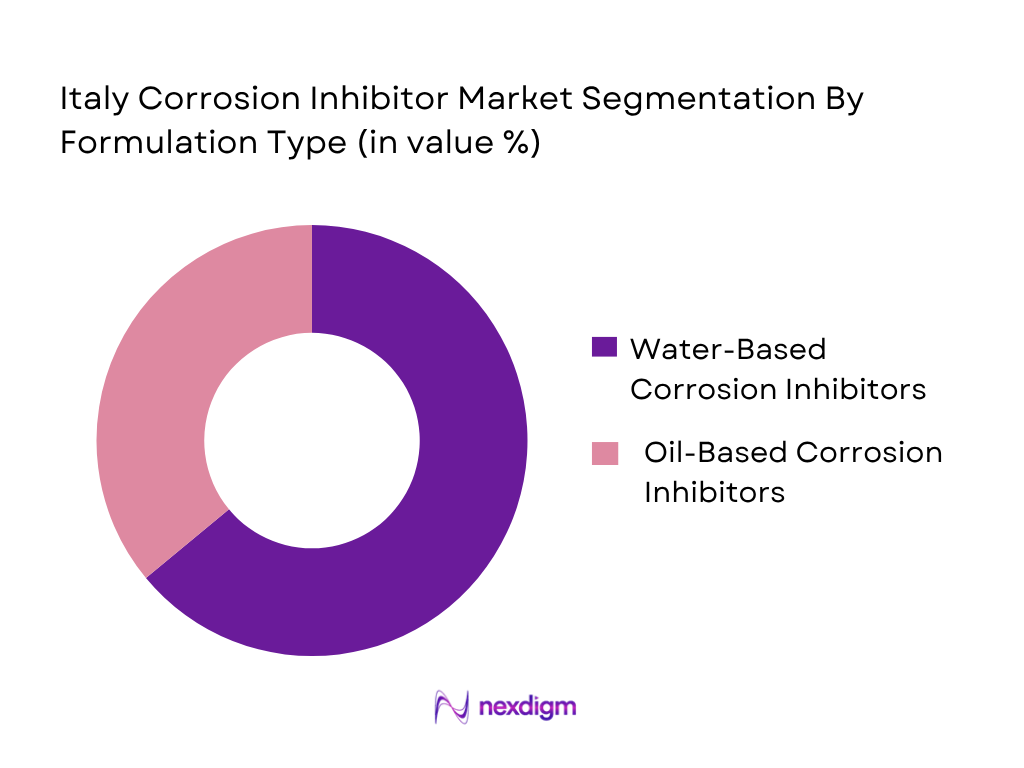
The Italy Corrosion Inhibitor Market is segmented by formulation type into water-based and oil-based corrosion inhibitors. Water-based systems represent a major addressable category because corrosion control is fundamental to cooling towers, boilers, closed-loop circuits, process-water networks and industrial heat-transfer systems. These applications are particularly relevant to Italy’s chemical, manufacturing, energy and process industries. Water-based formulations can incorporate organic acids, phosphonates, phosphates, molybdates, silicates, azoles and blended inhibitor packages according to metallurgy and water chemistry. Oil-based inhibitors remain strategically important in lubricants, refinery systems, hydrocarbon handling, rust-preventive oils and metalworking applications. Supplier portfolios increasingly emphasize low-dose, multi-metal and low-foaming technologies. Solenis, for example, markets corrosion inhibitors—including phosphorus-free formulations—for cooling-water treatment, while Italmatch’s Dequest portfolio combines scale inhibition, dispersion and corrosion-control functionality for industrial-water and oil-and-gas applications.
Competitive Landscape
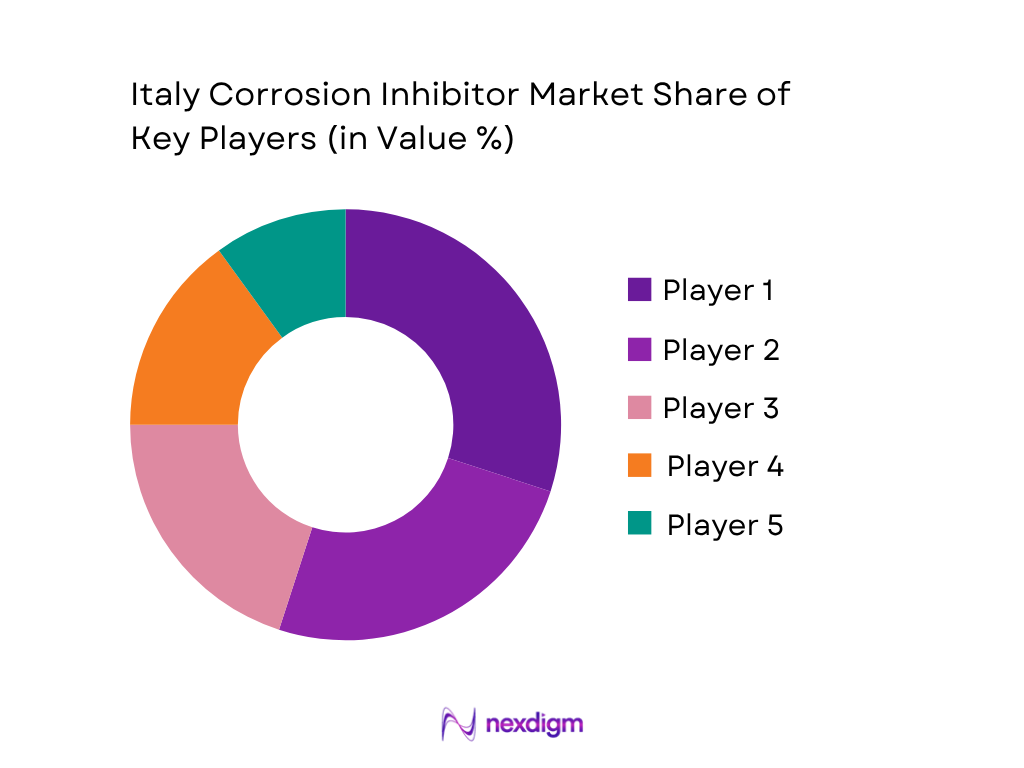
The Italy Corrosion Inhibitor Market has a fragmented-to-moderately consolidated specialty-chemical structure, combining Italian specialty-chemical producers with multinational water-treatment, lubricant-additive and industrial-process-chemical suppliers. Competition is based less on inhibitor molecule alone and increasingly on total treatment cost, dosage efficiency, metallurgy compatibility, regulatory profile, technical service, monitoring capabilities and ability to formulate combined corrosion/scale/deposit-control programs. Italy-based Italmatch has a particularly relevant position because of its domestic roots, water-management chemistry and specialty-additive portfolio, while multinational companies provide extensive application and technical-service capabilities.
| Major Player | Established | Headquarters | Corrosion-Inhibitor Focus | Key Chemistry / Portfolio | Major Target Systems | Metal / Application Coverage | Technical & Digital Capability | Italy/European Market Relevance |
| Italmatch Chemicals | 1998 | Arese, Italy | ~ | ~ | ~ | ~ | ~ | ~ |
| Ecolab / Nalco Water | 1923 / Nalco roots 1928 | St. Paul, Minnesota, USA | ~ | ~ | ~ | ~ | ~ | ~ |
| Kurita Water Industries | 1949 | Tokyo, Japan | ~ | ~ | ~ | ~ | ~ | ~ |
| Solenis | 2014 | Wilmington, Delaware, USA | ~ | ~ | ~ | ~ | ~ | ~ |
| Clariant | 1995 | Muttenz, Switzerland | ~ | ~ | ~ | ~ | ~ | ~ |
Italy Corrosion Inhibitor Market Analysis
Growth Drivers
Large Corrosion-Intensive Manufacturing and Metalworking Base
Italy’s extensive metals, machinery, chemical and engineering manufacturing base creates recurring demand for corrosion inhibitors in metalworking fluids, cooling circuits, process equipment, heat exchangers, storage systems and temporary metal protection. World Bank data places Italy’s nominal GDP at USD 2,380,825 million in 2024, with GDP per capita at USD 40,385.3, underscoring the scale of its advanced industrial economy. Istat reports that approximately 1.6 million people were employed across Italy’s mechanical industries, including metal products and electronics, while chemical, pharmaceutical and plastics industries accounted for approximately 380,000 employees. Italy also produced 20.0 million tonnes of crude steel in 2024, according to the World Steel Association, placing the country among the world’s major steel-producing economies. Such a large metallic asset base requires continuous rust prevention, passivation, cooling-water treatment and machinery protection. Steel production, fabricated-metal processing, precision machining and machinery assembly expose ferrous and non-ferrous surfaces to water, coolants, lubricants and aggressive process environments, making corrosion inhibition essential for equipment reliability, surface quality and component preservation.
Extensive Refining, Power and Process Infrastructure Requiring Continuous Asset Protection
Italy’s refining and energy infrastructure provides another strong structural demand base for corrosion inhibitors used in process water, refinery overhead systems, pipelines, boilers, cooling towers and heat-transfer circuits. World Bank data records Italy’s GDP at USD 2,380,825 million in 2024, reflecting an economy capable of supporting a substantial installed industrial-asset base. Data compiled from the Italian Ministry of Environment and Energy Security shows domestic refineries processed 68.588 million tonnes of crude oil, semi-finished products, additives, oxygenates and methane during 2024, while effective refining capacity stood at 87.50 million tonnes per year. Italy’s islands alone accounted for 42.905 million tonnes of refinery processing, highlighting the concentration of corrosion-intensive refining assets in Sicily and Sardinia. Terna separately recorded national electricity demand of 312,285 GWh and net domestic electricity production of 263,500 GWh during 2024. Refineries, power facilities and process plants operate extensive carbon-steel, stainless-steel, copper-alloy and mixed-metal systems exposed to water, chlorides, dissolved gases, acids and elevated temperatures, supporting persistent requirements for film-forming, anodic, cathodic and mixed corrosion-inhibitor programs.
Market Challenges
Water Availability and Increasingly Complex Water Chemistry Raise Treatment Requirements
Industrial corrosion control in Italy is becoming technically more demanding as water availability, water reuse and concentration management increase the importance of inhibitor compatibility with challenging operating conditions. World Bank data values the Italian economy at USD 2,380,825 million in 2024 and GDP per capita at USD 40,385.3, indicating a large industrial and municipal infrastructure base competing for water resources. Istat reports that Italy withdrew 8.87 billion cubic metres of water for public water supply in 2024, the lowest volume recorded in 25 years. Water-rationing measures affected 17 provincial and metropolitan capitals during the same period. For corrosion-inhibitor suppliers, constrained water availability matters because industrial operators increasingly seek to maximize recirculation, reduce blowdown and extend water residence times. These operating strategies can increase chloride, conductivity, hardness and dissolved-solids loading in cooling and process systems, raising the risks of pitting, under-deposit corrosion and galvanic attack. Suppliers must therefore formulate inhibitors capable of remaining stable across variable pH, higher ionic loading and mixed-metallurgy environments while maintaining compatibility with scale inhibitors, dispersants and biocides.
European Chemical Regulation Increases Reformulation and Compliance Complexity
Corrosion-inhibitor manufacturers serving Italy must continually reassess chemistry portfolios as European chemical regulation places greater scrutiny on substances used in lubricants, metalworking fluids, water treatment and industrial formulations. Italy’s economic exposure is significant: World Bank data records national GDP of USD 2,380,825 million in 2024, while the country’s large manufacturing system creates extensive downstream chemical use. The European Chemicals Agency reported 247 entries on the REACH Candidate List of substances of very high concern in January 2025. Importantly for corrosion-control and metalworking formulations, one newly identified substance—6-[(C10-C13)-alkyl-(branched, unsaturated)-2,5-dioxopyrrolidin-1-yl]hexanoic acid—was specifically associated with lubricants, greases and metalworking fluids. ECHA also expanded work concerning restrictions on certain chromium(VI) substances during 2024, directly relevant to legacy corrosion-protection and passivation chemistry. This regulatory environment creates formulation complexity because suppliers must preserve corrosion performance, metal compatibility, storage stability and inhibitor-film durability while replacing substances facing tighter controls. Qualification cycles can also lengthen when industrial customers require laboratory corrosion testing, plant trials and revised safety documentation before accepting replacement formulations.
Market Opportunities
Industrial Water Reuse Creates Scope for High-Performance, Multi-Functional Inhibitor Programs
Italy’s water-resource conditions create a significant opportunity for advanced corrosion inhibitors engineered for higher recirculation, challenging make-up water and integrated corrosion-scale control. World Bank data records Italy’s 2024 GDP at USD 2,380,825 million, confirming the scale of the industrial economy potentially exposed to water-efficiency requirements. Istat reports 8.87 billion cubic metres of public-water withdrawal during 2024 and water-rationing measures across 17 provincial and metropolitan capitals. At the same time, Terna recorded 312,285 GWh of electricity demand, demonstrating the scale of electricity generation, transmission and industrial systems where cooling and heat-transfer infrastructure remains operationally important. These conditions provide an opportunity for suppliers offering all-organic systems, multi-metal inhibitors, low-phosphorus programs, filming chemistry and combinations that integrate corrosion inhibition with scale and deposit control. As operators seek to reduce freshwater intake and keep water circulating for longer periods, inhibitor performance under high conductivity, chloride loading and elevated cycles of concentration becomes more valuable. Companies capable of combining chemical treatment with continuous monitoring and precise dosing can target cooling towers, closed loops, utilities, chemical plants, food processing facilities and other water-intensive industrial operations.
Regulatory Substitution and Modernization of Industrial Treatment Programs Support Advanced Chemistry Adoption
The transition away from higher-hazard industrial chemicals presents a clear development opportunity for organic, biodegradable, multi-metal and lower-hazard corrosion-inhibitor formulations in Italy. World Bank data places Italy’s GDP at USD 2,380,825 million in 2024, while Istat identifies approximately 1.6 million workers in mechanical industries and around 380,000 workers across chemicals, pharmaceuticals and plastics, demonstrating the breadth of downstream facilities requiring metal and equipment protection. ECHA’s Candidate List reached 247 entries in 2025, and the agency’s ongoing work on chromium(VI) restrictions reinforces the need for alternative passivation and corrosion-control chemistry. The opportunity is particularly relevant because Italy produced 20.0 million tonnes of crude steel in 2024 and operated refinery processing of 68.588 million tonnes, creating a sizeable installed base of steel pipelines, process vessels, cooling networks, storage equipment and fabricated components. Suppliers developing amine-based, carboxylate-based, azole-based, phosphorus-optimized and multifunctional formulations can address replacement demand while improving compatibility with modern industrial systems. Digital residual monitoring and automated dosing can further strengthen differentiation by improving treatment consistency and reducing chemical overfeed.
Future Outlook
The Italy Corrosion Inhibitor Market is expected to expand at approximately ~3.0% CAGR during the requested forecast period, with the growth trajectory shifting toward higher-value and environmentally optimized chemistry rather than simply higher chemical consumption. For context, the independently published Italy forecast from Grand View Research/Horizon indicates 2.9% CAGR for its available forecast window and projects market revenue reaching USD 314.2 million at the end of that published period.
Future growth will increasingly be influenced by industrial water optimization, asset-life extension, closed-loop water systems, higher cycles of concentration in cooling towers and increased demand for multifunctional treatment programs. As manufacturers attempt to reduce freshwater consumption, corrosion inhibitors capable of operating under elevated chloride, conductivity and hardness conditions should become more commercially important.
Major Players
- Italmatch Chemicals Group
- Ecolab – Nalco Water
- Kurita Water Industries
- Solenis
- Clariant
- BASF
- LANXESS
- Nouryon
- Henkel
- The Lubrizol Corporation
- Cortec Corporation
- ChemTreat – Veralto
- Dorf Ketal
- Innospec
- Veolia Water Technologies
Key Target Audience
- Corrosion Inhibitor and Specialty Chemical Manufacturers
- Industrial Water-Treatment Chemical and Service Providers
- Lubricant and Metalworking Fluid Manufacturers and Formulators
- Oil & Gas, Refining, Petrochemical and Power-Generation Companies
- Steel, Metal Processing, Automotive and Industrial Manufacturing Companies
- Chemical Distributors, Importers and Industrial Additive Suppliers
- Investments and Venture Capitalist Firms
- Government and Regulatory Bodies (Italian Ministry of Health, Ministry of Environment and Energy Security, Ministry of Enterprises and Made in Italy, ISPRA, Istituto Superiore di Sanità, European Chemicals Agency)
Research Methodology
Step 1: Identification of Key Variables
The initial research phase constructs the complete Italy Corrosion Inhibitor Market ecosystem, covering inhibitor manufacturers, additive suppliers, formulators, distributors, industrial-water service providers and end users. Secondary research identifies critical variables including inhibitor chemistry, application medium, dosage rate, end-use consumption, metallurgy, water chemistry, product pricing and regulatory requirements.
Step 2: Market Analysis and Construction
Historical market demand is constructed using both top-down and bottom-up approaches. The top-down model evaluates specialty-chemical consumption, relevant industrial output and addressable end-use industries, while the bottom-up model assesses cooling-water volumes, boiler systems, refinery and chemical-processing activity, metalworking-fluid consumption and average corrosion-inhibitor treatment rates.
Step 3: Hypothesis Validation and Expert Consultation
Market hypotheses are validated through CATIs and structured interviews with corrosion-inhibitor manufacturers, industrial-water specialists, chemical distributors, metalworking-fluid formulators, refinery personnel and plant-maintenance professionals. Interviews examine actual dosage practices, product replacement trends, average selling prices, customer qualification criteria, supplier switching behavior and adoption of environmentally optimized formulations.
Step 4: Research Synthesis and Final Output
Supply-side revenue calculations are reconciled with application-level demand estimates to remove double counting between inhibitor actives, formulated products and integrated treatment services. Findings are triangulated against company disclosures, industry associations, regulatory sources and trade information, producing a validated market model by chemistry, formulation type, application, end-use sector and competitive positioning.

- Executive Summary
- Research Methodology (Market Definition and Scope, Italy Corrosion Inhibitor Market Classification, Organic and Inorganic Corrosion Inhibitor Demand Assessment, Industrial Water Treatment Corrosion Inhibitor Consumption Mapping, Oil Refining and Petrochemical Corrosion Inhibitor Demand Assessment, Metalworking Corrosion Preventive Demand Assessment, Concrete and Reinforced Structure Corrosion Inhibitor Demand Assessment, Domestic Formulation and Blending Capacity Assessment, Import Dependency Analysis)

- Definition and Scope
- Italy Corrosion Inhibitor Industry Evolution and Development of Organic Inhibitors, Inorganic Inhibitors, Film-Forming Inhibitors, Vapor-Phase Inhibitors, Water Treatment Inhibitors and Industrial Corrosion-Control Ecosystem
- Organic Corrosion Inhibitor, Inorganic Corrosion Inhibitor, Mixed Inhibitor, Anodic Inhibitor, Cathodic Inhibitor, Film-Forming Inhibitor, Vapor-Phase Corrosion Inhibitor and Multifunctional Treatment Chemical Industry Structure
- Italy Corrosion Inhibitor Value Chain Analysis
- Italy Corrosion Inhibitor Supply Chain Analysis
- Amine and Organic Acid Supplier, Phosphonate and Phosphate Supplier, Nitrite Molybdate Silicate and Zinc Compound Supplier, Azole Supplier, Specialty Polymer Supplier, Corrosion Inhibitor Formulator, Industrial Water Treatment Company, Specialty Chemical Distributor, Metalworking Fluid Formulator, Concrete Admixture Supplier, EPC Contractor, Maintenance Service Provider and Industrial End-User Ecosystem Analysis

- Growth Drivers (Large Industrial Cooling Water and Boiler Treatment Base, Refinery and Petrochemical Asset Reliability Requirements, Increasing Industrial Water Recycling and Higher Cycles of Concentration, Growing Preventive Maintenance and Asset-Life Extension Demand, Strong Automotive Metalworking and Machinery Manufacturing Base, Corrosion Protection Demand from Coastal and Marine Exposure, Infrastructure Rehabilitation and Reinforced Concrete Protection Requirements)
- Market Challenges (Dependence on Imported Specialty Corrosion Inhibitor Actives, REACH and CLP Compliance Requirements, Restrictions on Hazardous Heavy-Metal and Legacy Chemistries, Volatility in Amine Phosphonate Molybdate and Specialty Organic Raw Material Prices, Long Industrial Product Qualification Cycles, Complexity of Multi-Metal Corrosion Protection)
- Market Opportunities (Low-Phosphorus and Phosphate-Free Water Treatment Inhibitors, Zinc-Free and Heavy-Metal-Free Corrosion Inhibitors, Bio-Based and Renewable Corrosion Inhibitor Chemistry, Advanced Film-Forming Inhibitors, Multi-Metal Protection Formulations, High-Cycles-of-Concentration Cooling Water Treatment, Smart Chemical Dosing and Online Corrosion Monitoring)
- Market Trends (Migration Toward Sustainable and Lower-Toxicity Chemistries, Film-Forming Corrosion Inhibitor Adoption, Phosphate and Zinc Reduction, Multi-Functional Corrosion and Scale Control Packages, Digital Corrosion Monitoring, Automated Chemical Dosing, High-Cycles Cooling Water Programs, Multi-Metal Compatibility Formulations)
- Regulatory and Standards Landscape (EU REACH Chemical Registration and Restriction Requirements, EU CLP Classification Labelling and Packaging Requirements, Industrial Emissions Directive Requirements, Italian Industrial Wastewater Discharge Requirements, Drinking Water Treatment Chemical Requirements, EN Water Treatment Chemical Standards)
- SWOT Analysis
- Porter’s Five Forces Analysis
- PESTLE Analysis
- Stakeholder Ecosystem
- Competition Ecosystem

- By Market Value (2020-2025)
- By Corrosion Inhibitor Consumption Volume (2020-2025)
- By Organic Corrosion Inhibitor Consumption Volume (2020-2025)
- By Inorganic Corrosion Inhibitor Consumption Volume (2020-2025)
- By Domestic Corrosion Inhibitor Production Value (2020-2025)
- By Domestic Corrosion Inhibitor Production Volume (2020-2025)
- By Corrosion Inhibitor Import Value (2020-2025)
- By Average Selling Price (2020-2025)

- By Product Category (In Value %)
Organic Corrosion Inhibitors
Inorganic Corrosion Inhibitors
Mixed and Hybrid Corrosion Inhibitors
Film-Forming Corrosion Inhibitors
Volatile and Vapor-Phase Corrosion Inhibitors
Corrosion and Scale Control Formulations
Corrosion and Deposit Control Formulations
Multifunctional Industrial Water Treatment Inhibitor Packages - By Chemistry Type (In Value %)
Amines and Amine Derivatives
Imidazolines
Phosphonates
Phosphates and Polyphosphates
Nitrites
Molybdates
Silicates
Zinc-Based Inhibitors
Benzotriazoles and Tolyltriazoles
Carboxylates and Organic Acids - By Inhibition Mechanism (In Value %)
Anodic Corrosion Inhibitors
Cathodic Corrosion Inhibitors
Mixed Corrosion Inhibitors
Film-Forming Corrosion Inhibitors
Passivating Corrosion Inhibitors
Adsorption-Based Corrosion Inhibitors
Oxygen-Scavenging Corrosion Control Systems
Volatile and Vapor-Phase Corrosion Inhibitors
Multi-Metal Corrosion Inhibitor Systems
Controlled-Release Corrosion Inhibitor Systems - By Application Type (In Value %)
Cooling Water Systems
Boiler and Steam Systems
Closed-Loop HVAC and Process Systems
Refinery and Petrochemical Process Equipment
Oil and Hydrocarbon Pipelines
Metalworking Fluids
Temporary Rust Preventive Fluids
Industrial Water Distribution Networks
Reinforced Concrete and Construction Applications
Equipment Preservation and Lay-Up Systems
Vapor-Phase Packaging and Storage Protection
Industrial Process Fluids
Heat Exchanger Systems
Storage Tanks and Process Vessels - By End-Use Industry (In Value %)
Petroleum Refining
Petrochemicals
Chemical and Specialty Chemical Manufacturing
Industrial Water Treatment
Power Generation and Utilities
Automotive and Transportation Equipment
Metalworking and Fabrication
Steel and Non-Ferrous Metals
Marine and Shipbuilding
Construction and Infrastructure
Pulp and Paper
Food and Beverage Processing
Pharmaceutical and Life Sciences
Commercial HVAC and Institutional Facilities

- Market Share of Major Players (By Italy Revenue, Corrosion Inhibitor Sales Volume, Organic Corrosion Inhibitor Sales Volume, Inorganic Corrosion Inhibitor Sales Volume, Product Category, Chemistry Type, End-Use Industry, Italy Manufacturing Formulation and Distribution Footprint, Technical Service and Application Support Coverage)
- Cross Comparison Parameters (Italy Corrosion Inhibitor Revenue, Corrosion Inhibitor Chemistry and Formulation Portfolio Breadth, Cooling Water Boiler Refinery Metalworking Concrete and Closed-Loop Application Coverage, Carbon Steel Copper Aluminium Stainless Steel and Multi-Metal Protection Capability, Italy Manufacturing Formulation and Technical-Service Footprint, Low-Phosphorus Heavy-Metal-Free and Sustainable Chemistry Portfolio, Corrosion Monitoring Automated-Dosing and Performance-Optimization Capability, Industrial Customer Distribution and Key-Account Coverage)
- SWOT Analysis of Major Players
- Competitive Positioning Matrix
- Corrosion Inhibitor Product Portfolio Benchmarking
- Pricing and Corrosion Inhibitor Chemistry Benchmarking
- Formulation, Film-Forming and Corrosion Monitoring Technology Assessment
- End-Use Industry and Critical Application Exposure Assessment
- Domestic Formulation Versus Imported Corrosion Inhibitor Supply Positioning
- Detailed Profiles of Major Companies
Ecolab / Nalco Water
Solenis
Kurita Water Industries / Kurita Europe
BASF SE
Cortec Corporation
Henkel AG & Co. KGaA
The Lubrizol Corporation
Nouryon
Clariant
Dow
Baker Hughes
SLB / ChampionX
Sika
Mapei
Veolia Water Technologies & Solutions

- Petroleum Refinery Corrosion Inhibitor Procurement Assessment
- Petrochemical and Chemical Plant Corrosion-Control Requirement Analysis
- Industrial Cooling Water Corrosion Inhibitor Demand Assessment
- Boiler Steam and Condensate Corrosion Treatment Procurement Analysis
- Power Generation Corrosion Inhibitor Requirement Assessment
- Automotive and Metalworking Corrosion Preventive Requirement Analysis
- Steel and Non-Ferrous Metal Processing Corrosion Inhibitor Assessment
- Marine Shipbuilding and Coastal Infrastructure Corrosion Protection Analysis
- Construction and Reinforced Concrete Corrosion Inhibitor Requirement Assessment
- Industrial Water Treatment Service Provider Corrosion Inhibitor Procurement Analysis

- By Market Value (2026-2035)
- By Corrosion Inhibitor Consumption Volume (2026-2035)
- By Organic Corrosion Inhibitor Consumption Volume (2026-2035)
- By Inorganic Corrosion Inhibitor Consumption Volume (2026-2035)
- By Domestic Corrosion Inhibitor Production Value (2026-2035)
- By Domestic Corrosion Inhibitor Production Volume (2026-2035)
- By Corrosion Inhibitor Import Value (2026-2035)
- By Average Selling Price (2026-2035)


 Request a Sample
 Ask for Customization
 Get a Quote
 Enquire Now