

 Download PDF
 Download PDF
Market Overview
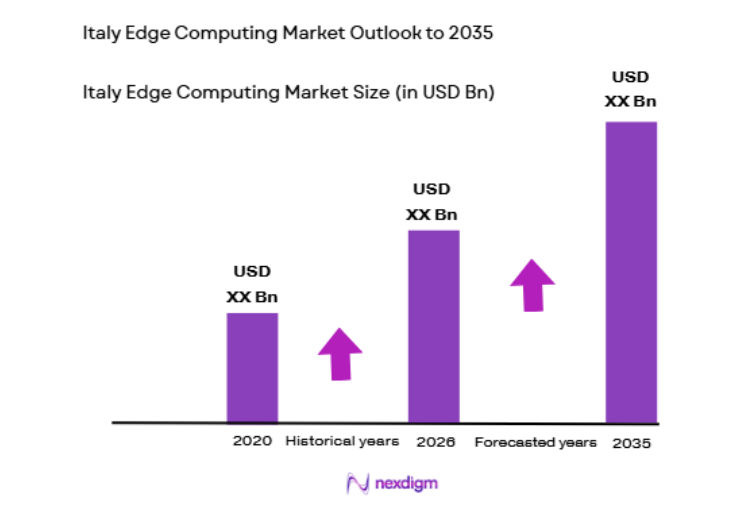
Italy’s edge computing market reached approximately USD ~ billion based on a recent historical assessment, supported by accelerated enterprise digitalization and industrial automation across manufacturing and logistics sectors. Data from Eurostat and Italy’s Ministry of Enterprises and Made in Italy indicates expanding IoT deployments and 5G infrastructure rollout, driving localized data processing needs. Increasing adoption of latency-sensitive applications such as predictive maintenance, autonomous systems, and real-time analytics continues to strengthen demand for distributed computing architectures nationwide.
Northern industrial hubs including Lombardy, Emilia-Romagna, and Veneto dominate edge computing adoption due to dense manufacturing clusters, advanced telecom infrastructure, and strong SME digitization initiatives. Cities such as Milan, Turin, and Bologna benefit from proximity to hyperscale data centers, research ecosystems, and smart city programs supported by national digital transition funding. Southern regions show emerging demand linked to logistics corridors and port modernization, but northern Italy maintains leadership through established Industry 4.0 integration and private-sector technology investment concentration.
Market Segmentation
By Product Type
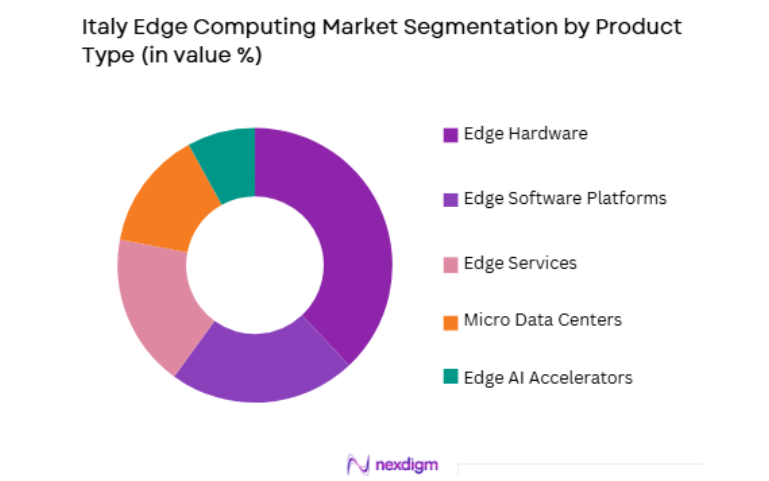
Italy Edge Computing market is segmented by product type into edge hardware, edge software platforms, edge services, micro data centers, and edge AI accelerators. Recently, edge hardware has a dominant market share due to factors such as demand patterns, brand presence, infrastructure availability, or consumer preference. Industrial enterprises prioritize ruggedized servers, gateways, and embedded compute nodes to support factory automation and machine-level analytics close to production environments. Telecom operators also invest heavily in distributed hardware nodes to support network function virtualization and 5G edge sites across metropolitan areas. Hardware dominance is reinforced by ongoing modernization of manufacturing plants under national Industry 4.0 incentives, which subsidize capital equipment purchases rather than software subscriptions. Italian system integrators typically deploy turnkey hardware-centric edge stacks for SMEs, further increasing physical node shipments.
By End-Use Industry
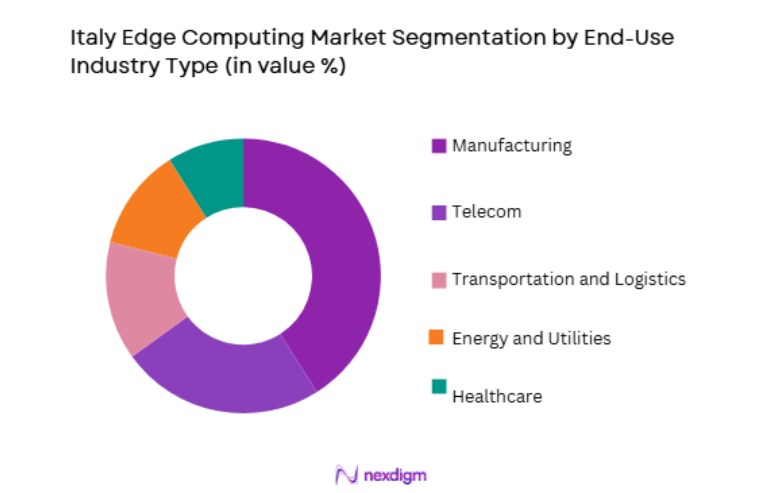
Italy Edge Computing market is segmented by end-use industry into manufacturing, telecom, transportation and logistics, energy and utilities, and healthcare. Recently, manufacturing has a dominant market share due to factors such as demand patterns, brand presence, infrastructure availability, or consumer preference. Italy’s large base of discrete and process manufacturers deploy edge systems for robotics control, machine vision inspection, and predictive maintenance to reduce downtime and improve productivity. Automotive and industrial machinery producers integrate localized analytics directly on shop floors to meet stringent latency and reliability needs. National Industry 4.0 tax credits and digital transformation funding encourage manufacturers to invest in connected equipment and edge analytics platforms.
Competitive Landscape
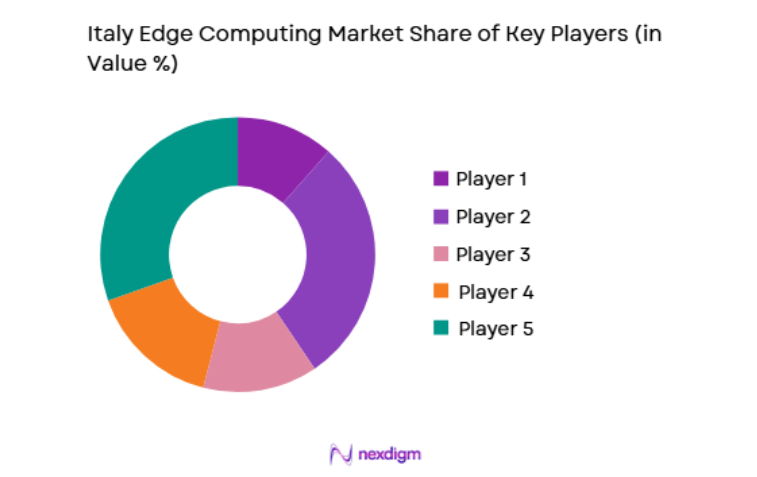
Italy’s edge computing market shows moderate consolidation, with global technology vendors collaborating with telecom operators and local system integrators to deliver integrated edge solutions. Major infrastructure providers leverage 5G rollouts and data-center adjacency to expand distributed computing footprints, while industrial automation firms embed edge capabilities into equipment platforms.
| Company Name | Establishment Year | Headquarters | Technology Focus | Market Reach | Key Products | Revenue | Italy Edge Deployment Focus |
| IBM | 1911 | USA | ~ | ~ | ~ | ~ | ~ |
| Cisco | 1984 | USA | ~ | ~ | ~ | ~ | ~ |
| HPE | 1939 | USA | ~ | ~ | ~ | ~ | ~ |
| Siemens | 1847 | Germany | ~ | ~ | ~ | ~ | ~ |
| Dell Technologies | 1984 | USA | ~ | ~ | ~ | ~ | ~ |
Italy Edge Computing Market Analysis
Growth Drivers
5G-Enabled Distributed Computing Infrastructure Expansion
Italy’s nationwide deployment of standalone 5G networks is fundamentally transforming edge computing economics by enabling ultra-low latency connectivity between distributed devices and localized processing nodes, encouraging telecom operators to integrate multi-access edge computing capabilities into base station architectures and regional aggregation points across metropolitan and industrial zones. As operators densify radio access networks and virtualize core functions, colocated edge compute becomes essential for applications such as augmented reality, autonomous robotics, and connected vehicles that require deterministic response times and localized data handling. Government-supported broadband and 5G coverage initiatives accelerate rural and industrial connectivity, expanding the addressable footprint for edge deployments beyond major cities into manufacturing clusters and logistics corridors. Telecom-cloud partnerships further stimulate infrastructure investment by combining network slicing, localized compute orchestration, and application hosting platforms that attract enterprise workloads to distributed nodes. Enterprises benefit from reduced backhaul costs and improved data sovereignty compliance when processing sensitive data at local edge sites rather than centralized clouds. Equipment vendors also bundle edge capabilities with radio and core network upgrades, embedding computing capacity directly into telecom infrastructure refresh cycles.
Industrial Automation and Industry 4.0 Digitization Momentum
Italy’s advanced manufacturing sector is rapidly integrating cyber-physical systems, robotics, and sensorized equipment that generate continuous operational data streams requiring immediate processing near machines, making edge computing a critical enabler of real-time control, predictive maintenance, and adaptive production optimization within smart factories. National Industry 4.0 incentive schemes encourage capital investment in connected machinery, machine vision, and industrial analytics platforms that rely on localized compute nodes to meet latency and reliability requirements in harsh shop-floor environments. Manufacturers deploy edge gateways and servers to aggregate data from programmable logic controllers and industrial IoT sensors, enabling on-site analytics that minimize downtime and energy consumption while improving quality assurance. Integration with digital twins and manufacturing execution systems further increases the need for distributed processing close to production assets to synchronize physical and virtual operations in real time. Italy’s strong presence in automotive, machinery, and precision engineering sectors amplifies adoption because these industries depend heavily on deterministic automation and high-speed inspection processes.
Market Challenges
Fragmented SME Adoption and Integration Complexity
Italy’s industrial landscape is dominated by small and medium enterprises that often lack internal IT resources and standardized digital architectures, creating significant barriers to edge computing deployment due to integration complexity with legacy machinery, heterogeneous control systems, and proprietary industrial protocols prevalent across manufacturing facilities. Many SMEs operate aging equipment without native connectivity, requiring costly retrofitting and custom gateway solutions before edge platforms can deliver value, increasing project risk and extending implementation timelines. Limited digital maturity also results in uncertainty around return on investment, as smaller firms struggle to quantify productivity gains from predictive analytics or real-time monitoring compared with traditional operational practices. Integration challenges are compounded by fragmented vendor ecosystems where hardware, software, and automation components originate from different suppliers, necessitating specialized system integration expertise that raises deployment costs. Workforce skill gaps in industrial IT and data analytics further constrain adoption, as companies lack personnel capable of managing distributed compute infrastructure and edge applications. Financing constraints and cautious capital spending behaviors among SMEs reduce willingness to invest in emerging technologies without clear and rapid payback.
Data Governance, Security, and Interoperability Concerns
Edge computing introduces distributed data processing across numerous nodes located in factories, telecom sites, and public infrastructure, creating complex governance challenges related to cybersecurity, data sovereignty, and interoperability with centralized cloud environments that Italian enterprises must address before scaling deployments. Industrial edge nodes often process sensitive operational or personal data, requiring compliance with European data protection regulations and sector-specific standards, which increases design and operational complexity for distributed architectures. The proliferation of connected devices expands attack surfaces, raising concerns about cyber threats targeting remote or physically accessible edge installations, particularly in critical infrastructure sectors such as energy and transportation. Lack of standardized interoperability frameworks between industrial equipment vendors, telecom platforms, and cloud providers complicates integration and lifecycle management of edge environments, leading to vendor lock-in risks and fragmented deployments. Enterprises must implement robust encryption, identity management, and remote monitoring across distributed nodes, increasing operational overhead compared with centralized IT systems.
Opportunities
Smart Manufacturing Clusters and Industrial Edge Ecosystems Development
Italy’s concentration of specialized manufacturing districts in regions such as Lombardy, Veneto, and Emilia-Romagna creates a unique opportunity to deploy shared or ecosystem-based edge computing infrastructures that support collaborative digitalization across interconnected supply chains, enabling small and medium enterprises to access advanced analytics and automation capabilities without bearing full standalone investment costs. Industrial consortia and regional innovation hubs can host localized edge platforms integrated with robotics, machine vision, and IoT networks that serve multiple manufacturers within geographic clusters, improving resource utilization and lowering barriers to adoption. Public funding for digital innovation centers and Industry 4.0 competence hubs provides institutional support for shared infrastructure initiatives that combine training, testing, and deployment services around edge technologies. Integration with regional logistics networks and smart infrastructure further enhances value by enabling end-to-end supply-chain visibility and real-time coordination between suppliers and manufacturers. Equipment vendors and telecom operators can deliver managed edge services tailored to cluster needs, creating recurring revenue models while accelerating SME digitalization.
5G-Edge Convergence for Smart Cities and Mobility Applications
Italy’s ongoing urban digitalization and transportation modernization programs present substantial opportunities for edge computing through integration with 5G-enabled smart city infrastructure, connected mobility systems, and intelligent public services that require localized processing for latency-sensitive and data-intensive applications across metropolitan environments. Cities deploying intelligent traffic management, public safety analytics, and environmental monitoring generate continuous sensor and video data streams that must be processed near collection points to deliver real-time insights and automated responses. Edge nodes colocated with telecom infrastructure enable scalable support for autonomous mobility trials, smart intersections, and vehicle-to-infrastructure communication essential for future urban transport ecosystems. Port modernization and logistics digitization initiatives also benefit from edge analytics for cargo tracking, predictive maintenance, and operational optimization across multimodal transport hubs. Government funding under national digital transition and sustainability programs supports deployment of connected urban infrastructure integrated with distributed computing capabilities.
Future Outlook
Italy’s edge computing market is expected to expand steadily as 5G standalone networks mature and industrial digitalization accelerates across manufacturing and logistics sectors. Distributed AI processing and micro data center deployments will increase to support real-time analytics and automation workloads. Government smart city and Industry 4.0 initiatives will reinforce investment in localized computing infrastructure.
Major Players
- IBM
- Cisco
- Hewlett Packard Enterprise
- Dell Technologies
- Siemens
- Schneider Electric
- Nokia
- Ericsson
- Advantech
- Lenovo
- Fujitsu
- Huawei
- Atos
- Red Hat
- Intel
Key Target Audience
- Telecom operators
- Manufacturing enterprises
- Transportation and logistics companies
- Energy and utilities providers
- Healthcare technology providers
- Investments and venture capitalist firms
- Government and regulatory bodies
- Edge infrastructure hardware vendors
Research Methodology
Step 1: Identification of Key Variables
Key demand variables such as 5G coverage, industrial automation intensity, IoT penetration, and data localization requirements were mapped across Italian regions and industries. Supply variables including vendor presence, infrastructure density, and telecom rollout progress were also identified to frame the market structure.
Step 2: Market Analysis and Construction
Segment-level adoption patterns and deployment scenarios were analyzed across product types and industries using infrastructure investment data and enterprise digitalization indicators. Market size was constructed through bottom-up aggregation of edge hardware, software, and services revenues within Italy.
Step 3: Hypothesis Validation and Expert Consultation
Preliminary findings were validated through expert inputs from telecom engineers, industrial automation specialists, and data-center architects familiar with Italian deployments. Assumptions regarding adoption drivers and constraints were refined through cross-verification with regional technology initiatives and industry programs.
Step 4: Research Synthesis and Final Output
Validated data and qualitative insights were synthesized into segmentation, competitive, and strategic analyses to produce a comprehensive view of Italy’s edge computing ecosystem. Final outputs emphasize structural drivers, adoption barriers, and opportunity areas shaping market evolution.

- Executive Summary
- Research Methodology (Definitions, Scope, Industry Assumptions, Market Sizing Approach, Primary & Secondary Research Framework, Data Collection & Verification Protocol, Analytic Models & Forecast Methodology, Limitations & Research Validity Checks)

- Market Definition and Scope
- Value Chain & Stakeholder Ecosystem
- Regulatory / Certification Landscape
- Sector Dynamics Affecting Demand

- Growth Drivers
5G rollout enabling distributed computing architecture
Industrial automation and Industry 4.0 adoption
Demand for low latency digital services - Market Challenges
Fragmented infrastructure across regions
High deployment and operational costs
Cybersecurity risks in distributed edge nodes - Market Opportunities
Smart city and mobility infrastructure projects
Private industrial edge deployments
Edge AI for manufacturing and logistics - Trends
Adoption of modular prefabricated edge sites
Integration of AI acceleration at edge - Government Regulations
- SWOT Analysis
- Porter’s Five Forces

- By Market Value, 2020-2025
- By Installed Units, 2020-2025
- By Average System Price, 2020-2025
- By System Complexity Tier, 2020-2025

- By System Type (In Value%)
Edge Servers and Micro Data Centers
Edge Storage Systems
Edge Networking Infrastructure
Ruggedized Edge Hardware
Edge Power and Cooling Systems - By Platform Type (In Value%)
Telecom Edge Infrastructure
Enterprise On Premise Edge
Cloud Provider Edge Nodes
Industrial Edge Platforms
Smart City Edge Infrastructure - By Fitment Type (In Value%)
New Edge Site Deployments
Retrofit Edge Integration
Modular Containerized Edge Units
Integrated Edge Infrastructure Solutions - By End User Segment (In Value%)
Telecom Operators
Manufacturing and Industrial Firms
Government and Smart Cities
Retail and Logistics Enterprises

- Market Share Analysis
- Cross Comparison Parameters (Latency Performance, Deployment Density, Ruggedization Level, Network Integration, Edge AI Capability, Scalability, Power Efficiency, Environmental Resilience, Remote Management, Interoperability, Security Architecture, Site Footprint)
- SWOT Analysis of Key Competitors
- Pricing & Procurement Analysis
- Key Players
Dell Technologies
Hewlett Packard Enterprise
Lenovo
Cisco
Nokia
Ericsson
Huawei
Schneider Electric
Vertiv
IBM
Intel
Advantech
Supermicro
Microsoft
Amazon Web Services

- Telecom operators deploying multi access edge computing
- Industries adopting edge for automation and monitoring
- Public sector enabling smart infrastructure systems
- Enterprises localizing data processing and analytics

- Forecast Market Value, 2026-2035
- Forecast Installed Units, 2026-2035
- Price Forecast by System Tier, 2026-2035
- Future Demand by Platform, 2026-2035


 Request a Sample
 Ask for Customization
 Get a Quote
 Enquire Now