

 Download PDF
 Download PDF
Market Overview
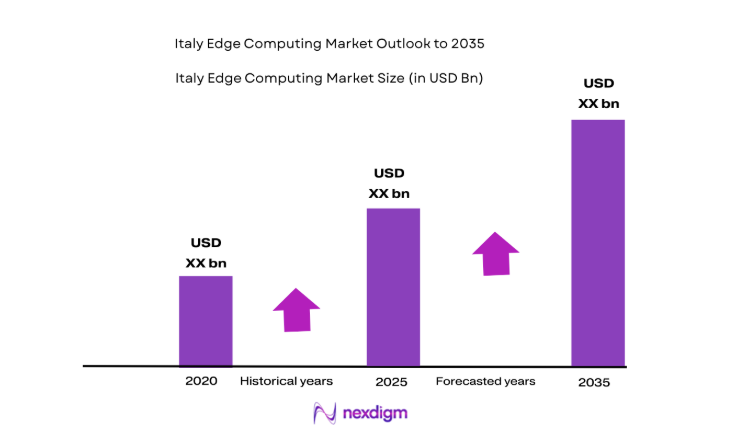
Based on a recent historical assessment, the Italy edge computing market reached approximately USD ~ billion, driven by telecom network virtualization, industrial automation investments, and expansion of localized data processing infrastructure. Deployment of multi access edge computing nodes by national operators and growth in AI enabled industrial analytics platforms accelerated infrastructure spending. Strong enterprise demand for low latency processing in manufacturing, logistics, and smart mobility ecosystems supported hardware, software, and integration revenues across distributed edge environments.
Based on a recent historical assessment, Milan and Turin dominate the Italy edge computing market due to concentration of advanced manufacturing clusters, telecom infrastructure density, and digital innovation ecosystems. Rome shows strong adoption linked to public sector digitalization and smart city programs, while Bologna and Genoa benefit from logistics and port digitization initiatives. Northern industrial corridors lead deployments because of automation maturity, 5G readiness, and proximity to hyperscale interconnection hubs enabling hybrid edge cloud architectures.
Market Segmentation
By Product Type
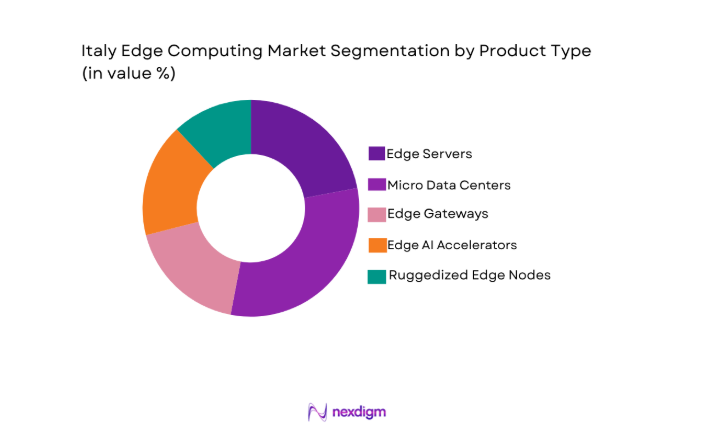
Italy edge computing market is segmented by product type into edge servers, micro data centers, edge gateways, edge AI accelerators, and ruggedized edge nodes. Recently, micro data centers has a dominant market share due to factors such as demand patterns, brand presence, infrastructure availability, or consumer preference.
By Platform Type
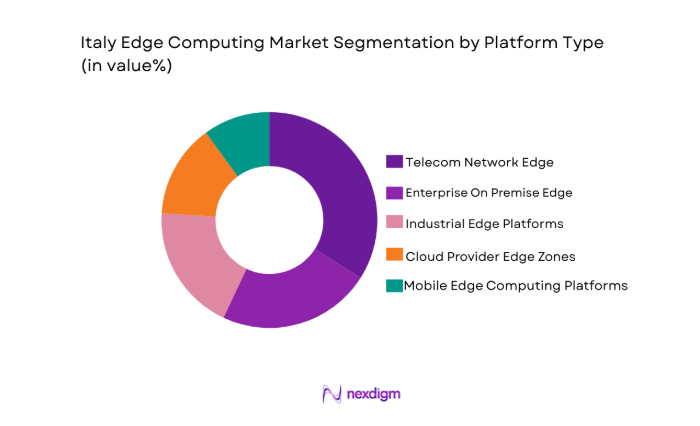
Italy edge computing market is segmented by platform type into telecom network edge, enterprise on premise edge, industrial edge platforms, cloud provider edge zones, and mobile edge computing platforms. Recently, telecom network edge has a dominant market share due to factors such as demand patterns, brand presence, infrastructure availability, or consumer preference.
Competitive Landscape
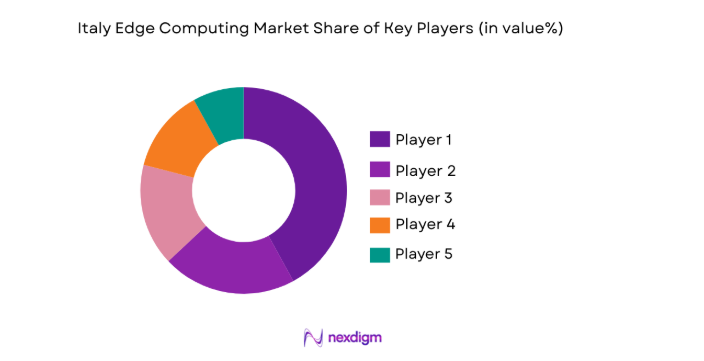
The Italy edge computing market shows moderate consolidation with telecom operators, semiconductor firms, and system integrators shaping deployment ecosystems. National telecom providers and domestic industrial technology companies maintain strong influence through infrastructure ownership and enterprise relationships, while global cloud and chip vendors participate through partnerships and localized platforms. Competitive positioning is defined by 5G integration capability, industrial vertical expertise, and managed edge service portfolios.
| Company Name | Establishment Year | Headquarters | Technology Focus | Market Reach | Key Products | Revenue | Edge Deployment Model |
| Telecom Italia | 1994 | Milan | ~ | ~ | ~ | ~ | ~ |
| Leonardo | 1948 | Rome | ~ | ~ | ~ | ~ | ~ |
| STMicroelectronics | 1987 | Geneva | ~ | ~ | ~ | ~ | ~ |
| Reply | 1996 | Turin | ~ | ~ | ~ | ~ | ~ |
| Almaviva | 1983 | Rome | ~ | ~ | ~ | ~ | ~ |
Italy Edge Computing Market Analysis
Growth Drivers
5G Enabled Low Latency Infrastructure Expansion Across Industrial and Urban Italy
The rapid rollout of standalone 5G architecture across Italy has fundamentally reshaped the feasibility and economics of distributed computing by enabling ultra low latency connectivity that supports real time analytics, autonomous control systems, and immersive digital applications across industrial zones and metropolitan corridors. Telecom operators have strategically integrated multi access edge computing nodes at base station aggregation sites and regional switching facilities, allowing enterprises to process data locally without reliance on distant centralized clouds, thereby reducing response times and network congestion. Manufacturing clusters in northern Italy, particularly in automotive, robotics, and precision engineering sectors, increasingly deploy edge enabled machine vision, predictive maintenance analytics, and digital twin simulations that depend on deterministic network performance delivered through 5G edge convergence. Smart mobility ecosystems in large urban areas integrate traffic analytics, connected vehicle communication, and surveillance workloads processed at roadside or metro edge nodes, demonstrating how telecom edge infrastructure directly supports municipal digital transformation strategies. The commercial viability of private 5G networks in factories, logistics hubs, and energy facilities has accelerated enterprise investment in localized edge computing stacks tightly coupled with radio infrastructure, creating a scalable model for distributed automation control and data sovereignty compliance. Cloud providers and telecom operators collaborate to extend hyperscale orchestration platforms into national edge zones, enabling developers to deploy containerized workloads across central and edge locations seamlessly while maintaining latency sensitive application performance. Regulatory support for digital infrastructure modernization and spectrum allocation frameworks has further incentivized telecom led edge expansion across industrial corridors and transportation networks, reinforcing infrastructure density advantages in advanced regions. The convergence of 5G and edge computing therefore functions as a foundational enabler for Italy’s transition toward real time digital operations across manufacturing, transport, utilities, and public services, sustaining long term market expansion and ecosystem investment.
Industrial Digitalization and Industry 4.0 Adoption in Manufacturing and Logistics Hubs
Italy’s strong base of small and medium sized manufacturing enterprises and globally competitive industrial clusters has accelerated adoption of edge computing technologies designed to support localized analytics, automation control, and machine intelligence at production and logistics sites. Industrial operators increasingly require real time processing of sensor streams, machine vision feeds, and operational telemetry directly on factory floors to support predictive maintenance, adaptive robotics, and energy optimization without exposing sensitive operational data to external networks. Edge computing platforms embedded within production equipment or deployed as micro data centers inside plants allow manufacturers to achieve deterministic latency, data sovereignty compliance, and continuous operation resilience even during connectivity disruptions. Logistics operators in port regions and intermodal transport corridors deploy edge enabled tracking, route optimization, and warehouse automation systems that process operational data locally to maintain performance under high throughput conditions and intermittent connectivity. The integration of AI inference accelerators at industrial edge nodes supports quality inspection, anomaly detection, and autonomous process control tasks that cannot tolerate cloud round trip latency, thereby improving productivity and reducing downtime across manufacturing ecosystems. Government incentives for industrial digital transformation and energy efficiency modernization further encourage enterprises to adopt distributed computing architectures capable of optimizing production lines and resource utilization in real time. System integrators and domestic automation firms provide tailored edge platforms aligned with industrial protocols and legacy equipment environments, lowering adoption barriers for mid sized manufacturers transitioning toward Industry 4.0 frameworks. The resulting convergence of automation, AI analytics, and localized computing infrastructure continues to drive strong demand for ruggedized, secure, and scalable edge deployments across Italy’s industrial economy.
Market Challenges
High Capital Intensity and Integration Complexity of Distributed Edge Infrastructure Deployments
Deploying edge computing infrastructure across geographically distributed sites in Italy requires substantial upfront capital investment in specialized hardware, localized data center enclosures, ruggedized environmental systems, and integration services capable of adapting to heterogeneous operational environments. Enterprises and telecom operators must invest in edge servers, AI accelerators, networking equipment, and orchestration platforms while simultaneously upgrading power, cooling, and connectivity infrastructure at remote or industrial locations that were not originally designed to host computing facilities. The fragmented nature of Italy’s industrial landscape, dominated by mid sized manufacturers and decentralized logistics operators, complicates standardized deployment models and increases customization costs for each site installation. Integration complexity arises from the need to connect edge nodes with legacy industrial control systems, proprietary automation equipment, and enterprise IT platforms that vary significantly across sectors and facilities, requiring specialized engineering expertise and extended deployment timelines. Lifecycle management costs remain high because distributed edge fleets must be monitored, patched, secured, and upgraded across hundreds of remote nodes, increasing operational expenditure compared with centralized cloud architectures. Telecom operators face similar cost burdens when densifying multi access edge computing nodes across national networks while maintaining service continuity and interoperability with existing core infrastructure. The absence of widely adopted interoperability standards across hardware vendors, orchestration platforms, and industrial protocols further increases vendor lock in risk and integration uncertainty for buyers evaluating long term investments. Small and medium enterprises often lack internal technical capabilities or capital budgets to deploy and manage edge infrastructure independently, limiting adoption beyond large industrial leaders and telecom driven projects. These financial and technical barriers collectively slow the pace of distributed edge expansion despite strong underlying demand for localized computing capabilities.
Cybersecurity and Data Governance Risks in Highly Distributed Edge Environments
The decentralized architecture of edge computing introduces expanded attack surfaces and governance challenges because data processing occurs across numerous remote nodes located in industrial sites, telecom facilities, transportation hubs, and urban infrastructure environments rather than within tightly controlled centralized data centers. Each edge node potentially becomes a target for intrusion, tampering, or malware injection, particularly in industrial and public infrastructure deployments where physical security and network segmentation may vary significantly across locations. Managing identity, access control, and software integrity across large fleets of edge devices requires sophisticated security orchestration frameworks capable of enforcing consistent policies and updates, yet many enterprises lack mature operational technology cybersecurity practices. Industrial edge deployments connected to production systems and critical infrastructure raise heightened risk because compromised nodes could disrupt manufacturing operations, energy distribution, or transportation control systems, creating safety and economic consequences beyond data breaches. Compliance with European data protection and sovereignty frameworks becomes more complex when sensitive operational or personal data is processed locally across multiple jurisdictions and organizational boundaries, requiring robust encryption, auditing, and governance mechanisms. Telecom operators and service providers must ensure secure multi tenant isolation within shared edge environments to prevent cross workload exposure while maintaining performance guarantees for latency sensitive applications. Legacy industrial equipment and proprietary protocols often lack built in security features, increasing vulnerability when connected to modern edge networks and analytics platforms. The shortage of specialized cybersecurity expertise in operational technology and edge architectures further constrains the ability of organizations to implement comprehensive protection across distributed environments. These security and governance challenges represent a major restraint on widespread adoption of edge computing in sectors handling critical infrastructure or sensitive industrial data.
Opportunities
Private 5G and Edge Convergence for Enterprise Campus and Industrial Network Transformation
The emergence of private 5G networks integrated with localized edge computing infrastructure presents a significant opportunity for enterprises in Italy to transform operational environments into fully autonomous, data driven campuses capable of real time analytics, robotics control, and immersive digital services. Enterprises deploying dedicated spectrum or licensed shared access networks within factories, logistics parks, airports, and energy facilities can integrate on site edge computing platforms directly with radio infrastructure, enabling deterministic communication and processing independent of public networks. This architecture supports mission critical industrial automation, autonomous vehicle coordination, augmented reality maintenance guidance, and digital twin simulation workloads that require ultra low latency and high reliability connectivity. Telecom operators and system integrators can deliver managed private 5G plus edge solutions as turnkey offerings tailored to sector specific requirements, lowering adoption barriers for mid sized enterprises lacking internal telecom expertise. The convergence of localized connectivity and computing also enhances data sovereignty by ensuring sensitive operational data remains within enterprise premises or national jurisdictional boundaries, aligning with regulatory and security expectations. Industrial clusters and technology parks in northern Italy provide concentrated demand environments where shared private 5G and edge ecosystems can serve multiple enterprises, reducing cost per deployment and accelerating adoption. Equipment vendors and semiconductor firms benefit from increased demand for edge optimized hardware integrated with radio and industrial control systems. Government digitalization initiatives and innovation funding further support pilot deployments of private network edge architectures in manufacturing, transport, and public infrastructure sectors. The maturation of this convergence model positions Italy to expand distributed autonomous industrial environments and advanced enterprise campuses at scale.
Edge Enabled Smart City and Intelligent Transport Infrastructure Modernization
Urban digital transformation programs across Italian metropolitan areas create substantial opportunity for edge computing deployments that support real time analytics, mobility optimization, environmental monitoring, and public safety systems operating at city scale. Municipal authorities and infrastructure operators increasingly deploy intelligent traffic management, connected public transport coordination, video analytics for safety monitoring, and environmental sensor networks that generate high volume data streams requiring local processing near data sources. Edge computing nodes positioned at intersections, transit stations, and municipal facilities enable rapid response and decision making without dependence on centralized cloud latency, improving urban mobility efficiency and emergency response capability. Integration of edge analytics with autonomous and connected vehicle ecosystems supports vehicle to infrastructure communication, predictive traffic flow control, and smart parking services essential for modern urban transport networks. Ports and logistics hubs in coastal cities adopt edge enabled cargo tracking, automated handling, and security monitoring platforms to enhance throughput and operational visibility in complex intermodal environments. Energy and utilities infrastructure within cities leverage edge computing for grid monitoring, distributed renewable integration, and demand response optimization, strengthening urban resilience and sustainability initiatives. Telecom operators expand metro edge zones to support municipal and enterprise applications simultaneously, creating shared digital infrastructure layers for cities and businesses. Public funding and European digital infrastructure programs provide financial support for smart city and transport modernization projects incorporating distributed computing architectures. These factors collectively position edge computing as a foundational technology for intelligent urban infrastructure evolution across Italy.
Future Outlook
Italy edge computing market is expected to expand steadily over the next five years as 5G densification, industrial automation, and smart infrastructure programs accelerate distributed computing adoption. Advancements in AI inference hardware, edge orchestration software, and private network integration will improve deployment efficiency and scalability. Regulatory emphasis on data sovereignty and digital infrastructure resilience will support localized processing architectures. Demand from manufacturing, transport, and public sector digitalization initiatives will remain primary growth catalysts.
Major Players
- Telecom Italia
- Leonardo
- STMicroelectronics
- Reply
- Almaviva
- Engineering Ingegneria Informatica
- Fastweb
- Vodafone Italia
- Wind Tre
- Italtel
- Exprivia
- SIAE Microelettronica
- E4 Computer Engineering
- Eurotech
- Selex ES
Key Target Audience
- Telecom operators
- Manufacturing enterprises
- Logistics and transport operators
- Energy and utilities companies
- Smart city authorities
- Cloud service providers
- Investments and venture capitalist firms
- Government and regulatory bodies
Research Methodology
Step 1: Identification of Key Variables
Key market variables including edge hardware shipments, telecom edge deployments, industrial adoption rates, and enterprise digitalization indicators were identified across Italy’s telecom, manufacturing, and public infrastructure sectors. Supply side inputs from vendors and operators were combined with demand side indicators such as automation spending and 5G rollout intensity.
Step 2: Market Analysis and Construction
Market size and segmentation were constructed through bottom up aggregation of edge infrastructure deployments across telecom, industrial, and enterprise environments. Revenue mapping incorporated hardware, software, and integration components associated with localized computing platforms. Regional industrial and telecom density patterns were integrated into demand modeling.
Step 3: Hypothesis Validation and Expert Consultation
Assumptions regarding adoption drivers, deployment economics, and sector demand were validated through consultation with telecom engineers, industrial automation specialists, and edge platform integrators operating in Italy. Cross verification ensured alignment between infrastructure rollout trends and enterprise digitalization trajectories.
Step 4: Research Synthesis and Final Output
Validated datasets and qualitative insights were synthesized into structured market estimates, segmentation shares, and competitive positioning analysis. Findings were aligned with national digital infrastructure strategies, industrial transformation programs, and technology adoption pathways shaping the Italy edge computing ecosystem.

- Executive Summary
- Research Methodology (Definitions, Scope, Industry Assumptions, Market Sizing Approach, Primary & Secondary Research Framework, Data Collection & Verification Protocol, Analytic Models & Forecast Methodology, Limitations & Research Validity Checks)

- Market Definition and Scope
- Value Chain & Stakeholder Ecosystem
- Regulatory / Certification Landscape
- Sector Dynamics Affecting Demand
- Strategic Initiatives & Infrastructure Growth

- Growth Drivers
Expansion of 5G infrastructure enabling low latency applications
Industrial automation and Industry 4.0 adoption across manufacturing hubs
Rising demand for real time data processing in smart cities and mobility
Growth of AI inference workloads at network edge locations
Data sovereignty and localization requirements within EU frameworks - Market Challenges
High upfront deployment and integration costs for distributed edge nodes
Interoperability issues across heterogeneous edge platforms
Limited skilled workforce for edge infrastructure management
Security vulnerabilities in distributed computing environments
Complex lifecycle management across large edge device fleets - Market Opportunities
Edge enabled predictive maintenance solutions for industrial sectors
Private 5G and edge convergence for enterprise campuses
Autonomous mobility and connected transport edge ecosystems - Trends
Convergence of edge and cloud orchestration platforms
Adoption of AI inference at telecom base station sites
Rise of micro modular data centers in urban locations
Edge deployments supporting immersive media and AR applications
Software defined edge infrastructure and virtualization growth - Government Regulations & Defense Policy
EU data governance and sovereignty compliance frameworks
National digital infrastructure and smart city funding programs
Cybersecurity certification and critical infrastructure protection policies - SWOT Analysis
- Stakeholder and Ecosystem Analysis
- Porter’s Five Forces Analysis
- Competition Intensity and Ecosystem Mapping

- By Market Value, 2020-2025
- By Installed Units, 2020-2025
- By Average System Price, 2020-2025
- By System Complexity Tier, 2020-2025

- By System Type (In Value%)
Edge Servers
Micro Data Centers
Edge Gateways
Edge AI Accelerators
Ruggedized Edge Nodes - By Platform Type (In Value%)
Telecom Network Edge
Enterprise OnPremise Edge
Industrial Edge Platforms
Cloud Provider Edge Zones
Mobile Edge Computing Platforms - By Fitment Type (In Value%)
Standalone Edge Installations
Integrated Data Center Edge
Embedded OEM Edge Modules
RackMounted Edge Systems
Containerized Edge Units - By EndUser Segment (In Value%)
Telecommunications Operators
Manufacturing and Industrial Firms
Transportation and Logistics Providers
Energy and Utilities Operators
Public Sector and Smart City Authorities - By Procurement Channel (In Value%)
Direct Enterprise Procurement
Telecom Operator Contracts
System Integrator Deployments
OEM Partnerships
Government and Municipal Tenders

- Market structure and competitive positioning
Market share snapshot of major players - Cross Comparison Parameters (Edge Hardware Portfolio, MEC Platform Capability, Industry Vertical Focus, Deployment Scale, AI Integration, 5G Integration, Managed Services Offering, Partnerships Ecosystem, Geographic Presence)
- SWOT Analysis of Key Competitors
- Pricing & Procurement Analysis
- Key Players
Telecom Italia
Leonardo
Engineering Ingegneria Informatica
Reply
Almaviva
STMicroelectronics
Fastweb
Vodafone Italia
Wind Tre
Italtel
Exprivia
SIAE Microelettronica
E4 Computer Engineering
Eurotech
Selex ES

- Telecom operators deploying MEC to monetize 5G investments
- Manufacturers adopting edge for real time process optimization
- Utilities using edge analytics for grid monitoring and resilience
- Public sector implementing edge for surveillance and smart mobility

- Forecast Market Value, 2026-2035
- Forecast Installed Units, 2026-2035
- Price Forecast by System Tier, 2026-2035
- Future Demand by Platform, 2026-2035


 Request a Sample
 Ask for Customization
 Get a Quote
 Enquire Now