

 Download PDF
Market Overview
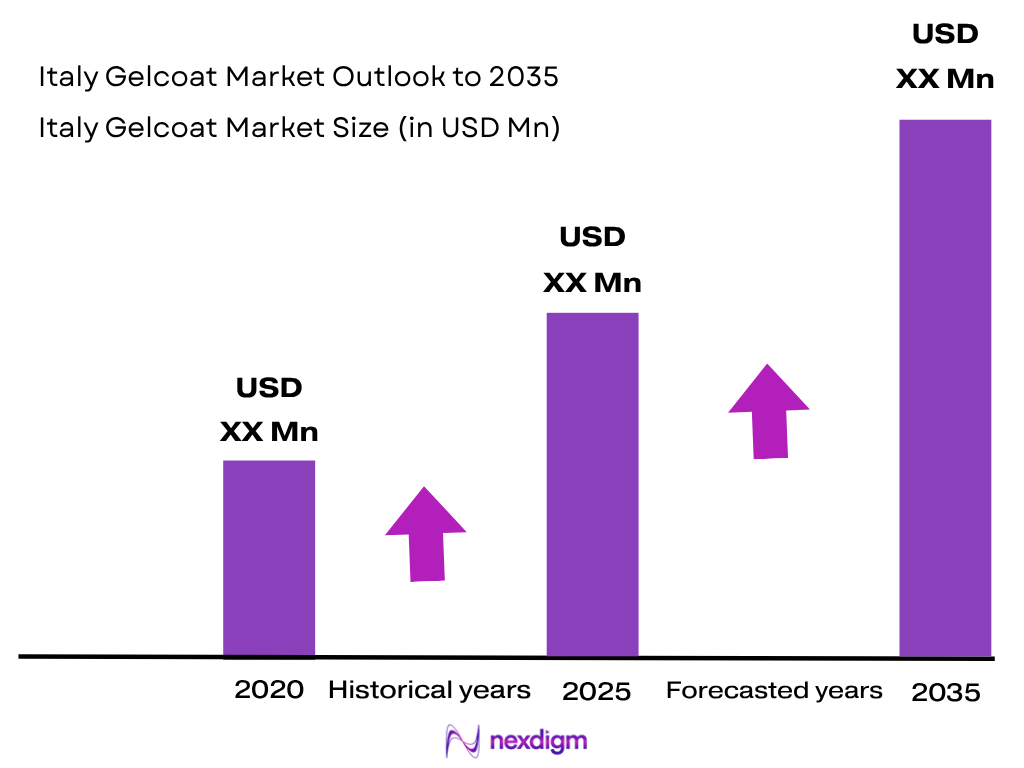
The Italy Gelcoat Market is valued at ~USD XX million in 2024, compared with ~USD XX million in 2023, with demand supported by Italy’s large composite manufacturing base, marine production, construction activity, transportation manufacturing, and wind-energy applications. Italy’s boating industry recorded EUR 8.60 billion in turnover in 2024, while new-build boatbuilding exceeded EUR 5.4 billion, creating substantial downstream demand for protective and aesthetic composite surface coatings.
The Italy Gelcoat Market is concentrated around established manufacturing clusters, particularly Liguria, Tuscany, Lombardy, Marche, Campania, Piedmont, Sicily and Lazio, where marine manufacturing and composite-processing capabilities are well developed. Italy’s boating supply chain generated more than EUR 13 billion in added value and supported approximately 168,000 jobs in 2024. Genoa and Liguria benefit from strong marine infrastructure, while Tuscany and Lombardy combine boatbuilding, industrial manufacturing and composite-processing capabilities.
Market Segmentation
By Resin Type
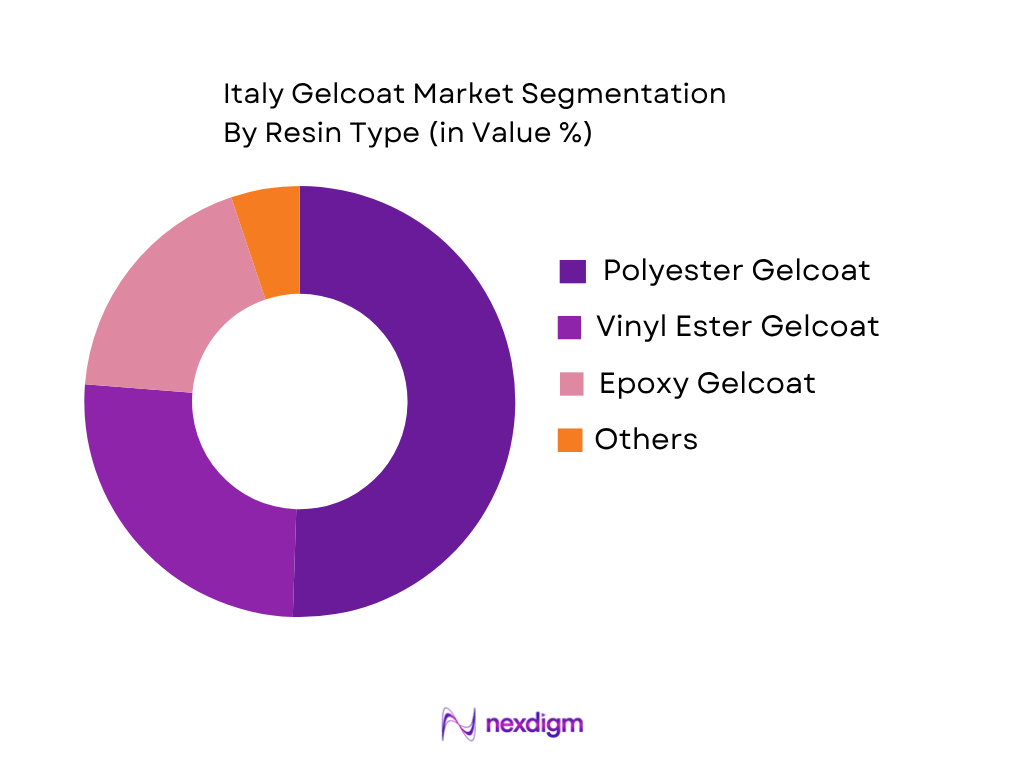
The Italy Gelcoat Market is segmented by resin type into polyester, vinyl ester, epoxy and others. Polyester gelcoat represents the leading segment, supported by its broad application across marine, construction, transportation, tooling and industrial composite manufacturing. Available Italy-specific market data places polyester gelcoat revenue at approximately USD 34.28 million in 2024, making it the largest resin category. Its established use in fiberglass-reinforced polyester structures, relatively straightforward processing characteristics and compatibility with large-volume composite manufacturing support its continued adoption. Italy’s marine industry is particularly important because gelcoat is extensively used as the exposed surface layer on fiberglass boats and components. The country’s boatbuilding production reached EUR 5.4 billion in 2024, reinforcing demand for established polyester-based composite systems. Vinyl ester and epoxy remain important for applications requiring enhanced chemical, moisture, mechanical or durability performance, while specialty formulations address increasingly demanding applications.
By End-Use Industry
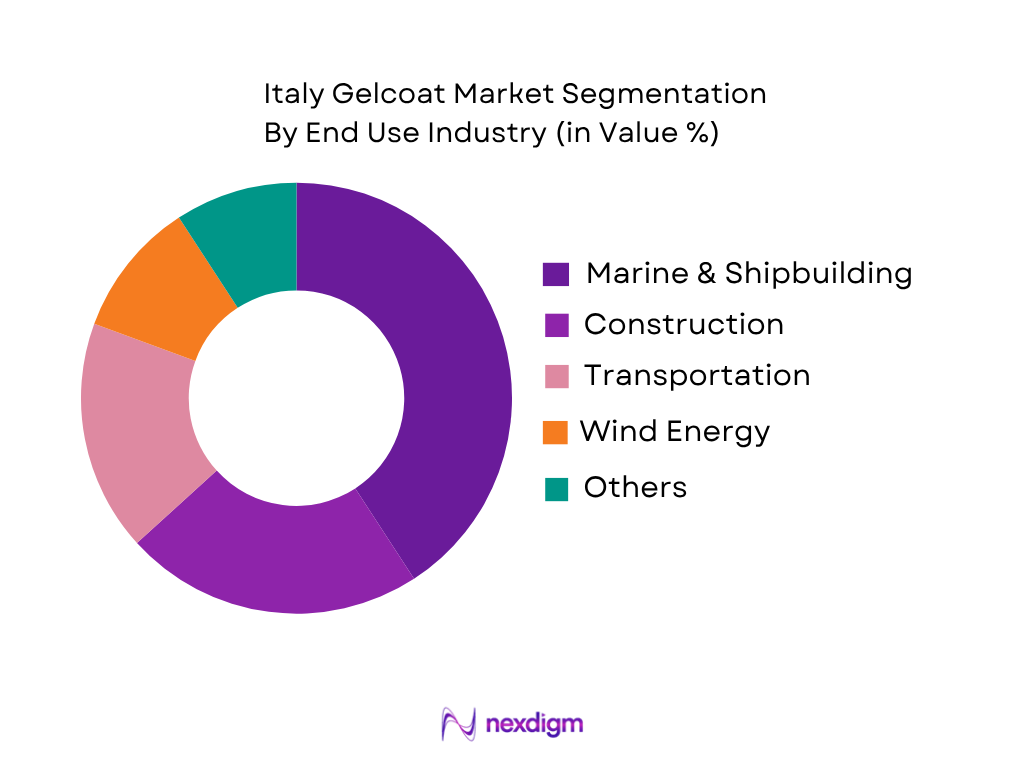
The Italy Gelcoat Market is segmented by end-use industry into marine, building and construction, automotive, wind energy and others. Marine is the leading end-use segment, supported by Italy’s globally significant yacht and boatbuilding industry and the extensive use of fiberglass-reinforced composites in hulls, decks, superstructures, components and recreational craft. Italy’s marine industry recorded EUR 8.60 billion in turnover in 2024, while domestic boatbuilding production exceeded EUR 5.4 billion. The country also exported approximately EUR 4.3 billion of recreational and sporting boats, demonstrating the scale of its production ecosystem. Gelcoat is particularly relevant to marine manufacturing because it provides the visible outer surface while contributing protection against water, UV exposure, chemicals and environmental degradation. Construction, transportation and wind-energy applications provide additional demand, but the concentration of composite-intensive boat manufacturing gives marine applications a particularly strong position within Italy’s gelcoat consumption base.
Competitive Landscape
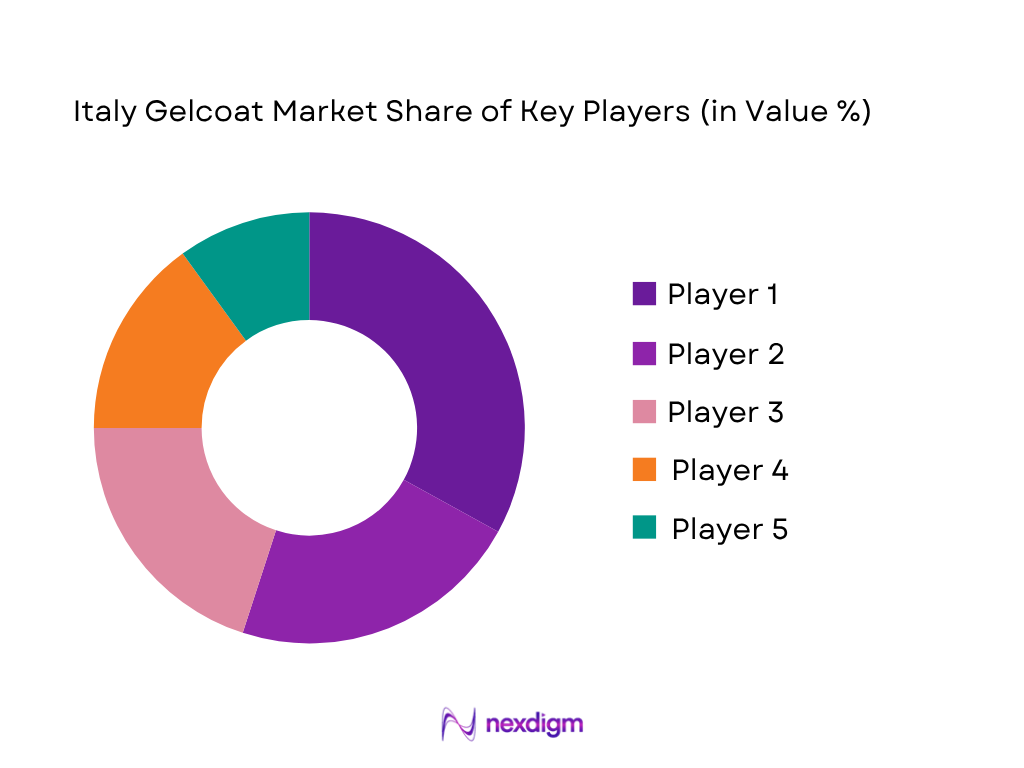
The Italy Gelcoat Market includes international resin and composite-material suppliers alongside specialized formulation and distribution companies. Competition is shaped by product formulation, resin chemistry, technical support, color customization, application compatibility, supply reliability and relationships with Italy’s marine and industrial composite manufacturers. Italy’s globally significant boatbuilding industry makes marine-grade performance and technical support particularly important competitive differentiators.
| Company | Establishment | Headquarters | Resin Portfolio | Key Applications | Application Technologies | Technical Differentiator | Italy Market Position |
| INEOS Composites | 2019* | Ohio, USA | ~ | ~ | ~ | ~ | ~ |
| Scott Bader | 1921 | Wellingborough, UK | ~ | ~ | ~ | ~ | ~ |
| Polynt Group | 1955 | Scanzorosciate, Italy | ~ | ~ | ~ | ~ | ~ |
| Reichhold / Polynt ecosystem | — | Europe / Italy | ~ | ~ | ~ | ~ | ~ |
| Interplastic Corporation | 1954 | Minneapolis, USA | ~ | ~ | ~ | ~ | ~ |
Italy Gelcoat Market Analysis
Growth Drivers
Marine Composite Manufacturing and High-End Boatbuilding Activity
Italy’s gelcoat demand is strongly supported by the country’s concentrated marine-composites and recreational boatbuilding ecosystem, where gelcoats are required to provide molded fiberglass hulls, decks, superstructures and interior composite parts with water resistance, gloss retention, UV durability and surface finish. Italian recreational boating production reached €7.55 billion in 2024, while new boat construction alone accounted for €5.4 billion of industrial output. The industry employed 31,480 workers in 2024, providing a substantial manufacturing base for fiberglass molding, lamination, surface preparation and coating operations. Italian yards also maintained an unusually large pipeline of high-value composite vessels: during 2025, yards were constructing 572 superyachts longer than 24 metres out of 1,138 units worldwide. By 2026, the Italian order book still contained 568 superyachts under construction, demonstrating that production activity remains extensive rather than being limited to short-term deliveries. This production profile matters for gelcoat manufacturers because large yachts require extensive finished composite surface areas and demanding marine surface systems capable of resisting saltwater, sunlight, moisture, abrasion and repeated cleaning. Italy’s boating supply chain generated more than €13 billion of value added in 2024 and supported approximately 168,000 jobs, indicating a broad domestic ecosystem encompassing boatyards, component manufacturers, refitting companies and specialist composite processors.
Expansion of Fiberglass-Reinforced Applications across Energy, Construction and Industrial Manufacturing
Gelcoat consumption in Italy is also supported by diversification of fiberglass-reinforced polymer applications beyond leisure craft, particularly where composite parts require weatherable, chemically resistant or decorative exterior surfaces. Italy operated 74,508.66 MW of renewable generating capacity in 2024, while total electricity production reached 270,963.09 GWh, creating a substantial infrastructure base in which composite materials are used across wind-energy equipment, electrical housings, covers and other engineered components. The wind sector became more relevant again during 2025, when Italy’s installed wind capacity reached 13,629 MW at year-end. Renewable capacity additions across all technologies totaled 7,191 MW during 2025, showing that Italy continues to install equipment requiring lightweight, corrosion-resistant materials and supporting downstream interest in durable composite surface technologies. Construction provides another sizeable application environment.
Market Challenges
Styrene, VOC and Environmental Compliance Requirements
Italian gelcoat producers and composite processors face increasing compliance pressure because conventional unsaturated-polyester gelcoats commonly rely on reactive monomers and spray-processing systems that require carefully controlled emissions, worker exposure, overspray and waste management. The scale of Italy’s industrial environmental burden illustrates why authorities and manufacturers are placing greater attention on material efficiency and emissions control. Italy generated more than 172 million tonnes of special waste in 2024, including 10.8 million tonnes classified as hazardous waste. Manufacturing activities represented 15.9 units out of every 100 units of special waste generated nationally, making industrial production a significant focus for waste-management and environmental controls.
Resin, Chemical Feedstock and Energy Exposure in Domestic Formulation
Gelcoat manufacturing in Italy remains exposed to volatility in chemical feedstocks and energy-intensive processing because polyester and vinyl-ester surface systems depend on resins, monomers, pigments, fillers, catalysts and specialty additives that move through international chemical supply chains. Italy imported €34 billion of chemicals and related products from countries outside the European Union in 2024, making it the EU’s fourth-largest extra-EU chemical importer after Germany, Belgium and the Netherlands. This import exposure is important for gelcoat formulators because shortages or delivery disruption in specialty resins, additives, stabilizers, pigments or intermediates can affect formulation continuity even where blending and finishing are performed domestically. Italian industrial producer-price data also demonstrate how quickly upstream manufacturing conditions can change.
Market Opportunities
Low-Styrene, Sustainable and Advanced Marine Gelcoat Development
Italy offers a strong future opportunity for low-styrene, lower-emission and more sustainable gelcoats because its largest composite end-use clusters combine substantial current production with increasing environmental expectations. Italian recreational boating production totaled €7.55 billion in 2024, while the new-build segment accounted for €5.4 billion. Direct employment reached 31,480 workers, giving suppliers a large population of laminators, yards and component manufacturers that can adopt newer surface technologies. The opportunity becomes more compelling at the premium end of the sector: Italian shipyards had 572 superyachts above 24 metres under construction during 2025, while the 2026 order book contained 568 vessels. These units incorporate extensive composite structures requiring high-quality exterior finishes, giving suppliers a commercial pathway for premium low-emission formulations where appearance, UV durability and chemical resistance are as important as reduced volatile content. Environmental conditions also create a reason for customers to move toward cleaner technologies. Italy generated over 172 million tonnes of special waste during 2024, including 10.8 million tonnes of hazardous material, while manufacturing accounted for a substantial portion of industrial waste generation. Products that reduce overspray, residual resin, solvent cleaning or rejected parts can therefore create value beyond simple regulatory compliance.
High-Performance UV-, Chemical- and Fire-Resistant Gelcoats with Automated and Repair Applications
Italy’s diversification into energy infrastructure, construction materials, advanced boating and industrial composites creates room for specialized gelcoats designed around performance rather than basic decorative finishing. The country operated 74,508.66 MW of renewable generating capacity in 2024 and produced 270,963.09 GWh of electricity, while wind capacity reached 13,629 MW by the end of 2025. These figures provide an installed industrial base around which corrosion-resistant composite covers, housings, nacelle-related components, access structures and other FRP products can be developed or maintained. Outdoor composite parts require prolonged UV and weather resistance, creating opportunities for gelcoats incorporating improved stabilizer packages and better color retention. Construction and infrastructure provide another substantial addressable manufacturing environment. Italy generated 90.4 million tonnes of construction and demolition special waste during 2024, emphasizing the scale of building replacement and renovation activity. Increased use of durable FRP panels, profiles, façades, covers and corrosion-resistant structural components can create demand for fire-retardant and weather-resistant gelcoats where regulatory requirements and lifecycle performance justify specialized formulations.
Future Outlook
Over the next decade, the Italy Gelcoat Market is expected to expand as composite materials remain important across marine manufacturing, transportation, construction, industrial equipment and renewable-energy applications. Italy’s established yacht and boatbuilding ecosystem provides a strong downstream base, while demand for lightweight, durable and visually finished composite structures supports gelcoat consumption. Product development is expected to increasingly emphasize lower-emission formulations, enhanced durability, improved application efficiency and specialty performance. The growing focus on sustainability within European manufacturing should further encourage development of formulations compatible with evolving environmental and occupational requirements.
Major Players
- Polynt Group
- Scott Bader
- INEOS Composites
- Interplastic Corporation
- AOC
- BÜFA Composite Systems
- Sicomin
- Poliya
- Mates Italiana
- Gurit
- Resoltech
- GRP Systems
- Composite Integration
- Reichhold / Polynt
- Specialty Resin Suppliers
Key Target Audience
- Marine and yacht manufacturers
- Composite material and fiberglass component manufacturers
- Mold and tooling manufacturers
- Automotive and transportation component manufacturers
- Wind-energy component manufacturers
- Investments and venture capitalist firms (industrial materials, composites and advanced manufacturing investors)
- Government and regulatory bodies (Italian Ministry of Enterprises and Made in Italy, Ministry of Environment and Energy Security, Italian Maritime Authorities)
- Industrial equipment and infrastructure manufacturers
Research Methodology
Step 1: Identification of Key Variables
The initial phase involves mapping the Italy Gelcoat Market ecosystem across resin manufacturers, gelcoat formulators, distributors, composite fabricators and downstream industries. Secondary research covers marine production, composite manufacturing, construction, transportation and renewable-energy activity. Variables include resin chemistry, application technology, end-use demand, production capacity and purchasing behavior.
Step 2: Market Analysis and Construction
Historical market information is compiled using a combination of industry statistics, company disclosures, trade information and sector-specific datasets. The analysis evaluates gelcoat consumption across resin type, application, gelcoat type and end-use industry. Bottom-up calculations are reconciled with broader industrial and downstream demand indicators.
Step 3: Hypothesis Validation and Expert Consultation
Market hypotheses are validated through discussions with composite manufacturers, resin suppliers, marine-industry participants and technical specialists. Interviews focus on formulation preferences, purchasing criteria, application methods, product substitution, environmental requirements and demand across major end-use sectors. Expert feedback is used to test assumptions and resolve discrepancies in secondary data.
Step 4: Research Synthesis and Final Output
The final stage integrates primary and secondary findings into a validated Italy Gelcoat Market model. Segment-level estimates are cross-checked against downstream production indicators, supplier portfolios and application requirements. The resulting analysis identifies market structure, competitive positioning, growth drivers, challenges, opportunities and future demand scenarios.

- Executive Summary
- Research Methodology (Market Definition and Scope, Gelcoat Product Classification, Market Boundary Conditions, Resin-System Mapping, Top-Down Market Sizing, Bottom-Up Market Sizing, Production-Side Assessment, Consumption-Side Assessment, Import–Export Reconciliation, Application-Level Demand Mapping, End-Use Industry Assessment, Company-Level Analysis, Capacity Mapping, Primary Industry Interviews, Expert Validation, Data Triangulation, Forecasting Framework, Scenario Analysis, Assumptions, Limitations)

- Definition and Scope
- Gelcoat Industry Evolution and Development
- Italy Gelcoat Manufacturing Ecosystem
- Gelcoat Value Chain Analysis
- Raw Material-to-Gelcoat Value Chain
- Gelcoat Supply Chain Structure

- Growth Drivers (Marine Composite Manufacturing, Swimming Pool Production, Sanitaryware Demand, Lightweight Transportation Components, Composite Construction Products, Industrial Corrosion Protection, Wind Energy Components, Expansion of Fiberglass-Reinforced Polymer Applications)
- Market Challenges (Styrene and VOC Compliance, Resin Raw Material Volatility, Energy-Intensive Formulation and Processing, Skilled Application Requirements, Surface Defect Risk, Cure-Time Constraints, Imported Specialty Additive Dependency, Environmental Compliance Burden)
- Market Opportunities (Low-Styrene Gelcoat Development, Bio-Based Resin Formulations, Sustainable Composite Surfaces, Advanced Marine Gelcoats, Fire-Retardant Formulations, High-UV-Resistance Products, Chemical-Resistant Industrial Gelcoats, Automated Spray Application, Repair and Refinish Gelcoats, High-Performance Tooling Gelcoats)
- Market Trends (Low-VOC Formulations, Styrene Reduction, Sustainable Resin Systems, High-Durability Marine Coatings, Fire-Retardant Gelcoats, UV-Stable Formulations, Faster-Curing Systems, Automated Application, Custom Color Formulation, High-Gloss Surface Finishes)
- Regulatory and Standards Landscape (REACH Compliance, CLP Requirements, VOC Regulations, Worker Exposure Requirements, Marine Certification, Fire-Resistance Standards, Chemical Storage Requirements, Environmental Compliance)
- SWOT Analysis
- Porter’s Five Forces Analysis
- PESTLE Analysis

- By Market Value (2020-2025)
- By Consumption Volume (2020-2025)
- By Domestic Production Volume (2020-2025)
- By Import Volume (2020-2025)
- By Export Volume (2020-2025)
- By Production Capacity (2020-2025)

- By Resin Type (In Value %)
Polyester Gelcoat
Orthophthalic Gelcoat
Isophthalic Gelcoat
Iso-NPG Gelcoat
Iso-Ortho Gelcoat
Vinyl Ester Gelcoat
Epoxy Gelcoat
Polyurethane Gelcoat
Specialty Resin-Based Gelcoat - By Application Method (In Value %)
Brush Application
Spray Application
Roller Application
Curtain Application
Hand Lay-Up Application
Mold Surface Application
Automated Application - By End-Use Industry (In Value %)
Marine and Boatbuilding
Swimming Pools and Spas
Sanitaryware
Transportation
Automotive and Commercial Vehicles
Construction and Infrastructure
Industrial Equipment
Tanks and Chemical Processing
Wind Energy
Sports and Leisure - By Product Function (In Value %)
General-Purpose Gelcoat
Marine Gelcoat
Mold and Tooling Gelcoat
Fire-Retardant Gelcoat
UV-Resistant Gelcoat
Hydrolysis-Resistant Gelcoat
Chemical-Resistant Gelcoat
Self-Extinguishing Gelcoat
High-Performance Gelcoat - By Distribution Channel (In Value %)
Direct Manufacturer Sales
Industrial Distributors
Composite Material Distributors
Specialty Chemical Distributors
Marine Supply Distributors
Automotive and Industrial Coating Distributors
Online B2B Channels

- Market Share of Major Players (By Value, Volume, Resin Type, Application Method, End-Use Industry, Product Function, Distribution Channel)
- Cross Comparison Parameters (Gelcoat Product Portfolio Breadth, Resin-System Coverage, Marine Gelcoat Capability, Tooling Gelcoat Portfolio, Fire-Retardant Formulation Capability, UV and Hydrolysis Performance, Application Technology Support, Italian Manufacturing and Distribution Footprint)
- SWOT Analysis of Major Players
- Detailed Profiles of Major Companies
Scott Bader Company Limited
Polynt Group
INEOS Composites
AOC
Interplastic Corporation
BUFA GmbH
CCP Composites
Poliya Composite Resins and Polymers
Reichhold LLC
Reichhold Industries
Mäder Group
Sicomin
Nord Composites Italia S.r.l.
Italbeit S.r.l.
Gurit Holding AG

- Industrial Consumer Profile
- Purchasing Behavior Assessment
- Application-Specific Demand Behavior
- Procurement Decision-Making Process
- Domestic Versus Imported Product Preference

- By Market Value (2026-2035)
- By Consumption Volume (2026-2035)
- By Domestic Production Volume (2026-2035)
- By Import Volume (2026-2035)
- By Export Volume (2026-2035)
- By Production Capacity (2026-2035)


 Request a Sample
 Ask for Customization
 Get a Quote
 Enquire Now