

 Download PDF
 Download PDF
Market Overview
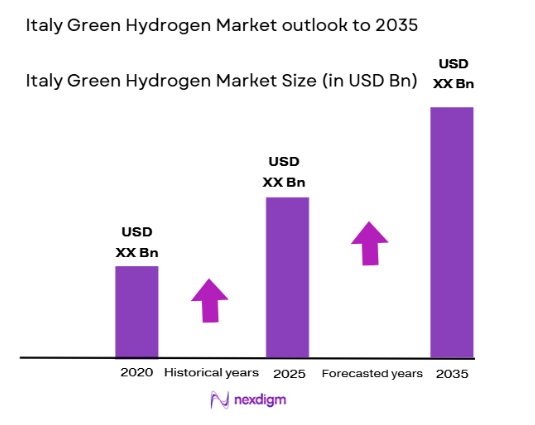
The Italy Green Hydrogen Market is projected to experience significant growth, driven by increasing investments in renewable energy and government incentives aimed at reducing carbon emissions. Based on a recent historical assessment, the market size is expected to reach USD ~ billion, primarily propelled by rising demand for clean energy solutions, technological advancements in hydrogen production, and strategic infrastructure development. Green hydrogen plays a key role in Italy’s decarbonization strategy, addressing industrial, transport, and energy sector needs.
Italy’s dominant cities such as Milan, Turin, and Rome are leading the adoption of green hydrogen technologies due to their strategic location, industrial base, and strong policy support. These cities serve as hubs for research and development, fostering innovation in energy solutions. Their prominence is further supported by collaborations between public and private sectors, pushing Italy to become a key player in the European hydrogen market. Furthermore, the Italian government’s commitment to renewable energy and sustainable development has solidified the country’s position as a leader in the global transition toward hydrogen.
Market Segmentation
By System Type:
Italy Green Hydrogen Market is segmented by system type into electrolyzers, green hydrogen production systems, storage systems, distribution systems, and fuel cells. Recently, electrolyzers have a dominant market share due to the growing shift towards water electrolysis technology for large-scale green hydrogen production. Electrolyzers are crucial for producing hydrogen by using renewable electricity, particularly from solar and wind sources. This sub-segment benefits from increasing government support, advancements in electrolysis technology, and the need for cost-efficient production methods to meet decarbonization targets. As demand for hydrogen solutions in the energy and transportation sectors grows, electrolyzers remain the preferred choice for sustainable production. 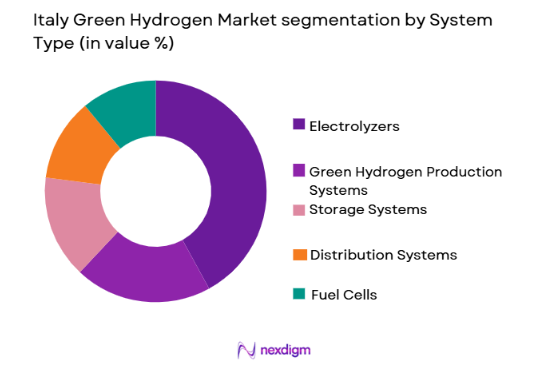
By Platform Type:
Italy Green Hydrogen Market is segmented by platform type into onshore platforms, offshore platforms, transportation platforms, industrial platforms, and commercial platforms. Recently, onshore platforms have a dominant market share, driven by their proximity to renewable energy sources, cost-effectiveness, and easier scalability compared to offshore platforms. Onshore platforms benefit from Italy’s geographical advantage, with its vast areas of wind and solar resources. The Italian government’s focus on reducing dependency on fossil fuels has accelerated the development of these platforms, further cementing onshore platforms’ leadership in green hydrogen production.
Competitive Landscape
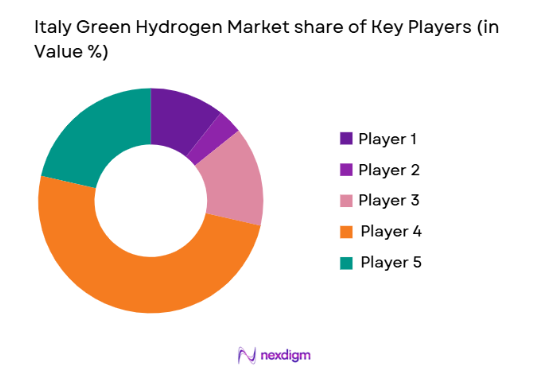
The competitive landscape of the Italy Green Hydrogen Market is marked by the presence of numerous international and local players aiming to capitalize on the growing demand for clean energy solutions. Major players are engaged in mergers and acquisitions to consolidate market presence and scale up their capabilities. The market is heavily influenced by the increasing involvement of large multinational corporations in renewable energy projects, which significantly impact the development of green hydrogen infrastructure in Italy. Key players are also focusing on technological innovations to improve hydrogen production efficiency and reduce costs.
| Company Name | Establishment Year | Headquarters | Technology Focus | Market Reach | Key Products | Revenue (USD Billion) | R&D Investment |
| Enel Green Power | 2008 | Rome, Italy | ~ | ~ | ~ | ~ | ~ |
| Snam | 1941 | Milan, Italy | ~ | ~ | ~ | ~ | ~ |
| Air Liquide | 1902 | Paris, France | ~ | ~ | ~ | ~ | ~ |
| Siemens | 1847 | Munich, Germany | ~ | ~ | ~ | ~ | ~ |
| Linde | 1879 | Guildford, UK | ~ | ~ | ~ | ~ | ~ |
Italy Green Hydrogen Market Analysis
Growth Drivers
Government Policy Support for Renewable Energy:
Government policies in Italy are one of the strongest drivers for the growth of the green hydrogen market. The Italian government has laid out ambitious decarbonization goals, supported by funding for renewable energy projects, including green hydrogen. The country’s Green Deal, part of its broader commitment to the European Union’s clean energy transition, has provided a favorable regulatory environment for hydrogen development. Furthermore, tax incentives and subsidies for hydrogen production technologies have increased private sector investment, further driving the market’s growth. As Italy works to meet its climate goals, the role of hydrogen as a clean alternative to natural gas and other fossil fuels has become increasingly central to its energy strategy. With hydrogen identified as essential to Italy’s energy mix, government initiatives continue to propel market expansion.
Technological Advancements in Electrolysis:
Technological advancements in electrolyzer technologies have significantly contributed to the growth of the green hydrogen market in Italy. Innovations in water electrolysis processes have led to a considerable reduction in production costs, making green hydrogen more economically viable. Electrolyzers that use renewable energy sources like solar and wind to produce hydrogen have become a key focus of both public and private investment. With advances in efficiency, scalability, and cost reduction, electrolyzers are poised to remain at the forefront of Italy’s green hydrogen market. Additionally, the rise of new materials and more efficient designs is expected to drive down the cost of electrolysis, making hydrogen a competitive alternative to conventional energy sources.
Market Challenges
High Capital Investment for Infrastructure Development:
One of the key challenges in the growth of the green hydrogen market in Italy is the high capital investment required for infrastructure development. Building production facilities, storage systems, and distribution networks for green hydrogen involves significant upfront costs, which can hinder widespread adoption. Although government incentives and private-sector funding are helping to address this challenge, the initial investment remains a barrier to rapid deployment. The complexity of developing integrated hydrogen ecosystems, from production to transportation, also increases the cost, limiting the ability of smaller players to enter the market. As the market matures, overcoming this cost hurdle will be critical for scaling green hydrogen solutions across Italy.
Regulatory and Compliance Barriers:
Navigating regulatory and compliance challenges is another obstacle for the green hydrogen market in Italy. While the Italian government has made strides in creating a supportive regulatory environment for renewable energy, inconsistent regulations and the lack of a unified European framework for hydrogen still pose challenges. In addition, ensuring compliance with environmental standards and meeting certification requirements for green hydrogen production can slow down the market’s progress. Overcoming these regulatory barriers is essential to facilitate smoother market expansion and encourage foreign and domestic investments in green hydrogen technologies.
Opportunities
Integration with Renewable Energy Projects:
An important opportunity for the green hydrogen market in Italy is the integration of hydrogen production with renewable energy projects. Italy’s vast solar and wind resources provide a unique opportunity to produce green hydrogen in combination with renewable electricity generation. By using excess renewable energy for hydrogen production, Italy can create a more flexible and sustainable energy grid. This synergy not only supports decarbonization efforts but also ensures more efficient use of renewable energy, reducing waste. The increasing push for energy storage solutions also presents an opportunity to combine hydrogen with energy storage technologies, making the grid more resilient and further driving the adoption of green hydrogen.
Partnerships Between Private Tech Firms and Government Bodies:
Collaboration between private tech firms and government bodies is another significant opportunity for the growth of the green hydrogen market in Italy. As the government continues to prioritize sustainable energy development, partnerships with technology companies can help accelerate the deployment of hydrogen production and distribution infrastructure. These collaborations can help drive technological innovation, reduce costs, and ensure that Italy meets its decarbonization goals. By leveraging expertise from both sectors, Italy can foster an environment that encourages investment in green hydrogen and supports the scaling of hydrogen technologies.
Future Outlook
The future outlook for the Italy Green Hydrogen Market over the next five years remains promising, with significant growth expected as the country continues to implement its green energy strategy. Technological innovations in electrolyzer efficiency and hydrogen storage, coupled with strong government support for renewable energy, will drive market expansion. The growing adoption of green hydrogen in transportation and industrial applications, supported by advancements in infrastructure, is expected to accelerate the market’s growth. Additionally, Italy’s strategic position within the European Union will facilitate greater integration with European hydrogen networks, expanding market opportunities across the continent.
Major Players
- Enel Green Power
- Snam
- Air Liquide
- Siemens
- Linde
- McPhy
- Hydrogenics
- Nel ASA
- Shell
- TotalEnergies
- ITM Power
- Engie
- Iberdrola
- Ballard Power Systems
- Plug Power
Key Target Audience
- Investments and venture capitalist firms
- Government and regulatory bodies
- Energy producers
- Hydrogen technology developers
- Automotive manufacturers
- Industrial manufacturers
- Environmental organizations
- Research institutions
Research Methodology
Step 1: Identification of Key Variables
Identification of the key factors driving the market, such as government policies, technological advancements, and infrastructure developments.
Step 2: Market Analysis and Construction
In-depth analysis of historical market data, segmentation, and growth drivers to create a reliable market model.
Step 3: Hypothesis Validation and Expert Consultation
Consultation with industry experts and stakeholders to validate market assumptions and refine the model.
Step 4: Research Synthesis and Final Output
Synthesis of collected data, expert insights, and statistical analysis to produce the final report.

- Executive Summary
- Research Methodology (Definitions, Scope, Industry Assumptions, Market Sizing Approach, Primary & Secondary Research Framework, Data Collection & Verification Protocol, Analytic Models & Forecast Methodology, Limitations & Research Validity Checks)

- Market Definition and Scope
- Value Chain & Stakeholder Ecosystem
- Regulatory / Certification Landscape
- Sector Dynamics Affecting Demand
- Strategic Initiatives & Infrastructure Growth

- Growth Drivers
Government Policy Support for Renewable Energy
Technological Advancements in Electrolysis
Rising Demand for Clean Energy Solutions
Expansion of Green Hydrogen Infrastructure
Corporate Commitments to Carbon Neutrality - Market Challenges
High Capital Investment for Infrastructure
Regulatory Barriers and Standards Development
Technological Limitations in Hydrogen Storage
Economic Feasibility of Green Hydrogen Production
Logistical Challenges in Distribution - Market Opportunities
Integration with Renewable Energy Projects
Increase in Carbon Pricing and Emission Regulations
Technological Innovation in Hydrogen Fuel Cells - Trends
Growth of Green Hydrogen in Transport Sector
Public and Private Sector Investments in Green Hydrogen
Innovations in Hydrogen Production Efficiency
Global Expansion of Hydrogen Infrastructure
Collaboration Between Governments and Industry Leaders - Government Regulations & Defense Policy
EU Green Deal and Hydrogen Strategy
Incentives for Renewable Energy Adoption
National Hydrogen Roadmap for Italy - SWOT Analysis
- Stakeholder and Ecosystem Analysis
- Porter’s Five Forces Analysis
- Competition Intensity and Ecosystem Mapping

- By Market Value, 2020-2025
- By Installed Units, 2020-2025
- By Average System Price, 2020-2025
- By System Complexity Tier, 2020-2025

- By System Type (In Value%)
Electrolyzers
Green Hydrogen Production Systems
Storage Systems
Distribution Systems
Fuel Cells - By Platform Type (In Value%)
Onshore Platforms
Offshore Platforms
Transportation Platforms
Industrial Platforms
Commercial Platforms - By Fitment Type (In Value%)
On-site Production
Off-site Production
Mobile Solutions
Integrated Solutions
Decentralized Solutions - By EndUser Segment (In Value%)
Energy Producers
Transportation Companies
Industrial Manufacturers
Government & Regulatory Bodies
Research Institutions - By Procurement Channel (In Value%)
Direct Procurement
Government Tenders
Third-party Distributors
Online Procurement Platforms
Private Sector Procurement - By Material / Technology (In Value%)
Electrolyzer Technologies
Hydrogen Storage Materials
Fuel Cell Technologies
Renewable Energy Integration Technologies
Advanced Filtration Materials

- Market structure and competitive positioning
- Market share snapshot of major players
- CrossComparison Parameters (Electrolyzers, Green Hydrogen Production Systems, Hydrogen Storage, Distribution Systems, Fuel Cells, Platform Type, Fitment Type, Procurement Channel, EndUser Segment, Technology)
- SWOT Analysis of Key Players
- Pricing & Procurement Analysis
- Key Players
Enel Green Power
Snam
Hydrogenics
Nel ASA
Air Liquide
Iveco
H2 Mobility
Siemens
Bosch
ABB
Linde
McPhy
Shell
TotalEnergies
Tesla

- Energy Sector’s Shift Towards Sustainable Solutions
- Transportation Industry’s Adoption of Hydrogen Fuel
- Industrial Sector’s Demand for Low-carbon Technologies
- Government’s Role in Shaping Market Growth

- Forecast Market Value, 2026-2035
- Forecast Installed Units, 2026-2035
- Price Forecast by System Tier, 2026-2035
- Future Demand by Platform, 2026-2035


 Request a Sample
 Ask for Customization
 Get a Quote
 Enquire Now