
 Download PDF
Market Overview
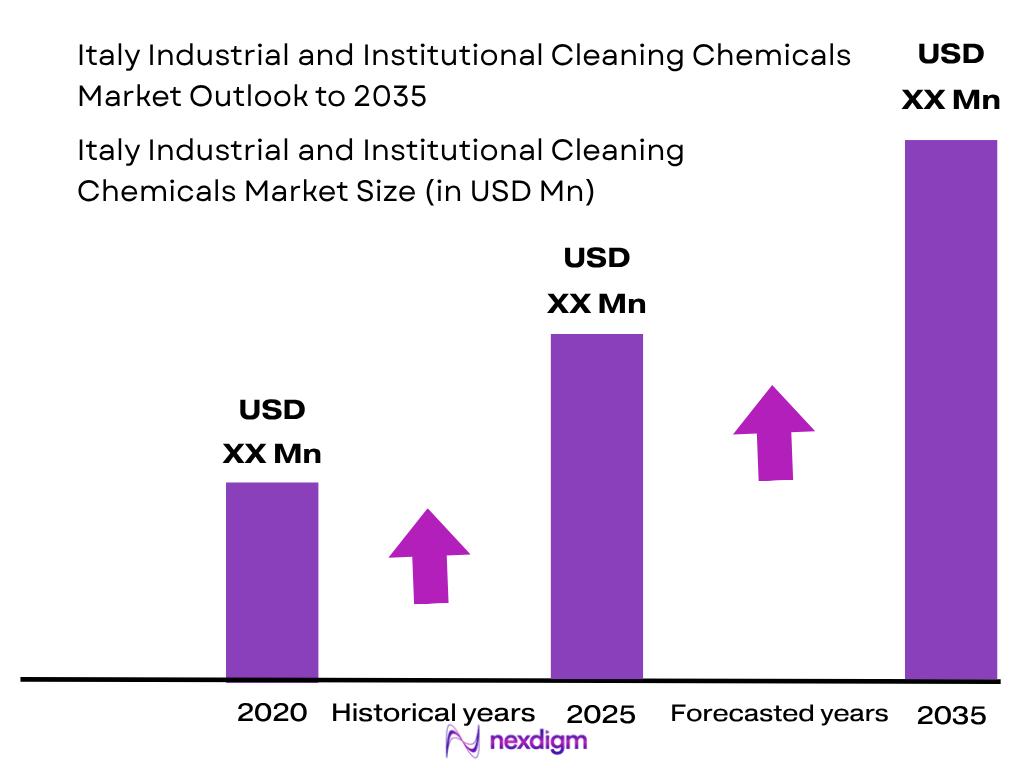
The Italy Industrial and Institutional Cleaning Chemicals Market is valued at approximately ~USD billion, supported by demand from healthcare facilities, food processing units, manufacturing plants, hospitality establishments, and professional cleaning service providers. The market expansion is driven by increasing hygiene compliance requirements, adoption of sustainable formulations, and growth of outsourced facility management services. Industry reports indicate that Italy’s I&I cleaning chemicals sector has maintained steady growth due to regulatory-driven sanitation demand and industrial activity.
The Italy Industrial and Institutional Cleaning Chemicals Market is concentrated around major industrial and commercial hubs including Milan, Turin, Bologna, Rome, and Venice due to their strong manufacturing base, healthcare infrastructure, hospitality activity, and commercial facility density. Northern Italy demonstrates strong demand because of its concentration of automotive, machinery, food processing, and chemical manufacturing industries. Central and southern regions contribute through tourism, healthcare networks, and institutional cleaning requirements.
Market Segmentation
By Product Type
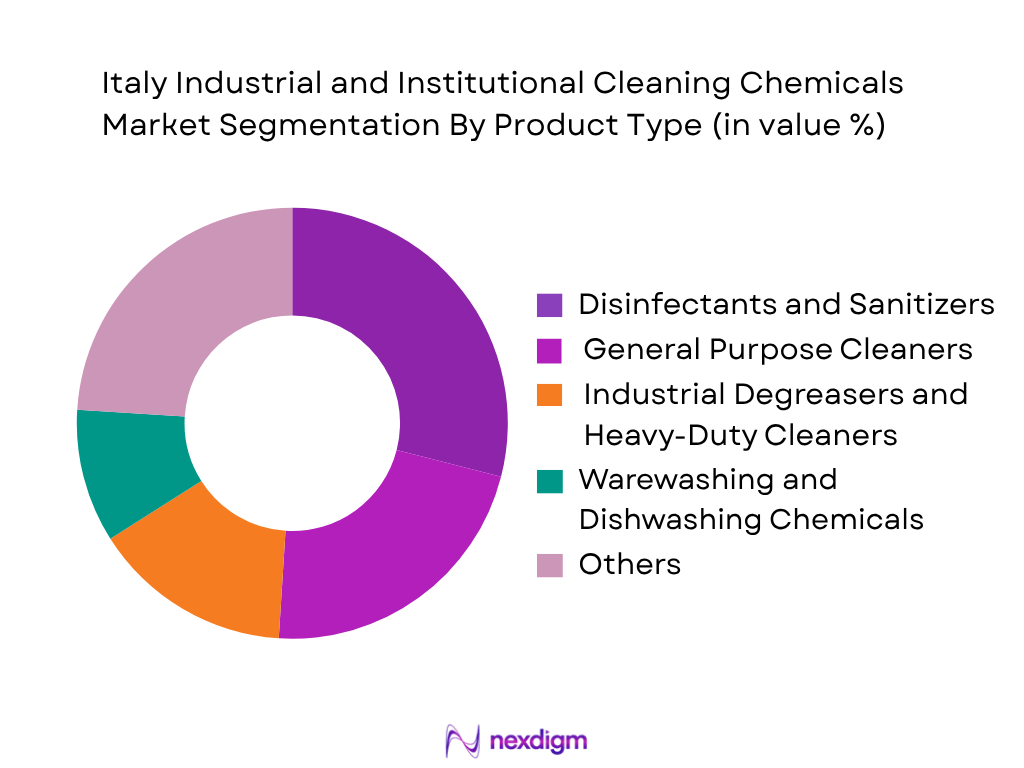
The Italy Industrial and Institutional Cleaning Chemicals Market is segmented by product type into general purpose cleaners, disinfectants and sanitizers, industrial degreasers, warewashing chemicals, laundry care chemicals, floor care chemicals, vehicle wash chemicals, food processing cleaning chemicals, healthcare cleaning chemicals, specialty industrial cleaning chemicals, and surface cleaners. Recently, disinfectants and sanitizers hold a leading position within the product segmentation due to increasing hygiene requirements across healthcare facilities, food processing environments, and institutional buildings. Healthcare infection prevention standards, food safety regulations, and workplace sanitation requirements continue to support demand for high-performance disinfectant formulations. General purpose cleaners maintain strong consumption due to widespread usage across commercial facilities, offices, and public institutions, while specialty cleaning chemicals are gaining adoption among manufacturing and pharmaceutical industries requiring application-specific solutions.
By End-Use Industry
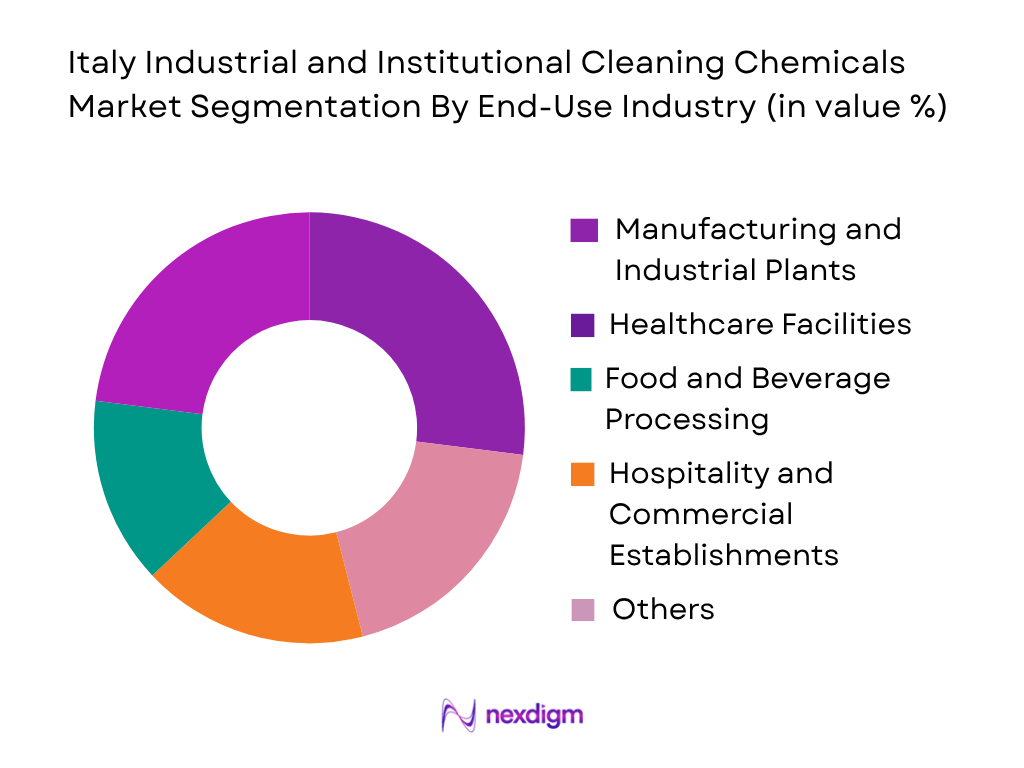
The Italy Industrial and Institutional Cleaning Chemicals Market is segmented by end-use industry into healthcare facilities, food and beverage processing, manufacturing plants, hospitality establishments, educational institutions, retail facilities, transportation facilities, pharmaceutical manufacturing, and government institutions. Manufacturing and industrial facilities represent a dominant segment due to Italy’s extensive industrial ecosystem, including automotive, machinery, metal processing, and precision engineering industries requiring regular cleaning and maintenance chemicals. Food and beverage processing also contributes significantly because of strict hygiene protocols and sanitation requirements. Healthcare facilities represent a high-value demand segment due to infection control requirements and continuous consumption of disinfectants. Hospitality demand remains important due to Italy’s tourism industry, which drives consumption of laundry chemicals, kitchen cleaning solutions, and surface maintenance products.
Competitive Landscape
The Italy Industrial and Institutional Cleaning Chemicals Market is moderately consolidated, with international hygiene solution providers and domestic chemical manufacturers competing across product innovation, sustainability, distribution strength, and technical service capabilities. Global companies such as Ecolab, Diversey, Henkel, and Kärcher maintain strong positions through extensive professional hygiene portfolios, while Italian manufacturers compete through customized formulations, regional distribution networks, and specialized cleaning solutions.
| Company | Establishment Year | Headquarters | Product Portfolio | Industrial Cleaning Capability | Sustainability Focus | Distribution Network | Technical Support | Innovation Capability |
| Ecolab | 1923 | St. Paul, USA | ~ | ~ | ~ | ~ | ~ | ~ |
| Diversey | 1923 | Fort Mill, USA | ~ | ~ | ~ | ~ | ~ | ~ |
| Henkel | 1876 | Düsseldorf, Germany | ~ | ~ | ~ | ~ | ~ | ~ |
| Kärcher | 1935 | Winnenden, Germany | ~ | ~ | ~ | ~ | ~ | ~ |
| Sutter Professional | 1858 | Borghetto di Borbera, Italy | ~ | ~ | ~ | ~ | ~ | ~ |
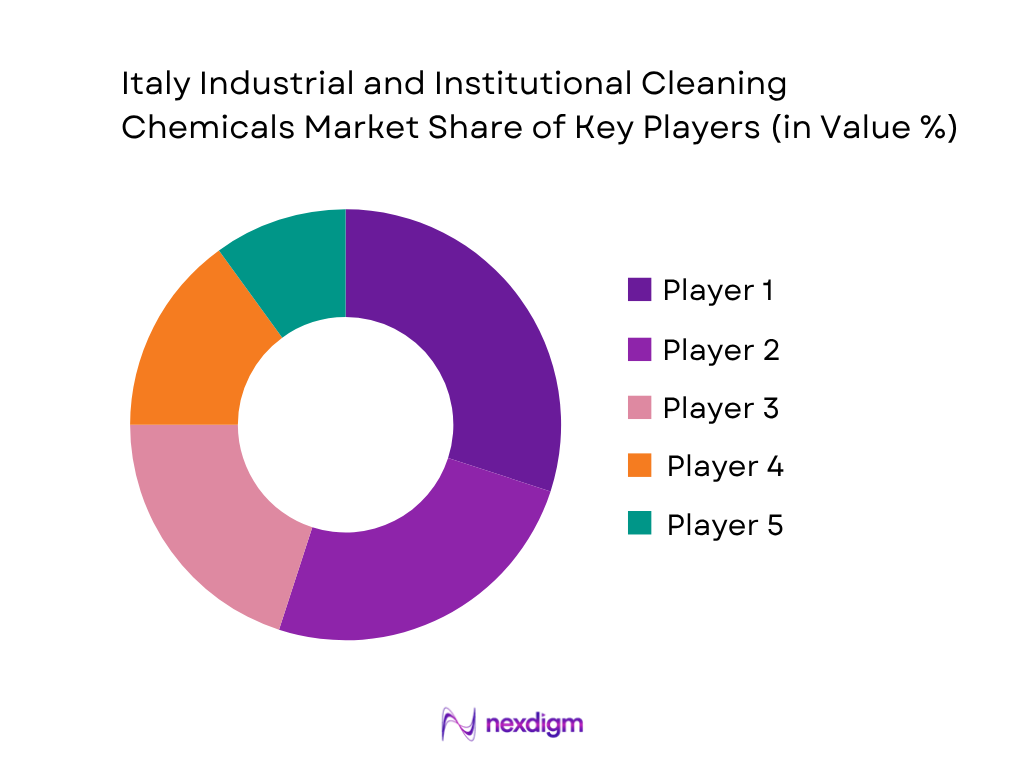
Italy Industrial and Institutional Cleaning Chemicals Market Analysis
Growth Drivers
Expansion of Industrial Manufacturing and Food Processing Activities
The Italy Industrial and Institutional Cleaning Chemicals Market is supported by the country’s strong industrial ecosystem, where manufacturing facilities require continuous cleaning, maintenance, and sanitation solutions. Italy recorded an industry value addition equivalent to 21.71% of GDP, reflecting the significant contribution of industrial activities to the national economy. The country remains one of Europe’s largest manufacturing hubs, particularly in machinery, automotive components, pharmaceuticals, chemicals, and food processing, creating sustained demand for industrial cleaning chemicals such as degreasers, alkaline cleaners, specialty formulations, and equipment sanitation solutions. Northern industrial regions including Lombardy, Veneto, Emilia-Romagna, and Piedmont remain major consumption centers due to their dense concentration of production facilities. The food and beverage sector further strengthens demand as Italy maintains a large agri-food ecosystem, where hygiene compliance and sanitation protocols require frequent use of cleaning chemicals across processing plants. In addition, Italy’s manufacturing base includes thousands of small and medium-sized enterprises that require outsourced cleaning solutions and specialized chemical applications. These industrial requirements continue to increase demand for professional-grade cleaning products designed for machinery maintenance, surface hygiene, and operational safety.
Rising Hygiene Requirements Across Healthcare, Hospitality, and Institutional Facilities
The Italy Industrial and Institutional Cleaning Chemicals Market is benefiting from increasing hygiene requirements across healthcare facilities, hospitality establishments, commercial buildings, and public institutions. Italy’s healthcare infrastructure includes a large network of hospitals and healthcare facilities that require continuous consumption of disinfectants, sanitizers, surface cleaners, and infection-control chemicals. The country’s service sector also supports institutional cleaning demand, with tourism playing an important role in generating requirements for professional hygiene solutions. Italy’s travel and tourism sector contributed approximately €215 billion to the economy, representing 10.5% of national economic output, increasing cleaning chemical demand from hotels, restaurants, catering facilities, and tourism accommodation providers. Additionally, Italy’s population of nearly 59 million people creates consistent demand for public infrastructure hygiene management, including schools, transport facilities, and government buildings. The growing adoption of professional cleaning services, stricter sanitation procedures, and regulatory emphasis on workplace safety are encouraging institutional buyers to shift toward specialized chemical formulations rather than conventional household cleaning products. This transition supports demand for concentrated cleaners, sustainable disinfectants, and application-specific hygiene solutions.
Market Challenges
Dependence on Specialty Chemical Imports and Raw Material Supply Volatility
The Italy Industrial and Institutional Cleaning Chemicals Market faces challenges due to dependence on imported specialty chemical ingredients and fluctuations in global raw material availability. Cleaning chemical production requires several inputs including surfactants, solvents, biocides, enzymes, and specialty additives, many of which are influenced by international supply chains and energy markets. Italy’s industrial sector remains highly integrated with European and global chemical supply networks, making manufacturers exposed to external disruptions affecting chemical availability. The country’s industrial production experienced pressure, with industrial output declining by 3.3% during the first nine months of 2024 compared with the previous year, reflecting broader manufacturing challenges that can influence chemical demand patterns and supplier operations. Energy-intensive chemical manufacturing processes also create operational challenges as electricity and natural gas costs influence production efficiency. Smaller domestic formulators face additional pressure due to limited bargaining power compared with multinational chemical producers. These factors encourage manufacturers to optimize formulations, strengthen supplier relationships, and increase investment in alternative raw materials. However, maintaining consistent quality while managing supply chain uncertainty remains a major challenge for cleaning chemical producers serving industrial and institutional customers.
Increasing Regulatory Compliance and Sustainability Requirements
The Italy Industrial and Institutional Cleaning Chemicals Market faces increasing complexity due to strict European environmental and chemical safety regulations. Manufacturers must comply with requirements related to chemical classification, labeling, biodegradability, occupational safety, and environmental impact management. Regulations governing chemical substances require companies to invest in formulation development, testing procedures, documentation, and sustainable product innovation. Italy’s alignment with European environmental objectives is increasing demand for low-impact formulations while simultaneously raising compliance requirements for manufacturers. Industrial and institutional buyers are increasingly evaluating cleaning chemicals based on sustainability factors such as reduced hazardous content, responsible packaging, and environmental certifications. These requirements create challenges especially for smaller manufacturers that have limited resources for research, certification, and product reformulation. The transition from traditional chemical formulations toward bio-based and environmentally preferable products requires investment in alternative ingredients and production technologies. Additionally, Italy’s industrial sector contributes significantly to the economy, with industry accounting for 21.71% of GDP, meaning regulatory changes affecting chemical usage can influence a broad range of manufacturing and institutional users.
Market Opportunities
Growing Adoption of Sustainable and Bio-Based Cleaning Formulations
The Italy Industrial and Institutional Cleaning Chemicals Market has significant opportunities through increasing adoption of sustainable cleaning solutions driven by environmental priorities and institutional procurement requirements. Demand is shifting toward biodegradable formulations, low-VOC chemicals, concentrated products, and reduced-water cleaning systems as organizations seek to improve sustainability performance. Italy’s broader environmental transition initiatives and industrial sustainability focus are encouraging companies to adopt greener operational practices. The country’s manufacturing sector, which contributes 21.71% of GDP through industrial value addition, represents a large opportunity for sustainable industrial cleaning solutions that reduce chemical consumption and improve workplace safety. Food processing, hospitality, and healthcare organizations are increasingly interested in cleaning products that maintain hygiene performance while reducing environmental impact. Bio-based surfactants, enzyme-based cleaners, and eco-certified disinfectants provide opportunities for manufacturers to differentiate their product portfolios. Sustainable packaging solutions and refill-based chemical delivery models are also gaining relevance among professional cleaning providers and facility management companies. Companies that develop environmentally responsible formulations combined with technical support services can address the increasing expectations of institutional buyers seeking both operational efficiency and sustainability compliance.
Expansion of Professional Hygiene Services and Advanced Cleaning Technologies
The Italy Industrial and Institutional Cleaning Chemicals Market presents opportunities through the expansion of professional cleaning services, digital chemical management systems, and automated dispensing technologies. Growth in hospitality, healthcare, commercial infrastructure, and industrial outsourcing is increasing demand for integrated hygiene programs rather than standalone cleaning products. Italy’s tourism sector generated €215 billion in economic contribution, supporting opportunities for hotel chains, restaurants, and tourism-related facilities to adopt advanced cleaning systems. Professional cleaning providers are increasingly seeking concentrated chemicals, automated dosing equipment, and application-specific solutions that improve efficiency and reduce operational waste. Manufacturing industries are also adopting specialized cleaning programs for machinery, production lines, and sensitive equipment where conventional chemicals are insufficient. Digital monitoring systems, smart dispensers, and data-based hygiene management platforms create additional opportunities by enabling organizations to track chemical usage and improve compliance. The presence of a large manufacturing base, including machinery, pharmaceutical, automotive, and food processing industries, provides a strong foundation for customized industrial cleaning solutions. Manufacturers combining chemical expertise with technology-enabled services are positioned to capture emerging demand from institutional and industrial customers.
Future Outlook
Over the next decade, the Italy Industrial and Institutional Cleaning Chemicals Market is expected to witness stable growth driven by increasing hygiene regulations, expansion of professional cleaning services, rising adoption of sustainable formulations, and demand for advanced sanitation solutions across healthcare, food processing, hospitality, and manufacturing sectors. Growth will increasingly shift toward concentrated chemicals, automated dosing systems, bio-based formulations, and specialized cleaning programs designed to improve operational efficiency and reduce environmental impact.
The market is expected to benefit from stronger adoption of green cleaning technologies and compliance-driven product innovation under European environmental regulations. Manufacturers focusing on low-VOC chemicals, biodegradable ingredients, and resource-efficient cleaning systems are expected to gain competitive advantage as institutional buyers increasingly prioritize sustainability alongside cleaning performance.
Major Players
- Ecolab Italia
- Diversey Italia
- Henkel Italia
- Kärcher Italia
- S.C. Johnson Professional Italia
- Christeyns Italia
- Werner & Mertz Professional
- Sutter Professional
- Italchimica
- Kiter
- Madel
- Kemika
- Fila Industria Chimica
- Nilfisk Italia
- Buzil Italia
Key Target Audience
- Chemical Manufacturers and Formulators
- Facility Management and Professional Cleaning Service Providers
- Food Processing and Beverage Companies
- Healthcare Organizations and Hospital Networks
- Hospitality and Tourism Operators
- Investments and Venture Capitalist Firms
- Government and Regulatory Bodies
- Industrial Procurement and Distribution Companies
Research Methodology
Step 1: Identification of Key Variables
The initial phase involves developing a comprehensive ecosystem map of the Italy Industrial and Institutional Cleaning Chemicals Market, covering manufacturers, raw material suppliers, distributors, facility management companies, and end-use industries. This stage includes extensive secondary research through industry databases, regulatory sources, company publications, and trade information to identify market variables influencing demand, supply, and competitive positioning.
Step 2: Market Analysis and Construction
In this phase, historical market information is collected and analyzed across product categories, chemical compositions, end-use industries, and distribution channels. The analysis evaluates industrial consumption patterns, institutional hygiene requirements, import dependency, manufacturing capacity, and pricing structures to establish a detailed market framework.
Step 3: Hypothesis Validation and Expert Consultation
Market assumptions and preliminary findings are validated through primary discussions with industry stakeholders, including chemical manufacturers, distributors, facility management companies, and institutional buyers. Expert consultations provide insights into formulation trends, procurement behavior, regulatory impact, and future adoption patterns.
Step 4: Research Synthesis and Final Output
The final stage integrates primary and secondary research findings using data triangulation techniques. Market estimates are validated through supply-side and demand-side assessments, competitor benchmarking, product analysis, and industry-level evaluation to create a comprehensive outlook of the Italy Industrial and Institutional Cleaning Chemicals Market.

- Executive Summary
- Research Methodology (Market Definitions and Scope, Italy Industrial and Institutional Cleaning Chemicals Taxonomy, Industrial Cleaning Chemical Classification, Institutional Cleaning Chemical Classification, Professional Hygiene Solution Mapping, Cleaning Chemical Application Framework, Raw Material Assessment, Sustainable Cleaning Chemistry Evaluation, Market Sizing Framework, Top-Down Analysis, Bottom-Up Analysis, Domestic Manufacturing Assessment, Import Dependency Assessment, Demand-Side Assessment)

- Definition and Scope
- Italy Industrial and Institutional Cleaning Chemicals Industry Evolution and Professional Hygiene Development
- Industrial and Institutional Cleaning Chemicals Manufacturing and Formulation Process
- Cleaning Chemicals Value Chain Analysis
- Italy Industrial and Institutional Cleaning Chemicals Supply Chain Analysis
- Cleaning Chemical Raw Material Ecosystem Analysis
- Italy Cleaning Chemicals Import Dependency and Localization Assessment
- Industrial Cleaning Application Architecture and Institutional Hygiene Solution Framework

- Growth Drivers (Expansion of Manufacturing Activities, Increasing Healthcare Hygiene Requirements, Growth of Hospitality and Tourism Sector, Rising Demand for Professional Cleaning Services, Increasing Adoption of Sustainable Cleaning Solutions)
- Market Challenges (Raw Material Cost Volatility, Dependence on Imported Specialty Chemicals, Fragmented Distributor Landscape, High Cost of Sustainable Cleaning Formulations, Regulatory Compliance Requirements, Price Competition Among Local Manufacturers)
- Market Opportunities (Bio-Based Cleaning Chemicals, EU Ecolabel Certified Products, Smart Chemical Dispensing Systems, Digital Cleaning Management Solutions, Customized Industrial Cleaning Programs)
- Market Trends (Low-VOC Cleaning Chemicals, Concentrated Product Adoption, Eco-Friendly Formulations, Automated Chemical Dosing Systems, Water-Saving Cleaning Technologies, Advanced Disinfection Solutions, Sustainable Packaging Solutions, Hygiene Monitoring Technologies)
- Regulatory and Standards Landscape (European REACH Regulation Compliance, CLP Classification Requirements, Biocidal Product Regulation, EU Ecolabel Standards, Occupational Chemical Safety Regulations, Environmental Protection Requirements, Waste Management Regulations, Industrial Hygiene Standards)
- SWOT Analysis
- Porter’s Five Forces Analysis
- PESTLE Analysis
- Stakeholder Ecosystem
- Competition Ecosystem

- By Market Value (2020-2025)
- By Cleaning Chemical Consumption Volume (2020-2025)
- By Domestic Production Volume (2020-2025)
- By Import Volume (2020-2025)
- By Export Volume (2020-2025)
- By Average Selling Price (2020-2025)
- By Industrial Facility Chemical Consumption Intensity (2020-2025)
- By Institutional Facility Chemical Consumption Intensity (2020-2025)

- By Product Type (In Value %)
General Purpose Cleaners
Disinfectants and Sanitizers
Industrial Degreasers and Heavy-Duty Cleaners
Warewashing and Dishwashing Chemicals
Laundry Care Chemicals
Floor Care Chemicals
Vehicle Wash Chemicals
Food Processing Cleaning Chemicals
Healthcare Cleaning Chemicals
Specialty Industrial Cleaning Chemicals
Surface and Glass Cleaning Chemicals - By Raw Material Type (In Value %)
Surfactants
Chlor-Alkali Chemicals
Solvents
Biocides
Phosphates
Enzymes
Acids and Alkalis
Chelating Agents
Fragrances and Preservatives
Bio-Based Raw Materials - By End-Use Industry (In Value %)
Food and Beverage Processing
Healthcare Facilities
Manufacturing and Industrial Plants
Hospitality and Commercial Establishments
Educational Institutions
Retail Facilities
Transportation and Logistics Facilities
Pharmaceutical Manufacturing
Automotive and Engineering Facilities
Government and Public Institutions - By Distribution Channel (In Value %)
Direct Manufacturer Sales
Industrial Chemical Distributors
Professional Cleaning Product Distributors
Facility Management Companies
Janitorial Supply Providers
B2B Digital Platforms
Institutional Procurement Contracts
Specialty Hygiene Solution Providers - By Region (In Value %)
Northern Italy
Lombardy
Veneto
Piedmont
Emilia-Romagna
Central Italy
Tuscany
Lazio
Marche
Southern Italy
Campania
Apulia
Sicily
Sardinia

- Market Share of Major Players
- Cross Comparison Parameters (Product Portfolio Breadth, Industrial Cleaning Chemical Capability, Institutional Hygiene Solution Coverage, Manufacturing and Blending Capacity, Distribution Network Reach, Sustainable Cleaning Technology Capability, Technical Service Support Strength, Formulation Innovation Capability)
- SWOT Analysis of Major Players
- Competitive Positioning Matrix
- Pricing and Distribution Network Benchmarking
- Detailed Profiles of Major Companies
Ecolab Italia
Diversey Italia
Henkel Italia
Kärcher Italia
S.C. Johnson Professional Italia
Christeyns Italia
Werner & Mertz Professional Italia
Kiter
Italchimica
Madel
Kemika
Sutter Professional
Vileda Professional Italia
Nilfisk Italia
Buzil Italia

- Buyer Segmentation
- Procurement Behaviour
- Supplier Selection Criteria
- Buyer Pain Points
- Technology Adoption Assessment
- Replacement and Repurchase Behaviour

- By Market Value (2026-2035)
- By Cleaning Chemical Consumption Volume (2026-2035)
- By Domestic Production Volume (2026-2035)
- By Import Volume (2026-2035)
- By Export Volume (2026-2035)
- By Average Selling Price (2026-2035)
- By Industrial Facility Chemical Consumption Intensity (2026-2035)
- By Institutional Facility Chemical Consumption Intensity (2026-2035)


 Request a Sample
 Ask for Customization
 Get a Quote
 Enquire Now