
 Download PDF
Market Overview
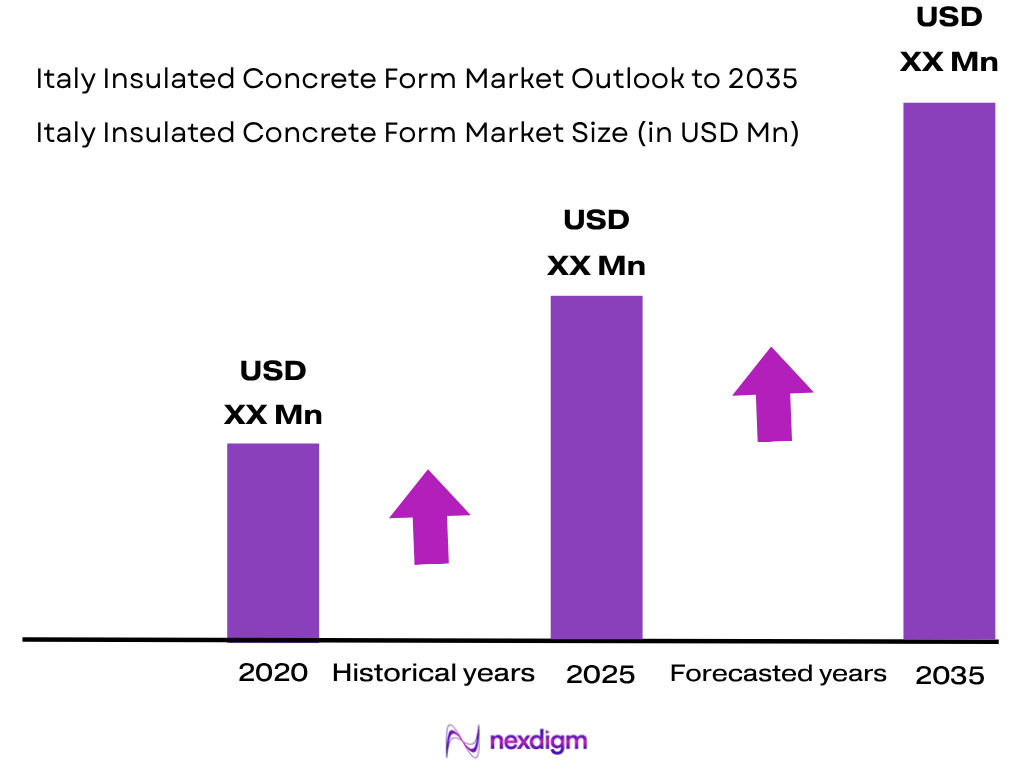
The Italy Insulated Concrete Form Market is valued at approximately USD ~XX million, based on historical construction activity and adoption of permanent insulated formwork. Demand is supported by Italy’s 12.4 million residential buildings, more than 7.4 million of which were built before the country’s first energy-saving legislation, alongside approximately 1.7 million non-residential buildings. Construction investment remains substantial, while tightening energy-performance requirements and seismic-resistance needs support adoption of insulated reinforced-concrete wall systems.
Lombardy, Veneto, Emilia-Romagna, Piedmont and Lazio represent the most influential demand clusters in the Italy Insulated Concrete Form Market because they combine large building stocks, new residential development, industrialized construction capability and strong energy-renovation activity. More than 1.1 million Energy Performance Certificates were registered nationally in the latest comparable period, with Lombardy accounting for around 239,000, Piedmont about 101,000, Veneto approximately 96,000, Emilia-Romagna nearly 94,000 and Lazio around 91,000, reinforcing their importance for high-performance building technologies.
Market Segmentation
By ICF System Architecture
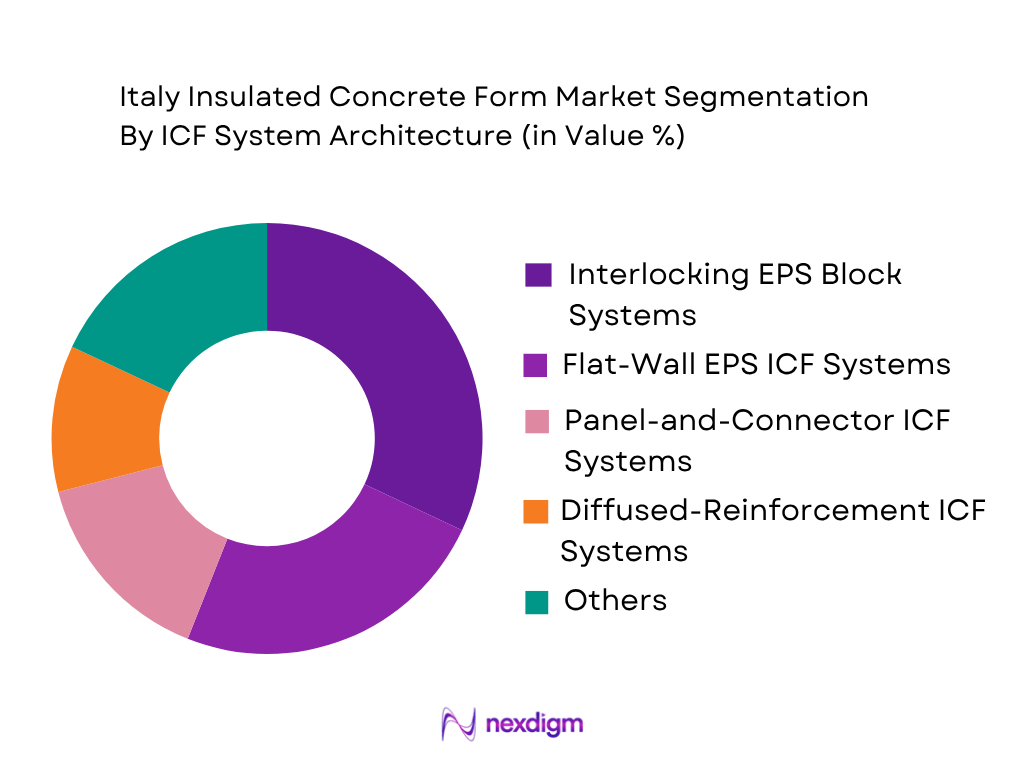
The Italy Insulated Concrete Form Market is segmented into interlocking EPS block systems, flat-wall EPS systems, panel-and-connector systems, diffused-reinforcement systems, wood-cement insulating formwork and integrated wall-and-floor systems. Interlocking EPS block and flat-wall ICF systems hold the dominant market position because they combine permanent thermal insulation with a continuous reinforced-concrete structural core in a single wall assembly. This configuration aligns well with Italian requirements for seismic resilience, thermal-bridge reduction and high building-envelope performance. Domestic companies such as ICF Italia and Pontarolo Engineering have developed EPS-based reinforced-concrete systems specifically targeting energy-efficient and earthquake-resistant construction. ICF Italia’s system is manufactured domestically and uses permanent polystyrene forms for reinforced-concrete load-bearing walls, while Pontarolo’s Climablock platform integrates EPS insulation with structural concrete construction. These systems are especially suitable for detached houses, low-rise residential projects and buildings where design teams seek to simplify the wall build-up while improving thermal continuity and structural performance.
By End-Use Construction
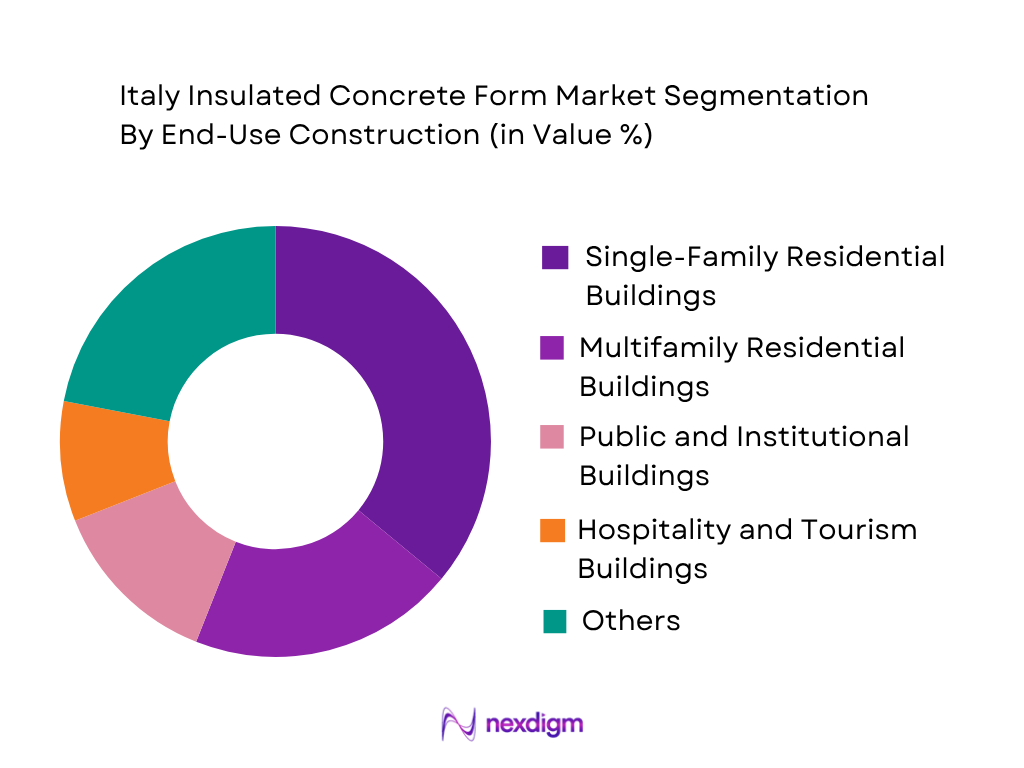
The Italy Insulated Concrete Form Market is segmented into single-family residential buildings, multifamily residential buildings, public and institutional buildings, hospitality developments, commercial buildings, industrial facilities and specialty applications. Single-family residential construction holds the dominant market position because ICF systems are particularly suited to low-rise projects requiring thermal efficiency, airtightness, acoustic protection and reinforced-concrete structural strength. Italy contains 12.4 million residential buildings, creating a substantial addressable construction and replacement ecosystem. Demand is further supported by seismic considerations, since the Department of Civil Protection identifies the entire national territory as seismic, with particularly exposed areas across the north-eastern regions, the Apennine belt, Calabria and eastern Sicily. ICF technology provides continuous reinforced-concrete walls combined with permanent insulation, making it especially relevant for detached houses and small residential developments in areas where energy and seismic performance are evaluated together. Public buildings and schools also provide opportunities because of renovation, energy-efficiency and structural-upgrade requirements.
Competitive Landscape
The Italy Insulated Concrete Form Market is characterized by a specialized group of domestic system manufacturers and construction-technology companies rather than large conventional building-material conglomerates. Competition centers on thermal insulation performance, seismic suitability, EPS or composite-form technology, integrated wall-and-floor solutions, technical design support and installer capability. Domestic companies possess an advantage because Italian projects require close coordination with local structural standards, climatic requirements, seismic design practices and building-energy regulations.
| Major Player | Establishment Year | Headquarters | Core ICF Technology | Insulating Material | Structural System | Seismic Capability | Integrated Floor System | Technical / Design Support |
| ICF Italia | 2010 | Trevi, Umbria | ~ | ~ | ~ | ~ | ~ | ~ |
| Pontarolo Engineering | 1960s heritage | San Vito al Tagliamento, Friuli-Venezia Giulia | ~ | ~ | ~ | ~ | ~ | ~ |
| Poliespanso | 1985 | Mantua, Lombardy | ~ | ~ | ~ | ~ | ~ | ~ |
| Isotex | 1985 | Poviglio, Emilia-Romagna | ~ | ~ | ~ | ~ | ~ | ~ |
| Ecosism | 2005 | Battaglia Terme, Veneto | ~ | ~ | ~ | ~ | ~ | ~ |
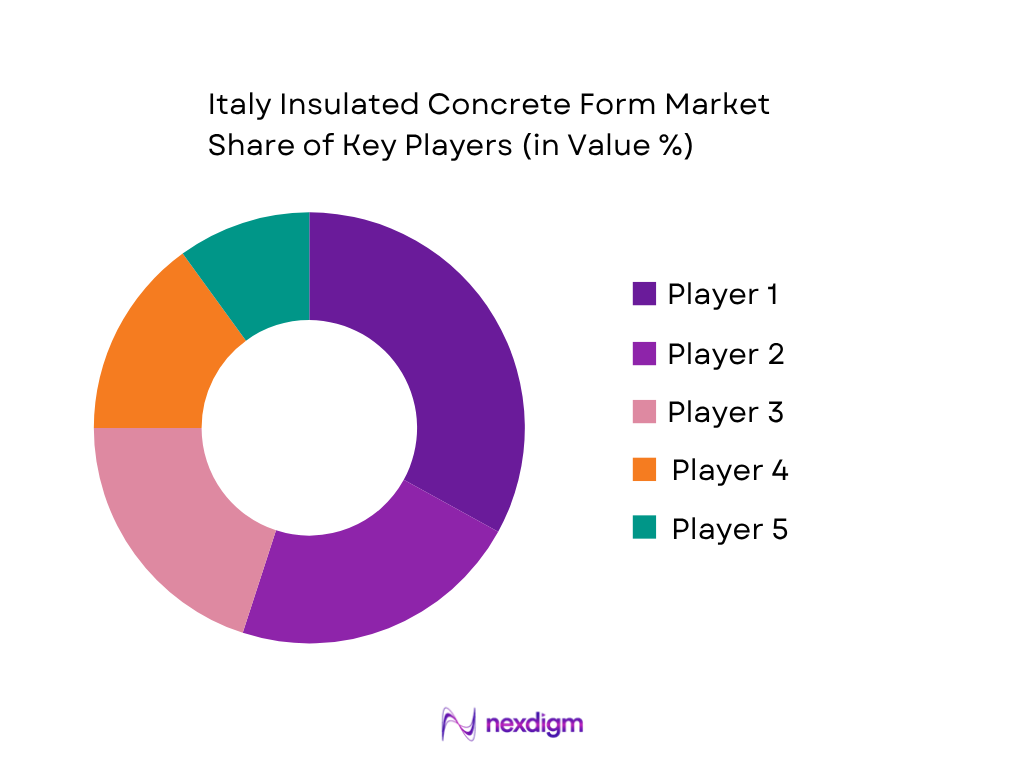
Italy Insulated Concrete Form Market Analysis
Growth Drivers
Seismic-Resistant and High-Performance Building Requirements Strengthening ICF Adoption
Italy’s exposure to seismic risk creates a strong structural driver for the Italy Insulated Concrete Form Market, particularly for systems combining permanent EPS insulation with monolithic reinforced-concrete walls. The Italian Civil Protection Department classifies the country as having medium-high seismic risk and very high vulnerability because of its extensive existing building stock. ENEA’s 2024 assessment identifies 12.4 million residential buildings, 1.7 million non-residential buildings, and approximately 770,000 publicly owned properties, creating a substantial base requiring structural improvement, replacement or energy-linked reconstruction. The Recovery and Resilience framework also allocates EUR 1 billion to replace or reconstruct 166 school buildings covering approximately 400,000 square metres, with seismic safety and energy efficiency among the central objectives. These characteristics directly favor ICF solutions because continuous reinforced-concrete cores can provide lateral-load resistance while permanent insulated forms address envelope performance within the same construction sequence. The macroeconomic environment also provides substantial underlying construction capacity: World Bank data place Italy’s 2024 GDP at USD 2,380.83 billion and GDP per capita at USD 40,385.3, supporting investment in higher-specification residential and institutional construction technologies.
Energy-Efficient Construction and Continuous Insulation Supporting EPS ICF Systems
Increasing requirements for high-performing building envelopes are strengthening demand for EPS and graphite-EPS insulated concrete forms in Italy, where thermal continuity, airtight construction and thermal-bridge reduction are becoming more important alongside structural performance. ENEA’s 2024 national building-stock report identifies 12.4 million residential buildings and 1.7 million non-residential buildings, highlighting the scale of properties affected by Italy’s energy-transition requirements. The same assessment identifies approximately 670,000 non-listed public properties that can potentially undergo energy requalification. New construction remains relevant as well: ISTAT recorded 13,454 dwellings authorized in new residential buildings during the fourth quarter of 2024, representing about 1.18 million square metres of useful residential floor area, together with more than 2.65 million square metres of authorized non-residential area. These volumes provide an addressable pipeline for ICF walls integrating structure and insulation rather than relying on separately installed envelope layers. World Bank macroeconomic data show Italy generated USD 2,380.83 billion of GDP in 2024, with GDP per capita of USD 40,385.3, providing an economic base capable of supporting increasingly sophisticated energy-efficient building technologies, including graphite EPS, continuous insulation and integrated ICF wall-and-floor systems.
Market Challenges
Entrenched Conventional Construction Methods Limiting Mainstream ICF Penetration
The Italy Insulated Concrete Form Market faces strong competition from conventional reinforced-concrete frames, masonry infill, clay blocks and externally insulated wall assemblies, which benefit from established contractor skills, engineering familiarity and extensive supply chains. This challenge is significant because even a large construction pipeline does not automatically translate into ICF adoption. ISTAT recorded 13,454 new-build dwellings and around 1.18 million square metres of useful residential floor space authorized during the fourth quarter of 2024, while non-residential authorizations exceeded 2.65 million square metres. By the fourth quarter of 2025, authorizations reached 14,322 dwellings, approximately 1.24 million square metres of residential floor area and over 2.54 million square metres of non-residential area. ICF manufacturers must therefore convert an active building pipeline away from technologies already familiar to architects, structural engineers and construction crews. Adoption also requires knowledge of reinforcement placement, concrete lifts, bracing, penetrations and finishing details, increasing training requirements for contractors unfamiliar with permanent formwork. Italy’s substantial USD 2,380.83 billion 2024 economy, reported by the World Bank, demonstrates that the principal constraint is not economic scale but competition for specification within a mature construction ecosystem dominated by long-established building techniques. (Istat)
Technical Execution, Installer Skills and Design Coordination Remain Barriers
ICF construction demands greater coordination between structural design, reinforcement detailing, concrete placement, services installation, openings, bracing and finishing than the apparent simplicity of an interlocking form system suggests, creating a technical challenge for the Italy Insulated Concrete Form Market. Italy’s large and diverse building stock intensifies this requirement: ENEA identifies 12.4 million residential buildings, 1.7 million non-residential buildings and approximately 770,000 public properties, meaning ICF suppliers encounter varied structural geometries, seismic conditions and energy-performance requirements rather than standardized applications. Construction activity also places pressure on qualified technical resources. ISTAT recorded 14,322 dwellings authorized in new residential buildings during the fourth quarter of 2025, alongside more than 1.24 million square metres of residential useful floor area and 2.54 million square metres of non-residential area. Successfully converting such projects to ICF requires trained installers capable of controlling wall alignment, concrete pressure, reinforcement congestion and interfaces with windows and mechanical services. The IMF reports a national population of 58.879 million, while the World Bank records 2024 GDP of USD 2,380.83 billion; this sizeable market increases the need for scalable installer networks, standardized detailing libraries, BIM support and regional technical-service capacity rather than isolated project expertise. (Media ENEA)
Market Opportunities
Public Buildings, Schools and Seismic-Energy Reconstruction Creating ICF White Spaces
Public-building replacement and combined seismic-energy reconstruction represent a significant future opportunity for the Italy Insulated Concrete Form Market, because these projects require exactly the combination of structural strength, insulation continuity and construction efficiency offered by reinforced-concrete ICF systems. Italy’s Recovery and Resilience Plan provides EUR 1 billion for the replacement of 166 school buildings encompassing approximately 400,000 square metres, with new facilities designed around reduced energy consumption and improved seismic safety. ENEA separately identifies approximately 770,000 publicly owned properties, including around 670,000 non-listed assets that can potentially undergo energy requalification. These figures create a sizeable specification base for ICF suppliers targeting schools, municipal buildings, healthcare facilities and other public assets where structure and thermal envelope can be delivered as an integrated system. The opportunity extends beyond individual block sales toward engineered packages combining graphite EPS forms, reinforcement layouts, BIM objects, concrete-placement guidance and certified installer support. World Bank data place Italy’s 2024 GDP at USD 2,380.83 billion, while GDP per capita reached USD 40,385.3, providing macroeconomic depth for technologically advanced public construction. Current public investment activity therefore creates a platform from which ICF can expand into broader institutional construction without relying on future numerical assumptions. (Reforms and Investments)
Residential Recovery and Integrated Wall-and-Floor Systems Expanding Addressable Applications
A growing opportunity for the Italy Insulated Concrete Form Market lies in expanding from individual insulated wall products into complete structural-envelope packages incorporating walls, floors, roofs and seismic detailing. ISTAT recorded 14,322 dwellings authorized in new residential buildings during the fourth quarter of 2025, compared with 13,454 dwellings in the corresponding quarter of 2024. Authorized residential useful floor area increased from approximately 1.18 million square metres to more than 1.24 million square metres, while non-residential floor area remained substantial at over 2.54 million square metres in the latest quarter. This active pipeline creates opportunities for Italian ICF manufacturers to provide interlocking EPS blocks, graphite-EPS forms, insulated floor modules, reinforcement accessories and engineering support as integrated systems rather than standalone components. The opportunity is particularly relevant for low-rise multifamily housing, villas, hospitality properties and smaller institutional projects where simplified construction sequencing can reduce the number of separate envelope operations. Italy’s macroeconomic base remains substantial: the World Bank reports USD 2,380.83 billion of GDP and USD 40,385.3 GDP per capita for 2024. These current indicators support further commercialization of higher-value ICF packages built around thermal continuity, seismic performance, BIM-enabled design and installer-supported project delivery. (Istat)
Future Outlook
The Italy Insulated Concrete Form Market is expected to grow at approximately ~XX% CAGR during 2026–2035, supported by the convergence of seismic resilience, energy-efficiency regulation, industrialized construction and low-energy building design. Growth will increasingly depend on systems capable of combining structural concrete, permanent insulation, low thermal bridging and simplified installation in a single construction package. Italy’s existing building stock creates an important structural opportunity. ENEA identifies approximately 12.4 million residential buildings, with more than 60% built before the first national energy-saving law, together with roughly 1.7 million non-residential buildings. The country also has approximately 770,000 public real-estate properties, around 670,000 of which are not protected by heritage restrictions and are therefore potentially accessible to energy-requalification programs. These conditions expand opportunities for ICF-related systems in replacement construction, additions, public-building redevelopment and combined seismic-energy interventions.
Major Players
- ICF Italia / Gruppo Bazzica
- Pontarolo Engineering
- Poliespanso
- Bioisotherm
- Carbon ED System
- Isotex
- LegnoBloc
- Isobloc
- Ecosism
- Argisol Distribution Network
- Fixolite
- Nudura
- Amvic Building System
- Fox Blocks
- ISO SPAN
Key Target Audience
- Insulated Concrete Form Manufacturers
- EPS and Graphite EPS Producers
- Residential and Multifamily Property Developers
- General Contractors and Industrialized Construction Companies
- Ready-Mix Concrete and Reinforcement Suppliers
- Building Material Distributors and ICF Installation Companies
- Investments and Venture Capitalist Firms
- Government and Regulatory Bodies (Ministry of Infrastructure and Transport, Ministry of Environment and Energy Security, ENEA, Department of Civil Protection, Superior Council of Public Works)
Research Methodology
Step 1: Identification of Key Variables
The initial phase involves developing an ecosystem map covering all significant participants within the Italy Insulated Concrete Form Market, including ICF manufacturers, EPS suppliers, reinforcing-steel suppliers, ready-mix concrete companies, contractors, structural engineers, developers and installers. Critical variables include installed wall area, system architecture, insulation thickness, concrete-core configuration, building type, regional seismic exposure, thermal-performance requirements and domestic manufacturing capability.
Step 2: Market Analysis and Construction
Historical market construction combines top-down and bottom-up approaches. The top-down framework evaluates residential and non-residential construction activity, building permits, national building stock, seismic exposure, energy-performance requirements and public-building renovation. The bottom-up analysis evaluates domestic ICF suppliers, product ranges, manufacturing capacity, regional dealer networks, installed projects, construction applications and average material consumption per square metre of ICF wall.
Step 3: Hypothesis Validation and Expert Consultation
Market hypotheses are validated through computer-assisted telephone interviews with ICF manufacturers, EPS processors, architects, structural engineers, contractors, developers and building-material distributors. Interviews assess actual adoption barriers, concrete-core preferences, installation productivity, seismic design requirements, thermal-performance expectations, system pricing structures, competitive substitution from masonry and conventional reinforced concrete, and differences between residential and institutional applications.
Step 4: Research Synthesis and Final Output
The final stage triangulates public construction statistics, supplier disclosures, building-energy information, technical standards and primary-market findings. Top-down demand estimates are reconciled with supplier-level sales, installation activity and material consumption from the bottom-up model. The resulting analysis establishes a validated view of market segmentation, competition, regional demand, technology adoption, structural-performance positioning and long-term opportunities within the Italy Insulated Concrete Form Market.

- Executive Summary
- Research Methodology (Market Definition and Scope, Italy Insulated Concrete Form Market Classification, EPS ICF Block and Panel Demand Assessment, Installed ICF Wall Area Mapping, Domestic ICF Manufacturing Capacity Assessment, Imported ICF System Assessment, EPS and Graphite EPS Feedstock Mapping, Reinforced Concrete Core Consumption Assessment, Steel Reinforcement Requirement Analysis, Ready-Mix Concrete Integration Assessment, ICF Wall and Floor System Mapping, Thermal Performance Assessment, Seismic Application Mapping, Building Application Demand Assessment, Primary Industry Interviews, Top-Down Construction Activity Assessment, Bottom-Up Company Revenue and Installation Volume Assessment, Project Pipeline Analysis, Distribution Network Assessment, Data Triangulation, Pricing Assessment, Forecasting Framework)

- Definition and Scope
- Italy Insulated Concrete Form Industry Evolution
- ICF Block Manufacturing
- Italy Insulated Concrete Form Value Chain Analysis
- Italy Insulated Concrete Form Supply Chain Analysis

- Growth Drivers (Demand for Seismic-Resistant Construction, Increasing Building Energy Performance Requirements, Expansion of NZEB and Low-Energy Buildings, Need for Continuous Thermal Insulation, Demand for Faster Construction, Integration of Structure and Insulation in a Single Construction Phase, Expansion of Sustainable Building Practices, Growing Interest in Passive House and CasaClima Standards, Public Building Energy Upgrades, Shortage of Skilled Construction Labour)
- Market Challenges (Competition from Traditional Masonry and Reinforced Concrete Frame Construction, Contractor Familiarity with Conventional Methods, Requirement for Accurate Concrete Placement, Bracing and Alignment Control, Fire Performance Requirements for EPS Systems, Complex Services and Opening Detailing, Need for Structural Engineering Expertise, Regional Fragmentation of ICF Installer Networks, Limited Mainstream Awareness, Higher Design Coordination Requirements)
- Market Opportunities (Seismic Reconstruction and Strengthening, Energy-Efficient New Residential Buildings, Public and Educational Buildings, Low-Rise Multifamily Housing, Integrated Wall-and-Floor ICF Systems, Graphite EPS ICF Systems, Bio-Attributed and Recycled EPS Forms, Passive House Construction, CasaClima Projects, Hospitality and Tourism Buildings, Swimming Pool Construction, Industrial and Logistics Buildings, Seismic-Energy Retrofit Systems, BIM-Based ICF Design Services)
- Market Trends (Graphite EPS Adoption, Neopor-Based Forms, Diffused-Reinforcement SAAD Construction, Flat-Wall ICF Systems, Continuous Insulation, Variable Concrete Core Thickness, Integrated EPS Floor Systems, BIM Objects and Digital Detailing, S4 Pumped Concrete Integration, Low-Thermal-Bridge Construction, Bio-Attributed EPS Feedstocks, Recycled EPS Content, Seismic and Energy Retrofit Integration)
- Regulatory and Standards Landscape (NTC Structural Requirements, Eurocode Structural Design Framework, Seismic Zoning Requirements, Italian Building Energy Performance Regulations, EU Energy Performance of Buildings Directive, NZEB Requirements, CAM Edilizia Requirements, Fire Safety Regulations, CE Marking Requirements, EPS Product Standards, Reinforced Concrete Design Requirements, Acoustic Performance Requirements)
- SWOT Analysis
- Porter’s Five Forces Analysis
- PESTLE Analysis

- By Market Value (2020-2025)
- By ICF Block and Panel Consumption Volume (2020-2025)
- By Installed ICF Wall Area (2020-2025)
- By Domestic ICF Production Volume (2020-2025)
- By EPS Consumption in ICF Systems (2020-2025)
- By Graphite EPS Consumption in ICF Systems (2020-2025)

- By ICF System Architecture (in value %)
Interlocking EPS Block ICF Systems
Flat-Wall EPS ICF Systems
Panel-and-Connector ICF Systems
Preassembled ICF Block Systems
Knock-Down ICF Systems
Diffused-Reinforcement SAAD Systems
Wood-Cement Insulating Formwork Systems
Composite Insulating Formwork Systems
One-Sided ICF Systems
Integrated Wall-and-Floor ICF Systems - By Insulating Form Material (in value %)
Expanded Polystyrene ICF
High-Density Expanded Polystyrene ICF
Graphite-Enhanced EPS ICF
Neopor-Based ICF
Bio-Attributed EPS ICF
Recycled-Content EPS ICF
Cement-Bonded Wood-Fibre Formwork
Cement-Bonded EPS Composite Forms
Hybrid Insulated Concrete Forms
Other Permanent Insulating Formwork Systems - By Concrete Core Configuration (in value %)
Narrow Concrete Core Systems
Medium Concrete Core Systems
Wide Concrete Core Systems
Variable-Width Concrete Core Systems
Flat Monolithic Concrete Core
Continuous Reinforced Concrete Wall Core
Diffused-Reinforcement Concrete Core
High-Seismic-Resistance Wall Configuration
Multi-Storey Structural Core Configuration
Application-Specific Engineered Concrete Core - By Building Element (in value %)
External Load-Bearing Walls
Internal Structural Walls
External Envelope Walls
Non-Load-Bearing Infill Walls
Foundation Walls
Basement and Underground Walls
Retaining Walls
ICF Floor Systems
Insulated Reinforced Concrete Roof Systems
Swimming Pool Walls
Lift and Stair Cores
Utility and Service Structures - By End-Use Construction (in value %)
Single-Family Residential Buildings
Villas and Detached Houses
Low-Rise Multifamily Residential Buildings
Mid-Rise Residential Buildings
Social and Affordable Housing
Schools and Educational Buildings
Healthcare and Assisted-Living Facilities
Municipal and Government Buildings
Hotels and Tourism Developments
Commercial and Office Buildings
Industrial and Logistics Buildings
Strategic and Emergency Buildings
Underground and Parking Structures
Swimming Pools and Recreational Facilities - By Performance Requirement (in value %)
High Thermal Insulation ICF Systems
Seismic-Resistant ICF Systems
High Acoustic Performance ICF Systems
Fire-Resistant ICF Wall Systems
Low Thermal-Bridge ICF Systems
NZEB-Compatible ICF Systems
Zero-Emission Building-Oriented ICF Systems
Passive House-Compatible ICF Systems
CasaClima-Compatible ICF Systems
High-Summer-Comfort ICF Systems

- Market Share of Major Players (By Italy Revenue, ICF Block and Panel Volume, Installed ICF Wall Area, Residential Project Exposure, Public and Commercial Project Exposure, Domestic Manufacturing Capacity, Product Architecture, Regional Distribution Network)
- Cross Comparison Parameters (Italy ICF Revenue, ICF Block Panel and Diffused-Reinforcement Portfolio Breadth, EPS Graphite EPS and Alternative Insulating Material Capability, Concrete Core Thickness and Structural Configuration Flexibility, Seismic Thermal Acoustic and Fire Performance Capability, Italian Manufacturing and Distribution Footprint, Residential Public Commercial and Retrofit Project Exposure, Structural Design BIM Installer Training and Technical Support Capability)
- SWOT Analysis of Major Players
- Detailed Profiles of Major Companies
ICF Italia / Gruppo Bazzica – High-Density EPS Permanent Formwork, Reinforced Concrete Wall Systems, ICF Floor Systems, One-Sided Forms and Italian-Manufactured Seismic-Efficient Building Solutions
Pontarolo Engineering – Climablock TWINPOR EPS ICF Systems, Reinforced Concrete Walls, Kaldo Floor Systems, BIM Support, Seismic Construction and NZEB-Compatible Building Solutions
Poliespanso – Plastbau Wall Systems, Variowall Modular EPS ICF Blocks, Plastbau Floor Systems, Insulated Reinforced Concrete Construction and EPS Manufacturing Solutions
Bioisotherm – Argisol Neopor ICF Blocks, Termosolaio Systems, Diffused-Reinforcement Construction, Seismic-Energy Retrofit Solutions and High-Performance Building Envelopes
Carbon ED System – EPS ICF Wall and Floor Systems, Reinforced Concrete Structural Construction, Seismic-Resistant Building Solutions and High-Energy-Performance Applications
Isotex – Wood-Cement Insulating Formwork Blocks, Neopor Insulation, Reinforced Concrete Structural Cores, Seismic Construction and Low-Energy Building Solutions
LegnoBloc – Cement-Bonded Wood-Fibre Formwork Blocks, Insulated Concrete Wall Systems, Floor Elements and Italian Manufacturing Capability
Isobloc – Italian-Manufactured Wood-Cement Insulating Formwork Blocks, Graphite Polystyrene Insulation, Concrete Core Systems and Seismic Construction Solutions
Ecosism – EPS-Based Single-Cast Insulating Concrete Modules, Factory-Integrated Reinforcement, External Wall Systems and Italian-Manufactured Industrialized Construction Technology
Argisol Distribution Network – Neopor ICF Wall Systems, High-Performance Concrete Forms, Seismic Building Applications and Regional Italian Construction Supply
Fixolite – Cement-Bonded Wood-Fibre Formwork Blocks, Graphite Insulation, High-Insulation Concrete Wall Systems and Italy-Oriented Certified Building Solutions
Nudura – EPS Flat-Wall ICF Systems, Enhanced Insulation Forms, One-Sided Forms, Integrated Floor and Roof Products and International High-Performance ICF Technology Benchmark
Amvic Building System – Stay-in-Place EPS ICF Forms, Reinforced Concrete Wall Systems, High-Thermal-Resistance Forms and International ICF Technology Benchmark
Fox Blocks – Double-Insulated ICF Forms, Reinforced Concrete Structural Walls, Specialty ICF Accessories and International Contractor-Oriented ICF Technology Benchmark
ISO SPAN – Cement-Bonded Wood-Chip Insulating Formwork, Reinforced Concrete Core Systems, High-Thermal-Mass Walls and European ICF Technology Benchmark

- Residential Developer ICF Adoption Assessment
- Single-Family Homebuilder ICF Requirement Analysis
- Multifamily Developer Structural Wall Assessment
- Public Building Procurement ICF Assessment
- School and Educational Facility ICF Adoption Analysis
- Healthcare Developer Building Performance Assessment
- Hospitality Developer Thermal-Acoustic Requirement Analysis
- Industrial Developer ICF Wall Requirement Assessment

- By Market Value (2026-2035)
- By ICF Block and Panel Consumption Volume (2026-2035)
- By Installed ICF Wall Area (2026-2035)
- By Domestic ICF Production Volume (2026-2035)
- By EPS Consumption in ICF Systems (2026-2035)
- By Graphite EPS Consumption in ICF Systems (2026-2035)


 Request a Sample
 Ask for Customization
 Get a Quote
 Enquire Now