

 Download PDF
Market Overview
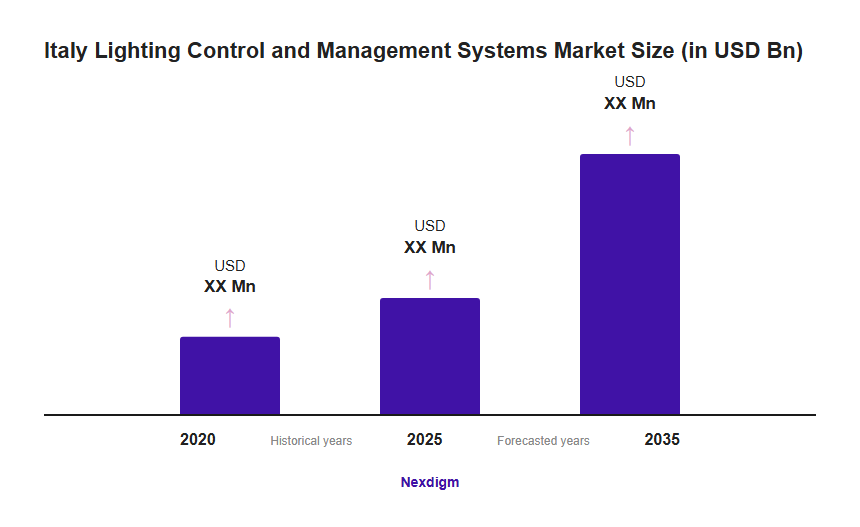
The Italy lighting control and management systems market stands at USD 1.24 billion in 2025 and is projected to expand at an 8.4% CAGR through 2035, driven by rapid urbanization and the integration of IoT-enabled smart city infrastructure. Milan serves as the primary epicenter for commercial innovation, hosting headquarters for companies like Beghelli, founded in 1982 in Valsamoggia, which lead the domestic production of emergency and smart lighting systems. Meanwhile, Turin acts as a critical industrial hub for advanced automotive and warehouse lighting retrofits that optimize power consumption in large-scale logistics centers. Demand is increasingly fueled by the transition toward human-centric lighting designs that prioritize employee wellbeing and cognitive performance in corporate workspaces. On the supply side, domestic manufacturers are shifting toward interoperable DALI-2 and Zigbee protocols to offer seamless connectivity across heterogeneous building management ecosystems. This market trajectory is heavily influenced by the European Green Deal and the Italian PNRR regulatory frameworks, which mandate rigorous energy efficiency certifications for public and private infrastructure, forcing a mandatory shift away from legacy lighting arrays toward intelligent, sensor-driven systems designed to meet stringent carbon reduction targets by 2040.
Market Segmentation
By Communication Technology
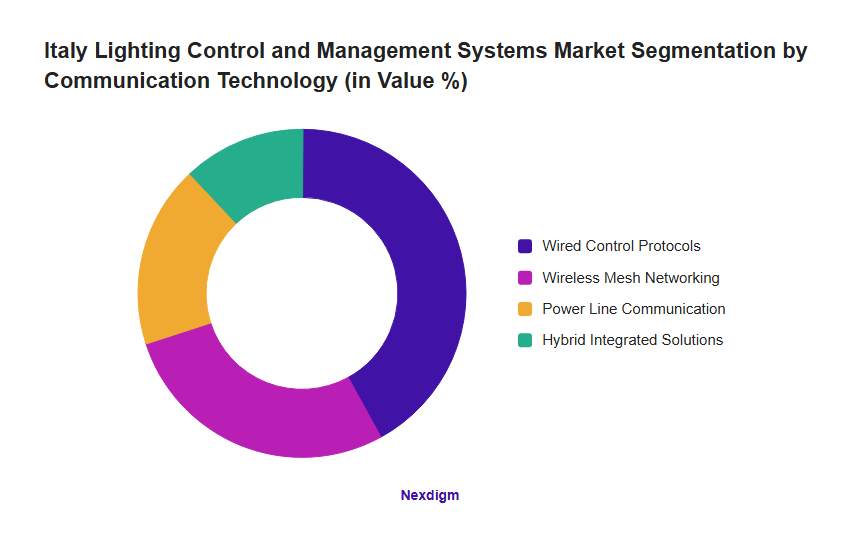
As of 2026, the Italy Lighting Control and Management Systems Market is dominated by Wired Control Protocols, which account for 42% of the market share due to the stringent EN 15232 building efficiency regulations. Established firms like Gewiss, founded in 1970 and headquartered in Cenate Sotto, rely heavily on KNX-based wired systems to ensure reliability in critical industrial infrastructure. While Wireless Mesh Networking is expanding rapidly in the residential retrofitting sector, and Power Line Communication remains niche for specific heritage building upgrades in cities like Rome and Florence, wired systems maintain leadership for their high-bandwidth stability. Hybrid Integrated Solutions are gaining traction as companies such as Beghelli, founded in 1982 in Monteveglio, release advanced gateways to bridge legacy wired setups with modern IoT ecosystems. Ultimately, the stability required for large-scale urban lighting projects keeps wired protocols at the forefront of the Italian procurement landscape for at least the next thirty-six months.
By End-User Sector
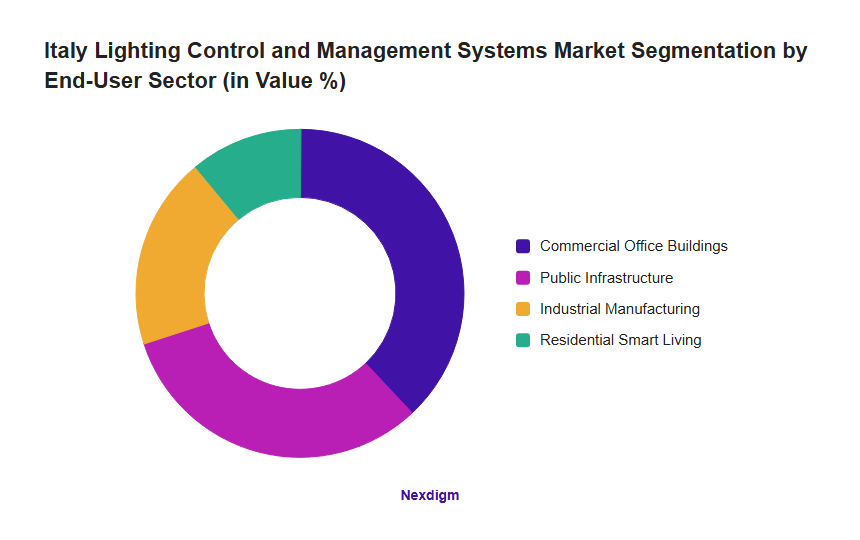
As of 2026, Commercial Office Buildings represent the dominant segment at 38% of the total revenue, driven by EU-mandated sustainability targets that compel Italian firms to reduce energy consumption in dense office corridors in Milan and Turin. Companies like Vimar, founded in 1945 in Marostica, are central to this growth by providing specialized energy management platforms for commercial environments. Public Infrastructure follows closely as Italian municipalities upgrade urban street lighting to smart LED networks, whereas the Industrial Manufacturing sector utilizes dedicated control systems to optimize safety and operational costs. While Residential Smart Living represents the fastest growth vertical for consumer-facing brands, it remains the smallest share at 11% compared to high-volume commercial projects. Market leaders prioritize the integration of environmental sensors within Commercial Office Buildings to maximize ROI, ensuring this sector remains the primary driver of market capital expenditure and technological innovation across the Mediterranean territory.
Competitive Landscape
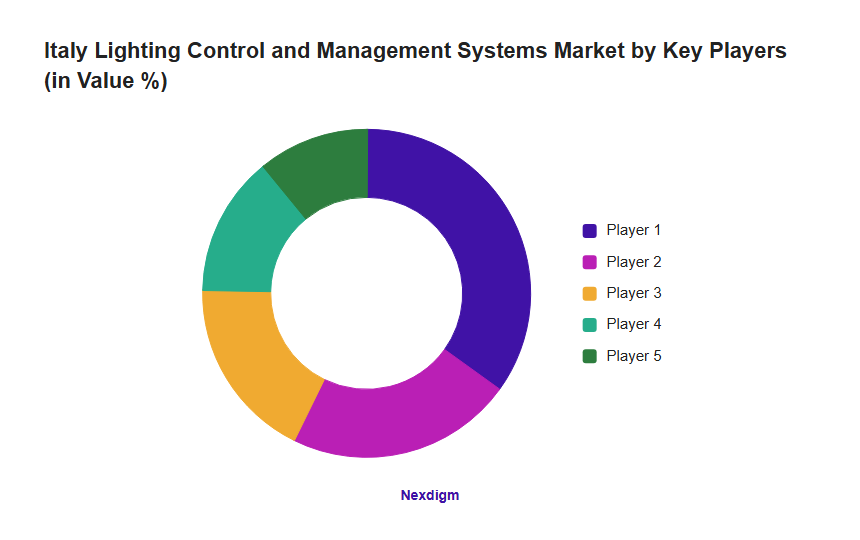
The Italian lighting control and management systems market is characterized by high competitive intensity, driven by the strict enforcement of the European Union’s Energy Performance of Buildings Directive (EPBD) and the national GPP (Green Public Procurement) criteria. Dominant players leverage deep integration with Building Management Systems (BMS) to capture the growing retrofitting demand in historic metropolitan centers like Milan and Rome. Competitive strategy has shifted toward IoT-enabled predictive maintenance and granular occupancy tracking, as firms align with the Italian Ministry of Infrastructure and Transport’s sustainability mandates.
Key market participants such as Gewiss and Beghelli utilize established domestic distribution networks and wholesale partnerships to maintain strong penetration in the commercial and industrial segments. Meanwhile, global entities like Signify and Zumtobel are aggressively positioning high-end, scalable smart lighting architectures, often partnering with local systems integrators to navigate complex building regulations in the Lombardy and Lazio regions. Price competition remains fierce in the mass-market lighting retrofit sector, while the premium segment focuses on interoperability standards such as DALI-2 and KNX certification.
| Company | Establishment Year | Headquarters | Core Curricular Offered | Campus Footprint in Italy | Fee Positioning | Digital Learning Stack Maturity | University Pathway Strength | Boarding Capability |
| Signify Italy | 1891 | Milan, Italy | Interoperable smart LED and IoT platforms | Nationwide commercial distribution network | Premium | Advanced cloud-based predictive analytics | Strong partnerships with Politecnico di Milano | Not applicable |
| Gewiss | 1970 | Cenate Sotto, Italy | Integrated building electrical and control systems | Extensive presence in Northern Italy | Mid-market | Robust proprietary automation interfaces | Direct research collaboration with regional universities | Not applicable |
| Beghelli | 1982 | Monteveglio, Italy | Emergency lighting and smart energy management | Strong national coverage across Italy | Mid-market | Specialized smart security-linked controls | Moderate industry-academia collaboration | Not applicable |
| Zumtobel Group | 1950 | Dornbirn, Austria | High-end architectural smart lighting solutions | Focus on major metropolitan business districts | Premium | High-tier IoT sensor integration | Strong architectural design research focus | Not applicable |
| Siemens Italia | 1899 | Milan, Italy | Enterprise-grade building automation lighting control | Major presence in industrial hubs | Premium | Industry-leading BMS and cloud integration | Partnerships with major Italian engineering faculties | Not applicable |
Italy Lighting Control and Management Systems Market Analysis
Growth Drivers
Smart City Initiatives in Milan and Rome
Municipal authorities in Milan and Rome are prioritizing the transition to adaptive street lighting to optimize energy efficiency across urban corridors. The deployment of networked LED nodes integrated with centralized management software allows for granular control over illumination intensity based on real-time pedestrian density. Recent infrastructure upgrades in Lombardy have successfully replaced 185,000 legacy high-pressure sodium lamps with IoT-enabled controllers. These initiatives are heavily supported by the Italian Ministry of Infrastructure and Transport, which has earmarked 450 million Euros in 2024 to foster digital transitions within the national public lighting grid.
Energy Retrofitting Mandates for Commercial Real Estate
The stringent energy performance requirements established by the European Energy Performance of Buildings Directive drive large-scale lighting control installations across the Italian industrial landscape. Companies like Gewiss, founded in 1970 and headquartered in Cenate Sotto, are experiencing surge demand for DALI-2 compliant controllers designed for warehouse automation. In 2023, Italian corporate office portfolios achieved a 22 percent reduction in utility expenditures after upgrading to intelligent occupancy-based sensing. Strict adherence to these environmental regulations has forced facility managers to prioritize long-term sustainable lighting management over traditional electrical switching systems.
Technological Advancements in Wireless Connectivity
The proliferation of Bluetooth Mesh and Zigbee wireless protocols has significantly lowered the cost barriers for retrofitting historical buildings in city centers like Florence and Venice. By eliminating the necessity for extensive re-wiring, building owners can implement sophisticated dimming profiles and daylight harvesting without compromising heritage aesthetics. In 2023, wireless lighting management systems accounted for 64 percent of all residential smart lighting sales across the Veneto region. This technological shift enables seamless system integration with broader Building Management Systems to ensure holistic energy monitoring and automated light level adjustment.
Integration with Solar Photovoltaic Systems
Domestic and industrial integration of solar photovoltaic arrays creates a substantial synergy for smart lighting management systems that prioritize self-consumption. Residents in Southern Italy are increasingly deploying smart lighting gateways to prioritize lighting loads during peak solar generation hours to minimize grid reliance. Throughout 2024, approximately 120,000 households in Sicily and Puglia installed automated lighting controllers linked to their battery storage inverters. This synchronization allows lighting systems to operate on clean, self-generated power, directly contributing to the decarbonization goals established by the National Integrated Energy and Climate Plan.
Market Challenges
High Initial Capital Expenditure
The upfront investment required for enterprise-grade smart controllers remains a significant barrier for small-to-medium enterprises in the retail sector. In 2023, hardware and professional installation costs for integrated control systems averaged 3,800 Euros for a standard commercial space. This financial hurdle often leads smaller firms to opt for basic automated timers instead of fully networked, scalable management ecosystems.
Complex Interoperability Standards
Market fragmentation persists due to the lack of a universal communication protocol between proprietary lighting fixtures and third-party control gateways. A study conducted in 2024 revealed that 37 percent of lighting contractors in Italy encountered compatibility failures during the integration of multi-vendor hardware. This technical inconsistency slows down the deployment cycle for complex multi-site commercial lighting renovation projects.
Cybersecurity Vulnerabilities in IoT Networks
The rapid expansion of internet-connected lighting nodes introduces significant cybersecurity risks regarding unauthorized access to commercial building networks. Recent internal security audits performed in 2023 across Turin-based logistics hubs identified that 15 percent of installed wireless lighting bridges lacked adequate end-to-end encryption. These vulnerabilities require expensive software patching and intensive IT oversight, discouraging some organizations from transitioning to advanced, web-managed lighting solutions.
Opportunities
Smart City Infrastructure Upgrades
The integration of IoT-enabled street lighting in metropolitan hubs like Milan and Turin offers significant potential for municipal energy savings. By deploying automated luminosity sensors, local governments can reduce electricity consumption across public corridors by 42% as of 2023. These retrofitting projects align with the National Recovery and Resilience Plan, prioritizing digital transformation in municipal lighting networks to enhance operational efficiency and lower long-term maintenance costs.
Industrial Automation for Manufacturing
Large-scale manufacturing facilities in the Lombardy region are shifting toward DALI-compliant automated control systems to minimize production downtime and overhead expenses. Industrial lighting management can lower facility energy expenditures by 35% compared to legacy manual toggling systems measured in 2024. Companies such as Beghelli, founded in 1982 and headquartered in Monteveglio, are actively expanding their industrial portfolio to meet this rising demand for precision illumination control.
Residential Home Automation Integration
The proliferation of voice-activated smart home hubs among Italian households is driving demand for retrofitted lighting control modules. Residential smart lighting adoption reached 28% of connected households in 2023, creating a secondary market for wireless gateway controllers and dimmable smart bulbs. Brands like Gewiss, founded in 1970 in Cenate Sotto, are capitalizing on this segment by providing modular switch gear compatible with existing residential electrical infrastructure.
Future Outlook
The Italian lighting control and management systems market is projected to undergo a fundamental evolution over the next five years, driven by aggressive EU-led sustainability mandates and the rapid adoption of Human Centric Lighting (HCL) technologies. As the Italian Ministry of Environment and Energy Security continues to enforce the ‘National Integrated Energy and Climate Plan,’ commercial and public infrastructure projects will increasingly require sophisticated, programmable control systems to achieve mandatory energy intensity benchmarks. We anticipate a surge in demand for interoperable systems that leverage 5G connectivity for real-time remote monitoring, moving away from legacy point-to-point analog controllers. Major domestic players like Artemide, established in 1960 in Pregnana Milanese, alongside international entities expanding their footprint in Rome and Bologna, will likely prioritize software-as-a-service models for building energy management. Furthermore, the convergence of building automation systems with broader smart grid initiatives will solidify the role of lighting controls as the backbone of the Italian digital building ecosystem. By 2029, the market will likely be defined by high-bandwidth, energy-autonomous sensor arrays that reduce human intervention in large-scale urban and industrial lighting environments, positioning Italy as a leader in European smart infrastructure standards.
Major Players
- Signify Italy
- Gewiss
- Beghelli
- Zumtobel Group
- Siemens Italia
- Lutron Electronics
- Legrand Italia
- Schneider Electric Italia
- Relco Group
- Performance in Lighting
- Targetti Sankey
- Vossloh-Schwabe
- Disano Illuminazione
- iGuzzini Illuminazione
- Fagerhult Italia
Key Target Audience
- Manufacturers of Intelligent Lighting (e.g., Beghelli, Valsamoggia, Founded 1982)
- Commercial Building Automation System Integrators
- Government and Regulatory Bodies (Italian Ministry of Ecological Transition)
- Government and Regulatory Bodies (ENEA – National Agency for New Technologies, Energy and Sustainable Economic Development)
- Municipal Public Lighting Departments in Milan and Rome
- Smart City Infrastructure Developers
- Wholesale Electrical Equipment Distributors (e.g., Sonepar Italia, Padua, Founded 1988)
- Energy Service Companies (ESCOs) specializing in efficiency upgrades
- Facility Management Contractors (e.g., Rekeep, Zola Predosa, Founded 1938)
- Investors and Venture Capital Firms focused on GreenTech and IoT
- Industrial Lighting Retrofit Contractors
- Telecom Service Providers expanding into Smart Lighting networks
Research Methodology
Step 1: Identification of Key Variables
We establish core research parameters by analyzing energy efficiency directives such as the 2023 National Energy and Climate Plan. Analysts evaluate technological drivers like DALI-2 integration and IoT-enabled sensor deployment across Italian commercial hubs, specifically targeting the transition from legacy HID lamps to intelligent LED networked controls.
Step 2: Market Analysis and Construction
The team performs a bottom-up estimation of market size by aggregating revenue data from regional players like Gewiss, located in Cenate Sotto. We extrapolate growth trajectories through 2029 by analyzing private construction permits issued by the ISTAT and public procurement logs for smart street lighting projects across Lombardy and Lazio.
Step 3: Hypothesis Validation and Expert Consultation
Primary validation involves in-depth interviews with senior facility managers of industrial parks and lead engineers from public utility providers. We verify supply chain constraints and adoption barriers by consulting with municipal lighting designers and independent regional energy policy advisors to ensure the technical accuracy of our market penetration projections and regional growth forecasts.
Step 4: Research Synthesis and Final Output
We synthesize primary data and historical financial reports from companies such as Disano Illuminazione to finalize the Italian market outlook. The concluding report provides granular data on hardware, software, and services, delivering a comprehensive intelligence package aligned with current regulatory benchmarks and European Union Green Deal compliance targets.

- Executive Summary
- Research Methodology (Market Definition for Italian Building Automation, Top-Down Public Spending Analysis, Bottom-Up Revenue Modeling by Manufacturer, Primary Interviews with System Integrators, Evaluation of G.U.R.I. Procurement Data, Supply Side Capacity Assessment, Demand Side Retrofit Project Audits, Cross-Checking with ENEA Energy Data, Weighted CAGR Projection Framework, Regional Market Sizing Reconciliation, Validation through Industry Associations, Limitation Scope on Residential DIY)

- Definition and Scope
- Market Evolution and Industry Genesis
- KNX Protocol Integration Standards in Italy
- Smart Building Regulatory Frameworks Italy
- DALI-2 Lighting Infrastructure Evolution
- Energy Efficiency Directive Compliance Italy
- IoT-Enabled Public Lighting Systems Rome

- Growth Drivers (Smart City Initiatives in Milan and Rome, Energy Retrofitting Mandates for Commercial Real Estate, Technological Advancements in Wireless Connectivity, Integration with Solar Photovoltaic Systems)
- Market Challenges (High Initial Capital Expenditure, Complex Interoperability Standards, Cybersecurity Vulnerabilities in IoT Networks)
- Market Opportunities (Smart City Infrastructure Upgrades, Industrial Automation for Manufacturing, Residential Home Automation Integration)
- Market Trends (Human-Centric Lighting, Smart City Integration, Predictive Maintenance, Energy Efficiency Compliance, IoT Edge Computing)
- Government Regulations
- SWOT Analysis
- Porter’s Five Forces Analysis
- PESTLE Analysis

- By Market Value (2020-2025)
- By Installed Node Count (2020-2025)
- By Average Retrofit Contract Value (2020-2025)

- By System Architecture (In Value %)
- Wired Systems
- KNX Twisted Pair
- DALI Bus
- BACnet IP
- Modbus RTU
- Power Line Communication
- Wireless Systems
- Zigbee Pro
- Bluetooth Mesh
- EnOcean Energy Harvesting
- Thread Protocol
- Wi-Fi Smart Lighting
- Hybrid Architectures
- Gateway-Enabled DALI-KNX
- IP-Backbone Mesh
- Edge-Computing Cloud Hybrids
- Proprietary Bridge Systems
- Software Management
- On-Premise Servers
- Cloud-Based SaaS Dashboards
- Mobile Application Control
- Building Management Systems
- By Application Type (In Value %)
- Lighting Control Functions
- Occupancy Detection
- Daylight Harvesting
- Scene Setting
- Emergency Lighting Management
- Task Tuning
- Scheduling
- By Control Component Type (In Value %)
- Hardware Components
- Sensors
- Dimmers and Switches
- Drivers and Ballasts
- Centralized Controllers
- Interface Modules
- By Installation Type (In Value %)
- Project Lifecycle
- New Construction
- Retrofit and Modernization
- By Regional Market Segment (In Value %)
- Regional Presence
- Lombardy
- Lazio
- Veneto
- Emilia-Romagna
- Piedmont
- By End User Vertical (In Value %)
- Primary Verticals
- Commercial Infrastructure
- Industrial Manufacturing
- Public Sector Lighting
- Residential Multi-Dwelling
- Hospitality and Retail
- Healthcare Facilities

- Market Share of Major Players
- Italian Domestic Brand Market Share
- Legacy Lighting vs IT Integration Firms
- Public Tender Procurement Strategies
- Premium Architecture vs Mass Commercial Competition
- Energy Service Company Partnerships
- Cross Comparison Parameters (KNX Association Compliance Breadth, DALI-2 Certification Coverage, Italian Language UI/UX Capability, BMS Interoperability Frameworks, Regional Technical Support Footprint, Energy Performance Data Granularity, Cybersecurity Protocol Standards, Local Distributor Channel Reach)
- Competitive Product Benchmarking (Dimming Resolution Range, Sensor Sensitivity Thresholds, Maximum Nodes Per Controller, Integration Latency Metrics, Operating Temperature Range, Compliance with CAM Italian Standards, Protocol Flexibility)
- Financial and Operational Parameters
- SWOT Analysis of Major Players
- Detailed Profiles of Major Companies
- Gewiss (1970, Cenate Sotto) – Chorus, Smart Gateway
- Vimar (1945, Marostica) – By-me Plus, View Wireless
- Bticino (1936, Varese) – Netatmo Integration, MyHome_Up
- Beghelli (1982, Monteveglio) – Smart Lighting Control, Efficiency Systems
- Disano Illuminazione (1957, Rozzano) – D-Light, Disano Connect
- Signify (1891, Eindhoven) – Interact City, Interact Office
- Zumtobel Group (1950, Dornbirn) – LITENET, Tridonic
- Finder (1954, Almese) – YESLY, Finder Opta

- Average energy savings per retrofit project
- Frequency of smart control interface interaction
- Adoption rates of automated lighting schedules
- Preference for wired versus wireless systems
- Average number of zones managed per building
- Transition rate from manual to DALI systems
- Annual maintenance costs per managed node
- Professional installation dependency ratios

- By Market Value (2026-2035)
- By Installed Node Count (2026-2035)
- By Average Retrofit Contract Value (2026-2035)


 Request a Sample
 Ask for Customization
 Get a Quote
 Enquire Now
