
 Download PDF
Market Overview
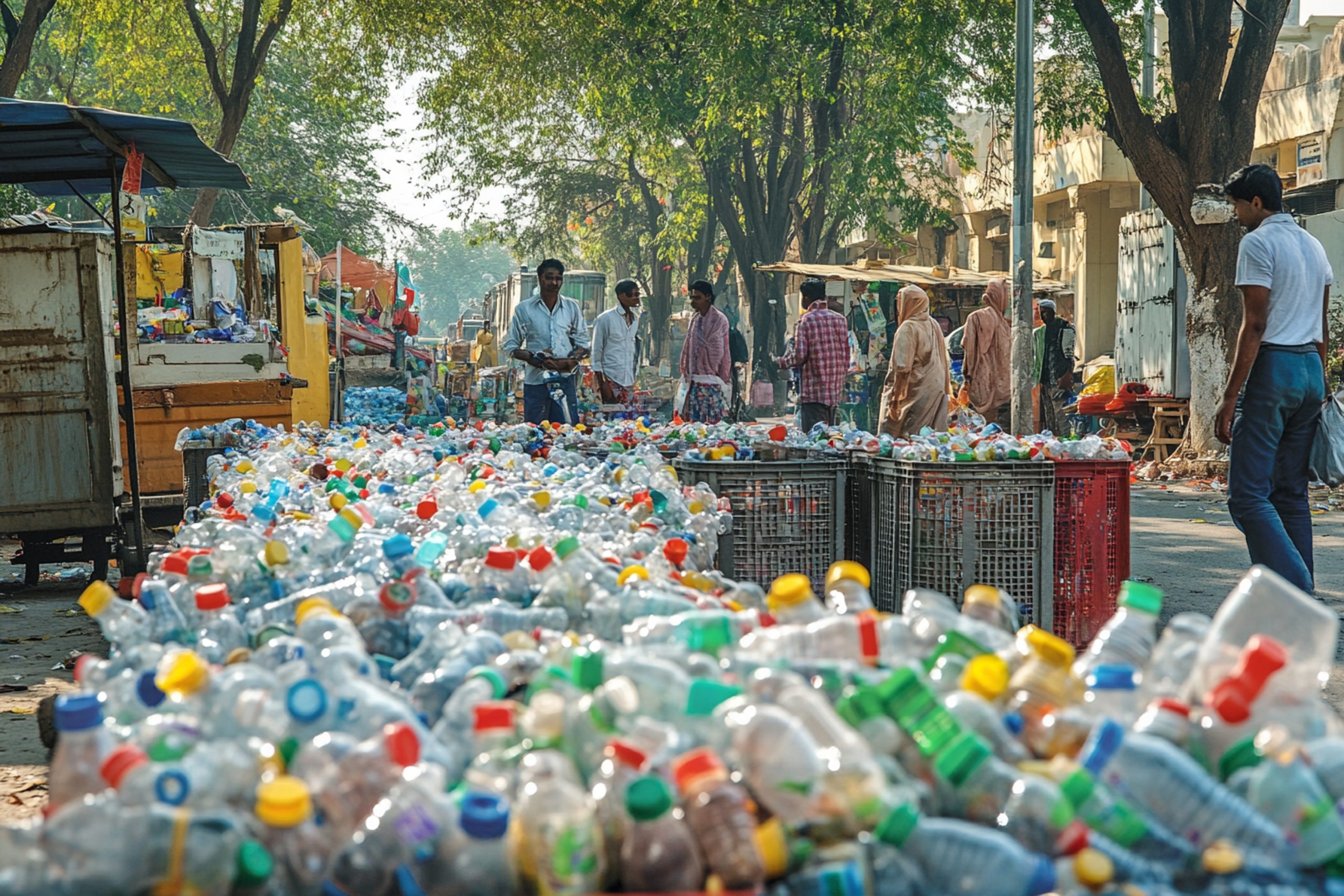
The Italy Plastics Market is a large, diversified materials and conversion ecosystem supported by packaging, construction, automotive, electrical, agricultural and consumer-product applications. PlasticsEurope records 7,443 kilotonnes of plastics conversion and 3,605 kilotonnes of domestic plastics production in the latest observed period. COREPLA data show plastic packaging placed on the market moving from 1,872,672 tonnes to 1,878,121 tonnes, while material sent for recycling increased from 1,056,341 tonnes to 1,109,848 tonnes, reinforcing circular-material demand.
Northern Italy, particularly Milan and Lombardy, Bergamo, Cittadella–Padua and the wider Veneto region, and Emilia-Romagna, dominates plastics processing because of dense manufacturing clusters, automotive and appliance customers, packaging converters, compounders and machinery suppliers. In the compostable-bioplastics chain alone, Veneto contains 27 converting companies and 298 dedicated employees, Emilia-Romagna has 21 companies and 297 employees, and Lombardy has 41 companies and 185 employees; nationwide dedicated employment moved from 2,980 to 2,913 workers between the two latest reporting periods.
Market Segmentation
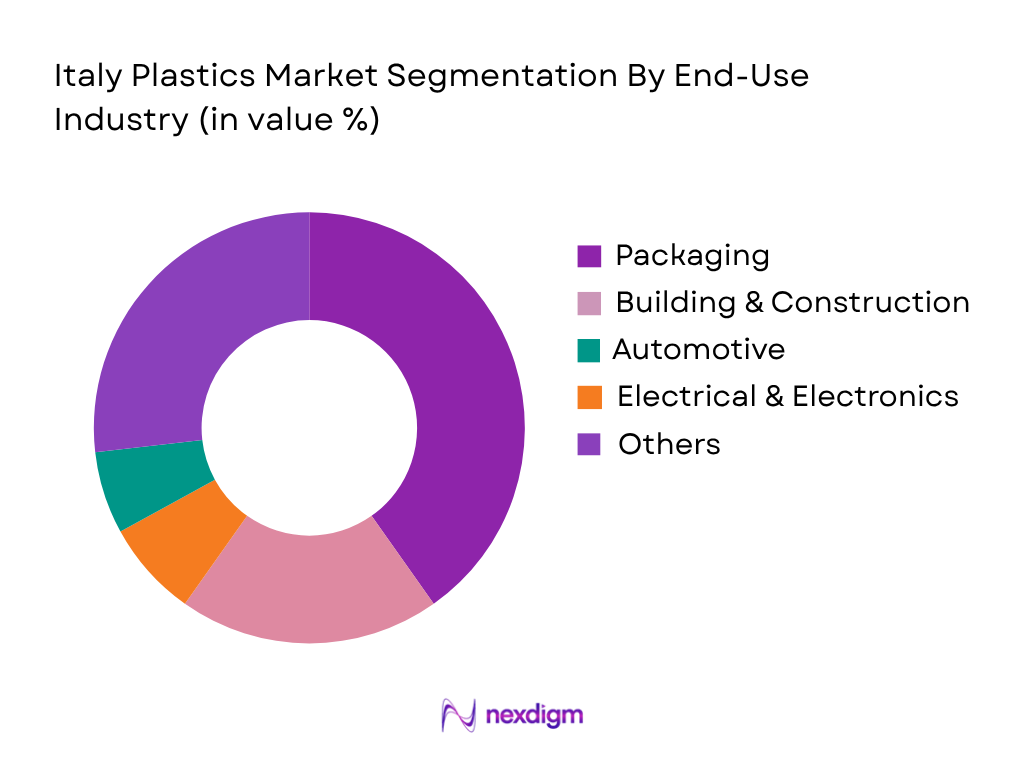
By End-Use Industry
The Italy Plastics Market is segmented by end-use industry into packaging, building and construction, automotive, electrical and electronics, agriculture, houseware/leisure/sports and other applications. Packaging holds the dominant position, reflecting Italy’s extensive food, beverage, pharmaceutical, personal-care and industrial-packaging manufacturing base. Plastics remain attractive because they combine low weight, barrier performance, formability, sealing properties and compatibility with high-speed filling systems. Flexible films, PET containers, trays, closures and protective packaging create recurring polymer demand. Packaging is also at the center of Italy’s transition toward recycled content and design-for-recycling. PlasticsEurope records packaging as the largest destination for Italian plastics conversion, ahead of construction and automotive applications. Increasing use of recycled PET and polyolefins, mono-material structures and lightweight packaging is therefore changing the composition of demand rather than eliminating plastics from the packaging value chain.
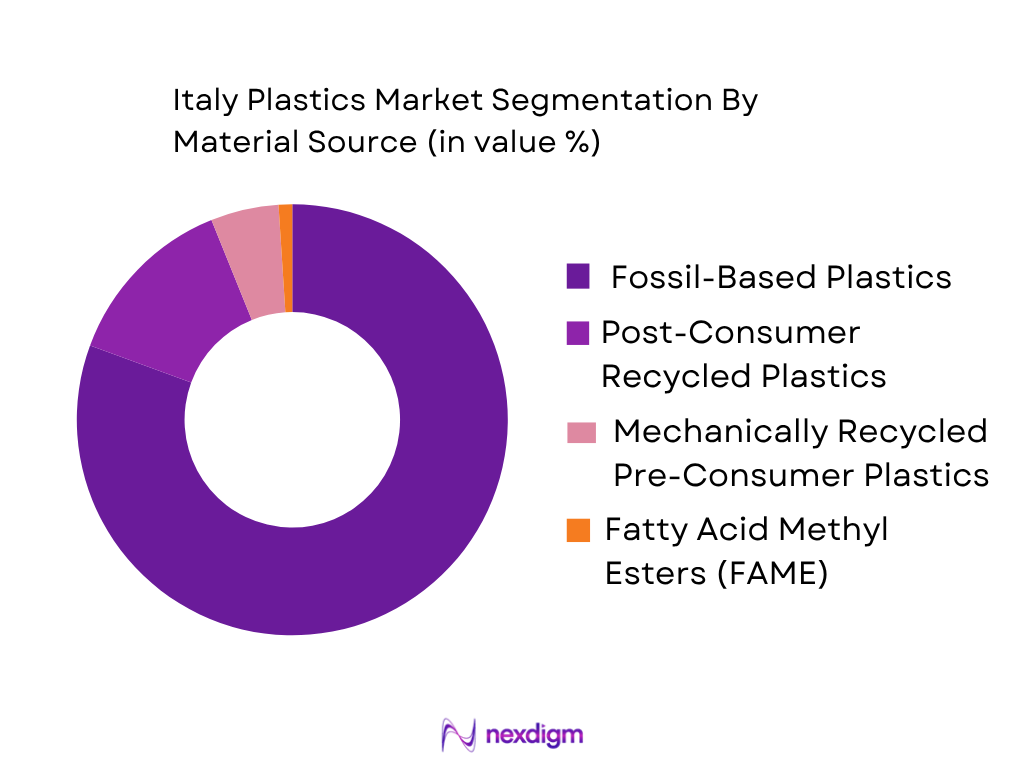
By Material Source
The Italy Plastics Market is segmented by material source into fossil-based plastics, post-consumer recycled plastics, mechanically recycled pre-consumer plastics and bio-based plastics. Fossil-based plastics remain dominant because Italy’s converters require large and consistent volumes of PE, PP, PVC, PET, styrenics and engineering polymers meeting precise processing, food-contact, mechanical and appearance specifications. Nevertheless, the material mix is changing. Recycled polymers are increasingly incorporated into packaging, construction products, household articles and selected automotive components, while regulatory requirements are strengthening demand for verified secondary material. Post-consumer recyclate penetration is especially important in packaging, while industrial scrap recovery supports pre-consumer recycling. Assorimap reports continued Italian mechanical-recyclate production despite margin pressure from low-cost virgin imports, demonstrating that circular materials are becoming structurally embedded in the supply chain rather than remaining a niche input.
Competitive Landscape
The Italy Plastics Market combines large integrated petrochemical suppliers with specialist Italian compounders, recyclers and downstream converters. Versalis and LyondellBasell have strong positions in primary polymers and petrochemicals, while RadiciGroup and Sirmax compete through engineering polymers and application-specific compounds. Aliplast represents the increasingly important circular-material segment through recycled polymers, films and PET sheets. Competition is therefore determined not only by resin capacity, but also by grade specialization, recycled-content capability, technical support, customer qualification and access to reliable feedstock.
| Company | Establishment Year | Headquarters | Core Polymer Portfolio | Italy Market Footprint | Circular Plastics Capability | Major End-Use Exposure | Compounding/Processing Capability | Strategic Position |
| Versalis S.p.A. | 2012 | San Donato Milanese, Italy | ~ | ~ | ~ | ~ | ~ | ~ |
| LyondellBasell | 2007 | Houston / Rotterdam / London | ~ | ~ | ~ | ~ | ~ | ~ |
| RadiciGroup | 1941 | Bergamo/Gandino, Italy | ~ | ~ | ~ | ~ | ~ | ~ |
| Sirmax Group | 1999* | Cittadella, Italy | ~ | ~ | ~ | ~ | ~ | ~ |
| Aliplast S.p.A. | 1982 | Ospedaletto di Istrana, Italy | ~ | ~ | ~ | ~ | ~ | ~ |
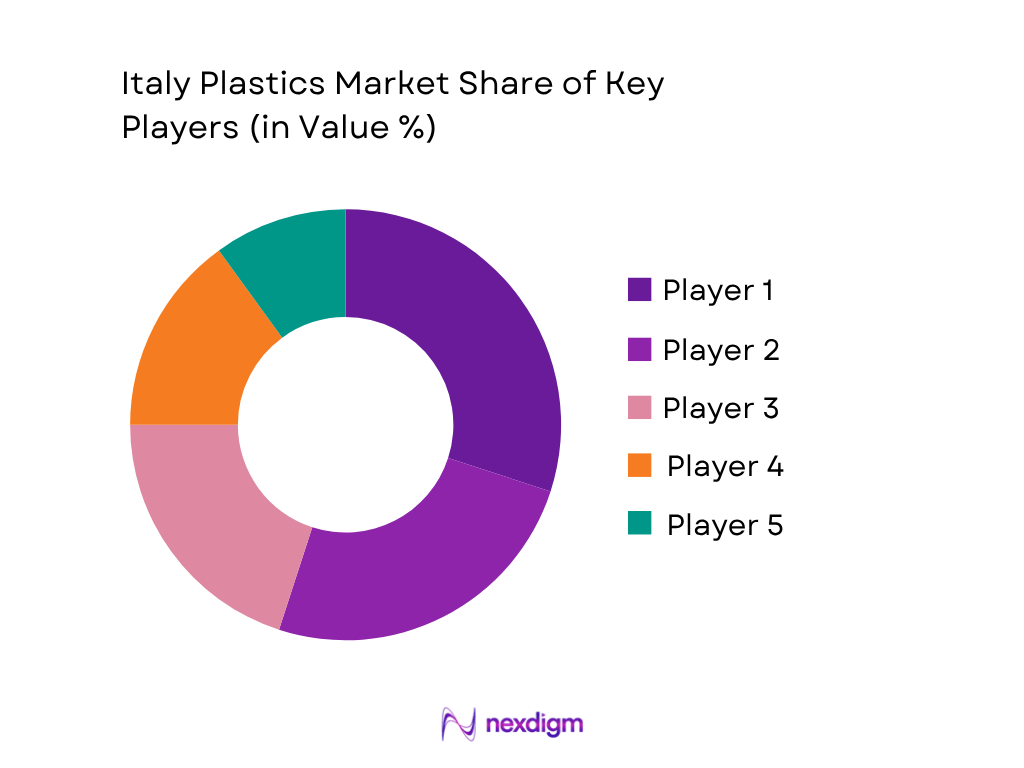
Italy Plastics Market Analysis
Growth Drivers
Strong Packaging and Circular-Plastics Demand Base
Italy’s plastics market is supported by a large packaging ecosystem in which polymer demand is closely connected with food processing, beverages, household products, personal care, pharmaceuticals and industrial distribution. In 2024, 1,878,121 tonnes of plastic packaging were placed on the Italian market, while 1,109,848 tonnes were directed to recycling. Of that recycled quantity, 796,848 tonnes were handled through consortium-related channels, including 762,865 tonnes originating from separate collection, while independent operators accounted for another 313,000 tonnes. Italy’s broader packaging system placed more than 13.95 million tonnes of packaging on the market and recycled approximately 10.70 million tonnes across materials, including 1,131,424 tonnes of traditional plastic packaging and 47,511 tonnes of compostable plastic packaging. More than 1.24 million tonnes of reusable packaging were also formally declared within the national system. Separately collected plastic packaging exceeded 1.5 million tonnes, creating substantial feedstock availability for sorting, washing, regranulation and compounding. Italy’s GDP stood at USD 2.38 trillion, while GDP per capita reached USD 40,385.3 in 2024, indicating a large industrial and consumer economy supporting sophisticated packaged-goods supply chains. These physical material flows reinforce demand for polyethylene, polypropylene, PET and specialty packaging polymers while simultaneously expanding requirements for recycled granulates, masterbatches and circular packaging solutions.
Dense Automotive, Component and Plastics-Processing Manufacturing Ecosystem
Italy’s plastics demand is supported by an extensive manufacturing ecosystem spanning automotive components, electrical equipment, machinery, appliances and engineered industrial products. The automotive supply chain comprised 5,451 industrial companies and approximately 273,000 production employees, while the dedicated automotive component industry included 2,134 companies employing around 168,000 people. These activities create direct demand for polypropylene compounds, polyamides, PC/ABS, PBT, thermoplastic elastomers and reinforced engineering plastics used in vehicle interiors, exterior modules, connectors, electrical insulation, lighting systems, dashboards and under-the-hood components. Italy also registered 1,558,704 new passenger cars in 2024, supporting a substantial automotive distribution, servicing and component ecosystem. The country’s plastics-processing technology base adds another layer of industrial demand and technical capability, with more than 170 manufacturers represented within the national plastics and rubber machinery industry by 2026. These companies cover injection moulding, extrusion, blow moulding, recycling equipment, moulds and automation. Italy’s GDP reached USD 2.38 trillion, with GDP per capita of USD 40,385.3 in 2024, supporting a large industrial economy capable of consuming technically differentiated polymer products. The interaction between component manufacturing, machinery expertise and polymer processing creates opportunities for Italian compounders and converters to develop application-specific grades requiring impact resistance, thermal stability, flame retardancy, dimensional accuracy and electrical performance rather than relying exclusively on commodity resin demand.
Market Challenges
Weak Domestic Automotive Production Reducing Technical Polymer Offtake
A major challenge for the Italy Plastics Market is contraction in domestic automotive manufacturing, which directly affects demand for polypropylene compounds, polyamides, ABS, polycarbonate blends, PBT, elastomers and other engineering thermoplastics consumed by vehicle and component plants. Italian motor-vehicle production totaled approximately 591,000 units in 2024, including around 310,000 passenger cars. This contrasts with 1,558,704 new passenger-car registrations, indicating a significant gap between domestic vehicle demand and domestic manufacturing activity. This distinction matters for plastics suppliers because polymers incorporated into imported vehicles are generally processed outside Italy, whereas domestically assembled vehicles generate material demand through Italian compounders, injection moulders, Tier-1 component suppliers and tooling manufacturers. The automotive industrial ecosystem includes 5,451 companies and approximately 273,000 production employees, while the component segment alone comprises 2,134 companies employing around 168,000 people. Reduced assembly volumes can consequently affect multiple layers of polymer demand, including interior components, exterior modules, fluid-management systems, electrical connectors and structural applications. Italy nevertheless remains a major industrial economy, with GDP of USD 2.38 trillion and GDP per capita of USD 40,385.3 in 2024. Plastics suppliers therefore face the strategic challenge of diversifying beyond domestic passenger-car assembly toward export-oriented components, commercial vehicles, appliances, electrical equipment and EV-compatible engineering polymers.
Recycled-Polymer Quality, Feedstock Availability and Competitive Pressure
Italy possesses substantial plastics recycling infrastructure, but transforming collected material into consistent specification-grade secondary polymers remains a major challenge. Domestic mechanical recyclers produced approximately 833,000 tonnes of recycled polymers in 2024, including more than 230,000 tonnes of recycled PET. At the same time, 1,878,121 tonnes of plastic packaging were placed on the market and 1,109,848 tonnes were directed toward recycling. The national packaging system processed 1,131,424 tonnes of traditional plastic packaging for recycling, alongside 47,511 tonnes of compostable plastic packaging. These figures demonstrate significant material availability, but collection volume does not directly translate into usable high-quality resin. Packaging waste can contain different polymer families, multilayer structures, labels, adhesives, pigments, food residues and moisture, requiring sophisticated sorting, washing, filtration and reprocessing. Automotive, food-contact, appliance and technical applications impose additional requirements involving odor, color, contamination, melt-flow consistency, mechanical strength and traceability. Italy’s GDP of USD 2.38 trillion and GDP per capita of USD 40,385.3 in 2024 support sophisticated domestic manufacturing industries whose material specifications can be difficult for inconsistent recyclate streams to satisfy. The industry must therefore improve optical sorting, washing, deodorization, melt filtration, polymer separation and controlled compounding to convert existing waste volumes into commercially viable rPET, rHDPE, rLDPE and rPP suitable for repeatable industrial applications.
Market Opportunities
Expansion of High-Quality Recycled Plastics and Closed-Loop Packaging
The Italy Plastics Market has a significant future opportunity in converting its existing collection infrastructure into larger volumes of high-quality secondary polymers suitable for closed-loop packaging and durable applications. More than 1.5 million tonnes of plastic packaging were separately collected in 2024, while 1,109,848 tonnes of plastic packaging were directed to recycling. Within the recycling system, 762,865 tonnes originated from separate collection channels, providing a substantial physical feedstock stream that can be upgraded through improved sorting, washing, decontamination and compounding. Italy recycled 1,131,424 tonnes of traditional plastic packaging and 47,511 tonnes of compostable plastic packaging, while more than 1.24 million tonnes of reusable packaging were formally declared. Domestic mechanical recyclers already produced approximately 833,000 tonnes of recycled polymers, including more than 230,000 tonnes of recycled PET, demonstrating an established technical and industrial foundation. Italy’s GDP reached USD 2.38 trillion and GDP per capita stood at USD 40,385.3 in 2024, supporting substantial packaged-food, beverage, household-product and consumer-goods industries capable of absorbing certified circular materials. Future opportunity therefore centers on increasing the quality and application range of material already entering the collection system. Food-grade decontamination, optical sorting, odor reduction, high-performance filtration, digital traceability and additive technologies can increase the usability of recycled polymers. Closed-loop arrangements connecting brand owners, converters and recyclers can further improve feedstock consistency and support broader deployment of bottle-to-bottle rPET, recycled polyolefin packaging and other circular polymer applications.
Advanced Engineering Plastics, Compounding and Processing Technology
Advanced engineering polymers and processing technologies represent another substantial opportunity for Italy’s plastics industry because the country combines a large component-manufacturing base with specialized machinery, moulding and materials expertise. More than 170 plastics and rubber processing machinery manufacturers were represented within the national industry ecosystem by 2026, covering injection moulding, extrusion, blow moulding, recycling machinery, compounding systems, moulds and industrial automation. Italian plastics and rubber machinery exports exceeded EUR 3.4 billion in 2025, demonstrating the international relevance of domestic processing technology. The automotive component ecosystem provides an important application base, comprising 2,134 companies and approximately 168,000 employees, while the wider automotive industrial network includes 5,451 companies and around 273,000 production workers. These companies create demand for technical polymers used in connectors, housings, lighting systems, thermal-management components, battery assemblies, interiors and electrical insulation. Italy’s GDP of USD 2.38 trillion and GDP per capita of USD 40,385.3 in 2024 further demonstrate the scale of the industrial economy supporting advanced-material adoption. Opportunities are particularly relevant for PA, PP compounds, PC/ABS, PBT, TPE and reinforced thermoplastics combining lightweighting, thermal stability, dimensional accuracy, flame retardancy and electrical performance. Italian compounders can also expand recycled engineering grades for automotive, appliance and electrical applications, while converters can deploy advanced automation, thin-wall moulding, material optimization and precision processing to address increasingly complex customer specifications.
Future Outlook
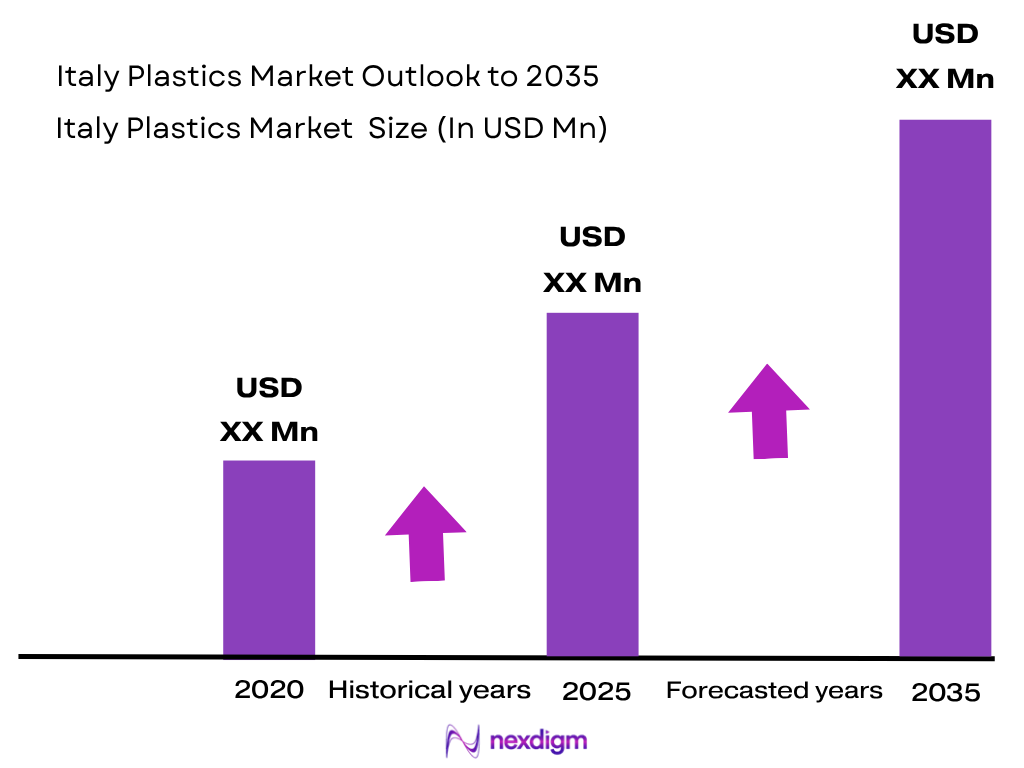
The Italy Plastics Market is expected to register a forecast CAGR of approximately ~X.X% during 2026-2035, with growth increasingly determined by the composition rather than simply the volume of polymer consumption. Recycled feedstocks, higher-performance engineering compounds, recyclable packaging formats and technically demanding automotive and electrical applications are expected to gain importance. At the same time, commodity virgin-polymer suppliers will continue facing pressure from imports, European capacity rationalization, energy costs and environmental regulation.
The most significant structural change will occur in plastic packaging. The EU Packaging and Packaging Waste Regulation requires plastic packaging to progressively incorporate recycled content and establishes recyclability requirements that become increasingly important from 2030. This supports investments in high-purity rPET, rPE and rPP, sorting technologies, mono-material packaging, decontamination processes and digital material traceability. Italy already has a meaningful recycling platform from which to expand. Assorimap identifies a sizable mechanical-recycling industry, while COREPLA operates a nationwide packaging-recovery ecosystem. However, the economics remain challenging because recyclers face high energy expenses and competition from inexpensive virgin and imported polymers. Consequently, future growth is likely to favor companies capable of securing waste feedstock, controlling quality, certifying recycled content and entering long-term agreements with converters and brand owners.
Major Players
- Versalis S.p.A.
- LyondellBasell / Basell Poliolefine Italia
- Borealis
- RadiciGroup
- Sirmax Group
- LATI Industria Termoplastici S.p.A.
- Aquafil S.p.A.
- Ravago Italia S.p.A.
- Aliplast S.p.A. – Hera Group
- BASF Italia S.p.A.
- SABIC Italia
- Covestro S.r.l.
- Serioplast Global Services S.p.A.
- Gualapack S.p.A.
- ILIP S.r.l.
Key Target Audience
- Plastic Resin Producers and Petrochemical Manufacturers
- Plastic Compounders, Masterbatch Producers and Converters
- Plastic Packaging Manufacturers and Brand Owners
- Mechanical and Chemical Plastic Recycling Companies
- Automotive, Appliance, Construction and Electrical Component Manufacturers
- Polymer Distributors, Importers and Raw-Material Procurement Companies
- Investments and Venture Capitalist Firms
- Government and Regulatory Bodies (Ministry of Enterprises and Made in Italy – MIMIT, Ministry of Environment and Energy Security – MASE, CONAI, COREPLA, European Commission Directorate-General for Environment)
Research Methodology
Step 1: Identification of Key Variables
The initial phase involves developing a complete ecosystem map of the Italy Plastics Market, covering polymer manufacturers, compounders, distributors, converters, recyclers, packaging producers and major end-use industries. Secondary research incorporates PlasticsEurope, COREPLA, CONAI, Assorimap, Amaplast, Eurostat, Italian institutional databases and corporate disclosures. Key variables include conversion volume, polymer mix, recycling penetration, end-use demand, import dependence, resin pricing and regulatory exposure.
Step 2: Market Analysis and Construction
Historical market construction is performed through both top-down and bottom-up approaches. The top-down framework evaluates polymer production, imports, exports, conversion volumes and national consumption, while the bottom-up framework analyzes converter throughput, plant capacities, recycled-polymer output and application demand. Material-flow reconciliation is then performed across packaging, construction, automotive, electrical/electronics, agriculture and consumer applications to minimize double counting.
Step 3: Hypothesis Validation and Expert Consultation
Market hypotheses are validated through computer-assisted telephone interviews and structured discussions with polymer producers, distributors, compounders, recycling operators, packaging manufacturers and downstream procurement specialists. Interviews focus on operating rates, resin sourcing, virgin-recycled price spreads, customer qualification requirements, plant utilization, regulatory compliance and application-level substitution. Responses are triangulated against published industry indicators to identify inconsistencies and refine market assumptions.
Step 4: Research Synthesis and Final Output
The final phase integrates primary findings with secondary datasets and company-level intelligence. Supply-side estimates are compared with consumption and end-use demand, while recycling volumes are reconciled with collection, sorting and secondary-polymer output. Scenario analysis is applied to regulatory change, recycled-content penetration, energy costs, import competition and end-market development. The resulting dataset supports market sizing, segmentation, competitive benchmarking and long-term forecasting for the Italy Plastics Market.

- Executive Summary
- Research Methodology (Market Definition and Scope, Italy Plastics Market Classification, Polymer Demand Assessment, Virgin and Recycled Resin Mapping, Plastics Conversion Technology Evaluation, End-Use Industry Consumption Assessment, Domestic Production and Import Dependency Analysis, Plastic Waste Collection and Recycling Framework Evaluation, Circular Plastics Ecosystem Assessment, Polymer Pricing Analysis, Plastics Processing Industry Mapping, Regulatory and Extended Producer Responsibility Framework Analysis)

- Definition and Scope
- Italy Plastics Industry Evolution and Development of Polymer Manufacturing, Conversion and Circular Economy Ecosystem
- Polymer Production, Compounding, Conversion, Recycling and End-Use Application Structure
- Italy Plastics Market Value Chain Analysis
- Italy Plastics Market Supply Chain Analysis
- Virgin Polymer, Recycled Resin, Compound, Masterbatch, Plastic Converter and Recycling Ecosystem Analysis
- Plastic Material Flow Assessment Across Packaging, Automotive, Building and Construction, Electrical and Electronics and Consumer Goods Applications

- Growth Drivers (Strong Plastic Conversion and Manufacturing Base, High Packaging Polymer Consumption, Growth of Recycled Plastic Adoption, Automotive Lightweighting Demand, Expansion of Energy-Efficient Building Materials, Increasing Demand for Engineering Plastics, Development of Circular Economy Infrastructure)
- Market Challenges (High Energy and Feedstock Costs, Dependence on Imported Polymer Grades, Virgin Resin Import Competition, Recycled Feedstock Quality Constraints, Plastic Waste Contamination, Converter Margin Pressure, Increasing Regulatory Compliance Requirements)
- Market Opportunities (Expansion of Recycled Polyolefin Production, Growth of Food-Grade Recycled PET, Development of Mono-Material Packaging, Chemical Recycling Capacity Development, Growth of High-Performance Engineering Compounds, Expansion of Bio-Based Plastics, Development of Closed-Loop Automotive and Industrial Recycling Systems)
- Market Trends (Virgin-to-Recycled Polymer Substitution, Mono-Material Packaging Adoption, Packaging Lightweighting and Downgauging, High-Performance Plastic Compounding, Circular Polymer Traceability, Design-for-Recycling Adoption, Artificial Intelligence and Automation in Plastics Processing)
- Regulatory and Standards Landscape (EU Packaging and Packaging Waste Regulation, Italian Extended Producer Responsibility Framework, CONAI Environmental Contribution System, COREPLA Plastic Packaging Recovery Framework, Single-Use Plastics Regulations, Recycled Content Requirements, REACH Compliance, Food-Contact Plastic Regulations, Compostable Plastic Standards)
- SWOT Analysis
- Porter’s Five Forces Analysis
- PESTLE Analysis
- Stakeholder Ecosystem
- Competition Ecosystem

- By Market Value (2020-2025)
- By Polymer Consumption Volume (2020-2025)
- By Domestic Plastic Resin Production Volume (2020-2025)
- By Virgin Plastic Consumption Volume (2020-2025)
- By Recycled Plastic Consumption Volume (2020-2025)
- By Plastic Conversion Volume (2020-2025)
- By Average Polymer Selling Price (2020-2025)

- By Polymer Type (In Value %)
Polyethylene (PE)
Low-Density Polyethylene (LDPE)
Linear Low-Density Polyethylene (LLDPE)
High-Density Polyethylene (HDPE)
Polypropylene (PP)
Polyvinyl Chloride (PVC)
Polyethylene Terephthalate (PET)
Polystyrene (PS) and Expanded Polystyrene (EPS)
Polyamide (PA)
Acrylonitrile Butadiene Styrene (ABS)
Polycarbonate (PC)
Polybutylene Terephthalate (PBT) and Polyoxymethylene (POM)
Other Engineering and Specialty Plastics - By Processing Technology (In Value %)
Injection Moulding
Blown Film Extrusion
Cast Film and Sheet Extrusion
Blow Moulding
Thermoforming
Pipe and Profile Extrusion
Rotational Moulding
Foam Processing
Compounding and Masterbatching
Additive Manufacturing - By End-Use Industry (In Value %)
Packaging
Rigid Plastic Packaging
Flexible Plastic Packaging
Automotive and Mobility
Building and Construction
Electrical and Electronics
Consumer Goods
Home Appliances
Agriculture
Healthcare and Medical
Textiles and Fibers
Industrial and Machinery Applications - By Product Form (In Value %)
Polymer Pellets and Granules
Plastic Compounds
Masterbatches
Plastic Films
Plastic Sheets
Pipes and Profiles
Fibers and Filaments
Plastic Foams - By Region (In Value %)
Northwest Italy
Lombardy
Piedmont
Northeast Italy
Veneto
Emilia-Romagna
Central Italy
Southern Italy
Sicily and Sardinia

- Market Share of Major Players (By Revenue, Polymer Type, Production Capacity, End-Use Industry, Virgin and Recycled Plastics Portfolio, Processing and Compounding Capability, Domestic Market Presence, Customer Segment Distribution)
- Cross Comparison Parameters (Italy Production Footprint and Installed Capacity, Polymer and Compound Portfolio Breadth, Virgin-to-Recycled Product Mix, Post-Consumer and Post-Industrial Recyclate Capability, Processing and Compounding Technology Capability, End-Use Industry Exposure, Circularity and Regulatory Readiness, Domestic Distribution and Export Reach)
- SWOT Analysis of Major Players
- Competitive Positioning Matrix
- Product and Polymer Portfolio Benchmarking
- Pricing and Resin Category Benchmarking
- Manufacturing, Compounding and Recycling Capacity Assessment
- Customer, Converter and OEM Partnership Assessment
- Detailed Profiles of Major Companies
Versalis S.p.A.
LyondellBasell / Basell Poliolefine Italia
Borealis
RadiciGroup
Sirmax Group
LATI Industria Termoplastici S.p.A.
Aquafil S.p.A.
Ravago Italia S.p.A.
Aliplast S.p.A.
BASF Italia S.p.A.
SABIC Italia
Covestro S.r.l.
Serioplast Global Services S.p.A.
Gualapack S.p.A.
ILIP S.r.l.

- Plastic Packaging Manufacturer Resin Procurement Assessment
- Automotive Component Manufacturer Polymer Requirement Analysis
- Building and Construction Plastic Product Manufacturer Assessment
- Electrical and Electronics Polymer Consumption Analysis
- Consumer Goods and Appliance Manufacturer Plastic Demand Assessment
- Plastic Converter Procurement and Supplier Selection Analysis
- Virgin versus Recycled Resin Preference Assessment
- Recycled Plastic Quality and Certification Requirement Analysis
- Polymer Grade, Price, Technical Performance and Supply Reliability Preference Analysis

- By Market Value (2026-2035)
- By Polymer Consumption Volume (2026-2035)
- By Domestic Plastic Resin Production Volume (2026-2035)
- By Virgin Plastic Consumption Volume (2026-2035)
- By Recycled Plastic Consumption Volume (2026-2035)
- By Plastic Conversion Volume (2026-2035)
- By Average Polymer Selling Price (2026-2035)
- By Recycled Content Penetration Volume (2026-2035)


 Request a Sample
 Ask for Customization
 Get a Quote
 Enquire Now