

 Download PDF
Market Overview
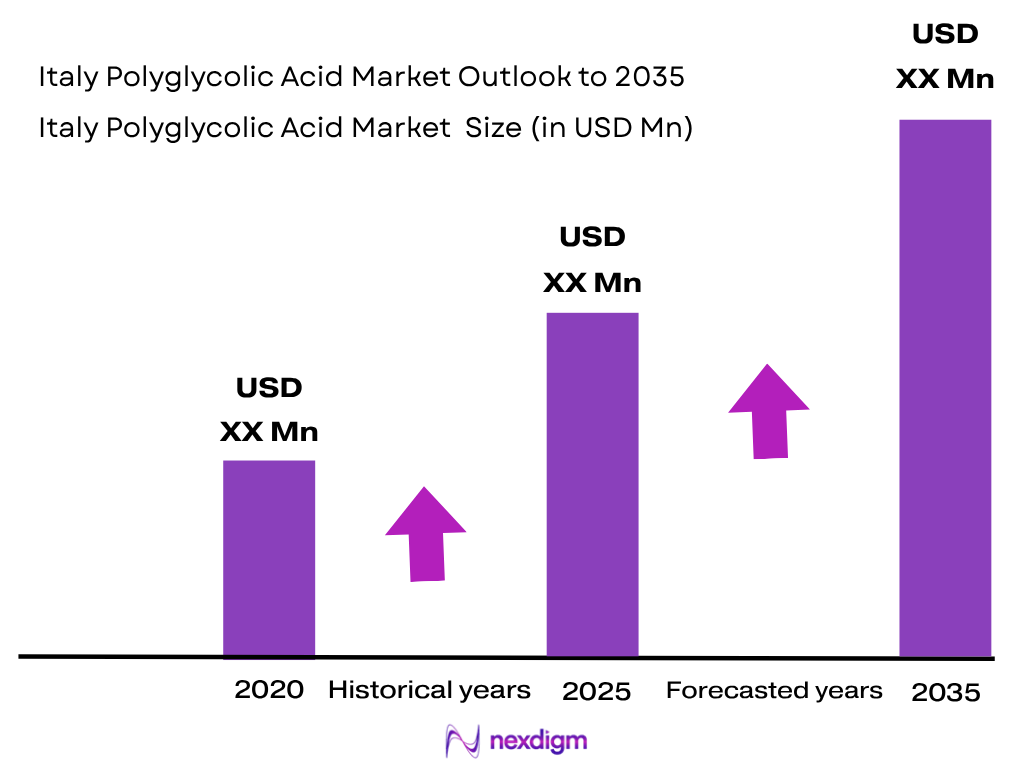
The Italy Polyglycolic Acid Market was valued at USD 132.82 million, while the forecast CAGR for 2026–2035 is maintained at ~XX% for report modelling. The market is supported by Italy’s medical-device ecosystem, which expanded from 4,641 companies and 117,607 employees to 4,648 companies and 130,520 employees across the latest reported industry datasets. Demand is concentrated in absorbable sutures, bioresorbable medical devices, specialty polymer components and emerging high-barrier applications.
Lombardy, Emilia-Romagna and Veneto, particularly Milan and the Mirandola biomedical district, represent the most influential Italian clusters for PGA-related commercialization because of their concentration of medical-device companies, hospitals, polymer-processing capabilities and biomedical manufacturing. Emilia-Romagna alone has 502 medical-device companies and nearly 17,000 employees, while Lombardy has 1,396 companies and more than 58,000 employees. These clusters provide the manufacturing, clinical-validation, procurement and distribution infrastructure required for medical-grade PGA products.
Market Segmentation
By Grade Type
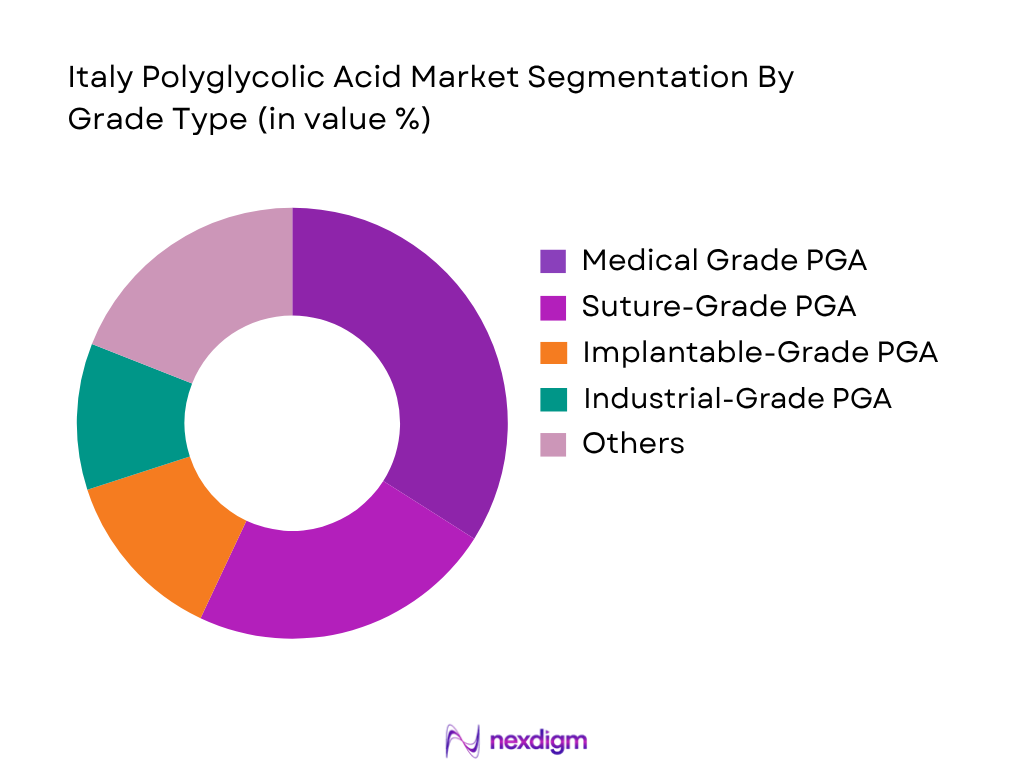
The Italy Polyglycolic Acid Market is segmented into medical-grade PGA, suture-grade PGA, implantable-grade PGA, industrial-grade PGA, fiber-spinning-grade PGA, extrusion-grade PGA and barrier-film/coating-grade PGA. Medical-grade PGA represents the dominant segment in the report model because Italy’s strongest established PGA applications are associated with absorbable surgical products and bioresorbable medical technologies. PGA offers biodegradability and controlled resorption, while medical-grade polyglycolide can be processed through extrusion, fiber spinning, braiding and coating. Italy’s established medical-device manufacturing environment reinforces this positioning. The biomedical segment alone accounts for 1,381 Italian medical-device companies, creating a substantial industrial ecosystem for wound closure, surgery and implantable applications. Medical-grade material also requires tighter purity, molecular-weight consistency, residual-monomer control and regulatory documentation than general industrial PGA. Consequently, suppliers capable of delivering GMP-grade or medical-device-qualified polymer have stronger positioning within Italy’s higher-value PGA applications.
By Application Type
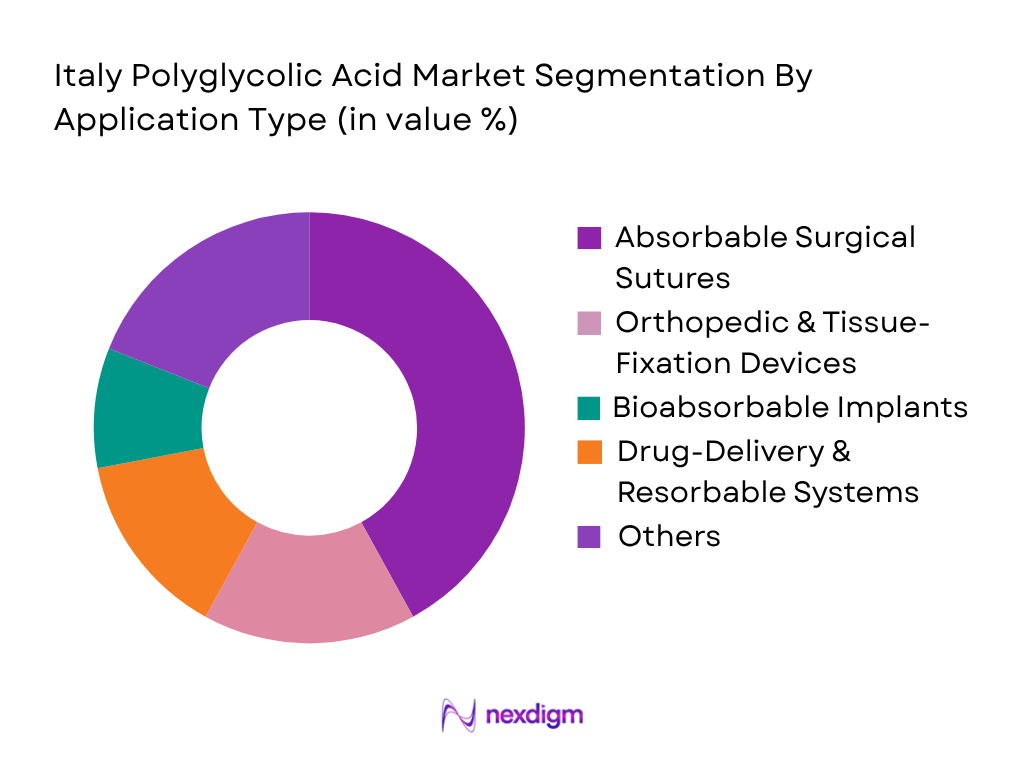
The Italy Polyglycolic Acid Market is segmented into absorbable surgical sutures, orthopedic and tissue-fixation devices, bioabsorbable implants, drug-delivery and resorbable systems, high-barrier packaging and specialty industrial applications. Absorbable surgical sutures represent the dominant application in the report model, reflecting PGA’s established clinical role as a resorbable fiber material. PGA-based polymers can be converted through fiber spinning, braiding and coating into synthetic absorbable wound-closure products, providing predictable mechanical support followed by hydrolytic degradation. Italy’s broad hospital network and established surgical-device procurement environment support recurring requirements for wound-closure products across general surgery, dental surgery, gynecology and other specialties. The country’s medical-device industry also includes thousands of production and distribution businesses, providing channels for imported medical-grade PGA, finished sutures and related devices. Future diversification is expected in tissue fixation, resorbable implants and specialty barrier applications as polymer-processing capabilities develop.
Competitive Landscape
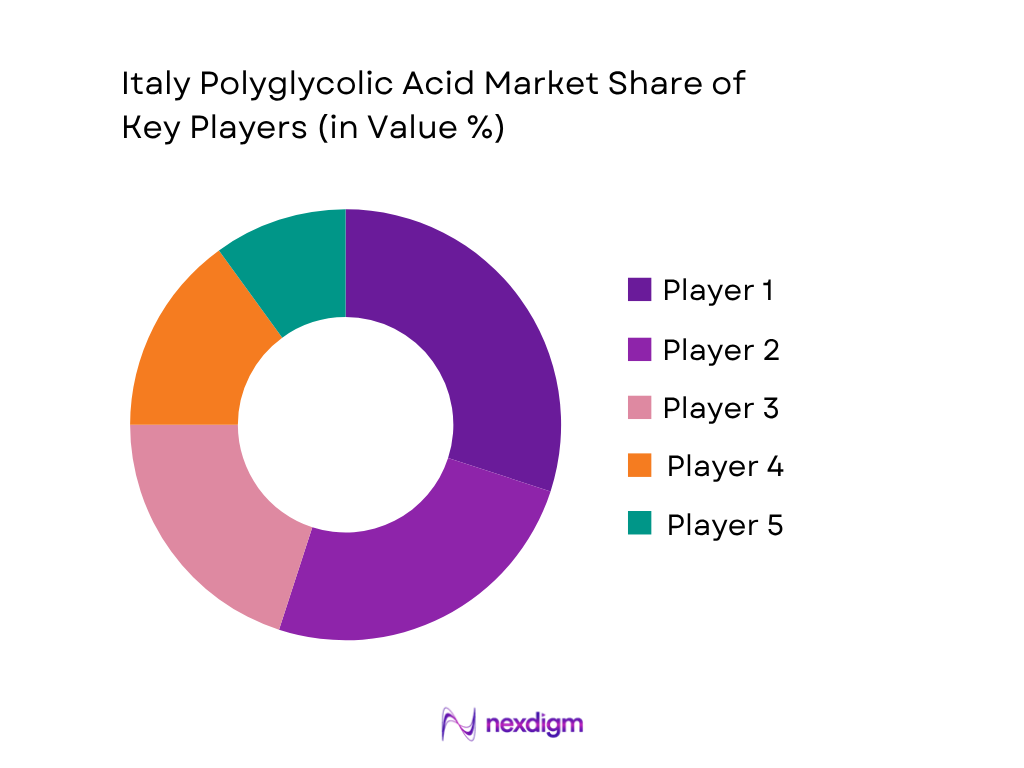
The Italy Polyglycolic Acid Market has a specialized competitive structure combining global PGA resin producers, medical-grade bioresorbable polymer suppliers and major wound-closure or implantable-device manufacturers. Kureha is particularly relevant on the industrial resin side through Kuredux PGA, while Corbion participates through PURASORB medical-grade polyglycolide and glycolide-based biomaterials. Medical-device groups such as B. Braun, Johnson & Johnson MedTech/Ethicon and W. L. Gore & Associates influence downstream competition through sutures, surgical technologies and bioresorbable-material applications.
| Company | Established | Headquarters | PGA / Related Portfolio | Primary Application | Material Positioning | Processing Capability | Italy Relevance | Regulatory/Technical Strength |
| Kureha Corporation | 1944 | Tokyo, Japan | ~ | ~ | ~ | ~ | ~ | ~ |
| Corbion N.V. | 1919 | Amsterdam, Netherlands | ~ | ~ | ~ | ~ | ~ | ~ |
| B. Braun | 1839 | Melsungen, Germany | ~ | ~ | ~ | ~ | ~ | ~ |
| Johnson & Johnson MedTech / Ethicon | 1886* | New Brunswick, USA* | ~ | ~ | ~ | ~ | ~ | ~ |
| W. L. Gore & Associates | 1958 | Newark, USA | ~ | ~ | ~ | ~ | ~ | ~ |
Italy Polyglycolic Acid Market Analysis
Growth Drivers
Large Surgical and Hospital-Care Base Supporting Medical-Grade PGA Demand
Italy’s extensive hospital and surgical-care infrastructure creates a strong demand foundation for the Italy Polyglycolic Acid Market, particularly for medical-grade PGA used in absorbable sutures, wound-closure systems and bioresorbable devices. Italy recorded 8,045,050 hospital discharge records and approximately 54.8 million inpatient days in 2024, demonstrating substantial clinical activity requiring surgical consumables and medical devices. The national breast-implant registry additionally recorded 36,189 surgical interventions, 34,938 patients and 60,945 individual procedures across 612 healthcare facilities, involving 1,377 surgeons through the end of 2024. These procedures do not represent direct PGA consumption but demonstrate the scale of Italy’s surgical infrastructure and specialist healthcare network. PGA benefits from this environment because its controlled hydrolytic degradation makes it suitable for temporary wound closure and other resorbable applications. The downstream manufacturing ecosystem further strengthens demand, with Italy currently supporting 4,618 medical-device companies and 133,627 employees, including 2,743 manufacturers and 1,499 distributors. Medical-device research and development expenditure reached approximately EUR 1.1 billion in 2024, supporting new biomaterial and implant development. Italy’s broader economic capacity is also substantial: World Bank data record 2024 GDP of USD 2,383,435,562,458.1, GDP per capita of USD 40,385.3, and a population of 58,952,704. Together, these clinical, industrial and macroeconomic indicators support continued PGA utilization across surgical sutures and related medical applications.
Strong Medical-Device Manufacturing and Biomedical Innovation Ecosystem
Italy’s established medical-technology manufacturing ecosystem supports PGA commercialization because medical-grade polyglycolide requires specialized polymer processing, sterilization validation, traceability, quality control and regulatory documentation. The country currently has 4,618 medical-device companies employing 133,627 people, including 2,743 manufacturers, 1,499 distributors and 376 service companies, creating a substantial downstream network for medical-grade PGA resin and finished products. The innovation environment is also significant, with approximately EUR 1.1 billion invested in medical-device research and development during 2024 and 303 innovative start-ups and innovative SMEs operating within the sector. Regional clusters provide additional commercialization capabilities. Lombardy hosts 1,396 medical-device companies and more than 58,000 employees, including 858 manufacturing enterprises, while regional medical-device research expenditure reaches approximately EUR 401 million. Emilia-Romagna contains 502 medical-device companies and nearly 17,000 employees, supported by the Mirandola biomedical manufacturing district, while Tuscany contains 306 companies and 9,089 employees, including 198 manufacturers. These clusters provide potential partners for PGA fiber spinning, extrusion, suture manufacturing, implant development and regulatory qualification. Italy’s 2024 macroeconomic base further supports sophisticated medical manufacturing, with GDP of USD 2,383,435,562,458.1, GDP per capita of USD 40,385.3, and 58,952,704 residents, according to World Bank data. The combination of specialized manufacturing, biomedical R&D and established regional clusters therefore provides a strong platform for increasing medical-grade PGA commercialization.
Market Challenges
Stringent MDR Certification and Medical-Grade Qualification Requirements
Regulatory qualification represents a significant challenge for the Italy Polyglycolic Acid Market because major PGA applications, including absorbable sutures and implantable devices, require extensive conformity assessment and material validation. European regulatory data recorded 28,069 Medical Device Regulation applications and 10,554 MDR certificates issued through October 2024, illustrating the scale of certification activity facing European manufacturers. Regulatory requirements became increasingly digitized in 2026, with mandatory use of relevant EUDAMED modules beginning on 28 May 2026. This is particularly important for PGA because changes in polymer characteristics, moisture history, residual monomer, fiber structure, coating, sterilization or degradation behavior can influence finished-device performance. Consequently, replacing or qualifying a PGA resin supplier is considerably more complex than changing a conventional industrial polymer supplier. Italy’s medical-device industry includes 2,743 manufacturers, 1,499 distributors, 376 service businesses and 133,627 employees, meaning a large potential PGA customer base operates under this demanding regulatory framework. The industry also invested approximately EUR 1.1 billion in R&D during 2024, demonstrating the technical resources required for medical-device development and qualification. World Bank data place Italy’s 2024 GDP at USD 2,383,435,562,458.1, GDP per capita at USD 40,385.3, and population at 58,952,704. Despite this substantial economic base, regulatory complexity remains a meaningful entry barrier, favoring PGA suppliers capable of providing consistent medical-grade polymers, complete traceability, technical documentation and long-term quality assurance.
Specialized Processing Requirements and Competition from Alternative Resorbable Polymers
PGA’s specialized processing requirements and competition from alternative bioresorbable materials constrain broader adoption in Italy. The polymer’s hydrolytic degradability requires careful resin drying, moisture management, thermal processing, sterilization validation and protective packaging. Italy possesses substantial medical-device manufacturing capacity, with 2,743 manufacturers operating within a sector of 4,618 companies and 133,627 employees, but not every manufacturer has the specialized fiber-spinning, braiding, extrusion or implant-processing capabilities required for PGA. Competition is intensified by the availability of PLA, PLGA, PCL, PDO and other glycolide-based systems that allow device manufacturers to select different degradation and mechanical-support profiles for specific clinical applications. Italy’s substantial biomedical innovation activity reinforces this material competition: approximately EUR 1.1 billion was invested in medical-device R&D in 2024, while 303 innovative start-ups and innovative SMEs operate within the sector. Regional clusters also contain sophisticated customers capable of comparing polymer platforms, including 1,396 medical-device companies in Lombardy, 502 in Emilia-Romagna and 306 in Tuscany. Italy’s economic scale remains supportive, with 2024 GDP of USD 2,383,435,562,458.1, GDP per capita of USD 40,385.3, and population of 58,952,704, according to World Bank data. PGA suppliers must therefore differentiate through consistent molecular properties, predictable degradation, processing support, sterilization compatibility and regulatory documentation rather than relying on biodegradability alone.
Market Opportunities
Expansion into Bioabsorbable Fixation and Implantable Medical Devices
The Italy Polyglycolic Acid Market has significant future potential beyond conventional sutures in bioabsorbable fixation devices, tissue-reinforcement structures, meshes and temporary implantable components. Italy’s current clinical infrastructure provides a strong platform for developing such applications. The country recorded 8,045,050 hospital discharge records and approximately 54.8 million inpatient days in 2024, while the national breast-implant registry documented 36,189 surgical interventions, 34,938 patients and 60,945 individual procedures across 612 healthcare facilities. These statistics do not indicate existing PGA consumption but demonstrate Italy’s extensive surgical and implant-management infrastructure. The industrial base is similarly relevant, comprising 2,743 medical-device manufacturers, 1,499 distributors and 376 service businesses, with total employment of 133,627 people. Approximately EUR 1.1 billion of medical-device R&D expenditure in 2024 and 303 innovative start-ups and innovative SMEs provide an established environment for developing new bioresorbable technologies. Lombardy alone contains 1,396 medical-device companies and more than 58,000 employees, while Emilia-Romagna contains 502 companies and nearly 17,000 employees. Italy’s 2024 GDP of USD 2,383,435,562,458.1, GDP per capita of USD 40,385.3, and population of 58,952,704 further support advanced healthcare technology development. These current capabilities create future opportunities for PGA-based temporary clips, pins, anchors, meshes, tissue-support structures and other resorbable components where controlled degradation after healing provides clinical functionality.
High-Barrier and Sustainable Packaging as an Industrial Diversification Opportunity
High-barrier packaging provides a future diversification opportunity for the Italy Polyglycolic Acid Market, particularly where PGA can function as a thin barrier layer rather than replacing conventional packaging polymers in bulk. Italy processed a substantial packaging stream in 2024, with more than 13.95 million tonnes of packaging placed on the market and approximately 10.699 million tonnes effectively recycled. Within plastic and bioplastic packaging, approximately 1.178935 million tonnes were recycled, including 1.131424 million tonnes of conventional plastic packaging and 47,511 tonnes of compostable plastic packaging. Italy’s packaging-recovery infrastructure also extends across 7,396 municipalities, while approximately EUR 789 million was transferred to local administrations to support additional separate-collection activities. Reusable packaging volumes exceeded 1.24 million tonnes, further demonstrating the scale of the country’s circular packaging ecosystem. These current volumes provide a large converter and recycling base against which new PGA barrier technologies can be developed and validated. PGA has potential in specialty food packaging, beverage structures and multilayer applications where oxygen and gas barrier performance is important, although commercial adoption will depend on maintaining compatibility with existing recycling systems. Italy’s macroeconomic foundation strengthens this opportunity, with 2024 GDP of USD 2,383,435,562,458.1, GDP per capita of USD 40,385.3, and population of 58,952,704. The strongest opportunity therefore lies in technically targeted PGA coatings and thin functional layers that enhance packaging performance without disrupting Italy’s established material-recovery infrastructure.
Future Outlook
The Italy Polyglycolic Acid Market is expected to expand at a forecast CAGR of ~XX% during 2026–2035, supported by wider utilization of bioresorbable polymers in medical devices and continued demand for synthetic absorbable sutures. Development activity is expected to extend PGA beyond conventional wound closure toward orthopedic fixation, tissue reinforcement and specialized implantable components. Industrial opportunities are also likely to emerge around high-performance biodegradable components and barrier-material applications. Medical-grade PGA is expected to remain strategically important because regulatory compliance, polymer purity and controlled degradation create substantial entry barriers. Suppliers capable of combining high-purity PGA with technical support for extrusion, fiber spinning, braiding, coating and implant manufacturing will be better positioned to serve Italian device manufacturers.
Italy’s medical-technology ecosystem provides a strong downstream platform. The country has thousands of medical-device manufacturers, distributors and service companies, while Lombardy and Emilia-Romagna provide particularly concentrated biomedical clusters. The Mirandola area remains an important reference point for biomedical manufacturing, supporting access to specialized engineering, production expertise and healthcare supply chains.
Major Players
- Kureha Corporation – Kuredux PGA resin and specialty industrial PGA applications
- Corbion N.V. – PURASORB polyglycolide and medical-grade resorbable polymers
- BMG Co., Ltd. – Medical-grade polyglycolide and bioabsorbable polymer materials
- Shanghai Pujing Chemical Technology Co., Ltd. – Medical and industrial PGA materials
- CHN Energy Yulin Chemical Co., Ltd. – PGA and glycolic-acid-chain production
- Shanghai DODGEN Chemical Technology Co., Ltd. – PGA polymerization and processing technologies
- Bio Sud Medical Systems S.r.l. – PGA-based absorbable surgical sutures
- Omnia S.p.A. – Absorbable surgical and dental sutures
- B. Braun – Absorbable surgical sutures and wound-closure technologies
- Johnson & Johnson MedTech / Ethicon – Glycolide-based absorbable wound-closure products
- Healthium Medtech Limited – PGA absorbable sutures and surgical products
- DemeTECH Corporation – PGA absorbable surgical sutures
- SERAG-WIESSNER GmbH & Co. KG – PGA-based absorbable surgical sutures
- RESORBA Medical GmbH – PGA absorbable surgical sutures
- W. L. Gore & Associates – Bioresorbable tissue-reinforcement materials
Key Target Audience
- PGA Resin and Glycolide Manufacturers
- Medical-Grade Bioresorbable Polymer Manufacturers
- Absorbable Surgical Suture and Wound-Closure Manufacturers
- Bioabsorbable Implant and Orthopedic Device Manufacturers
- Specialty Polymer Distributors and Medical Biomaterial Suppliers
- Investments and Venture Capitalist Firms
- Government and Regulatory Bodies (Italian Ministry of Health, Italian Medicines Agency, European Commission, European Chemicals Agency)
- High-Barrier Packaging and Specialty Polymer Converters
Research Methodology
Step 1: Identification of Key Variables
The initial phase involves developing an ecosystem map for the Italy Polyglycolic Acid Market, covering PGA resin producers, glycolide suppliers, medical polymer companies, suture manufacturers, device OEMs, distributors and industrial converters. Secondary and proprietary databases are reviewed to identify critical variables such as PGA consumption, medical-grade demand, application mix, resin imports, processing capability and regulatory requirements.
Step 2: Market Analysis and Construction
Historical market development is analyzed using both top-down and bottom-up approaches. The top-down model evaluates Italy’s medical-device, bioresorbable-polymer and specialty-material environment, while the bottom-up model assesses PGA consumption across sutures, implants, fixation devices, packaging and industrial components. Supplier revenues, application volumes, trade flows and channel structures are triangulated to construct the market model.
Step 3: Hypothesis Validation and Expert Consultation
Market hypotheses are validated through primary consultations and computer-assisted telephone interviews with polymer suppliers, medical-device manufacturers, suture producers, distributors and application specialists. Interviews focus on PGA grade requirements, material qualification, procurement practices, competitive polymers, processing constraints and application adoption. Primary findings are cross-checked against secondary evidence to reduce inconsistencies between supply-side and demand-side calculations.
Step 4: Research Synthesis and Final Output
The final phase reconciles top-down market indicators with bottom-up PGA consumption estimates. Application-level findings are compared with supplier positioning, medical-device manufacturing activity, distribution channels and regulatory conditions. Data triangulation is used to finalize segmentation, competitive positioning and forecast assumptions, producing an internally consistent assessment of the Italy Polyglycolic Acid Market and its development through 2035.

- Executive Summary
- Research Methodology (Market Definition and Scope, Italy Polyglycolic Acid Market Classification, Medical-Grade and Industrial-Grade PGA Assessment, Glycolic Acid and Glycolide Feedstock Mapping, PGA Resin Supply Assessment, Top-Down Market Sizing, Bottom-Up Application Consumption Analysis, Absorbable Suture Demand Assessment, Bioabsorbable Medical Device Mapping, High-Barrier Packaging Evaluation, Import and Distribution Analysis)

- Definition and Scope
- Italy Polyglycolic Acid Industry Evolution and Development of Resorbable Biomaterials Ecosystem
- PGA Chemistry, Glycolide Polymerization and Material Performance Characteristics
- Italy PGA Resin Import, Distribution, Conversion and End-Use Structure
- Italy Polyglycolic Acid Value Chain Analysis
- Italy Polyglycolic Acid Supply Chain Analysis
- Glycolic Acid, Glycolide, PGA Resin, Medical Polymer, Suture and Specialty Packaging Ecosystem Analysis
- PGA Integration Assessment Across Absorbable Sutures, Bioabsorbable Medical Devices and High-Barrier Packaging Applications

- Growth Drivers (Large Surgical Procedure Base, Established Absorbable Suture Consumption, Expansion of Italian Medical Device Manufacturing, Growing Resorbable Biomaterial Adoption, Development of Dental PGA Sutures, Increasing Specialty Polymer Applications)
- Market Challenges (Dependence on Imported PGA Resin, Limited Dedicated Domestic PGA Production, Hydrolytic and Moisture Sensitivity, Medical Device Qualification Complexity, Competition from PLGA and PDO Sutures, Limited Industrial-Scale PGA Processing Expertise)
- Market Opportunities (Bioabsorbable Fixation Devices, PGA Surgical Meshes and Scaffolds, Dental and Oral Surgery Sutures, Controlled-Degradation Medical Components, PGA-Based Tissue Reinforcement, High-Barrier Packaging Layers, Localized PGA Distribution and Processing)
- Market Trends (Resorbable Medical Device Development, PGA Copolymer Adoption, Braided and Coated Suture Optimization, Controlled Absorption Profiles, Medical Polymer Traceability, Implantable Biomaterial Innovation, Lightweight Barrier Structures)
- Regulatory and Standards Landscape (EU Medical Device Regulation, Italian Ministry of Health Medical Device Registration Requirements, EUDAMED Framework, CE Conformity Assessment, ISO 10993 Biocompatibility Requirements, European Pharmacopoeia Suture Requirements, REACH Compliance, EU Packaging and Packaging Waste Regulation)
- SWOT Analysis
- Porter’s Five Forces Analysis
- PESTLE Analysis
- Stakeholder Ecosystem
- Competition Ecosystem

- By Market Value (2020-2025)
- By PGA Consumption Volume (2020-2025)
- By Medical-Grade PGA Consumption Volume (2020-2025)
- By Industrial-Grade PGA Consumption Volume (2020-2025)
- By Absorbable Suture PGA Consumption Volume (2020-2025)
- By Bioabsorbable Medical Device PGA Consumption Volume (2020-2025)
- By High-Barrier Packaging PGA Consumption Volume (2020-2025)

- By Grade Type (In Value %)
Medical-Grade PGA
Suture-Grade PGA
Implantable-Grade PGA
Industrial-Grade PGA
Fiber-Spinning-Grade PGA
Extrusion-Grade PGA
Injection-Moulding-Grade PGA
Barrier-Film and Coating-Grade PGA - By Application Type (In Value %)
Absorbable Surgical Sutures
General Surgery Sutures
Dental and Oral Surgery Sutures
Gynecological and Urological Sutures
Orthopedic and Tissue-Fixation Devices
Bioabsorbable Implants
Drug-Delivery and Resorbable Systems
High-Barrier Packaging Films
Specialty Industrial Components - By End-Use Industry (In Value %)
Medical Device Manufacturing
Hospitals and Surgical Care
Dental and Oral Healthcare
Orthopedic and Trauma Care
Pharmaceutical and Drug Delivery
Food and Beverage Packaging
Specialty Polymer Processing
Industrial Applications - By Physical Form (In Value %)
PGA Resin Pellets
Medical Polymer Granules
Multifilament Fibers
Braided PGA Sutures
Monofilaments
Bioabsorbable Meshes and Scaffolds
Barrier Films
Barrier Coatings
Extruded and Moulded Components - By Degradation Profile (In Value %)
Rapid-Absorption PGA
Standard-Absorption PGA
Controlled-Hydrolysis PGA
Extended Mechanical-Retention PGA Systems
Application-Specific Degradation PGA
PGA-Based Copolymer Systems - By Processing Technology (In Value %)
Melt Extrusion
Fiber Spinning
Suture Braiding
Suture Coating
Injection Moulding
Film Extrusion
Barrier Coating
Precision Medical Polymer Processing - By Sales Channel (In Value %)
Direct PGA Producer Supply
Specialty Polymer Distributors
Medical Biomaterial Distributors
Medical Device OEM Procurement
Suture Manufacturer Procurement
Healthcare Procurement Networks
Packaging Converter Procurement
Contract Manufacturing Networks - By Region (In Value %)
Lombardy
Emilia-Romagna
Veneto
Piedmont
Tuscany
Lazio
Southern Italy

- Market Share of Major Players (By PGA Resin Supply, Medical-Grade PGA Presence, Absorbable Suture Portfolio, Bioabsorbable Device Applications, Industrial PGA Applications, Distribution Coverage, Customer Segment, Italy Market Presence)
- Cross Comparison Parameters (PGA Resin and Medical Polymer Supply Capability, Medical-Grade Purity and Biocompatibility Positioning, PGA Suture and Implant Product Portfolio, Absorption and Tensile-Retention Profile, PGA Processing and Fiber Technology Capability, Italy Healthcare Customer Reach, EU MDR and Regulatory Readiness, Application Development and Technical Support Capability)
- SWOT Analysis of Major Players
- Competitive Positioning Matrix
- Detailed Profiles of Major Companies
Kureha Corporation – Kuredux PGA Resin, High-Barrier and Specialty PGA Applications
Corbion N.V. – PURASORB Polyglycolide and Medical-Grade Resorbable Polymer Materials
BMG Co., Ltd. – Medical-Grade Polyglycolide and Bioabsorbable Polymer Materials
Shanghai Pujing Chemical Technology Co., Ltd. – Medical and Industrial PGA Materials
CHN Energy Yulin Chemical Co., Ltd. – PGA and Glycolic-Acid-Chain Production
Shanghai DODGEN Chemical Technology Co., Ltd. – PGA Polymerization Technology and Industrial PGA Materials
Bio Sud Medical Systems S.r.l. – PGA and PGA-Based Absorbable Surgical Sutures
Omnia S.p.A. – PGA Absorbable Surgical Sutures for Dental and Surgical Applications
B. Braun – Absorbable Surgical Sutures and Resorbable Medical Products
Johnson & Johnson MedTech / Ethicon – Glycolide-Based Absorbable Wound-Closure Products
Healthium Medtech Limited – PGA Absorbable Sutures and Surgical Wound-Closure Solutions
DemeTECH Corporation – PGA Absorbable Surgical Sutures
SERAG-WIESSNER GmbH & Co. KG – PGA-Based Absorbable Surgical Sutures
RESORBA Medical GmbH – PGA Absorbable Surgical Sutures
W. L. Gore & Associates – PGA-Based Bioabsorbable Tissue Reinforcement Materials

- Medical Device Manufacturer PGA Adoption Assessment
- Absorbable Suture Manufacturer Material Requirements Analysis
- Hospital and Surgical Application Assessment
- Dental and Oral Surgery Application Assessment
- Orthopedic and Bioabsorbable Device Manufacturer Analysis
- Pharmaceutical and Drug-Delivery Application Assessment
- High-Barrier Packaging Converter Analysis
- Medical Biomaterial Distributor Assessment
- PGA Material Attribute Preference Analysis

- By Market Value (2026-2035)
- By PGA Consumption Volume (2026-2035)
- By Medical-Grade PGA Consumption Volume (2026-2035)
- By Industrial-Grade PGA Consumption Volume (2026-2035)
- By Absorbable Suture PGA Consumption Volume (2026-2035)
- By Bioabsorbable Implant PGA Consumption Volume (2026-2035)
- By High-Barrier Packaging PGA Consumption Volume (2026-2035)
- By Imported PGA Resin Volume (2026-2035)


 Request a Sample
 Ask for Customization
 Get a Quote
 Enquire Now