
 Download PDF
Market Overview
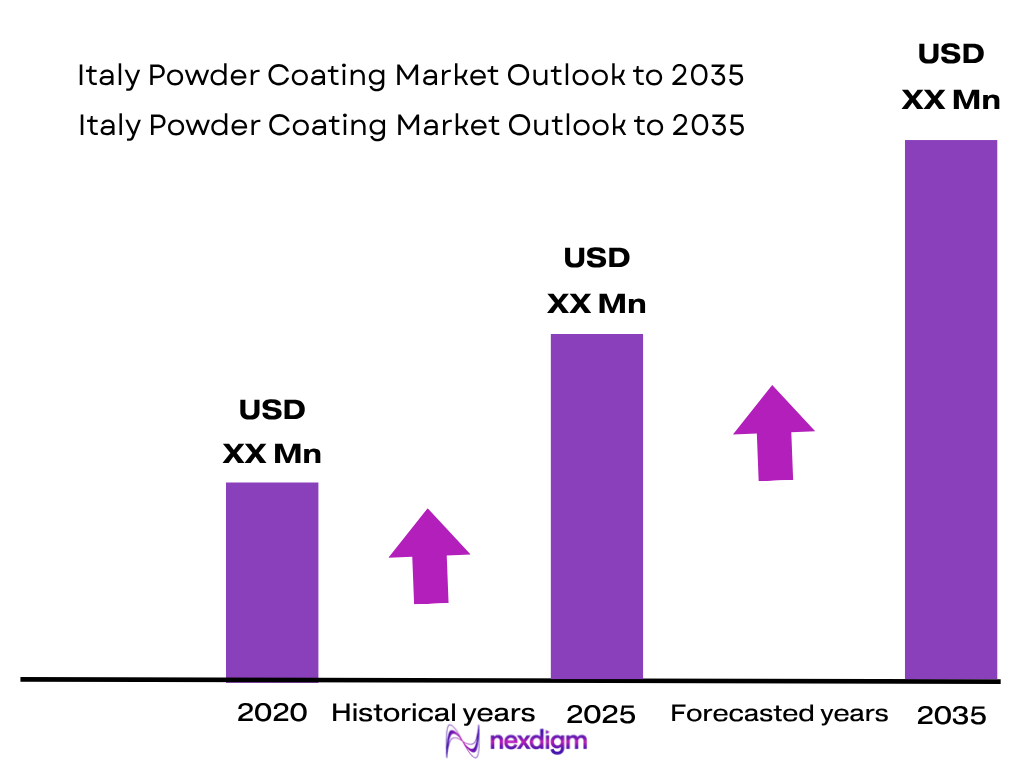
The Italy Powder Coating Market is represented at approximately USD ~million, supported by machinery, architectural aluminium, automotive components, appliances, furniture and general metal finishing. The industrial base remains substantial: machine-tool, robot and automation production moved from about €7.6 billion in the earlier annual observation to €6.327 billion in the latest observation, while exports reached €4.273 billion. Polyester remains the leading powder resin because exterior durability and architectural applications are important demand centres.
Milan and wider Lombardy, Vicenza and Veneto, Turin and Piedmont, and Bologna–Emilia-Romagna form the principal powder-coating demand belt because these areas concentrate metalworking, machinery, automotive suppliers, furniture, aluminium finishing and coating manufacturers. Vehicle production moved from 873,000 units in the earlier observation to 591,000 units in the latest observation, while Veneto-based powder producers operate extensive domestic production and stocking capabilities. Lombardy additionally recorded export growth in the latest regional trade dataset, reinforcing its manufacturing relevance.
Market Segmentation
By Resin Chemistry
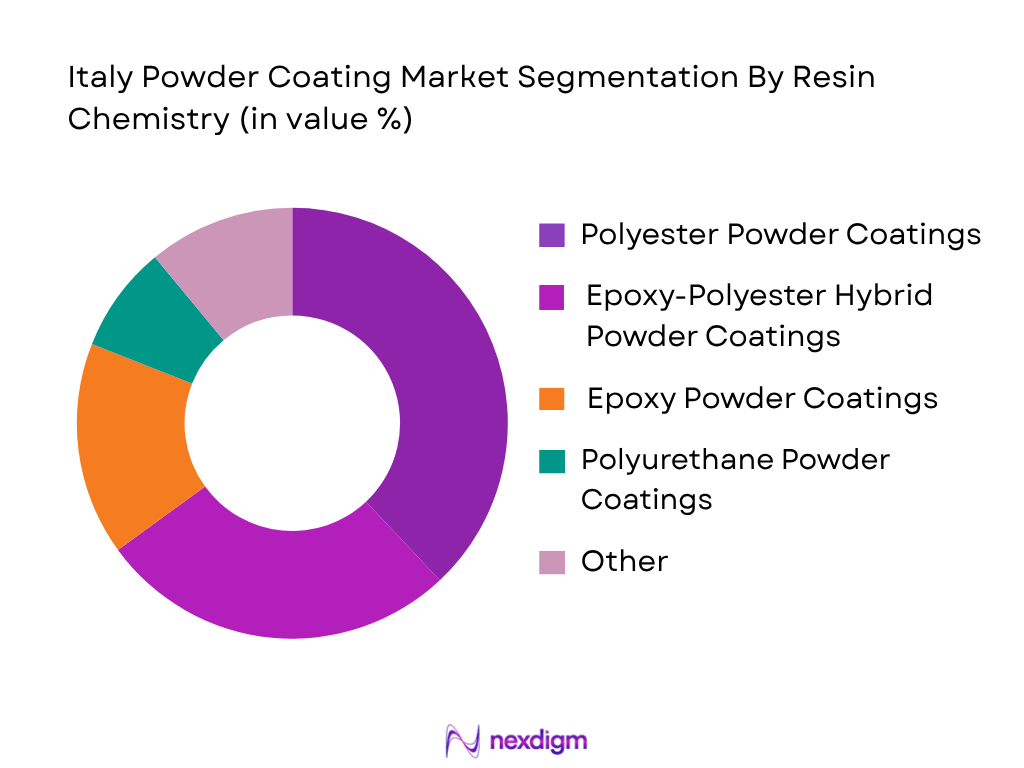
The Italy Powder Coating Market is segmented by resin chemistry into polyester, epoxy-polyester hybrid, epoxy, polyurethane, acrylic and other specialty or thermoplastic powders. Polyester powder coatings hold the dominant position because Italy has substantial demand from architectural aluminium, outdoor furniture, machinery housings, agricultural equipment and fabricated metal products that require weather resistance, colour retention and exterior durability. The position of polyester is reinforced by Italy’s architectural finishing ecosystem, where QUALICOAT-qualified Class 1 and Class 2 systems are commercially important. Europolveri, for example, offers polyester powders certified for QUALICOAT Classes 1 and 2, while Axalta markets SuperDurable polyester systems for façades, windows, doors and other exterior construction elements. Polyester is also compatible with low-temperature technology, textured finishes and TGIC-free chemistry. Epoxy-polyester hybrids remain important for indoor machinery, appliances, shelving and office furniture because they combine attractive appearance with strong mechanical properties. Pure epoxy systems are concentrated in corrosion protection, primers, electrical applications and chemically demanding environments. Current external market benchmarking also identifies polyester as Italy’s largest powder-coating resin category.
By End-Use Industry
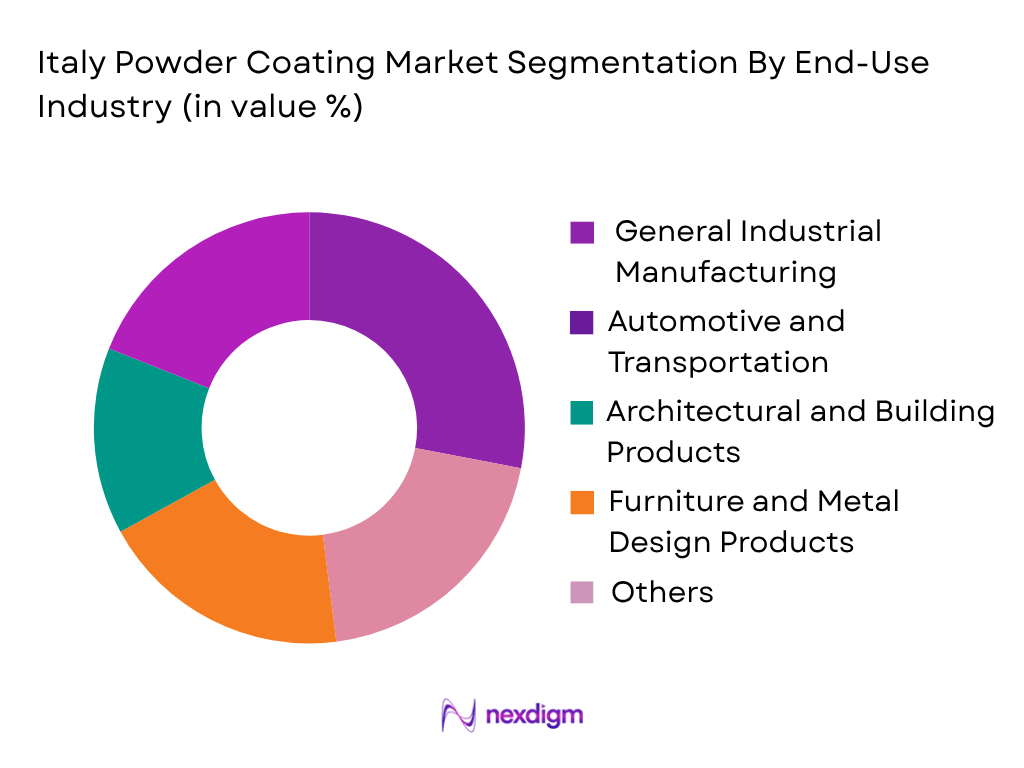
The Italy Powder Coating Market is segmented by end-use into general industrial manufacturing, automotive and transportation, architectural and building products, furniture, appliances and other industrial applications. General industrial manufacturing represents the leading demand category because Italy maintains a highly developed network of machinery producers, equipment manufacturers, metal fabricators, pumps and valve companies, electrical enclosure producers and specialist job coaters. Italian machine-tool, robot and automation production reached €6.327 billion, while exports reached €4.273 billion, demonstrating the size and international orientation of an important powder-consuming industrial ecosystem. Powder coatings are used on machine frames, guards, cabinets, pumps, material-handling equipment and fabricated assemblies because electrostatic application provides repeatable film build, colour flexibility and recoverable overspray. Automotive remains another important category despite weaker vehicle assembly, supported by component manufacturers and commercial vehicle supply chains. Architectural aluminium and metal furniture also have particular relevance in Italy because of the country’s construction-product, furniture and design industries. Furniture-sector exports alone reached €14.4 billion in the latest reported annual dataset, sustaining demand for premium matt, textured, metallic and scratch-resistant finishes.
Competitive Landscape
The Italy Powder Coating Market combines large international suppliers such as AkzoNobel and Axalta with technically specialised domestic manufacturers including Pulverit, ST Powder Coatings and Europolveri. Competition is fragmented across architectural, industrial, furniture, automotive and functional applications rather than being driven purely by scale. Italian buyers increasingly compare suppliers on curing temperature, colour-matching speed, metallic bonding capability, QUALICOAT approvals, stock availability, corrosion performance and local technical support. Domestic manufacturers have therefore developed portfolios capable of competing with multinational suppliers in both standard RAL products and highly customised industrial powders.
| Company | Establishment Year | Headquarters | Italy Presence | Powder Brand / Portfolio | Resin Chemistry Breadth | Low-Cure Capability | Architectural Qualification | Key End-Use Strength |
| AkzoNobel | 1792 heritage | Amsterdam, Netherlands | ~ | ~ | ~ | ~ | ~ | ~ |
| Axalta Coating Systems | 1866 heritage | Philadelphia, USA | ~ | ~ | ~ | ~ | ~ | ~ |
| Pulverit S.p.A. | 1973 | Milan, Italy | ~ | ~ | ~ | ~ | ~ | ~ |
| ST Powder Coatings S.p.A. | 2004 | Mantua, Italy | ~ | ~ | ~ | ~ | ~ | ~ |
| Europolveri S.p.A. | 1982 | Sandrigo, Vicenza, Italy | ~ | ~ | ~ | ~ | ~ |
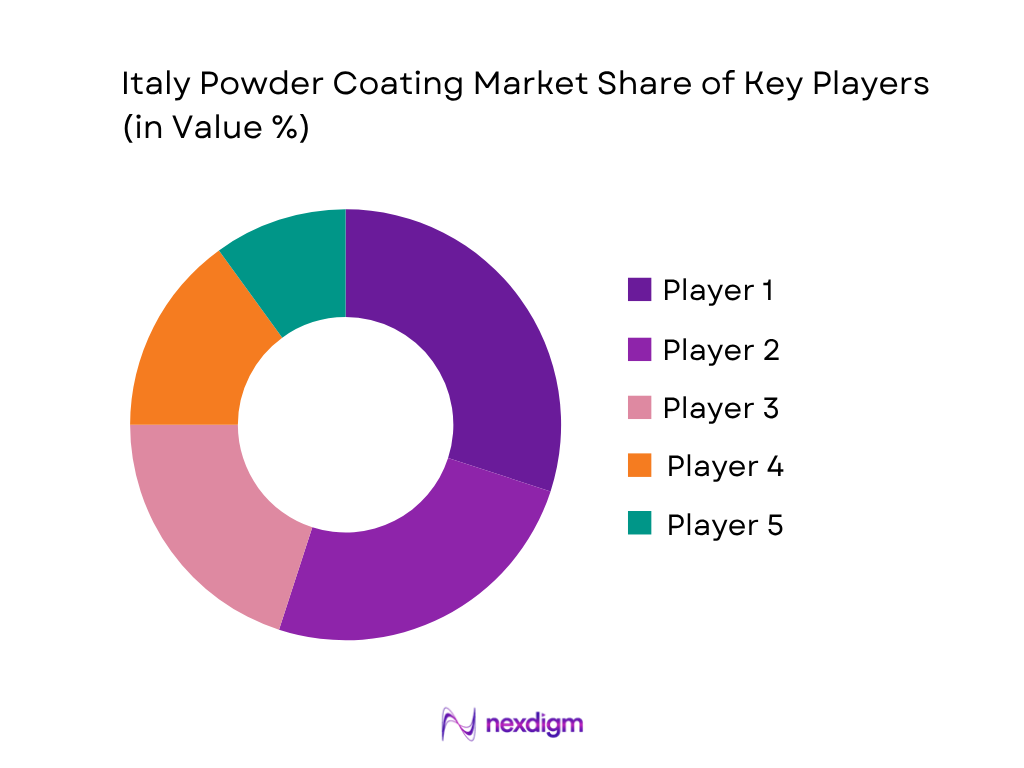
Italy Powder Coating Market Analysis
Growth Driver
Strong Machinery, Metalworking and Industrial Equipment Base
Italy’s large machinery and engineered-metal ecosystem creates a structural demand base for powder coatings used on machine frames, guards, cabinets, pumps, compressors, material-handling systems, agricultural equipment and fabricated assemblies. Italian machine-tool, robot and automation production reached €6.327 billion in 2024, including €4.273 billion of exports and €2.054 billion of deliveries to the domestic market. In 2025, production reached €6.391 billion, domestic deliveries increased to €2.631 billion, and domestic consumption reached €4.534 billion, sustaining finishing requirements across industrial supply chains. These activities support polyester and epoxy-polyester systems because machinery producers require durable surfaces, repeatable colours, mechanical resistance and efficient coating of complex fabricated components. Italy’s broader macroeconomic base reinforces this demand, with 2024 GDP at USD 2,383,435,562,458.1, manufacturing generating USD 345,289,219,194 of value added, and industry including construction generating USD 515,181,930,568. The scale of this manufacturing economy provides powder-coating suppliers with a diversified customer base extending beyond any single OEM category and supports continuing demand for durable industrial finishing technologies.
Automotive Component and Transportation Supply Chain
Italy’s automotive component ecosystem remains an important powder-coating demand driver even when domestic vehicle assembly fluctuates, because components such as brackets, suspension parts, seat structures, wheels, housings, frames and fabricated assemblies require corrosion-resistant and mechanically durable finishes. Italy’s automotive component industry exported €24.6 billion of products in 2024, imported €17.8 billion, and generated a trade surplus of €6.8 billion. The national component ecosystem comprised 2,134 companies, employed 168,000 people, and generated €55.5 billion in turnover, demonstrating substantial industrial depth beyond final vehicle assembly. Mechanical automotive parts alone accounted for €16.4 billion of exports, while engines and engine parts contributed €3.9 billion. This export-oriented structure supports powder coating because suppliers must meet repeatable OEM specifications for corrosion protection, film integrity, adhesion and automated-line compatibility. Italy generated USD 345,289,219,194 of manufacturing value added in 2024, within national GDP of USD 2,383,435,562,458.1. This combination of large-scale manufacturing and globally connected component production supports demand for epoxy primers, polyester topcoats, hybrid powders and increasingly functional electrical coatings.
Market Challenges
Contraction in Automotive Manufacturing and Component Output
Weak automotive production represents a direct challenge for Italian powder-coating suppliers exposed to wheels, chassis components, seat structures, brackets and other transportation applications. Approximately 591,000 motor vehicles were manufactured in Italy in 2024, including roughly 310,000 passenger cars. Automotive-component exports still reached €24.6 billion, but imports stood at €17.8 billion, while vehicle exports were valued at €17.6 billion against imports of €36.8 billion. The automotive-component ecosystem remains large, with 2,134 companies and 168,000 employees, meaning lower production utilization can affect a broad network of captive coating lines and external job coaters rather than only vehicle assembly plants. The challenge is particularly relevant for powder suppliers because automotive specifications can require lengthy qualification processes, limiting the ability to rapidly replace lost volumes with new customers. Italy’s broader economic base generated USD 2,383,435,562,458.1 of GDP in 2024 and USD 345,289,219,194 of manufacturing value added. Consequently, the issue is not absence of industrial capacity but weaker utilization in a strategically important powder-consuming vertical, increasing the need to diversify toward machinery, electrical equipment, architecture and furniture applications.
Uneven Construction Pipeline and Pressure on Architectural Finishing Demand
Architectural aluminium, windows, façades, railings, shutters, HVAC equipment and fabricated building products form an important application base for durable polyester powder coatings, making uneven construction activity a material challenge. In the fourth quarter of 2024, approximately 14,000 new residential dwellings were authorized on a seasonally adjusted basis, while useful residential floor area was around 1.25 million square metres and authorized non-residential floor area was approximately 2.7 million square metres. In the first quarter of 2025, authorized new dwellings declined to 11,958 units, useful residential floor area reached approximately 1.06 million square metres, and non-residential area stood slightly above 2.25 million square metres. These physical indicators matter directly to architectural powder suppliers because fewer approved buildings can reduce subsequent demand for coated aluminium profiles, doors, windows, façade elements and metal accessories. Italy nevertheless generated USD 515,181,930,568 of industrial and construction value added in 2024, alongside national GDP of USD 2,383,435,562,458.1. The challenge is therefore managing cyclical project variability while maintaining stocked colours, technical service and qualified architectural powder systems.
Market Opportunities
Renewable Energy and Electrical Infrastructure Equipment
Italy’s expanding renewable-electricity infrastructure provides a future growth avenue for powder coatings used on inverter cabinets, electrical enclosures, battery-storage housings, mounting systems, control panels, fabricated support structures and ancillary equipment. Approximately 7.5 GW of new renewable generating capacity was activated during 2024, materially expanding the physical infrastructure requiring electrical and metal equipment. By June 2025, Italy had 79.7 GW of installed renewable power, comprising 39.9 GW of solar, 21.58 GW of renewable hydro, 13.29 GW of wind, 3.98 GW of biomass and 0.95 GW of geothermal capacity. These current infrastructure figures demonstrate a substantial equipment base requiring corrosion protection and durable factory finishing. Exterior cabinets, mounting assemblies and electrical housings require resistance to weathering, mechanical damage and environmental exposure, creating applications for polyester and functional powder systems. Italy’s industrial platform supports this opportunity, with 2024 industry and construction value added of USD 515,181,930,568, manufacturing value added of USD 345,289,219,194, and GDP of USD 2,383,435,562,458.1. This installed renewable and manufacturing footprint creates opportunities for super-durable polyester, anticorrosion primers, dielectric powders and low-temperature cure systems.
Premium Furniture, Metal Design and Export-Oriented Finishing
Italy’s furniture and design manufacturing ecosystem creates a differentiated growth opportunity for powder coatings because manufacturers increasingly require matt, fine-texture, metallic, scratch-resistant and customized finishes for metal furniture, shelving, lighting, outdoor furnishings and contract interiors. The Italian wood-furniture supply chain generated €19.4 billion of exports in 2024, of which the furniture macro-system accounted for €14.4 billion. These export volumes create finishing requirements extending beyond conventional corrosion protection toward appearance, tactile texture, colour consistency and design differentiation. Powder coating is particularly suited to metal furniture because it supports repeatable industrial application while allowing smooth, textured, bonded-metallic and specialty-effect surfaces. Italy’s broader production environment strengthens this opportunity, with USD 345,289,219,194 of manufacturing value added in 2024, USD 515,181,930,568 of industry and construction value added, and national GDP of USD 2,383,435,562,458.1. The opportunity is therefore supported by an established export-oriented manufacturing base rather than speculative future consumption. Powder manufacturers capable of rapid custom-colour development, small-batch manufacturing, low-temperature curing and premium decorative effects can address Italian furniture and design producers seeking both technical durability and differentiated aesthetics for international markets.
Future Outlook
The Italy Powder Coating Market is expected to transition toward higher-performance and lower-energy systems through 2035. The draft market model assumes a ~6.0% CAGR during 2026–2035, with development increasingly concentrated in low-temperature cure powders, super-durable architectural polyester, functional coatings, premium furniture finishes and corrosion-resistant systems. Energy efficiency, automation and faster colour changes will become more significant procurement factors. Domestic suppliers with flexible production capabilities are expected to benefit from Italy’s fragmented but technically demanding OEM and job-coater base.
Low-temperature curing represents a particularly relevant innovation direction. Pulverit markets technology capable of curing within 3 minutes at 120°C, while ST Powder Coatings offers Cool Powder systems starting at 140°C and EVO+ formulations capable of curing at 140–150°C, compared with conventional cycles around 180°C. Such products can help Italian applicators process high-mass fabricated components and reduce oven requirements while maintaining production throughput. Architectural finishing should remain a premium technology opportunity. QUALICOAT Class 2 super-durable polyester systems are available from multiple suppliers, while Italian manufacturers offer metallic, anodized-effect, textured, matt and wood-effect technologies to support architects and façade manufacturers. Europolveri’s ArchitecturalPlus products combine TGIC-free chemistry with QUALICOAT and GSB certification, reflecting the importance of qualification and long-duration exterior performance within this segment.
Major Players
- AkzoNobel Coatings S.p.A. – Interpon
- Sherwin-Williams Italy – Inver
- Axalta Coating Systems Italy S.r.l. – Alesta
- Pulverit S.p.A.
- ST Powder Coatings S.p.A.
- Arsonsisi S.p.A.
- Europolveri S.p.A.
- KANSAI HELIOS Italy S.r.l.
- TIGER Drylac Italia S.r.l.
- Adapta Color Italia S.r.l.
- Vires Polveri S.r.l.
- Fox Color S.r.l. – AZ Powder Coatings
- PPG Industries Italia
- IGP Pulvertechnik
- Protech Group / Oxyplast
Key Target Audience
- Powder Coating Manufacturers
- Automotive and Transportation Component Manufacturers
- Machinery, Industrial Equipment and Metal Fabrication Companies
- Architectural Aluminium Extruders, Fabricators and Job Coaters
- Furniture, Lighting and Metal Design Product Manufacturers
- Resin, Pigment, Additive and Powder Application Equipment Suppliers
- Investments and Venture Capitalist Firms
- Government and Regulatory Bodies (Ministry of Environment and Energy Security – MASE, Ministry of Enterprises and Made in Italy – MIMIT, Italian National Institute for Environmental Protection and Research – ISPRA, European Chemicals Agency – ECHA)
Research Methodology
Step 1: Identification of Key Variables
The initial phase involves developing an ecosystem map for the Italy Powder Coating Market covering resin suppliers, powder manufacturers, distributors, equipment suppliers, job coaters and industrial OEMs. Secondary information is collected from industrial associations, government databases, company disclosures and certification organizations. Critical variables include powder consumption, resin mix, application technology, end-use structure, domestic manufacturing and trade flows.
Step 2: Market Analysis and Construction
Historical market activity is reconstructed through both top-down and bottom-up approaches. The top-down assessment evaluates Italian industrial production, machinery, automotive, furniture and architectural activity, while the bottom-up model assesses powder-manufacturer sales, distributor throughput, job-coater consumption and OEM coating requirements. Market value and volume are reconciled to ensure consistency across resin chemistry and end-use segmentation.
Step 3: Hypothesis Validation and Expert Consultation
Research hypotheses are validated through computer-assisted telephone interviews and structured consultations with powder manufacturers, applicators, distributors, equipment suppliers and OEM coating specialists. Interviews assess resin preferences, coating-line utilization, film thickness, cure temperatures, powder reclaim, customer qualification and supplier switching behaviour. Primary feedback is used to refine assumptions and test segmentation boundaries.
Step 4: Research Synthesis and Final Output
The final phase triangulates supply-side revenues with demand-side consumption indicators and industry production data. Manufacturer estimates are cross-checked against applicator throughput, OEM activity and trade patterns. Resin and end-use shares are independently validated before consolidation, producing a coherent market model covering historical development, competition, segmentation and the long-term outlook for the Italy Powder Coating Market.

- Executive Summary
- Research Methodology (Market Definition and Scope, Italy Powder Coating Taxonomy, Thermoset and Thermoplastic Powder Classification, Resin Chemistry Mapping, Functional and Decorative Powder Classification, Substrate Mapping, Surface Pretreatment Assessment, Electrostatic Application Technology Assessment, Cure Technology Assessment, Film Thickness Assessment, Powder Recovery and Reclaim Assessment, Market Sizing Framework)

- Definition and Scope
- Italy Powder Coating Industry Evolution and Technology Development
- Powder Coating Manufacturing and Formulation Process
- Powder Coating Value Chain Analysis
- Italy Powder Coating Supply Chain Analysis
- Resin, Pigment, Additive and Filler Ecosystem Analysis
- Italy Powder Coating Domestic Manufacturing and Import Dependency Assessment
- OEM Powder Coating Application Architecture and Job-Coater Solution Framework

- Growth Drivers (Large Metalworking and Machinery Manufacturing Base, Automotive and Auto Component Production, Architectural Aluminum Finishing Demand, Strong Metal Furniture and Design Manufacturing, Appliance and White Goods Production, Export-Oriented Industrial Manufacturing, Liquid-to-Powder Conversion, Increasing Demand for Durable Corrosion-Resistant Finishes)
- Market Challenges (Industrial Production Cyclicality, Dependence on Imported Resin and Pigment Inputs, Energy-Intensive Cure Requirements, Fragmented Job-Coater Ecosystem, Small-Batch and Frequent Color Change Complexity, Competition from Imported Powder Coatings, OEM Qualification Requirements, Surface Pretreatment Quality Variation)
- Market Opportunities (Low-Temperature and Fast-Cure Powders, Super-Durable Architectural Powder Coatings, Premium Metal Furniture and Design Finishes, EV Battery and Electrical Insulation Powders, Functional and ESD Powder Coatings, Zinc-Free Corrosion Protection Primers, Heat-Sensitive Substrate Powder Coating, Localized Specialty and Small-Batch Powder Manufacturing)
- Market Trends (TGIC-Free Polyester Adoption, Low-Bake Fast-Cure Systems, Super-Durable Architectural Powders, Fine-Texture and Matt Finishes, Bonded Metallic Powder Coatings, Functional Powder Coatings, Robotic Powder Application, Sustainable Solvent-Free Finishing)
- Regulatory and Standards Landscape (EU REACH Requirements, CLP Classification and Labelling Requirements, Italian Environmental and Industrial Emissions Requirements, Occupational Safety Requirements, ATEX Combustible Dust Requirements, QUALICOAT Architectural Performance Requirements, QUALITAL Requirements, Qualisteelcoat Requirements, ISO 12944 Corrosion Protection Standards, ASTM and ISO Powder Coating Test Standards)
- SWOT Analysis
- Porter’s Five Forces Analysis
- PESTLE Analysis
- Stakeholder Ecosystem
- Competition Ecosystem

- By Market Value (2020-2025)
- By Powder Coating Consumption Volume (2020-2025)
- By Coated Surface Area (2020-2025)
- By Domestic Production Volume (2020-2025)
- By Import Volume (2020-2025)
- By Export Volume (2020-2025)
- By Average Selling Price (2020-2025)
- By Thermoset Powder Consumption (2020-2025)
- By Thermoplastic Powder Consumption (2020-2025)

- By Resin Chemistry (In Value %)
Pure Polyester Powder Coatings
TGIC Polyester Powder Coatings
TGIC-Free Polyester Powder Coatings
Super-Durable Polyester Powder Coatings
Epoxy Powder Coatings
Epoxy-Polyester Hybrid Powder Coatings
Polyurethane Powder Coatings
Acrylic Powder Coatings
Fluoropolymer Powder Coatings
Silicone Polyester Powder Coatings
Nylon Powder Coatings
Polyethylene Powder Coatings
Other Specialty Thermoplastic Powders - By Coating Technology (In Value %)
Thermosetting Powder Coatings
Thermoplastic Powder Coatings
Low-Temperature Cure Powder Coatings
Low-Bake Fast-Cure Powder Coatings
Ultra-Low-Bake Powder Coatings
UV-Curable Powder Coatings
Thin-Film Powder Coatings
High-Temperature Resistant Powder Coatings - By Functional Performance (In Value %)
Decorative Powder Coatings
Corrosion-Resistant Powder Coatings
Super-Durable Architectural Powders
High-Temperature Powder Coatings
Electrical Insulation and Dielectric Powders
Antimicrobial Powder Coatings
Anti-Graffiti Powder Coatings
Scratch-Resistant Powder Coatings
Chemical-Resistant Powder Coatings
Heavy-Duty Corrosion-Protection Powders
Fire-Retardant Powder Coatings
Electrostatic Dissipative Powder Coatings
Powder-on-Powder Primer Systems
Zinc-Rich and Zinc-Free Powder Primers - By End-Use Industry (In Value %)
Architectural Aluminum and Building Products
General Industrial Manufacturing
Automotive and Auto Components
Appliances and White Goods
Electrical and Electronics
Furniture and Metal Fabrication
HVAC and Heating Equipment
Machinery and Machine Tools
Agricultural and Construction Equipment
Commercial Vehicles and Transportation Equipment
Lighting Equipment
Bicycles and Micromobility Components
Renewable Energy Equipment
Rail and Public Transportation Components - By Distribution Channel (In Value %)
Direct Powder Manufacturer-to-OEM Sales
Direct Manufacturer-to-Job Coater Sales
Authorized Powder Coating Distributors
Industrial Paint and Coating Distributors
Regional Stocking Warehouses
Dealer and Reseller Networks
Equipment and Powder Bundled Distribution
Project-Specific Supply Contracts
Online B2B Industrial Platforms
Custom Color and Small-Batch Channels - By Region (In Value %)
Lombardy
Veneto
Emilia-Romagna
Piedmont
Friuli-Venezia Giulia
Trentino-Alto Adige
Tuscany
Marche
Lazio
Campania
Apulia
Liguria
Umbria
Sicily
Remaining Italy

- Market Share of Major Players (By Revenue, Volume, Resin Chemistry, Powder Technology, End-Use Industry, Application Type, Market Type, Distribution Channel)
- Cross Comparison Parameters (Resin Chemistry and Powder Technology Breadth, Italy and European Manufacturing and Supply Footprint, Low-Temperature and Fast-Cure Technology Capability, Super-Durable Architectural Powder Portfolio Strength, Metallic and Special-Effect Powder Capability, Functional and Corrosion-Protection Powder Capability, Custom Color Matching and Small-Batch Technical Support, Sustainable and TGIC-Free Low-Energy Powder Portfolio)
- SWOT Analysis of Major Players
- Pricing and Distribution Network Benchmarking
- Detailed Profiles of Major Companies
AkzoNobel Coatings S.p.A. – Interpon
Sherwin-Williams Italy – Inver
Axalta Coating Systems Italy S.r.l. – Alesta
Pulverit S.p.A.
ST Powder Coatings S.p.A.
Arsonsisi S.p.A.
Europolveri S.p.A.
KANSAI HELIOS Italy S.r.l.
TIGER Drylac Italia S.r.l.
Adapta Color Italia S.r.l.
Vires Polveri S.r.l.
Fox Color S.r.l. – AZ Powder Coatings
PPG Industries Italia
IGP Pulvertechnik
Protech Group / Oxyplast

- Buyer Segmentation
- OEM Procurement Behaviour
- Supplier Selection Criteria
- Buyer Pain Points
- Technology Adoption Assessment
- Replacement and Repurchase Behaviour

- By Market Value (2026-2035)
- By Powder Coating Consumption Volume (2026-2035)
- By Coated Surface Area (2026-2035)
- By Domestic Production Volume (2026-2035)
- By Import Volume (2026-2035)
- By Export Volume (2026-2035)
- By Average Selling Price (2026-2035)
- By Thermoset Powder Consumption (2026-2035)
- By Thermoplastic Powder Consumption (2026-2035)


 Request a Sample
 Ask for Customization
 Get a Quote
 Enquire Now