
 Download PDF
 Download PDF
Market Overview
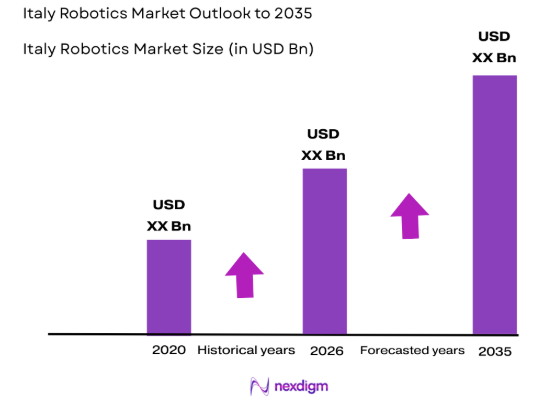
The Italy Robotics market is expected to reach USD ~ billion in 2025, driven by advancements in industrial automation, robotics, and artificial intelligence. The increasing demand for automation in sectors such as automotive, manufacturing, and logistics is propelling market growth. Robotics technologies are essential in enhancing productivity, reducing operational costs, and ensuring high-quality production. As industries continue to focus on innovation and technological integration, the need for robotics solutions remains strong in Italy.
Regions like Lombardy, Emilia-Romagna, and Piedmont dominate the Italian robotics sector due to their strong industrial bases. Lombardy, home to Milan, is a key innovation hub with a high concentration of technology-driven companies. Emilia-Romagna is known for its manufacturing prowess, especially in automotive and machinery, making it a center for industrial automation. Piedmont, with a focus on automotive manufacturing, particularly Fiat, is also crucial for robotics integration. These cities benefit from advanced infrastructure, research and development centers, and strong industrial support, driving robotics adoption.
Market Segmentation
By Product Type
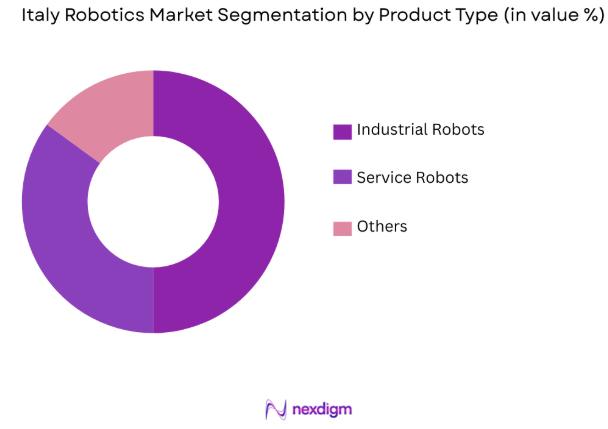
The Italy Robotics market is segmented by product type into industrial robots, service robots, and others. Recently, industrial robots have dominated the market share due to their application in manufacturing and automotive industries. Industrial robots are increasingly used to automate processes like assembly, welding, packaging, and material handling, improving efficiency and reducing labor costs. Italy’s strong automotive and manufacturing industries, including leading companies like Fiat, are driving the demand for industrial robots. Additionally, technological advancements, such as collaborative robots (cobots), have further fueled the demand for industrial robots, especially for applications that require human-robot collaboration. As these technologies continue to evolve, industrial robots are expected to maintain their dominance in the market.
By End-User Industry
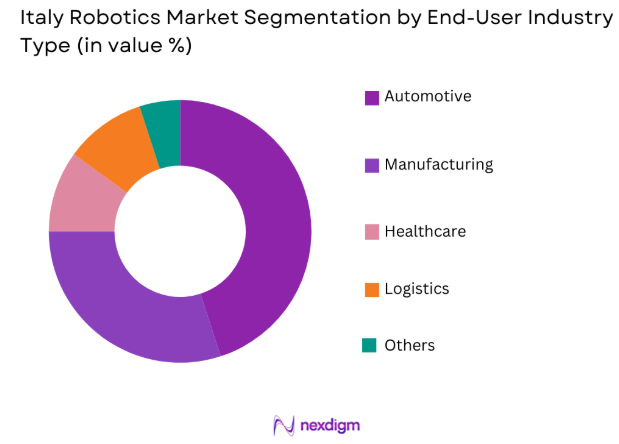
The Italy Robotics market is segmented by end-user industry into automotive, manufacturing, healthcare, logistics, and others. The automotive industry holds a dominant market share due to the widespread use of robotics for assembly, painting, and quality control. Italy’s automotive sector, led by brands like Fiat and Ferrari, has been at the forefront of robotics adoption. Robotics in automotive manufacturing enables precise, high-speed production, which is critical for maintaining global competitiveness. Furthermore, the trend toward electric vehicle (EV) production, which requires specialized robotic applications, has increased the demand for robotics solutions. As the automotive industry continues to modernize and adopt Industry 4.0 technologies, the demand for robotics will likely remain high, solidifying the sector’s dominance in the market.
Competitive Landscape
The Italy Robotics market is characterized by competition among both global and local players, with companies focusing on innovation and product differentiation. Major players in the market are investing heavily in research and development to integrate artificial intelligence, machine learning, and automation solutions into their robotic systems. The market also witnesses strategic collaborations between robotics manufacturers and end-users to tailor solutions that meet industry-specific needs. Additionally, the Italian government’s support for advanced manufacturing and automation through various incentives is driving further competition. With the rise of Industry 4.0, there is an increasing trend of automation solutions combining robotics, IoT, and AI, leading to more dynamic and intelligent systems.
| Company Name | Establishment Year | Headquarters | Technology Focus | Market Reach | Key Products | Revenue | Additional Parameter |
| ABB | 1988 | Zurich, Switzerland | ~ | ~ | ~ | ~ | ~ |
| FANUC | 1956 | Oshino, Japan | ~ | ~ | ~ | ~ | ~ |
| KUKA | 1898 | Augsburg, Germany | ~ | ~ | ~ | ~ | ~ |
| Universal Robots | 2005 | Odense, Denmark | ~ | ~ | ~ | ~ | ~ |
| Comau | 1973 | Turin, Italy | ~ | ~ | ~ | ~ | ~ |

Italy Robotics Market Analysis
Growth Drivers
Technological Advancements in Robotics and AI
Technological advancements in robotics and artificial intelligence (AI) are driving the growth of the Italy Robotics market. Robotics technology has evolved significantly, with innovations in AI, machine learning, and sensors enabling robots to perform increasingly complex tasks. In the industrial sector, robots are now capable of handling more delicate operations such as quality control, assembly, and inspection with greater precision than ever before. The integration of AI in robotics enables real-time decision-making, predictive maintenance, and the ability to optimize production processes autonomously. As Italy continues to invest in Industry 4.0 technologies, the demand for intelligent robotics solutions will grow, enhancing manufacturing productivity and reducing costs. Additionally, the increasing adoption of collaborative robots (cobots) in industries such as automotive and electronics, which work alongside human workers, is expanding the scope of robotic applications in Italy. As these technologies continue to advance, the market for robotics in Italy is expected to witness sustained growth, providing new opportunities for companies to innovate and capture market share.
Rising Demand for Automation in Manufacturing
The growing demand for automation in manufacturing is another key driver of the Italy Robotics market. Italy has a strong manufacturing base, particularly in industries such as automotive, machinery, and consumer goods, where robotics is becoming increasingly integral to operations. Robotics technologies are used to automate repetitive and high-precision tasks such as welding, assembly, and painting, which improve efficiency, reduce labor costs, and enhance product quality. The automotive sector, in particular, is investing heavily in robotics to meet global demand and maintain competitiveness, with major manufacturers such as Fiat and Ferrari incorporating robots into their production lines. Furthermore, Italy’s focus on adopting Industry 4.0 principles, which involve integrating robots with IoT, AI, and data analytics, is driving the need for advanced automation solutions. The country’s efforts to improve productivity and optimize supply chains in manufacturing will continue to fuel the demand for robotics technologies in the years to come, supporting growth in the Italian robotics market.
Market Challenges
High Initial Investment and Integration Costs
One of the main challenges facing the Italy Robotics market is the high initial investment and integration costs associated with robotics systems. While robotics can provide significant long-term benefits, including improved efficiency, cost savings, and higher-quality products, the upfront costs of purchasing and integrating robotics systems can be a barrier for many companies, particularly small and medium-sized enterprises (SMEs). The cost of advanced robotics systems, installation, and necessary infrastructure upgrades can be prohibitive, especially for industries with tight profit margins. Additionally, the complexity of integrating robotics with existing manufacturing systems can result in longer implementation timelines and increased costs. Overcoming these challenges will require companies to explore financing options, such as leasing or government incentives, and to develop cost-effective solutions that lower the barriers to entry for SMEs in the robotics market.
Skilled Labor Shortages and Training Needs
The shortage of skilled labor is another significant challenge for the growth of the Italy Robotics market. As robotics systems become more advanced, there is an increasing demand for skilled workers who can operate, maintain, and program these systems. However, many companies in Italy face a shortage of qualified personnel with the expertise required to work with complex robotic systems. This skills gap is particularly evident in industries like automotive manufacturing, where robots play a crucial role in production lines. To address this issue, companies need to invest in training programs that can upskill their workforce to operate and maintain robotics systems effectively. Additionally, collaboration with educational institutions to develop robotics-focused curricula will be essential for ensuring a steady pipeline of skilled labor to meet the growing demand for robotics in Italy.
Opportunities
Growth in Collaborative Robotics (Cobots)
The increasing adoption of collaborative robotics (cobots) presents a significant opportunity for the Italy Robotics market. Cobots are designed to work alongside human workers, enhancing productivity and safety without requiring safety barriers or complex configurations. The demand for cobots is growing, particularly in industries such as automotive, electronics, and consumer goods, where repetitive tasks such as assembly, packaging, and material handling can be automated. The ability of cobots to work safely in close proximity to humans is a key factor driving their adoption, as they enable companies to optimize labor resources and improve operational efficiency. As industries look for more flexible and cost-effective automation solutions, cobots are becoming increasingly popular. Furthermore, advancements in AI and machine learning are enhancing the capabilities of cobots, making them more adaptable and intelligent. The growing demand for flexible automation solutions presents a significant opportunity for companies in the Italian robotics market to develop and deploy cobots across a wide range of applications.
Medical Robotics and Healthcare Applications
The adoption of robotics in healthcare is another significant opportunity for the Italy Robotics market. Medical robotics is increasingly being used for minimally invasive surgeries, rehabilitation, and diagnostics, offering higher precision, reduced recovery times, and improved patient outcomes. Italy’s healthcare system, which is one of the best in Europe, is increasingly adopting robotic systems to improve the quality of care and efficiency of medical procedures. Surgical robots, such as those used in laparoscopic and orthopedic surgeries, are gaining popularity due to their ability to perform complex procedures with high accuracy. Additionally, robotic systems are being used in rehabilitation centers to assist patients with physical therapy and recovery. As the healthcare sector continues to embrace robotics for its potential to enhance medical treatments and improve patient care, the demand for medical robots and healthcare-focused robotics solutions in Italy is expected to rise, creating significant opportunities for growth in the market.
Future Outlook
The future outlook for the Italy Robotics market is promising, with sustained growth driven by advancements in robotics technologies, the increasing adoption of automation across industries, and the growing demand for collaborative robots. The automotive, manufacturing, and healthcare sectors will continue to be the key drivers of market expansion. Furthermore, Italy’s focus on Industry 4.0 and the integration of robotics with AI, IoT, and machine learning will enhance the capabilities of robotic systems, fostering innovation and increasing their adoption across various sectors. As the market continues to evolve, opportunities for growth will emerge in new applications, particularly in medical robotics and collaborative automation solutions.
Major Players
- ABB
- FANUC Corporation
- KUKA
- Universal Robots
- Comau
- Yaskawa Electric
- Omron Corporation
- Kawasaki Robotics
- Stäubli Robotics
- Mitsubishi Electric
- Denso Robotics
- Epson Robots
- Universal Automation
- Teradyne
- Bosch Rexroth
Key Target Audience
- Investments and venture capitalist firms
- Government and regulatory bodies
- Robotics manufacturers
- Healthcare providers
- Manufacturing industry leaders
- Logistics companies
- Automotive manufacturers
Research Methodology
Step 1: Identification of Key Variables
Identification of key market drivers, challenges, and technological trends affecting the Italy Robotics market, including automation, AI, and government policies.
Step 2: Market Analysis and Construction
In-depth analysis of market trends, segmentation, and competition to create an accurate representation of the market dynamics.
Step 3: Hypothesis Validation and Expert Consultation
Consultations with industry experts, key stakeholders, and academic professionals to validate assumptions and refine the market analysis.
Step 4: Research Synthesis and Final Output
The findings from the analysis and consultations are synthesized into a comprehensive report, offering actionable insights and strategic recommendations.

- Executive Summary
- Research Methodology (Definitions, Scope, Industry Assumptions, Market Sizing Approach, Primary & Secondary Research Framework, Data Collection & Verification Protocol, Analytic Models & Forecast Methodology, Limitations & Research Validity Checks)

- Market Definition and Scope
- Value Chain & Stakeholder Ecosystem
- Regulatory / Certification Landscape
- Sector Dynamics Affecting Demand

- Growth Drivers
Advancements in Robotic Technologies
Growing Demand for Automation in Manufacturing
Increase in Investments in Robotics by Government and Private Sector - Market Challenges
High Initial Capital Investment
Regulatory Compliance and Safety Standards
Lack of Skilled Workforce for Robotics Integration - Market Opportunities
Rise in Adoption of Robotics in Healthcare
Expansion of Robotics in Logistics & Supply Chain
Collaborative Robotics in Small & Medium Enterprises - Trends
Shift Toward Collaborative Robots
Increased Use of AI and Machine Learning in Robotics - Government Regulations
Standards for Robot Safety and Usage
Government Initiatives Supporting Robotics Integration
Regulatory Challenges in Robotics Automation - SWOT Analysis
- Porter’s Five Forces

- By Market Value, 2020-2025
- By Installed Units, 2020-2025
- By Average System Price, 2020-2025
- By System Complexity Tier, 2020-2025

- By System Type (In Value%)
Industrial Robots
Collaborative Robots
Service Robots
Automated Guided Vehicles
Robotic Process Automation - By Platform Type (In Value%)
Fixed Systems
Mobile Systems
Modular Systems
Autonomous Systems - By Fitment Type (In Value%)
On-Premise Solutions
Cloud-based Solutions
Integrated Solutions
Hybrid Solutions - By End User Segment (In Value%)
Manufacturing
Healthcare
Logistics & Warehousing
Agriculture

- Market Share Analysis
- Cross Comparison Parameters (System Type, Platform Type, End User Segment, Fitment Type, Regulatory Compliance, Technological Innovation, Cost of Ownership)
- SWOT Analysis of Key Competitors
- Pricing & Procurement Analysis
- Key Players
ABB
KUKA
FANUC
Yaskawa Electric
Universal Robots
Staubli Robotics
Teradyne
Denso Robotics
Rethink Robotics
Adept Technology
Comau
Omron Robotics
Robot System Products
Kawasaki Robotics
Epson Robots

- Manufacturers Increasing Use of Automation
- Healthcare Providers Adopting Robotics for Surgery and Assistance
- Logistics Companies Embracing Robotics for Efficiency and Precision
- Agricultural Sector Increasing Use of Drones and Robots

- Forecast Market Value, 2026-2035
- Forecast Installed Units, 2026-2035
- Price Forecast by System Tier, 2026-2035
- Future Demand by Platform, 2026-2035


 Request a Sample
 Ask for Customization
 Get a Quote
 Enquire Now