
 Download PDF
 Download PDF
Market Overview
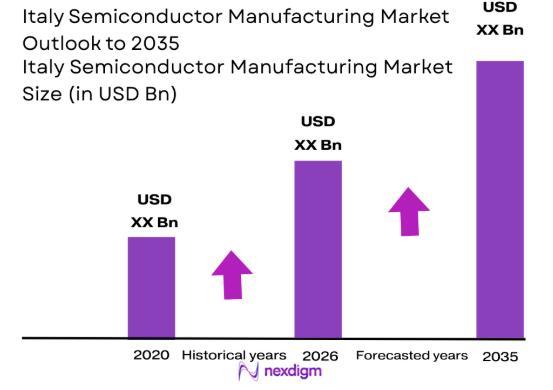
The Italy Semiconductor Manufacturing market has seen substantial growth due to an increasing demand for semiconductors in various industries such as consumer electronics, automotive, and telecommunications. The market size is expected to reach approximately USD ~ billion by the end of this year, driven by technological advancements, rising investments in infrastructure, and continuous innovation in chip manufacturing processes. The increasing adoption of advanced semiconductor technologies like 5G, IoT, and AI has further fueled this expansion.
Italy is emerging as a significant player in the semiconductor sector, with major semiconductor production hubs located in cities like Turin, Milan, and Bologna. These cities dominate the landscape due to their strong industrial bases, proximity to research institutions, and robust infrastructure. Italy’s government support for innovation, as well as its strategic location in Europe, plays a vital role in fostering semiconductor development and facilitating easy access to key markets across the EU.
Market Segmentation
By Product Type
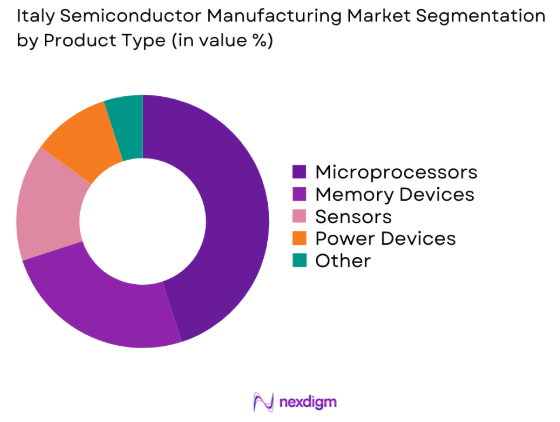
The Italy Semiconductor Manufacturing market is segmented by product type into microprocessors, memory devices, sensors, and power devices. The microprocessors sub-segment has a dominant market share due to the consistent demand from industries like consumer electronics, automotive, and telecommunications. Microprocessors’ widespread use in smartphones, PCs, and automotive electronics, combined with continuous innovation in chip performance, has driven their leadership in market share.
By End-User Industry
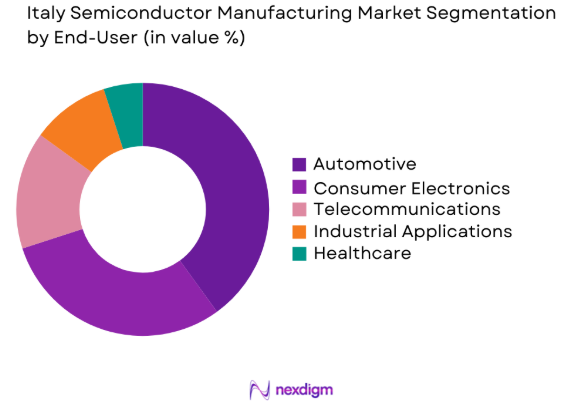
The Italy Semiconductor Manufacturing market is segmented into consumer electronics, automotive, telecommunications, industrial applications, and healthcare. The automotive sub-segment is dominating the market share, driven by the growing demand for electric vehicles (EVs), advanced driver-assistance systems (ADAS), and autonomous driving technologies. The integration of semiconductors in automotive systems for efficiency, safety, and performance is accelerating their growth in the sector.
Competitive Landscape
The Italian semiconductor manufacturing market is highly competitive, with key players focusing on technological innovation and geographical expansion. The market is characterized by the presence of both global giants and regional leaders, with increasing consolidation occurring through strategic mergers and acquisitions. These players are expanding their production capacities, forming collaborations, and enhancing their technological expertise to meet the growing demand for advanced semiconductor solutions.
| Company Name | Establishment Year | Headquarters | Technology Focus | Market Reach | Key Products | Revenue (USD) | Additional Parameter |
| STMicroelectronics | 1987 | Geneva, Switzerland | ~ | ~ | ~ | ~ | ~ |
| Infineon Technologies | 1999 | Munich, Germany | ~ | ~ | ~ | ~ | ~ |
| NXP Semiconductors | 2006 | Eindhoven, Netherlands | ~ | ~ | ~ | ~ | ~ |
| Microchip Technology | 1989 | Chandler, Arizona | ~ | ~ | ~ | ~ | ~ |
| Texas Instruments | 1951 | Dallas, Texas | ~ | ~ | ~ | ~ | ~ |
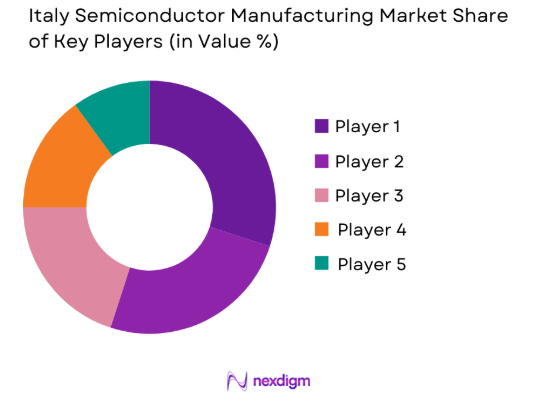
Italy Semiconductor Manufacturing market Analysis
Growth Drivers
Technological Advancements in Semiconductor Manufacturing
Technological advancements in semiconductor manufacturing, including smaller nodes and advanced materials, are driving significant market growth. Innovations like 5nm and 3nm fabrication processes enhance power efficiency, speed, and overall performance, meeting the growing demands of modern electronics and automotive systems. The shift towards more efficient and compact chip designs has become essential as industries increasingly rely on AI, 5G, and IoT technologies. These advancements enable the development of high-performance chips tailored for cutting-edge applications, such as autonomous vehicles, smart devices, and next-generation telecommunications. The continuous progress in semiconductor technologies ensures the industry’s ability to support the rapid growth of these emerging sectors and future tech developments.
Government Support for R&D and Innovation
The Italian government has made substantial investments in semiconductor manufacturing, offering funding and incentives for R&D, particularly targeting sectors like automotive and telecommunications. These efforts have resulted in significant advancements in local semiconductor production, enhancing Italy’s position within the European market. Government support for establishing manufacturing facilities, combined with European Union initiatives, has fostered the growth of high-tech industries in the country. This strategic focus on semiconductor innovation and infrastructure development is attracting global attention, making Italy a key hub for advanced semiconductor technologies. As a result, Italy is poised to play a vital role in Europe’s semiconductor supply chain and contribute to the sector’s long-term growth.
Market Challenges
Supply Chain Disruptions
A significant challenge facing the Italian semiconductor manufacturing market is the ongoing global supply chain disruptions. Shortages of critical raw materials and logistical bottlenecks have caused production delays and increased costs. These disruptions have affected industries reliant on semiconductor components, including automotive and consumer electronics, forcing manufacturers to navigate an uncertain supply environment. Additionally, geopolitical factors such as trade restrictions, tariffs, and shifting international relations have further complicated supply chain stability. These factors create significant challenges for Italian semiconductor manufacturers, impacting their ability to meet demand and maintain consistent production schedules. The situation highlights the need for more resilient and diversified supply chain strategies within the industry.
High Capital Investment Requirements
Semiconductor manufacturing demands significant capital investment for advanced facilities, R&D, and specialized equipment. The high initial costs, coupled with the need for skilled labor and advanced technological expertise, create substantial barriers to entry for smaller players. These financial and technical requirements limit the ability of new or smaller firms to compete, as only large corporations with extensive resources can dominate the market. This concentration of power in the hands of a few major players reduces competition and makes it challenging for emerging companies to scale. Consequently, the semiconductor sector remains largely controlled by established industry giants with the necessary financial backing and technological capabilities to thrive.
Opportunities
Expansion of Electric Vehicles (EVs)
The growing adoption of electric vehicles (EVs) offers a significant growth opportunity for Italy’s semiconductor manufacturing market. As EV manufacturers incorporate more semiconductors for battery management, powertrain systems, and charging infrastructure, the demand for advanced chips will surge. This shift toward EVs, coupled with government regulations and incentives supporting their adoption, will further drive the need for specialized semiconductors tailored to automotive applications. With Italy’s strong automotive sector and increasing investment in semiconductor production, the country is poised to become a central hub for manufacturing the chips required to power the rapidly expanding EV market. This trend positions Italy to play a critical role in meeting the rising demand for automotive semiconductors.
Rising Demand for 5G Technology
The rollout of 5G networks is expected to significantly boost demand for semiconductors in telecommunications infrastructure and devices. Italy’s strategic location in Europe, coupled with the fast adoption of 5G across the continent, offers semiconductor manufacturers a prime opportunity to expand their market reach and product offerings. As 5G technology becomes more widespread, the demand for upgraded components, such as RF chips and processors, will increase to support high-speed communication networks. This shift to 5G presents a major growth opportunity for Italy’s semiconductor manufacturing sector, positioning the country as a key player in supplying the advanced components needed for the next generation of telecommunications systems.
Future Outlook
The semiconductor manufacturing market in Italy is poised for significant growth over the next five years, driven by advancements in technology and the increasing adoption of high-tech solutions across various industries. Innovations in semiconductor fabrication, combined with rising demand for electric vehicles and 5G technology, will further strengthen the sector’s position. Italy’s favorable regulatory environment and government initiatives aimed at bolstering local semiconductor production will also support long-term growth prospects.
Major Players
- STMicroelectronics
- Infineon Technologies
- NXP Semiconductors
- Microchip Technology
- Texas Instruments
- Broadcom
- Analog Devices
- ON Semiconductor
- Skyworks Solutions
- Renesas Electronics
- Advanced Micro Devices
- Xilinx
- Samsung Electronics
- Intel
- Qualcomm
Key Target Audience
- Investments and venture capitalist firms
- Government and regulatory bodies
- Semiconductor manufacturers
- Automotive companies
- Telecommunications companies
- Healthcare device manufacturers
- Research and development organizations
- OEMs in consumer electronics
Research Methodology
Step 1: Identification of Key Variables
Identify critical market variables such as demand drivers, technology trends, and regulatory influences that affect the semiconductor manufacturing market.
Step 2: Market Analysis and Construction
Conduct a thorough analysis of market data, segment performance, and competitive dynamics to build a comprehensive market model.
Step 3: Hypothesis Validation and Expert Consultation
Validate assumptions with industry experts and key stakeholders to ensure that the model reflects real-world conditions and future market shifts.
Step 4: Research Synthesis and Final Output
Consolidate the analysis into a final report that presents insights, conclusions, and actionable recommendations for stakeholders.

- Executive Summary
- Research Methodology (Definitions, Scope, Industry Assumptions, Market Sizing Approach, Primary & Secondary Research Framework, Data Collection & Verification Protocol, Analytic Models & Forecast Methodology, Limitations & Research Validity Checks)

- Market Definition and Scope
- Value Chain & Stakeholder Ecosystem
- Regulatory / Certification Landscape
- Sector Dynamics Affecting Demand
- Strategic Initiatives & Infrastructure Growth

- Growth Drivers
Increased Demand for Consumer Electronics
Government Incentives for Semiconductor Research
Technological Advancements in Chip Manufacturing - Market Challenges
High Initial Capital Investment
Technological Integration Barriers
Supply Chain Disruptions - Market Opportunities
Expansion of Automotive Semiconductor Applications
Growth in Telecommunications Network Demand
Rising Investments in Smart Technologies - Trends
Shift Towards Smaller Semiconductor Nodes
Rising Use of AI in Semiconductor Design
Increasing Adoption of 5G Networks - Government Regulations
- SWOT Analysis of Key Competitors
- Porter’s Five Forces

- By Market Value, 2020-2025
- By Installed Units, 2020-2025
- By Average System Price, 2020-2025
- By System Complexity Tier, 2020-2025

- By System Type (In Value%)
Wafer Fabrication
Assembly and Packaging
Testing Equipment
Raw Materials
Chip Design - By Platform Type (In Value%)
Computing Platforms
Communication Platforms
Automotive Platforms
Consumer Electronics Platforms
Industrial Platforms - By Fitment Type (In Value%)
On-premise Solutions
Cloud-based Solutions
Modular Solutions
Integrated Solutions
Hybrid Solutions - By End User Segment (In Value%)
Consumer Electronics
Automotive
Telecommunications
Industrial Applications
Healthcare - By Procurement Channel (In Value%)
Direct Procurement
Distributors
Third-party Integrators
Government Contracts
Online Marketplaces

- Market Share Analysis
- Cross Comparison Parameters (System Type, Platform Type, Procurement Channel, End User Segment, Fitment Type, Market Size, Technology Adoption, Geographic Reach, Competitive Intensity, Consumer Demographics)
- SWOT Analysis of Key Competitors
- Pricing & Procurement Analysis
- Key Players
STMicroelectronics
Infineon Technologies
Micron Technology
Intel
Qualcomm
NXP Semiconductors
Texas Instruments
Broadcom
Analog Devices
ON Semiconductor
Skyworks Solutions
Renesas Electronics
Advanced Micro Devices
XilinxSamsung Electronics

- Rising Consumer Demand for High-performance Devices
- Growing Need for Automotive Semiconductors
- Telecommunications Network Expansion
- Advancements in Healthcare Devices

- Forecast Market Value, 2026-2035
- Forecast Installed Units, 2026-2035
- Price Forecast by System Tier, 2026-2035
- Future Demand by Platform, 2026-2035


 Request a Sample
 Ask for Customization
 Get a Quote
 Enquire Now