
 Download PDF
 Download PDF
Market Overview
The Italy Solar EPC Market is projected to reach USD ~ billion, with growth primarily driven by increasing government initiatives promoting clean energy and a rising demand for sustainable infrastructure. Solar energy adoption is being encouraged by financial incentives and environmental regulations, boosting investments in solar EPC services. Additionally, technological advancements in photovoltaic systems and grid integration are contributing significantly to market expansion, making solar energy more cost-competitive compared to traditional sources.
Dominant players in the market include Italy’s leading solar energy companies and those operating in cities with high solar potential, such as Rome, Milan, and Naples. These cities benefit from favorable solar radiation and established infrastructure, making them key locations for solar projects. The government’s commitment to renewable energy targets and the growing interest in decentralized energy solutions have played a pivotal role in shaping the dominance of these regions in the market. 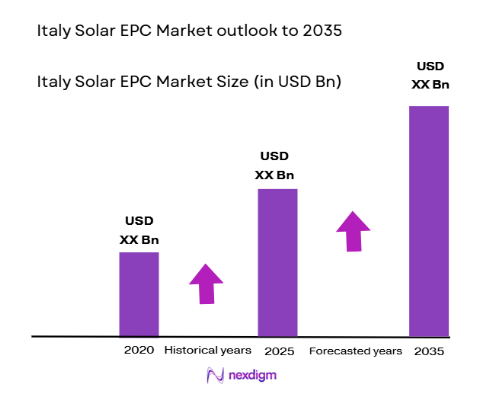
Market Segmentation
By Product Type:
The Italy Solar EPC Market is segmented by product type into ground-mounted systems, roof-mounted systems, building-integrated photovoltaic (BIPV) systems, floating solar systems, and hybrid solar systems. Recently, ground-mounted systems have dominated the market share due to their scalability, cost-effectiveness, and efficiency in harnessing solar energy over large areas. With Italy’s ample land availability and favorable sunlight conditions, ground-mounted solar systems are the preferred choice for utility-scale solar projects. Moreover, this sub-segment benefits from economies of scale, providing higher returns on investments for large projects, which has led to its growth in both residential and commercial solar energy deployments. 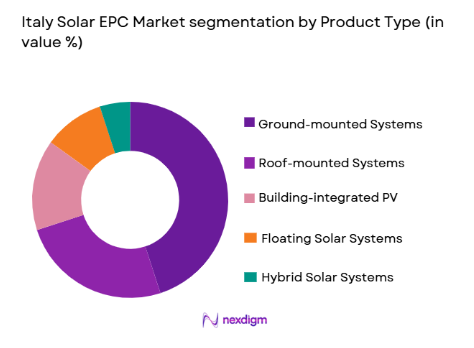
By Platform Type:
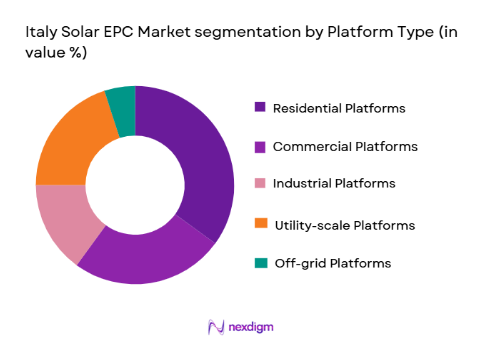
The market is segmented by platform type into residential platforms, commercial platforms, industrial platforms, utility-scale platforms, and off-grid platforms. Residential platforms have a dominant market share due to the increasing adoption of solar energy for household electricity generation. Factors such as rising electricity costs, environmental consciousness, and government incentives for residential solar installations have made solar energy an attractive option for homeowners. Furthermore, the availability of small-scale solar systems tailored for residential use has accelerated the demand, driving the growth of this sub-segment in the solar EPC market.
Competitive Landscape
The competitive landscape of the Italy Solar EPC Market is characterized by a high level of competition, with several global and local players involved in large-scale solar installations. Consolidation is occurring as companies look to integrate vertically and offer end-to-end services, encompassing solar design, procurement, and construction. Major players are also focusing on technological innovation and efficiency improvements, driving competitive dynamics in the market. The key players have a significant influence over market pricing, project execution timelines, and technological adoption.
| Company Name | Establishment Year | Headquarters | Technology Focus | Market Reach | Key Products | Revenue (USD Billion) | Project Scale (MW) |
| Enel Green Power | 2008 | Rome, Italy | ~ | ~ | ~ | ~ | ~ |
| First Solar | 1999 | Tempe, USA | ~ | ~ | ~ | ~ | ~ |
| SunPower | 1985 | San Jose, USA | ~ | ~ | ~ | ~ | ~ |
| Trina Solar | 1997 | Changzhou, China | ~ | ~ | ~ | ~ | ~ |
| JinkoSolar | 2006 | Shanghai, China | ~ | ~ | ~ | ~ | ~ |
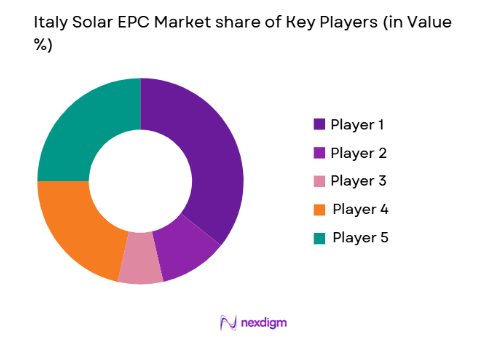
Italy Solar EPC Market Analysis
Growth Drivers
Government Incentives:
Government initiatives, including tax credits, grants, and subsidies, are key drivers of growth in the Italy Solar EPC Market. With Italy’s ambitious renewable energy targets, the government has introduced favorable policies that encourage investments in solar energy. These incentives significantly reduce the upfront cost of solar projects, making them more accessible to both businesses and residential consumers. Additionally, initiatives like net metering and feed-in tariffs ensure a steady return on investment, which enhances the attractiveness of solar energy. The government’s commitment to reaching carbon neutrality and increasing renewable energy adoption by 2030 is a strong motivator for EPC companies to expand their operations. As a result, these policies are boosting demand for solar EPC services across all sectors of the Italian economy.
Technological Advancements:
The constant evolution of solar technologies has been another growth driver for the Italy Solar EPC Market. The development of more efficient solar panels, such as bifacial modules and hybrid systems, is increasing the performance of solar installations. Advancements in energy storage solutions also allow for the better integration of solar energy into the grid, overcoming intermittency issues. The rise of integrated solutions such as building-integrated photovoltaics (BIPV) is further spurring growth, particularly in residential and commercial sectors. The continued reduction in the cost of solar panels and installation further boosts the demand for solar EPC services, as these technological innovations make solar energy more affordable and practical for a wider range of consumers.
Market Challenges
High Initial Investment:
Despite the incentives provided by the government, the high initial capital required for solar EPC projects remains a significant challenge for market growth. While the cost of solar panels has decreased in recent years, the total cost of installation, including equipment, labor, and permitting, can still be a barrier to entry for many consumers, particularly in the residential sector. Small to medium-sized businesses may also struggle to finance large-scale solar projects without substantial financial backing, limiting the overall market potential. Additionally, the financing process for such projects can be complex, which further deters investment in solar EPC solutions. This high upfront cost remains one of the main challenges for achieving widespread solar adoption in Italy.
Regulatory and Policy Uncertainty:
The solar EPC market in Italy also faces challenges arising from regulatory and policy uncertainties. While government incentives have spurred demand for solar solutions, sudden changes in energy policies or subsidy schemes could disrupt market growth. For example, alterations to feed-in tariffs or net metering policies may negatively affect the financial viability of solar projects, especially for investors and developers. The unpredictability of policy changes creates an element of risk for stakeholders in the market, making long-term investments more difficult. This uncertainty surrounding policy direction can hinder the expansion of the solar EPC market, especially when compared to more stable renewable energy markets in other countries.
Opportunities
Residential Solar Expansion:
One of the most significant opportunities in the Italy Solar EPC Market lies in the expansion of residential solar energy solutions. The increasing awareness of climate change, coupled with rising electricity prices, is encouraging homeowners to invest in solar panels. Government incentives aimed at promoting clean energy adoption, including tax credits and rebates, make solar energy more attractive for residential customers. This trend is expected to continue as more individuals and families look for ways to reduce their carbon footprint and lower their utility bills. As a result, the demand for residential solar EPC solutions will continue to rise, creating growth opportunities for companies in the solar EPC sector.
Integration of Solar with Energy Storage:
The integration of solar energy systems with energy storage technologies presents another major opportunity for market growth. Energy storage systems help mitigate the intermittency of solar energy, allowing users to store excess energy produced during the day for use at night or during cloudy periods. As battery technology continues to improve and costs decrease, solar-plus-storage solutions are becoming increasingly popular for both residential and commercial customers. The ability to offer integrated solar and storage solutions can differentiate EPC providers and enable them to capture a larger market share. Moreover, the growing demand for off-grid solar systems in rural and remote areas further enhances the potential for this market segment.
Future Outlook
The future of the Italy Solar EPC Market looks promising, with continued growth expected over the next five years. Increasing government support for renewable energy projects, combined with advancements in solar technologies and energy storage, will drive demand for solar EPC solutions. As Italy strives to meet its renewable energy targets, the market is poised for expansion in both residential and commercial sectors. The adoption of innovative solutions such as floating solar panels and BIPV will further enhance market growth, creating new opportunities for EPC providers. Additionally, the need for decentralized energy solutions and the integration of solar energy into smart grids will continue to shape the future landscape of the market.
Major Players
- Enel Green Power
- First Solar
- SunPower
- Trina Solar
- JinkoSolar
- Canadian Solar
- LONGi Green Energy
- RWE Renewables
- EDF Renewables
- NextEra Energy
- Soltec
- SMA Solar Technology
- First Solar
- SolarEdge Technologies
- Sunrun
Key Target Audience
- Investments and venture capitalist firms
- Government and regulatory bodies
- Solar EPC service providers
- Large-scale commercial developers
- Utility providers
- Environmental NGOs
- Renewable energy technology manufacturers
- Construction and infrastructure companies
Research Methodology
Step 1: Identification of Key Variables
Identifying key market variables that impact the solar EPC industry such as technology trends, policy changes, and economic factors.
Step 2: Market Analysis and Construction
Conducting a thorough market analysis using historical data and forecasts to build an accurate market model.
Step 3: Hypothesis Validation and Expert Consultation
Validating market hypotheses by consulting with industry experts and stakeholders to ensure data accuracy and reliability.
Step 4: Research Synthesis and Final Output
Synthesizing the research findings into a comprehensive report, ensuring all conclusions align with market data and trends.

- Executive Summary
- Research Methodology (Definitions, Scope, Industry Assumptions, Market Sizing Approach, Primary & Secondary Research Framework, Data Collection & Verification Protocol, Analytic Models & Forecast Methodology, Limitations & Research Validity Checks)

- Market Definition and Scope
- Value Chain & Stakeholder Ecosystem
- Regulatory / Certification Landscape
- Sector Dynamics Affecting Demand
- Strategic Initiatives & Infrastructure Growth

- Growth Drivers
Government Incentives and Subsidies for Solar Energy
Rising Demand for Clean Energy Solutions
Technological Advancements in Photovoltaic Systems
Declining Solar Panel Costs
Increased Corporate Sustainability Initiatives - Market Challenges
Regulatory and Policy Uncertainties
High Initial Capital Investment
Competition with Other Renewable Energy Sources
Interconnection and Grid Compatibility Issues
Seasonal Variability in Solar Energy Production - Market Opportunities
Growing Demand for Residential Solar Systems
Expansion of Solar Capacity in Rural Areas
Technological Innovations in Solar Storage Solutions - Trends
Integration of Solar with Energy Storage Systems
Shift towards Floating Solar Installations
Rise in Solar-powered Hybrid Systems
Development of Smart Solar Grids
Increased Focus on Energy Efficiency Standards - Government Regulations & Defense Policy
Incentives for Solar Energy Adoption
Regulations on Grid Integration of Solar Energy
National Energy Transition Plans - SWOT Analysis
- Stakeholder and Ecosystem Analysis
- Porter’s Five Forces Analysis
- Competition Intensity and Ecosystem Mapping

- By Market Value, 2020-2025
- By Installed Units, 2020-2025
- By Average System Price, 2020-2025
- By System Complexity Tier, 2020-2025

- By System Type (In Value%)
Ground-mounted Systems
Roof-mounted Systems
Building-integrated Photovoltaic (BIPV) Systems
Floating Solar Systems
Hybrid Solar Systems - By Platform Type (In Value%)
Residential Platforms
Commercial Platforms
Industrial Platforms
Utility-scale Platforms
Off-grid Platforms - By Fitment Type (In Value%)
On-premise Solutions
Cloud-based Solutions
Hybrid Solutions
Integrated Solutions
Modular Solutions - By EndUser Segment (In Value%)
Private Sector / Residential Users
Commercial Developers
Industrial Companies
Government Organizations
Utility Providers - By Procurement Channel (In Value%)
Direct Procurement
Government Tenders
Private Sector Procurement
Online Bidding Platforms
Third-party Distributors - By Material / Technology (in Value%)
Monocrystalline Silicon
Polycrystalline Silicon
Thin-film Solar Cells
Concentrated Solar Power (CSP)
Hybrid Solar Technologies

- Market structure and competitive positioning
- Market share snapshot of major players
- CrossComparison Parameters (System Type, Platform Type, Procurement Channel, EndUser Segment, Fitment Type, Material/Technology, Geography, System Complexity Tier, Average System Price, Installed Units)
- SWOT Analysis of Key Players
- Pricing & Procurement Analysis
- Key Players
Enel Green Power
First Solar
SunPower
RWE Renewables
Iberdrola
EDF Renewables
NextEra Energy
JinkoSolar
Canadian Solar
Trina Solar
LONGi Green Energy
Sungrow Power Supply
JA Solar Technology
Hanwha Q CELLS
Enphase Energy

- Growing Interest in Solar for Commercial Applications
- Increased Adoption of Solar in Rural Areas
- Government and Utility Support for Solar Solutions
- Private Sector Demand for Sustainable Energy Sources

- Forecast Market Value, 2026-2035
- Forecast Installed Units, 2026-2035
- Price Forecast by System Tier, 2026-2035
- Future Demand by Platform, 2026-2035


 Request a Sample
 Ask for Customization
 Get a Quote
 Enquire Now