

 Download PDF
Market Overview
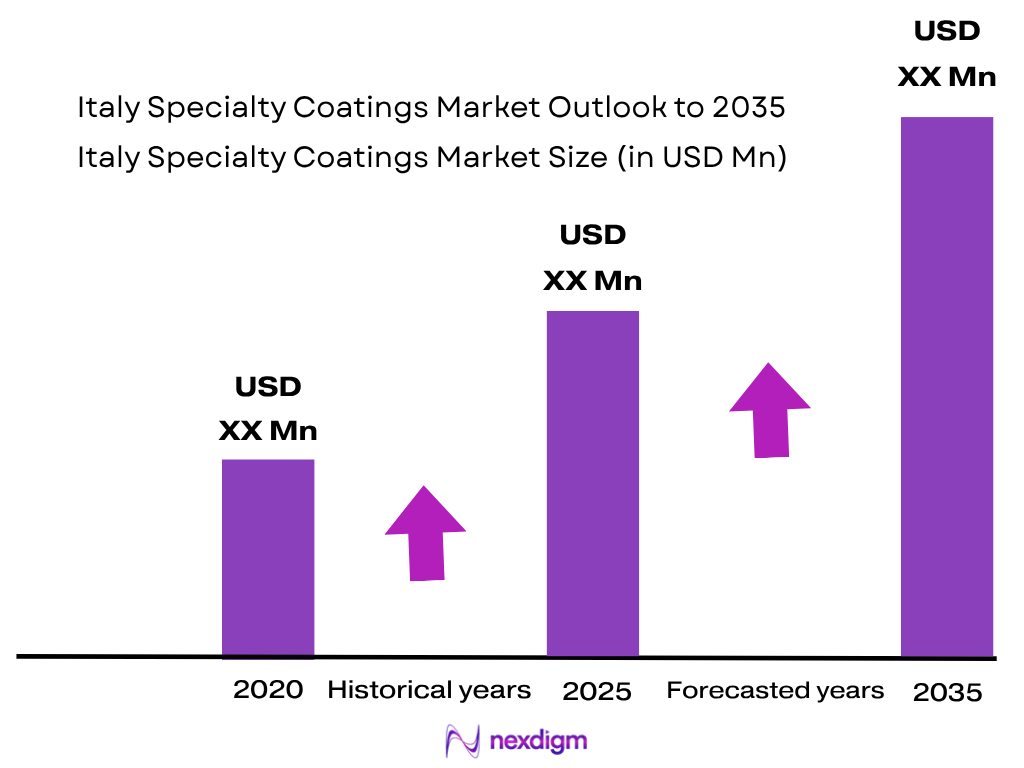
The Italy Specialty Coatings Market is valued at approximately ~USD billion, supported by industrial wood finishing, automotive, machinery, metal fabrication, marine, packaging and protective applications. Underlying coating demand remains tied to a large manufacturing base: domestic motor-vehicle production moved from 880,000 units to 591,000 units, while passenger-car output moved from 541,000 units to approximately 310,000 units. High-performance formulations remain essential despite weaker automotive volumes because customers increasingly prioritize corrosion resistance, durability, finish quality and process efficiency.
Specialty-coatings activity is concentrated around Milan/Lombardy, Como, Turin/Piedmont, Venice-Treviso/Veneto, Bologna-Modena/Emilia-Romagna and Genoa/Liguria, reflecting Italy’s industrial, furniture, automotive and marine clusters. Como has strategic powder-coatings capacity, where AkzoNobel completed a €21 million expansion incorporating four new manufacturing lines. Genoa benefits from marine and yacht activity, while Italy’s nautical-sector turnover increased from approximately €8.33 billion to €8.6 billion, sustaining premium protective, antifouling and yacht-finish demand.
Market Segmentation
By Coating Type
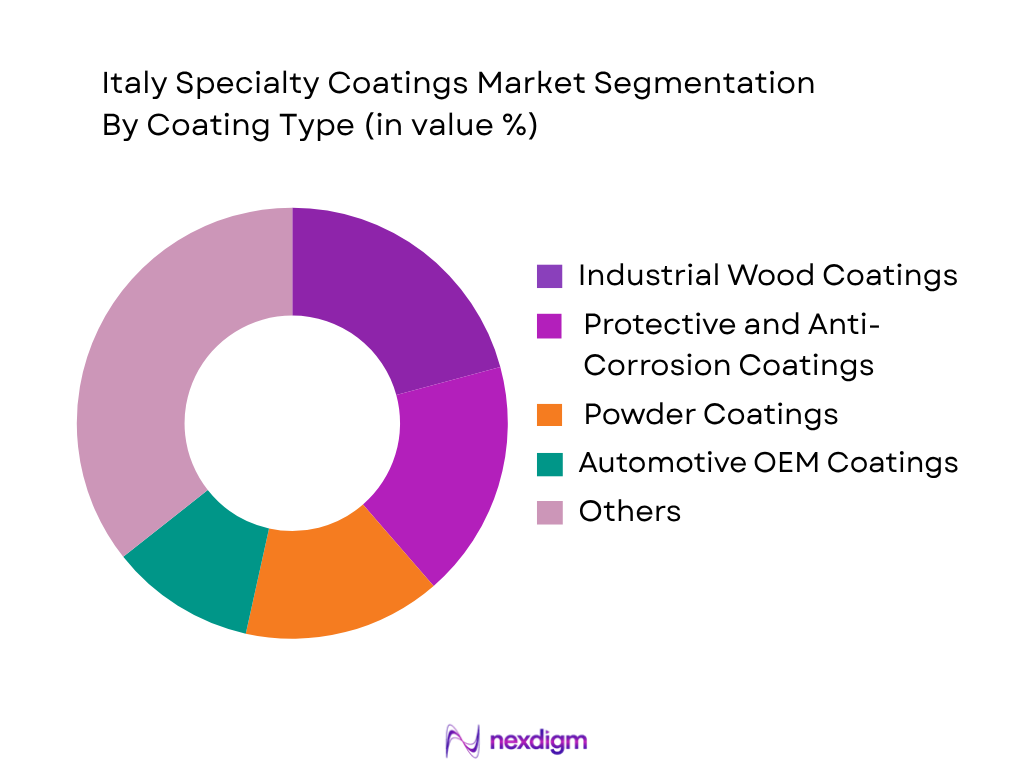
The Italy Specialty Coatings Market is segmented by coating type into protective and anti-corrosion coatings, marine and yacht coatings, automotive OEM coatings, automotive refinish coatings, powder coatings, packaging and can coatings, industrial wood coatings, industrial floor coatings, fire-protective coatings, and high-temperature and chemical-resistant coatings. Industrial wood coatings represent a leading specialty segment, supported by Italy’s internationally competitive furniture, cabinetry, joinery and interior-design manufacturing ecosystem. The country has a particularly strong position in premium furniture, where appearance, tactile finish, scratch resistance, chemical resistance and low-VOC formulation are important purchasing criteria. Italy is also identified as Europe’s largest national industrial wood-coatings market by specialist industry research. Demand is concentrated across Lombardy, Veneto, Friuli-Venezia Giulia and Marche, where furniture producers increasingly use polyurethane, acrylic, waterborne and UV-curable systems. Protective and powder coatings also constitute substantial demand pools because of machinery production, fabricated metals, infrastructure maintenance and industrial export activity.
By Resin Type
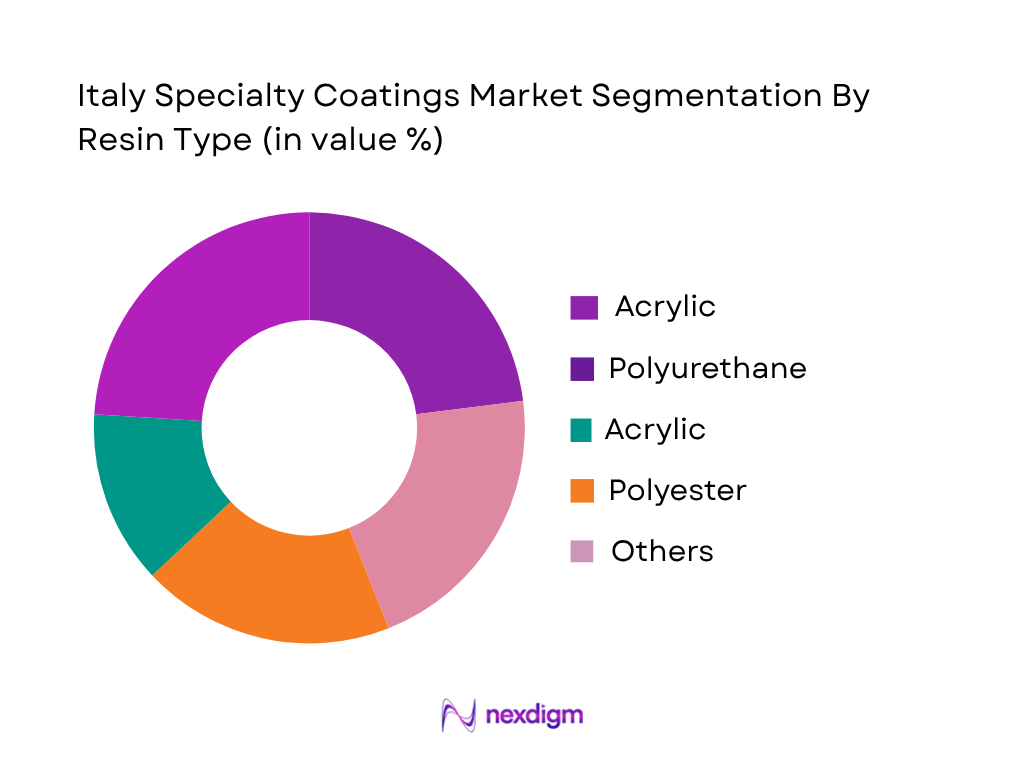
The Italy Specialty Coatings Market is segmented by resin type into acrylic, polyurethane, epoxy, polyester, alkyd, fluoropolymer/PVDF, silicone, polysiloxane, epoxy-polyester hybrids and other high-performance resin systems. Acrylic coatings hold a leading position across the wider Italian industrial-coatings landscape, supported by their balance of weatherability, colour retention, application versatility and compatibility with lower-emission formulations. Grand View Research identifies acrylic as the largest revenue-generating product within Italy’s industrial-coatings market. Polyurethane is particularly significant in industrial wood, automotive refinish and premium finishing because of its hardness, chemical resistance and aesthetic properties, while epoxy coatings remain fundamental for anti-corrosion, industrial flooring and heavy-duty protective systems. Polyester and epoxy-polyester hybrids benefit from Italy’s powder-coatings manufacturing base and metal-finishing activity. Resin selection is increasingly influenced by VOC reduction, curing energy, substrate compatibility, durability requirements and total applied coating cost rather than material price alone.
Competitive Landscape
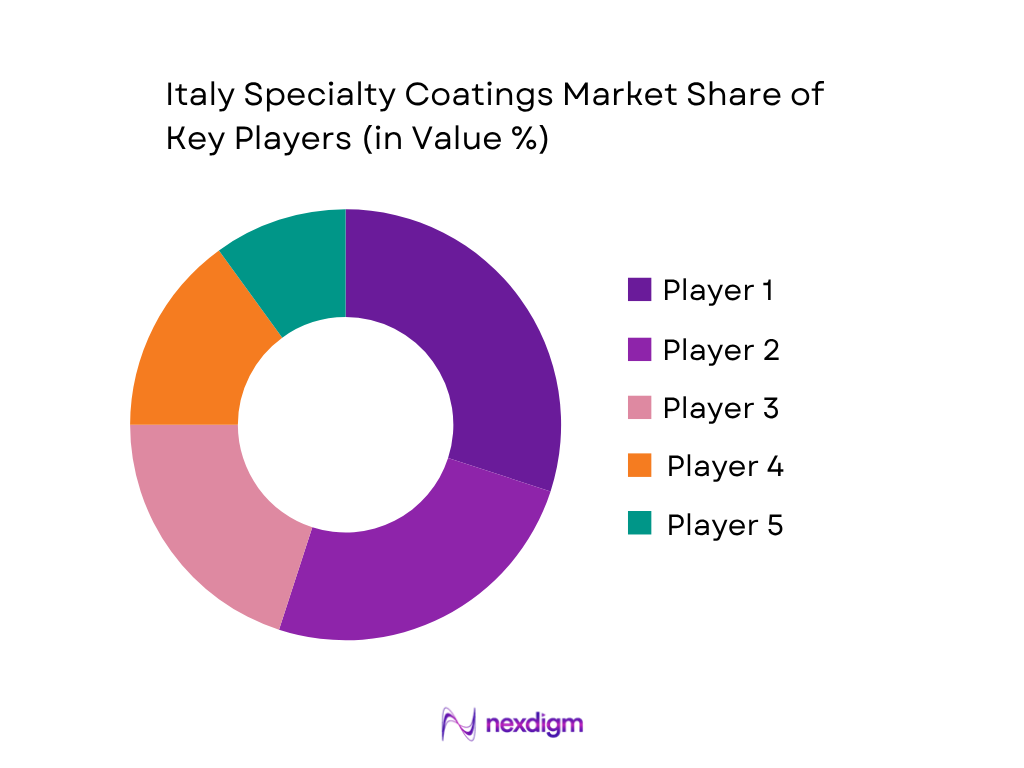
The Italy Specialty Coatings Market combines major multinational coating companies with technically strong domestic specialists. Competition is particularly intense in industrial wood, automotive refinish, powder, marine, protective and general industrial systems. AkzoNobel maintains multiple Italian specialty divisions, including wood, powder, marine and vehicle refinishes, while PPG competes across automotive OEM, refinish, industrial, packaging, powder and protective systems. Sherwin-Williams has substantial industrial wood exposure through Sayerlack and ICA-related capabilities, while Axalta and BASF retain strong automotive and industrial technology positions.
| Company | Establishment Year | Headquarters | Italy Specialty Focus | Key Resin/Technology Capability | Major End-Use Exposure | Application Technology | Italian Market Presence | Technical Positioning |
| AkzoNobel | 1792 heritage | Amsterdam, Netherlands | ~ | ~ | ~ | ~ | ~ | ~ |
| PPG Industries | 1883 | Pittsburgh, USA | ~ | ~ | ~ | ~ | ~ | ~ |
| Sherwin-Williams / ICA-Sayerlack | 1866 | Cleveland, USA | ~ | ~ | ~ | ~ | ~ | ~ |
| Axalta Coating Systems | 1866 heritage | Philadelphia, USA | ~ | ~ | ~ | ~ | ~ | ~ |
| BASF Coatings | 1865 parent heritage | Ludwigshafen, Germany | ~ | ~ | ~ | ~ |
Italy Specialty Coatings Market Analysis
Growth Driver
Strong Wood-Furniture and Industrial Finishing Ecosystem
Italy’s specialty coatings demand is structurally supported by its dense wood-furniture and industrial finishing base, where coatings are integral to surface protection, appearance, abrasion resistance, chemical resistance and automated finishing lines. FederlegnoArredo reported that the Italian wood-furniture supply chain comprised 64,144 companies and nearly 297,000 employees in 2024, while sector exports reached EUR 19.4 billion. The scale of this production ecosystem sustains recurring demand for polyurethane, acrylic, waterborne, UV-curable and other high-performance coating systems used on furniture, cabinetry, flooring, doors and engineered wood. The wider macroeconomic base also remains substantial: World Bank data place Italy’s 2024 GDP at USD 2.383 trillion, providing a large domestic industrial platform for specialty coating consumption. The export orientation of Italian furniture further raises coating-performance requirements because manufacturers must meet international specifications for durability, colour consistency, emission limits and finish quality. In 2025, the wood-furniture supply chain still supported more than 292,000 employees across over 62,000 enterprises, indicating continued production depth. This combination of industrial density, export exposure and technically demanding finishing processes makes wood and furniture manufacturing a durable demand driver for Italy’s specialty coatings suppliers. These dynamics sustain specification-led demand across domestic production.
Marine, Machinery and Metalworking Manufacturing Base
Italy’s marine, machinery, metalworking and advanced manufacturing ecosystem creates another strong demand base for protective, powder, anti-corrosion, high-temperature and functional coatings. Confindustria Nautica reported 31,480 direct employees in the Italian recreational boating industry for 2024, while Italian yards had 572 superyachts under construction out of 1,138 units globally in the 2025 industry monitor. Such a concentrated shipbuilding pipeline requires primers, fillers, antifouling systems, abrasion-resistant finishes, polyurethane topcoats and corrosion-control systems across steel, aluminium and composite substrates. The broader economy reinforces this industrial demand: Istat placed Italy’s 2024 GDP at EUR 2.1996 trillion, while the World Bank recorded GDP at USD 2.383 trillion. Export-facing manufacturing also remains material to coatings consumption because Italian machinery, fabricated metals and transport-equipment producers require repeatable finishing standards for international customers. The country’s manufacturing clusters in Lombardy, Veneto, Emilia-Romagna, Piedmont and Liguria support coating demand across OEM plants, subcontractors and specialist applicators. For specialty coating producers, the key advantage is application diversity: marine maintenance, yacht finishing, machinery protection and fabricated-metal coating generate demand for multiple resin chemistries and curing technologies rather than dependence on a single downstream sector. This reduces concentration risk across industrial coating niches.
Market Challenge
Contraction in Domestic Automotive Production
The contraction in Italian automotive manufacturing represents a direct challenge for specialty coating suppliers exposed to OEM primers, basecoats, clearcoats, electrocoat systems, plastic-component finishes and automotive component coatings. ANFIA reported that Italy produced 591,000 motor vehicles in 2024, including about 310,000 passenger cars, while domestic new-car registrations reached 1,558,704 units. The gap between vehicles sold and vehicles manufactured locally reduces the coating volume captured inside Italian assembly plants even when the national vehicle parc continues to support refinish activity. Automotive parts production also weakened, limiting throughput for coatings used on wheels, suspension parts, metal components, plastics and commercial-vehicle assemblies. This pressure occurred within a large but slow-moving economy: World Bank data put Italian GDP at USD 2.383 trillion in 2024, while Istat measured national GDP at EUR 2.1996 trillion. The challenge for coating manufacturers is therefore mix management rather than simple demand disappearance. Suppliers heavily dependent on automotive OEM volumes must redirect capacity toward refinish, industrial metal, rail, agricultural machinery and other performance applications. Qualification cycles, customer-specific colour standards and line-validation requirements make that diversification technically demanding and can delay replacement of lost automotive volumes. It also pressures plant utilization.
Raw-Material and Energy Import Dependence
Raw-material and energy dependence remains a significant operating constraint for Italy’s specialty coatings industry because epoxy intermediates, isocyanate-related inputs, solvents, pigments, additives and energy-intensive manufacturing processes are exposed to imported feedstocks and external supply conditions. ICE data show that Italy imported EUR 49.079 billion of crude oil and natural gas in 2024 and recorded a EUR 48.304 billion trade deficit in that category. Istat separately reported an overall national energy trade deficit of EUR 49.555 billion for the same year. These flows matter to coating formulators because petrochemical feedstocks influence resin, solvent and additive availability, while electricity and thermal energy affect mixing, dispersion, curing, powder production and application lines. The macroeconomic scale does not remove that exposure: World Bank data record Italian GDP at USD 2.383 trillion in 2024, meaning a large manufacturing economy still relies materially on imported energy inputs. Istat also recorded a EUR 34 billion goods trade deficit with China in 2024, highlighting broader dependence on foreign intermediate products. Specialty coating suppliers therefore face procurement complexity, longer sourcing chains and formulation risk when key inputs become constrained, making dual sourcing, local inventories and chemistry substitution strategically important.
Market Opportunity
Premium Marine and Superyacht Coating Applications
Italy’s global leadership in superyacht construction creates a clear expansion opportunity for premium marine and protective specialty coatings, particularly products engineered for corrosion resistance, antifouling, UV durability, underwater protection, high-gloss finishing and composite substrates. Confindustria Nautica reported that Italian shipyards had 572 superyachts under construction in the 2025 monitor, compared with 1,138 units worldwide, demonstrating an unusually concentrated base of coating-intensive projects. The industry employed 31,480 direct workers in 2024 and supported a much broader network of yards, component suppliers, refit operators, marinas and specialist applicators. This creates repeated coating demand across new-build, maintenance and refit cycles rather than a single application event. The opportunity is reinforced by Italy’s wider economic capacity: World Bank data place national GDP at USD 2.383 trillion in 2024, while IMF data show nominal GDP of roughly EUR 2.192 trillion for the same year. Specialty suppliers can target higher-specification systems for aluminium, steel and composites, including low-friction surfaces, fouling-control technologies and fast-curing repair systems. Because Italian yacht production is concentrated in premium vessels with exacting aesthetic standards, technical service, colour matching and application support can become strong competitive differentiators alongside coating performance. Refit broadens demand.
Grid Modernization and Renewable-Energy Infrastructure
The expansion and renewal of Italy’s electricity infrastructure creates a forward opportunity for protective and functional coatings used on transmission structures, substations, renewable-energy equipment, storage infrastructure and associated fabricated metal. Terna reported that installed solar and wind capacity stood at about 50 GW at the end of 2024, while data-centre connection requests had reached around 30 GW by December 2024, indicating rising pressure for new grid assets and reinforcement. Terna’s updated investment programme allocates EUR 16.6 billion to regulated activities across the 2024–2028 plan, including EUR 10.8 billion for transmission-grid development and EUR 3.6 billion for renewal and efficiency of existing assets. These projects expand the addressable surface area for anti-corrosion primers, powder coatings, zinc-rich systems, weather-resistant topcoats, fire-protective products and electrical-infrastructure finishes. Italy’s macroeconomic base supports implementation capacity, with World Bank data placing 2024 GDP at USD 2.383 trillion and IMF data showing general-government gross fixed capital formation of EUR 80.3 billion in 2024. For coating suppliers, the opportunity is strongest where infrastructure owners require longer maintenance intervals, outdoor durability, corrosion protection and application systems compatible with accelerated project execution. Grid modernization also supports demand from domestic metal fabricators.
Future Outlook
The Italy Specialty Coatings Market is forecast to expand at approximately ~X.X% CAGR during the forecast period, with growth increasingly shifting toward higher-value and lower-emission technologies. Waterborne, powder, UV-curable, high-solids and multifunctional coatings are expected to gain strategic importance as manufacturers reduce VOC emissions, shorten curing cycles and lower application energy. Italy’s wood/furniture, machinery, marine, metalworking, packaging and premium automotive-refinish sectors should remain important demand anchors. Regulatory compliance will simultaneously accelerate reformulation and product replacement.
Industrial wood coatings will continue transitioning toward waterborne and UV-curable formulations as furniture producers seek faster line speeds and lower solvent emissions. Powder coatings should gain from efficient material transfer, reclaimability and solvent-free application, particularly across fabricated metal, appliances, automotive components and architectural aluminium. Grand View Research identifies radiation-cured coatings as the fastest-growing technology within Italy’s broader paints and coatings landscape, while specialist wood-coatings research similarly highlights rapid UV adoption in cabinets and flooring.
Protective coatings will increasingly be sold on lifecycle economics instead of initial material cost. Longer maintenance intervals, corrosion protection, reduced downtime and fewer coating layers will become more important to infrastructure owners and industrial operators. Marine and yacht coatings should benefit from Italy’s globally significant yacht-building ecosystem, while functional technologies such as anti-fingerprint, antimicrobial, heat-resistant, low-friction and easy-clean surfaces could develop higher-value niches.
Major Players
- AkzoNobel
- PPG Industries
- Sherwin-Williams / ICA-Sayerlack
- Axalta Coating Systems
- BASF Coatings
- Jotun
- Hempel
- IVM Chemicals / Milesi / ILVA
- Sirca
- Renner Italia
- Boero YachtCoatings
- Lechler
- Teknos
- Mapei
- Sika Italia
Key Target Audience
- Specialty Coatings Manufacturers
- Industrial OEMs and Component Manufacturers
- Resin, Pigment, Additive and Specialty Chemical Suppliers
- Industrial Coating Distributors and Applicator Networks
- Automotive, Furniture, Marine and Metal-Fabrication Companies
- Investments and Venture Capitalist Firms
- Government and Regulatory Bodies (Ministry of Enterprises and Made in Italy, Ministry of Environment and Energy Security, Italian Institute for Environmental Protection and Research, European Chemicals Agency)
- Private Equity Firms, Strategic Investors and Corporate Development Teams
Research Methodology
Step 1: Identification of Key Variables
The initial phase involves constructing an ecosystem map covering specialty-coating manufacturers, raw-material suppliers, industrial OEMs, distributors, applicators and major end-user sectors within the Italy Specialty Coatings Market. Secondary research draws on industry associations, company disclosures, trade databases and regulatory information. Variables including coating type, resin chemistry, technology, substrate, end-use demand and distribution structure are identified for market modelling.
Step 2: Market Analysis and Construction
Historical demand is assessed using a combination of domestic manufacturing activity, industrial output, coating consumption patterns, import-export flows and major end-user indicators. Bottom-up analysis evaluates coating requirements across industrial wood, automotive, marine, machinery, metal fabrication and protective applications. Top-down analysis is used to reconcile the resulting market values and volumes against broader Italian paints and coatings industry benchmarks.
Step 3: Hypothesis Validation and Expert Consultation
Market hypotheses are validated through structured interviews with coating manufacturers, raw-material suppliers, distributors, industrial applicators, OEM procurement teams and technical specialists. Computer-assisted telephone interviews can be used to assess pricing, technology penetration, qualification requirements, customer switching behaviour and application economics. Feedback is triangulated against secondary evidence to identify inconsistencies and improve segment-level reliability.
Step 4: Research Synthesis and Final Output
The final stage integrates primary findings with production, trade, end-market and competitive data to develop a coherent Italy Specialty Coatings Market model. Company portfolios, manufacturing footprints, technology strengths and distribution channels are cross-checked against official disclosures. Forecast assumptions incorporate manufacturing conditions, regulatory change, technology substitution, application efficiency, raw-material economics and expected development of key industrial end-use sectors.

- Executive Summary
- Research Methodology (Market Definition and Scope, Italy Specialty Coatings Taxonomy, Coating Chemistry Classification, Functional Performance Mapping, Market Sizing Framework, Top-Down Analysis, Bottom-Up Analysis, Domestic Production Assessment, Import Dependency Assessment, Demand-Side Assessment, Supply-Side Assessment, End-Use Application Mapping, Industrial Consumption Assessment, Primary Industry Interviews, Trade-Flow Validation, Data Triangulation, Forecasting Framework, Scenario Analysis, Assumptions and Limitations)

- Definition and Scope
- Italy Specialty Coatings Industry Evolution and Technology Development
- Specialty Coatings Manufacturing and Formulation Process
- Specialty Coatings Value Chain Analysis
- Italy Specialty Coatings Supply Chain Analysis
- Specialty Coatings Raw Material Ecosystem Analysis
- Italy Specialty Coatings Import Dependency and Localization Assessment
- Specialty Coatings Performance and Application Architecture

- Growth Drivers (High-Value Industrial Manufacturing Base, Furniture and Wood Processing Industry Strength, Automotive and Transportation Coating Demand, Marine and Superyacht Manufacturing Activity, Industrial Maintenance Demand, Powder Coating Adoption, Infrastructure Refurbishment Requirements, Low-VOC Coating Adoption)
- Market Challenges (Imported Specialty Raw-Material Dependency, Epoxy and Polyurethane Feedstock Volatility, Energy and Manufacturing Cost Pressure, OEM Qualification Requirements, Skilled Applicator Constraints, Surface Preparation Quality Issues, VOC and Chemical Compliance Costs, Specialty Formulation Complexity)
- Market Opportunities (Marine and Yacht Protective Coatings, Industrial Wood Coatings, Waterborne Industrial Coatings, High-Performance Powder Coatings, High-Solids Epoxy Systems, Infrastructure Protective Coatings, Premium Automotive Refinish, Renewable-Energy Protective Coatings, Advanced Functional Coatings)
- Market Trends (Waterborne Conversion, High-Solids Technology Adoption, Powder Coating Penetration, Low-VOC Formulation, Polysiloxane Adoption, Functional Surface Coatings, Fast-Cure Systems, Longer-Life Corrosion Protection)
- Regulatory and Standards Landscape (REACH Compliance, CLP Classification and Labelling, VOC and Solvent Management, Biocidal Product Compliance, Microplastics Restriction, Packaging Compliance Requirements, Food-Contact Coating Requirements, Worker Exposure and Isocyanate Safety Standards)
- SWOT Analysis
- Porter’s Five Forces Analysis
- PESTLE Analysis

- By Market Value (2020-2025)
- By Coating Consumption Volume (2020-2025)
- By Domestic Production Volume (2020-2025)
- By Import Volume (2020-2025)
- By Export Volume (2020-2025)
- By Industrial Coatings Consumption Volume (2020-2025)
- By Specialty Coatings Production Capacity (2020-2025)
- By Average Realized Selling Price (2020-2025)
- By Application Revenue (2020-2025)

- By Coating Type (In Value %)
Protective and Anti-Corrosion Coatings
Marine and Yacht Coatings
Automotive OEM Coatings
Automotive Refinish Coatings
Powder Coatings
Packaging and Can Coatings
Industrial Wood Coatings
Industrial Floor Coatings
Fire-Protective and Intumescent Coatings
High-Temperature and Chemical-Resistant Coatings - By Resin Type (In Value %)
Epoxy
Polyurethane
Acrylic
Polyester
Alkyd
Fluoropolymer and PVDF
Silicone
Polysiloxane
Epoxy-Polyester Hybrid
Other High-Performance Resin Systems - By Technology (In Value %)
Waterborne Coatings
Solvent-Borne Coatings
Powder Coatings
High-Solids Coatings
UV-Cured Coatings
Two-Component Coatings
Moisture-Cured Coatings
Advanced Functional Coatings - By End-Use Industry (In Value %)
Automotive Manufacturing
Wood and Furniture Manufacturing
Marine, Shipbuilding and Yachting
Machinery and General Industrial
Steel and Metal Fabrication
Infrastructure and Construction
Packaging
Power and Renewable Energy
Aerospace
Rail and Transportation Equipment - By Substrate (In Value %)
Carbon Steel
Galvanized Steel
Aluminium
Stainless Steel
Concrete
Wood and Engineered Wood
Plastics and Engineering Polymers
Composite Materials
Metal Packaging Substrates - By Sales Channel (In Value %)
Direct-to-OEM Sales
Direct Industrial Project Sales
Specialty Coating Distributors
Marine and Protective Coating Distributors
Automotive Refinish Distributors
Industrial Applicators and Contractors
Specification and Project Sales
Dealer and Specialist Retail Networks

- Market Share of Major Players (By Revenue, Volume, Coating Type, Resin Type, Technology, Application, End-Use Industry, Distribution Channel)
- Cross Comparison Parameters (Italy Specialty Coating Revenue, Specialty Coating Portfolio Breadth, Resin and Technology Coverage, Italian Manufacturing and Formulation Footprint, Automotive and Industrial Wood Market Penetration, Marine and Yacht Coating Presence, Local Technical Service and Application Support Capability, Distribution and Regional Reach)
- SWOT Analysis of Major Players
- Competitive Positioning Matrix
- Product and Technology Portfolio Benchmarking
- Pricing and Distribution Network Benchmarking
- Detailed Profiles of Major Companies
AkzoNobel
PPG Industries
Sherwin-Williams / ICA-Sayerlack
Axalta Coating Systems
BASF Coatings
Jotun
Hempel
IVM Chemicals / Milesi / ILVA
Sirca
Renner Italia
Boero YachtCoatings
Lechler
Teknos
Mapei
Sika Italia

- Buyer Segmentation
- Procurement Behaviour
- Supplier Selection Criteria
- Buyer Pain Points
- Technology Adoption Assessment
- Replacement and Repurchase Behaviour

- By Market Value (2026-2035)
- By Coating Consumption Volume (2026-2035)
- By Domestic Production Volume (2026-2035)
- By Import Volume (2026-2035)
- By Export Volume (2026-2035)
- By Industrial Coatings Consumption Volume (2026-2035)
- By Specialty Coatings Production Capacity (2026-2035)
- By Average Realized Selling Price (2026-2035)
- By Application Revenue (2026-2035)


 Request a Sample
 Ask for Customization
 Get a Quote
 Enquire Now