
 Download PDF
Market Overview
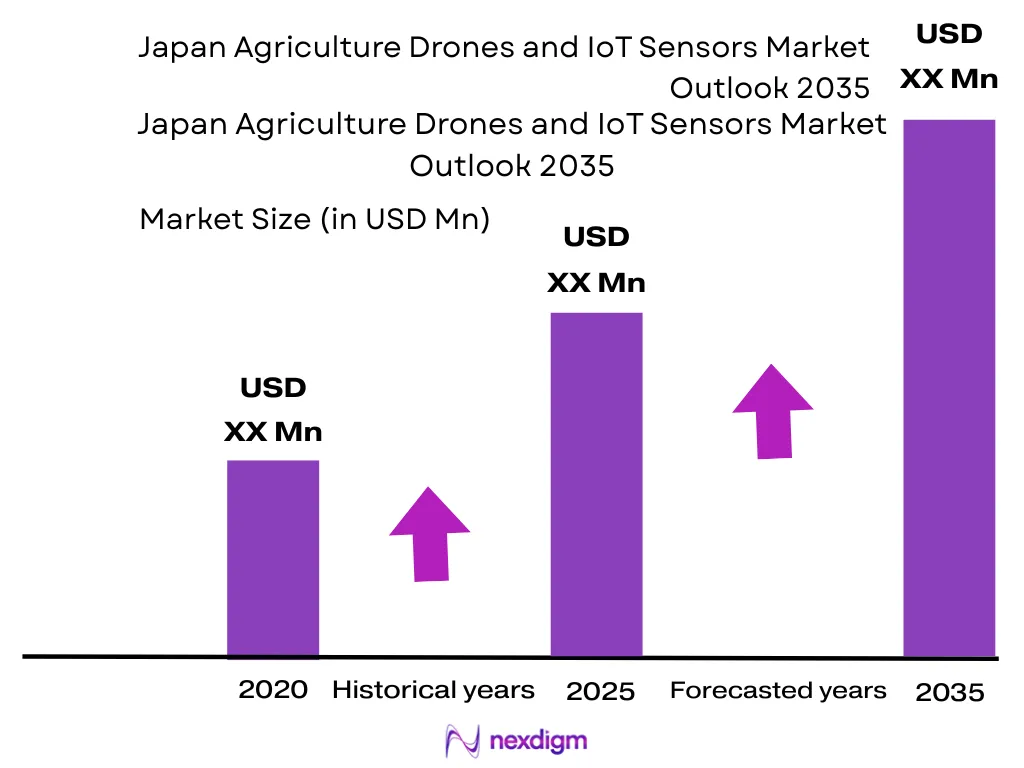
The Japan Agriculture Drones and IoT Sensors Market is valued at USD ~ million, based on a five-year historical analysis, and is forecast to grow at a 17.28% CAGR during the outlook period. Demand is driven by drone spraying, crop monitoring, multispectral imaging, paddy water sensors and smart farming platforms. Japan’s broader smart agriculture market was valued at USD ~ million in 2023, reflecting rising adoption of robotics, IoT and AI-enabled farm operations. Hokkaido, Tohoku, Kanto, Chubu and Kyushu dominate Japan Agriculture Drones and IoT Sensors Market because they combine crop scale, smart agriculture demonstrations and region-specific use cases. Hokkaido supports large-area mapping and broadacre drone use; Tohoku supports paddy drones and water sensors; Kanto has greenhouse IoT and platform adoption; Chubu supports orchards and tea; Kyushu-Okinawa supports tea, sweet potato, sugarcane and greenhouse monitoring. MAFF reported 217 smart agriculture demonstration districts across Japan.
Market Segmentation
By Product Type
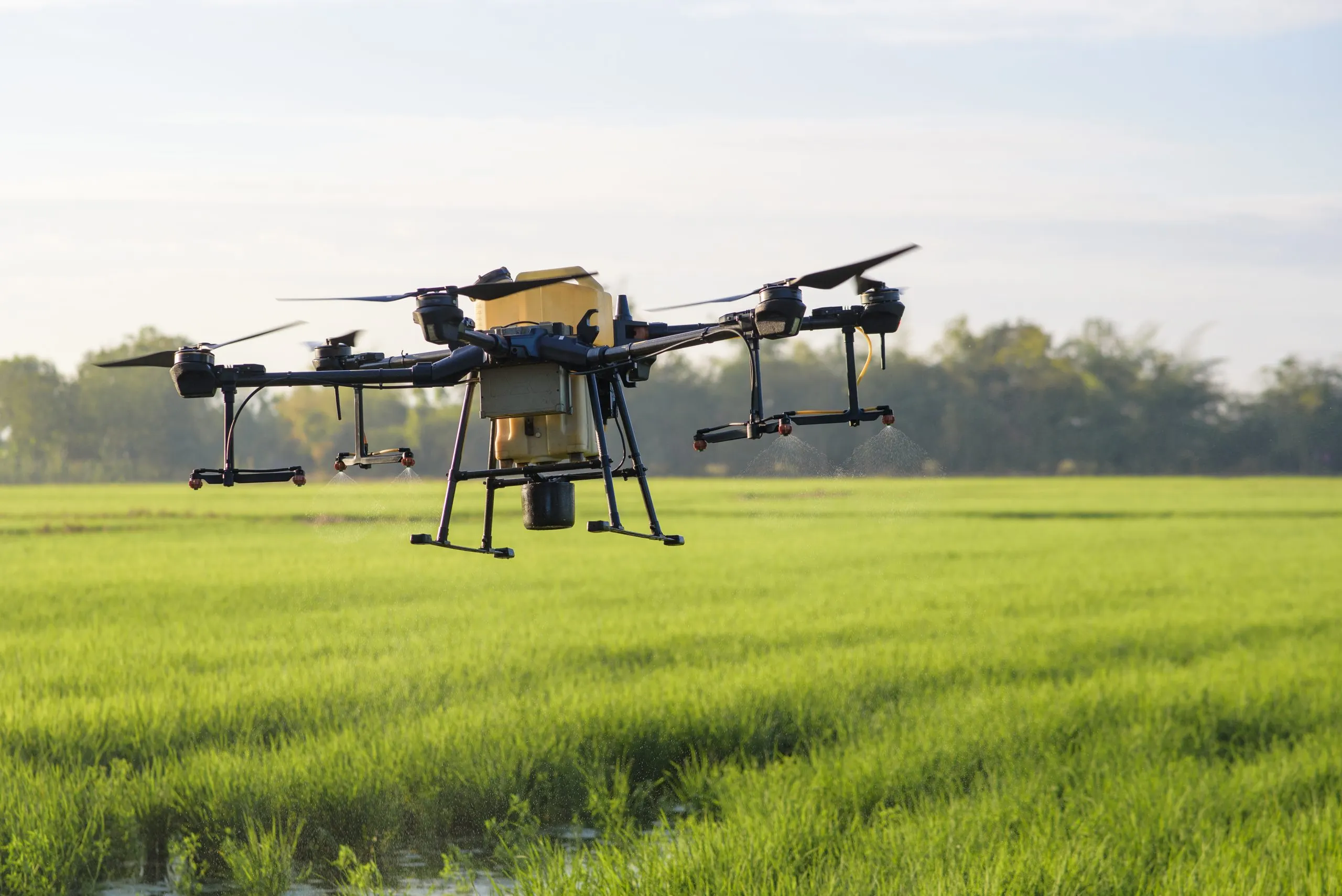
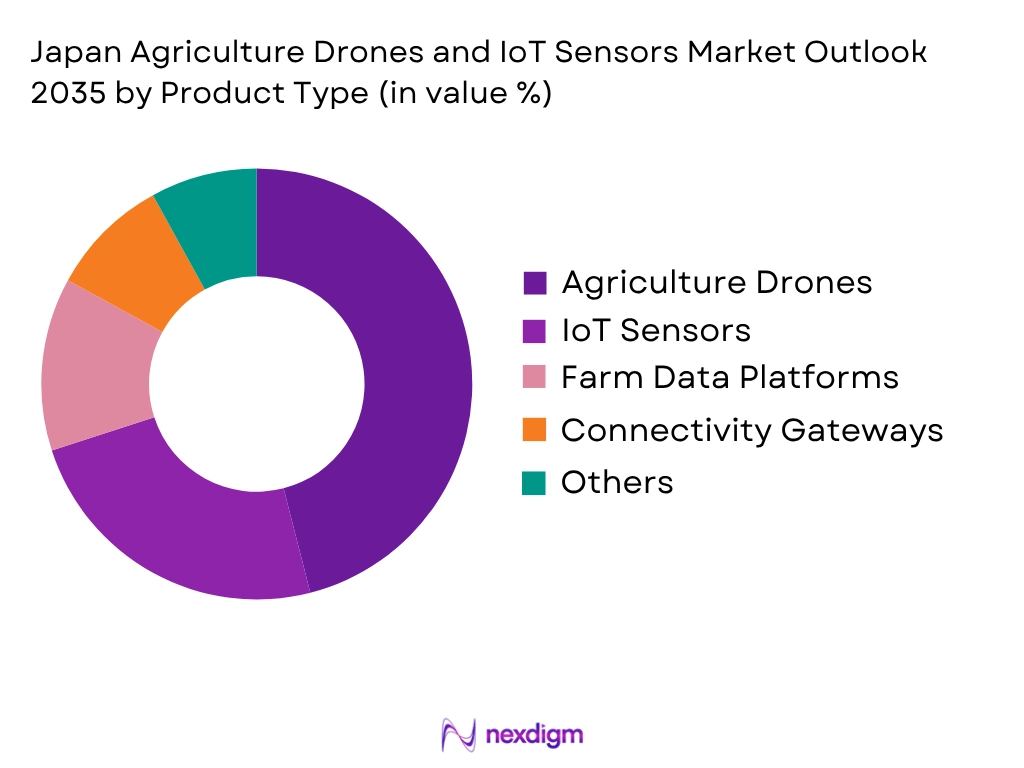
Japan Agriculture Drones and IoT Sensors Market is segmented by product type into agriculture drones, IoT sensors, farm data platforms, connectivity gateways, drone payloads, and analytics software. Recently, agriculture drones have a dominant market share in Japan under the segmentation product type, due to their direct role in labor-saving spraying, crop scouting, field mapping and precision application. Drone adoption is especially relevant for paddy rice, tea, orchards and large field crops, where farmers face aging workforce constraints and narrow operating windows. MAFF’s smart agriculture material highlights drones as part of smart field operations, while Japan’s agriculture drone market is reported at USD ~ million with strong long-term growth. IoT sensors are also expanding, but deployment is more fragmented across greenhouses, paddy water control, livestock monitoring and soil-climate measurement.
By Application
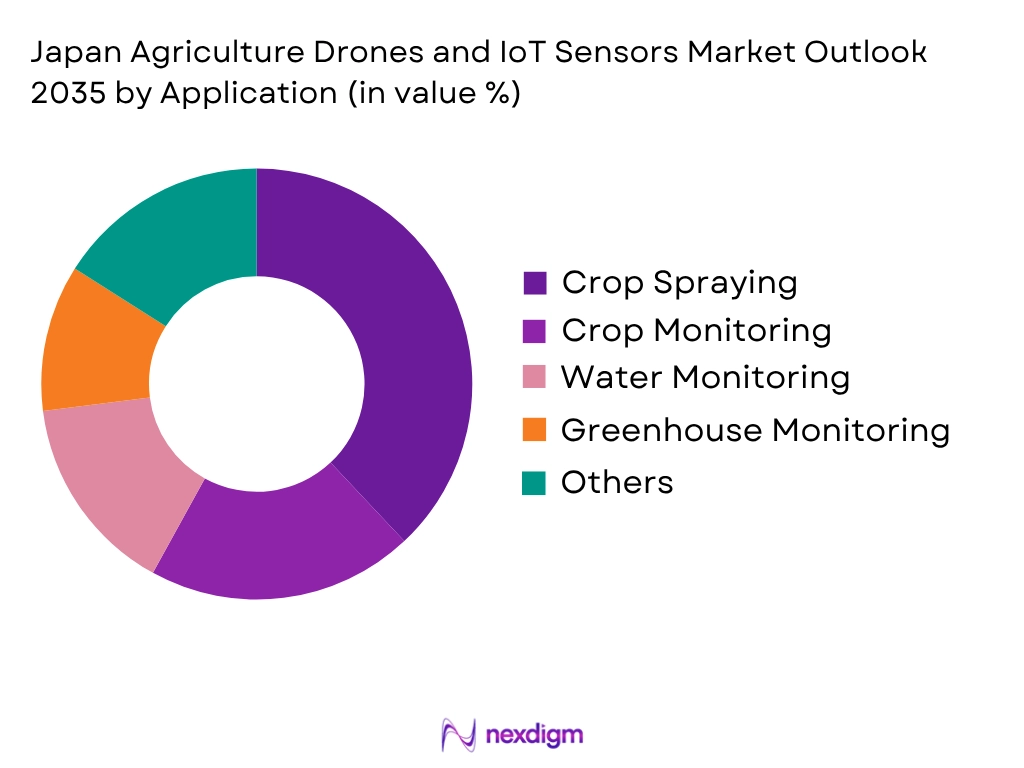
Japan Agriculture Drones and IoT Sensors Market is segmented by application into crop spraying, crop monitoring, soil and water monitoring, greenhouse monitoring, field mapping, pest and disease analytics, and livestock monitoring. Recently, crop spraying has a dominant market share in Japan under the segmentation application, due to the country’s labor shortage, paddy-field intensity and demand for precise agrochemical application. Drone spraying reduces manual workload in rice, tea, vegetables and orchard operations, making it a practical solution for older farmers and farm contractors. Crop monitoring and imaging are growing because multispectral and thermal cameras help detect stress, nutrient deficiency and disease. Soil and water monitoring is especially relevant in paddy farming, where remote water-level sensing reduces field visits. Greenhouse sensors are important in Kanto and Kyushu because controlled-environment farming requires temperature, humidity, CO2 and nutrient monitoring.
Competitive Landscape
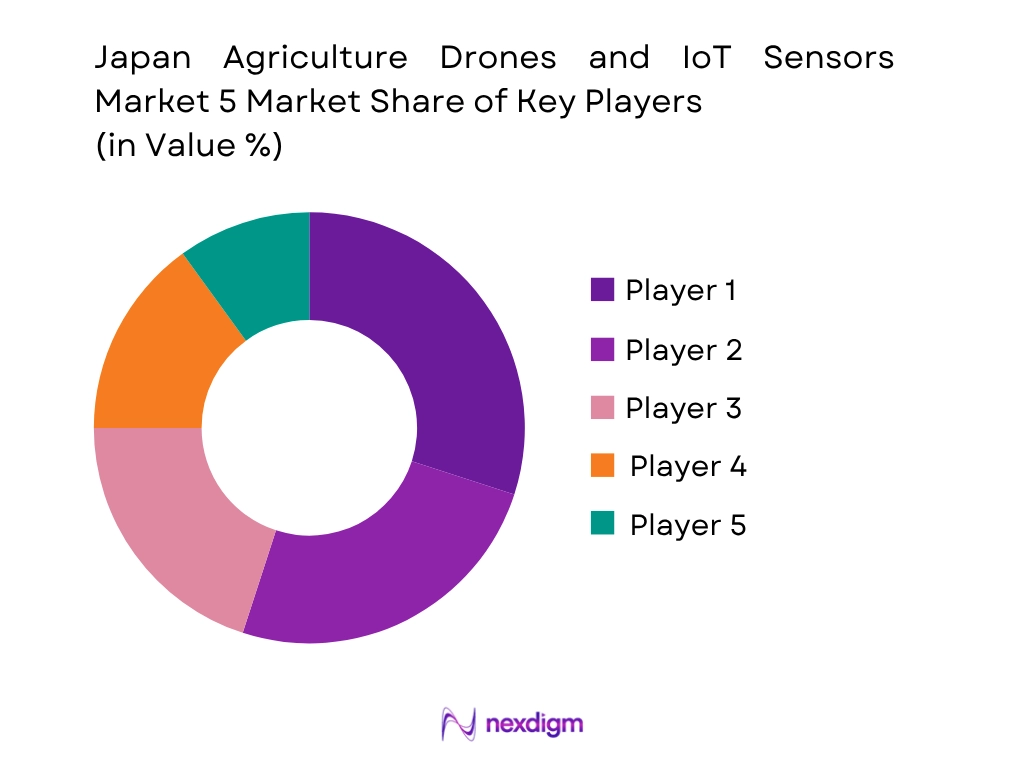
The Japan Agriculture Drones and IoT Sensors Market is led by a mix of drone OEMs, machinery companies, agri-tech software firms, telecom providers and sensing technology companies. DJI Agriculture, Yamaha Motor and Nileworks compete strongly in agricultural drones, while Kubota, Yanmar and OPTiM connect drones, sensors and farm data platforms with wider smart agriculture use cases. NTT, Fujitsu, NEC, KDDI and SoftBank support the market through connectivity, IoT networks, AI analytics and cloud infrastructure.
| Company | Establishment Year | Headquarters | Core Offering | Key Crop / Use Case | Drone Capability | IoT / Data Capability | Channel Strength | Strategic Position |
| DJI Agriculture | 2006 | Shenzhen, China | ~ | ~ | ~ | ~ | ~ | ~ |
| Yamaha Motor Co., Ltd. | 1955 | Iwata, Japan | ~ | ~ | ~ | ~ | ~ | ~ |
| Nileworks Inc. | 2015 | Tokyo, Japan | ~ | ~ | ~ | ~ | ~ | ~ |
| Kubota Corporation | 1890 | Osaka, Japan | ~ | ~ | ~ | ~ | ~ | ~ |
| OPTiM Corporation | 2000 | Tokyo, Japan | ~ | ~ | ~ | ~ | ~ | ~ |
Japan Agriculture Drones and IoT Sensors Market
Growth Drivers
Labour shortage and aging farm operators are accelerating drone spraying and IoT-based monitoring adoption
Japan Agriculture Drones and IoT Sensors Market is being driven by a structural shortage of farm labour, which directly supports demand for drone spraying, remote water-level monitoring, greenhouse sensors, crop scouting and automated field-condition alerts. MAFF’s Basic Plan reference states that core persons mainly engaged in farming numbered 1.11 million in 2024, while their average age reached 69.2 years. Japan also had 4.27 million hectares of domestic farmland in 2024, creating a situation where fewer and older operators must manage time-sensitive fieldwork across rice, vegetables, tea, orchards and protected cultivation. Drones and IoT sensors are market-specific responses because they reduce manual field visits, support pesticide-spraying services, automate water monitoring and enable data-led crop management. The macroeconomic base supports technology adoption: World Bank recorded Japan’s GDP at USD 4.03 trillion, GDP per capita at USD 32,487.1, and population at nearly 124 million in 2024. These indicators justify demand for labour-saving agricultural technologies that protect domestic production capacity.
Smart agriculture policy is expanding field deployment of drones, sensors and AI dashboards
Japan Agriculture Drones and IoT Sensors Market is supported by national smart agriculture policy, which is moving drone and IoT use from pilots into field-level deployment. MAFF’s smart agriculture material states that the Smart Agriculture Demonstration Project has been implemented since 2019 to introduce advanced technologies into production sites and verify management effects. The same MAFF material identifies paddy farming applications such as automatic water management, farming apps, drone-based growth monitoring, and combines capable of obtaining yield and quality data. OECD reported that MAFF allocated JPY 4,500 million in 2024 to promote smart agricultural technologies, including automation systems, precision farming technologies and AI-driven decision-making tools. These policy-backed deployments create demand for spraying drones, mapping drones, water-level sensors, weather stations, greenhouse climate sensors, connectivity gateways and farm data platforms. IMF’s 2026 Japan consultation lists nominal GDP at USD 4,190 billion in 2024, GDP per capita at USD 33,820, and population at 124 million, reinforcing Japan’s capacity to support digital farming adoption.
Market Challenges
Drone registration and operational compliance increase complexity for farm users and service providers
Japan Agriculture Drones and IoT Sensors Market faces a regulatory challenge because agricultural drones are subject to unmanned aircraft rules in addition to farm-use requirements. MLIT states that unmanned aircraft weighing 100 grams or more must be registered under Japan’s Civil Aeronautics Act, must display a registration ID, and must be equipped with a remote ID function. MLIT’s unmanned aircraft registration portal states that registration became mandatory on June 20, 2022, and flights of unregistered unmanned aircraft are not allowed. For agriculture, this affects spraying drones, mapping drones and sensor-relay drones used in rice fields, tea plantations, orchards and vegetable farms. Operators may also need flight permission or approval depending on airspace and flight method, which adds training, documentation and compliance burden for farmers, contractors and JA-linked service providers. Japan remains a high-value economy, with World Bank reporting USD 4.03 trillion GDP and USD 32,487.1 GDP per capita in 2024, but regulatory friction can slow adoption among small farms.
Fragmented farmland limits operating efficiency for drones, fixed sensors and farm data platforms
Japan Agriculture Drones and IoT Sensors Market is constrained by fragmented farmland, small plot structure and terrain diversity, which reduce deployment efficiency for drones and IoT systems. MAFF’s Basic Plan reference records domestic farmland at 4.27 million hectares in 2024, while OECD states that Japan’s average farm size increased from 1.4 hectares in 1990 to 3.3 hectares in 2022, but remains small compared with other OECD countries. This is market-specific because drone spraying is most efficient when flight paths, refilling, field boundaries and battery replacement can be standardized across larger areas. Small paddy plots, hilly orchards, dispersed vegetable fields and slope-based tea farms increase setup time and reduce per-flight productivity. IoT sensors also require calibration, gateways, maintenance visits and connectivity, which become more complicated when fields are spread across different owners or community-based operations. World Bank recorded Japan’s population at nearly 124 million and GDP at USD 4.03 trillion in 2024, showing strong food demand but limited land scalability. Shared deployment and contractor-led operations are therefore essential.
Market Opportunities
Drone-as-a-service and cooperative deployment models can widen access to smart farming tools
Japan Agriculture Drones and IoT Sensors Market has a strong opportunity in drone-as-a service, cooperative ownership, shared sensor networks and contractor-led deployment because many farms need labour-saving technologies without owning full hardware stacks. MAFF’s smart agriculture material highlights models where agricultural cooperatives own smart agricultural machines and outsource operations to reduce farmer investment burden. It also describes shared use of rice-planting machines with straight-drive assist and combine harvesters with taste and yield sensors across 3 locations in Okayama. This model is directly transferable to agriculture drones and IoT sensors because JA cooperatives, contractors and service operators can provide paddy spraying, field imaging, orchard scouting, greenhouse monitoring and water-sensor maintenance across multiple farms. The opportunity is supported by farm demographics: MAFF records 1.11 million core persons mainly engaged in farming and an average age of 69.2 years in 2024. IMF lists Japan’s nominal GDP at USD 4,190 billion in 2024, while World Bank records GDP per capita at USD 32,487.1, supporting service-based digitization in an advanced economy. Sources: MAFF, IMF, World Bank.
Crop-specific IoT and drone applications create expansion potential across paddy, greenhouse and specialty crops
Japan Agriculture Drones and IoT Sensors Market has future growth potential in crop-specific applications such as paddy water automation, greenhouse environmental monitoring, drone-based crop diagnosis, tea-field management and sugarcane operations. MAFF’s smart agriculture material identifies automatic water management, drone-based growth monitoring, farming apps and yield-quality data collection as paddy farming applications. It also presents smart agriculture use cases across spinach, cabbage and carrot in Miyazaki, green tea in Kagoshima and sugarcane in Okinawa, using drones, automatic sprinkler systems, environmental sensors, robotic tea-garden management machines and centralized information systems. These applications show that demand extends beyond spraying drones into soil-water sensing, humidity and temperature monitoring, nutrient-solution tracking, crop imagery, remote alerts and AI-assisted diagnosis. Demonstration activity across Japan supports regional replication, while macro conditions support premium technology adoption: World Bank reported USD 4.03 trillion GDP and USD 32,487.1 GDP per capita in 2024, and IMF’s 2026 WEO shows Japan GDP per capita at USD 35.7 thousand. These indicators support precision farming tools where labour savings and crop quality justify adoption.
Future Outlook
Over the next phase, Japan Agriculture Drones and IoT Sensors Market is expected to expand through drone spraying, autonomous flight, greenhouse IoT, paddy water automation, AI crop diagnosis and sensor-linked farm management platforms. Demand will be strongest where technology directly reduces field labor, improves crop quality and strengthens farm decision-making. Japan’s aging farm workforce will remain the central reason for adoption. Drones and IoT sensors will not only replace manual field checks but also help growers standardize work records, monitor field conditions and reduce dependence on experienced labor. This is especially important in rice, greenhouse vegetables, fruits, tea and sugarcane.
Service-based models will also grow. Many small farmers may not buy advanced drones or full sensor networks directly; instead, they are likely to use drone spraying services, JA cooperative shared equipment, contractor-operated flights and subscription-based sensor dashboards. MAFF’s smart agriculture material specifically references shared use of drones and smart machinery. Regulation will remain important. Drone operators must comply with Japan’s unmanned aircraft rules, including registration and operating approvals where applicable. As agricultural drones become more autonomous and sensor platforms collect more field data, compliance around flight safety, pesticide spraying, radio communication and data governance will become a key differentiator.
Major Players
- DJI Agriculture
- Yamaha Motor Co., Ltd.
- Nileworks Inc.
- Kubota Corporation
- Yanmar Holdings Co., Ltd.
- OPTiM Corporation
- NTT Group / NTT AgriTechnology
- Fujitsu Limited
- NEC Corporation
- Sony Semiconductor Solutions Corporation
- Topcon Corporation
- KDDI Corporation
- SoftBank Corp.
- SkymatiX, Inc.
- Seraku Co., Ltd. / Midori Cloud
Key Target Audience
- Agriculture drone manufacturers
- IoT sensor manufacturers
- Smart agriculture platform providers
- Agricultural machinery companies
- Telecom and cloud infrastructure providers
- Farm cooperatives and drone service operators
- Investments and venture capitalist firms
- Government and regulatory bodies, including MAFF, MLIT, MIC, METI, JCAA and Japan Agricultural Cooperatives Group
Research Methodology
Step 1: Identification of Key Variables
The initial phase involves constructing an ecosystem map for the Japan Agriculture Drones and IoT Sensors Market, covering drone OEMs, sensor providers, farm data platforms, telecom operators, machinery dealers, JA cooperatives, farm contractors and agricultural corporations. The key variables include drone unit deployment, IoT sensor installations, crop use cases, regional adoption, payload type, connectivity type and subscription penetration.
Step 2: Market Analysis and Construction
In this phase, historical data is compiled across spraying drones, mapping drones, soil sensors, paddy water sensors, greenhouse sensors, connectivity gateways and analytics platforms. The market is assessed by hardware revenue, software subscriptions, drone-as-a-service activity, sensor-as-a-service adoption, crop application and sales channel structure.
Step 3: Hypothesis Validation and Expert Consultation
Market hypotheses are validated through CATI-style interviews with drone service providers, agri-tech companies, machinery dealers, JA procurement stakeholders, greenhouse operators, rice farmers and agricultural corporations. These consultations help verify product adoption, service pricing structure, training gaps, regulatory concerns, sensor maintenance and platform integration requirements.
Step 4: Research Synthesis and Final Output
The final phase integrates secondary research, expert inputs and bottom-up deployment indicators to prepare the market model. Segment shares, competitive positioning, growth drivers, challenges and future outlook are cross-checked against smart agriculture policy, drone regulation, crop-specific use cases and regional farm structure.

- Executive Summary
- Research Methodology (Market Definitions and Assumptions, Abbreviations, Drone and IoT Sensor Scope, Market Sizing Approach, Top-to-Bottom Smart Agriculture Spend Validation, Bottom-to-Top Unit Deployment and Subscription Revenue Build-Up, Primary Interviews with Drone OEMs/IoT Sensor Providers/Farmers/JA Cooperatives/Agri-Tech Platforms/Service Operators, Secondary Research Validation, Regulatory Mapping, Limitations and Future Conclusions)

- Definition and Scope
- Market Genesis
- Evolution of Japan’s Smart Agriculture Ecosystem
- Timeline of Major Players
- Business Cycle
- Supply Chain and Value Chain Analysis

- Growth Drivers (Labour-Saving Farm Operations, Precision Spraying, Paddy Water Management, Greenhouse Automation, Smart Agriculture Policy, Farm Data Platforms, Crop Quality Monitoring, Regional Demonstration Programs)
- Market Challenges (High Upfront Cost, Farmer Digital Skill Gap, Drone Flight Restrictions, Battery Limitations, Connectivity Gaps, Data Interoperability, Sensor Maintenance, Small Plot Fragmentation)
- Opportunities (AI Crop Scouting, Autonomous Spraying, Paddy Water Automation, Sensor Subscription Models, Cooperative Drone Fleets, Greenhouse IoT, Livestock Monitoring)
- Trends (Autonomous Flight, RTK Navigation, Multispectral Imaging, AI Disease Detection, Edge Analytics, Farm Data Platforms, Remote Sensing, Cooperative Machinery Sharing, Subscription Analytics)
- Government Regulation (Civil Aeronautics Act, MLIT Drone Registration, Remote ID, Flight Permission and Approval, Pesticide Control Law, Radio Act, Personal Information Protection, Farm Data Governance, Smart Agriculture Policy)
- SWOT Analysis
- PESTLE Analysis
- Porter’s Five Forces Analysis
- Stakeholder Ecosystem

- By Value (2020-2025)
- By Unit Sales (2020-2025)
- By Installed Base (2020-2025)

- By Product Type (In Value %)
Agriculture Drones
IoT Sensors
Farm Data Platforms
Connectivity Gateways
Drone Payloads and Accessories - By Application (In Value %)
Crop Spraying
Crop Monitoring
Field Mapping and Surveying
Soil and Water Monitoring
Greenhouse Monitoring - By End User (In Value %)
Individual Farmers
Agricultural Corporations
JA Cooperatives
Farm Contractors
Greenhouse Operators - By Region (In Value %)
Hokkaido
Tohoku
Kanto
Chubu

- Market Share of Major Players on the Basis of Value and Unit Sales
- Cross Comparison Parameters (Drone Payload and Flight Capability, IoT Sensor Portfolio Breadth, Crop-Specific Use Case Depth, Farm Data Platform and AI Analytics Strength, JA/Dealer/Service Network Reach, MLIT Drone Compliance and Operator Support, Aftermarket/Battery/Sensor Calibration Capability, Interoperability with Farm Management and Machinery Platforms)
- SWOT Analysis of Major Players
- Detailed Profiles of Major Companies
DJI Agriculture
Yamaha Motor Co., Ltd.
Nileworks Inc.
Kubota Corporation
Yanmar Holdings Co., Ltd.
OPTiM Corporation
NTT Group / NTT AgriTechnology
Fujitsu Limited
NEC Corporation
Sony Semiconductor Solutions Corporation
Topcon Corporation
KDDI Corporation
SoftBank Corp.
SkymatiX, Inc.
Seraku Co., Ltd. / Midori Cloud

- Market Demand and Utilization
- Purchasing Power and Budget Allocation
- Regulatory and Compliance Requirements
- Needs, Desires and Pain Point Analysis
- Decision-Making Process

- By Value (2026-2035)
- By Unit Sales (2026-2035)
- By Installed Base (2026-2035)


 Request a Sample
 Ask for Customization
 Get a Quote
 Enquire Now